By Naseef Umar, Founder and CEO of AutoSmart, with over a decade in automotive operations, dealer standards, network performance and audits. Published October 16, 2026.
A 5S audit checklist is a scored list of questions, one set per Sort, Set in Order, Shine, Standardise and Sustain, that an auditor answers the same way at every visit so workshop results can be compared over time. The workshop is worth the effort: "Fixed operations once again proved to be one of the most reliable drivers of dealership profitability in Q3 2025." (Haig Partners, 2025) Yet many networks score 5S on paper at every visit and never trend it. This guide sets out the fields to capture, what to lock across sites, what to build the checklist in, and how service bay and body shop modules differ. For the wider programme, see 5S audits across a dealer network.
Key Takeaways
A 5S audit checklist only trends if every visit captures the same fields: zone, S, score on a fixed scale, photo on low scores, owner and due date.
A network 5S template should lock S definitions, question wording, score anchors, weights, pass threshold and action deadlines, and leave zone names, local hazards and owners local.
Software earns its place through a consistent score, photo evidence, trend per S and tracked actions, not through promised percentage gains.
A body shop 5S module needs a mixing room, flammable store, spray booth and a scan and calibration area that a service bay module does not.
What should a 5S audit checklist capture so results compare over time?
A 5S audit checklist that trends over time captures the same fields at every visit: site, zone, date, auditor, the S scored, a score on a fixed scale with written anchors, a photo on low scores, and an owner with a due date. In a Washington State DOT study, only 1.8% of paper observations could be recalled by location (Clappia, 2026).
The fields to capture at every visit
Eight fields do the work. Each one exists so a score from March can sit beside a score from September.
Site and zone. Score per zone (a lift bay, a tool wall, a paint prep area), not per workshop. Zone scores roll up; a single workshop score cannot be pulled apart.
Audit date and auditor. You need both to spot an auditor who scores harder or softer than the rest.
The S being scored. Record Sort, Set in Order, Shine, Standardise and Sustain separately, so you can see which one is slipping.
Score on a fixed scale. Pick one scale (0 to 4 or 1 to 5) and never change it between cycles.
Written anchors for each score level. Say what a 1 looks like and what a 5 looks like in that zone.
A photo on every low score. The photo is the evidence, and it is also the baseline for the next visit.
An owner. A named person for every failed item.
A due date and a status. Open, in progress or closed, so the next audit starts from what happened to the last findings.
How to keep scores comparable between auditors
Scoring subjectivity is the main reason 5S trends mislead. Two habits fix most of it.
An anchor photo is a reference image that shows what each score level looks like in a specific zone, for example a tool board at a 1 and at a 5. Put it next to the question so the auditor compares the bay to the picture, not to memory.
A paired audit is when two auditors score the same zone independently, then compare and resolve the gaps. Run one per cycle in a few zones and you will see quickly where wording is loose.
Add one rule: a low score needs a photo and an owner. That single rule stops a 2 from being a shrug.
What does moving the 5S checklist into software give us?
Moving a 5S checklist into software gives a workshop network a score calculated the same way every time, a photo attached to each failed question, a record that trends by site and by S, and corrective actions with an owner and due date. In a Washington State DOT field pilot, mobile inspectors saved an average of 1.78 hours a day (Clappia, 2026).
That pilot is a proxy. It covers road inspections, not workshop 5S, and Clappia is a vendor reporting a government study, so treat the numbers as a direction of travel. The same report found that only 55% of paper inspection reports were submitted within 24 hours of the site visit (Clappia, 2026). A 5S score that reaches the office days late, without a photo, is hard to act on.
What software removes
The process-level gains are easier to defend than any percentage:
No transcription delay. The score exists the moment the audit is submitted.
Evidence stays with the finding. The photo sits on the question, not in a separate deck.
Trend comes free. Every cycle is stored against the same questions, so a zone's history is one screen away.
Actions have owners. A Person-In-Charge (PIC) is the named owner responsible for closing a corrective action by its due date. Software can assign one for every failed item and chase it.
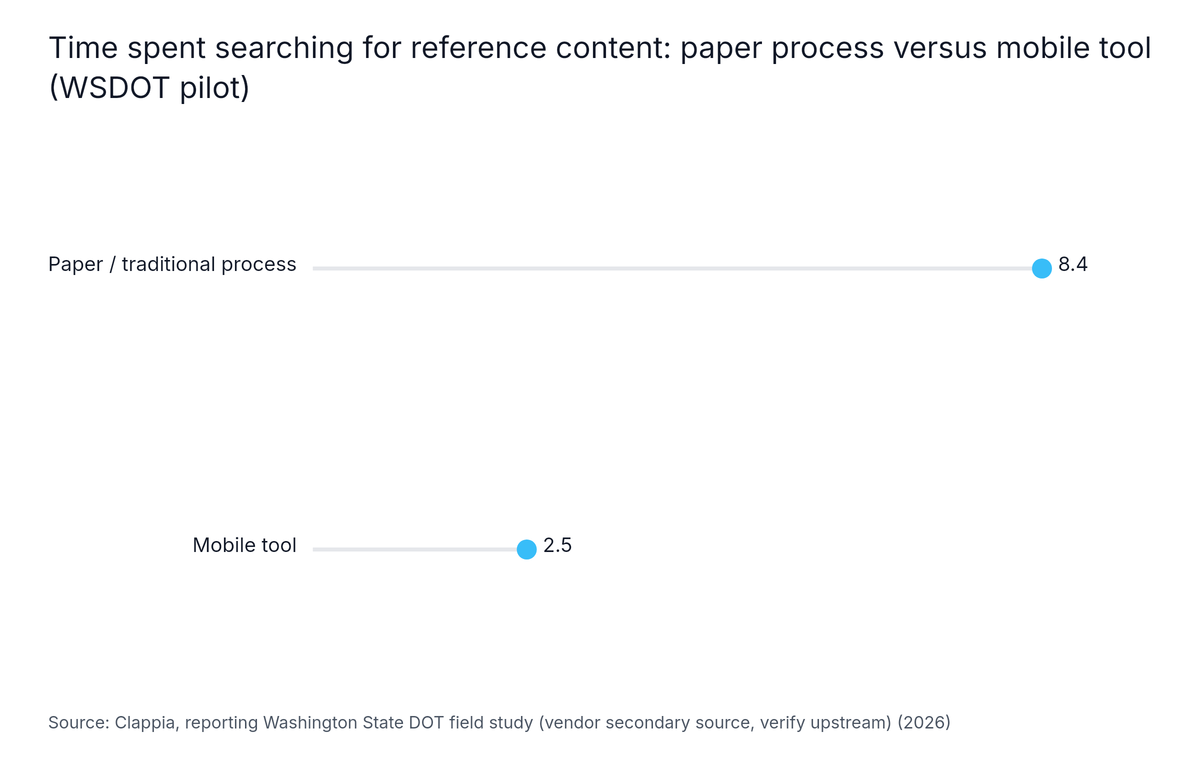
In the same pilot, time spent searching for reference content fell 64%, from 8.35 minutes to 2.45 minutes per search (Clappia, 2026). For a 5S audit, the equivalent is the auditor seeing last quarter's failures and photos on the same screen as the current question.
Lollipop chart: Time spent searching for reference content: paper process versus mobile tool (WSDOT pilot). Highest: Paper / traditional process at 8.4.
In a 2026 survey of 823 service technicians, 45% named miscommunication between field and office, and 44% named poor scheduling or last-minute changes, as top productivity obstacles (ServiceTrade, 2026). Those respondents work in commercial fire protection and mechanical service, not dealership workshops, so read it as an adjacent-field signal. ServiceTrade's CEO William Chaney put the remedy plainly: "Contractors can address the challenge by adopting technology that removes day-to-day friction and increases productivity for every member of the team." (ServiceTrade via GlobeNewswire, 2026)
Field teams will keep a parallel paper record if the app is slow or fails without signal. Offline-first is an app design in which the audit keeps working with no signal and syncs the results once a connection returns. Workshops in basements and industrial estates need it. See how paperless auditing works for a multi-site dealer network and what offline-first mobile audit software has to do on site.
Our data: AutoSmart's data shows one audit cycle reduced from 10 days to 3 days. That figure is not specific to 5S and is not an average across all customers. AutoSmart's data on manual audit processes (also not 5S-specific) is that each audit generates 8 to 20 findings, and each finding needs 4 to 5 follow-ups, including escalations, before closure.
What should the 5S checklist template lock down and what should stay local?
A 5S audit checklist template should lock everything that affects comparability: the definition of each S, question wording, the score scale and anchors, weights, the pass threshold, the photo-on-fail rule and the action deadline. Zone names, local hazards, owners, audit day and a capped set of extra questions can stay local. Locked fields make scores comparable; local fields keep the checklist usable.
A locked field is a template element that only the network standards owner can change, so every site scores against the same rule. Use the table below as the starting split.
Template element
Lock network-wide or keep local?
Reason
Definition of each S
Lock
Auditors must read Sort and Sustain the same way
Question wording
Lock
Rewording breaks the trend line
Score scale and anchors
Lock
Anchors make a 3 mean the same thing everywhere
Weights and pass threshold
Lock
Cross-site ranking needs identical maths
Photo-on-fail rule
Lock
Evidence rules cannot vary by site
Action deadline
Lock
Closure speed is comparable only on one clock
Zone names and zone map
Local
Layouts differ between a satellite shop and a main dealer
Local hazards
Local
A coastal site and an inland site face different risks
Owners
Local
People change at site level
Audit day and time
Local
Fits site rosters
Extra questions
Local, capped
Keeps the core comparable
Where most templates fall short
Generic templates score an unspecified "work area" and use one item list for every site. They rarely score per zone, set a minimum zone list or give size-based extras, so a small shop and a large one are not comparable. Few pair the checklist with an action-closure loop, which is why teams drift into tidying up on audit day and slacking in between. Owner, due date and trend fields in the template are the structural answer. For where spreadsheets stop working, read what to evaluate after spreadsheets.
What should we build the 5S audit checklist in?
A network 5S audit checklist can be built in a spreadsheet, a general forms app or a dedicated audit platform. Spreadsheets suit a pilot at a handful of sites, forms apps suit simple capture, and an audit platform suits networks that need offline capture, template version control, site roll-ups, trend per S and action closure. Pick by the criteria, not the price.
The selection criteria
Score any option against these seven:
Offline capture. Can the auditor finish a visit with no signal?
Photo on a finding. Is a live photo attached to the question, with a date and time?
Template version control and locking. Can the standards owner change a question once and lock it?
Site roll-ups and trend per S. Can you see a zone's history and compare sites?
Action assignment and closure. Does a failed item become an owned task?
Role permissions. Can an auditor see only their own sites?
Low-burden mobile use. Is it faster than paper?
The last one matters. In the 2026 ServiceTrade survey, 55% of technicians rated mobile apps and digital tools as an increasingly important skill (ServiceTrade, 2026), but the same release says systems that add work remain a top frustration.
Spreadsheet, forms app or audit platform
Criterion
Spreadsheet
Forms app
Audit platform
Offline capture
Limited, file-based
Varies by product
Built for it in field audit tools
Photo on a finding
Manual paste
Often supported
Live capture with timestamp
Template locking
Weak, easy to overwrite
Partial
Versioned and locked
Site roll-ups and trend
Manual consolidation
Manual or export
Automatic
Action closure
Email and chasing
Rarely built in
Owner, due date, closure evidence
Best fit
Pilot at a few sites
Simple one-off checks
Multi-site networks
A spreadsheet is a sound first template for deciding the questions. It breaks when you need locked fields and rollups across many sites. For what a purpose-built tool does, see running 5S inside an auto audit platform, and use these demo scenarios to stress-test any shortlist.
How does a service bay 5S checklist differ from a body shop one?
A service bay 5S checklist centres on lifts, tool boards, fluids, tyres and the EV high-voltage zone, while a body shop checklist adds the mixing room, flammable store, spray booth, prep bays and a scan and calibration area. Calibrations appeared on 35.6% of direct repair program (DRP) estimates by Q4 2025 (Autobody News, 2025), so calibration space needs its own zone.
Build one core block that every site scores, then add a module by workshop type.
Block
Zones and items
Core (all sites)
Floor markings, walkways, waste and recycling, PPE, fire equipment, consumables storage, visual standards board
Service bay module
Lift areas, tool chests and shadow boards, tyre and wheel area, fluids and spill kits, quick-lube lane, EV high-voltage zone
Body shop module
Paint mixing room, flammable store, spray booth and overspray, masking and prep bays, sanding and dust, welding zone, frame bay, scan and calibration bay, parts-on-racks staging by job
Service bay: add the EV zone
Dealership outlooks for 2026 say service departments need hybrid and EV capability, including high-voltage safety protocols and specialised tools (Citrin Cooperman, 2026). The checklist needs a marked high-voltage area, visible isolation tools and a clear rule on who may enter.
Body shop: tie 5S to the hazard list
KPA's 2026 list of the most frequently cited OSHA violations for collision centres includes respiratory protection, hazard communication, spray finishing and flammable liquid use and storage (Aftermarket Matters, 2026). Each maps to a 5S item: flammable store contents under Sort, labelled containers and respirator storage under Set in Order, booth and filter cleanliness under Shine. Review safety audit cadence and escalation when these items fail.
For context, the US Bureau of Labor Statistics reported 2.3 total recordable cases per 100 full-time workers in private industry for 2024, the lowest rate since 2003 (National Safety Council, 2026). The 2025 data is due on 18 November 2026, so refresh any benchmark after that date.
Body shop: give calibration its own space
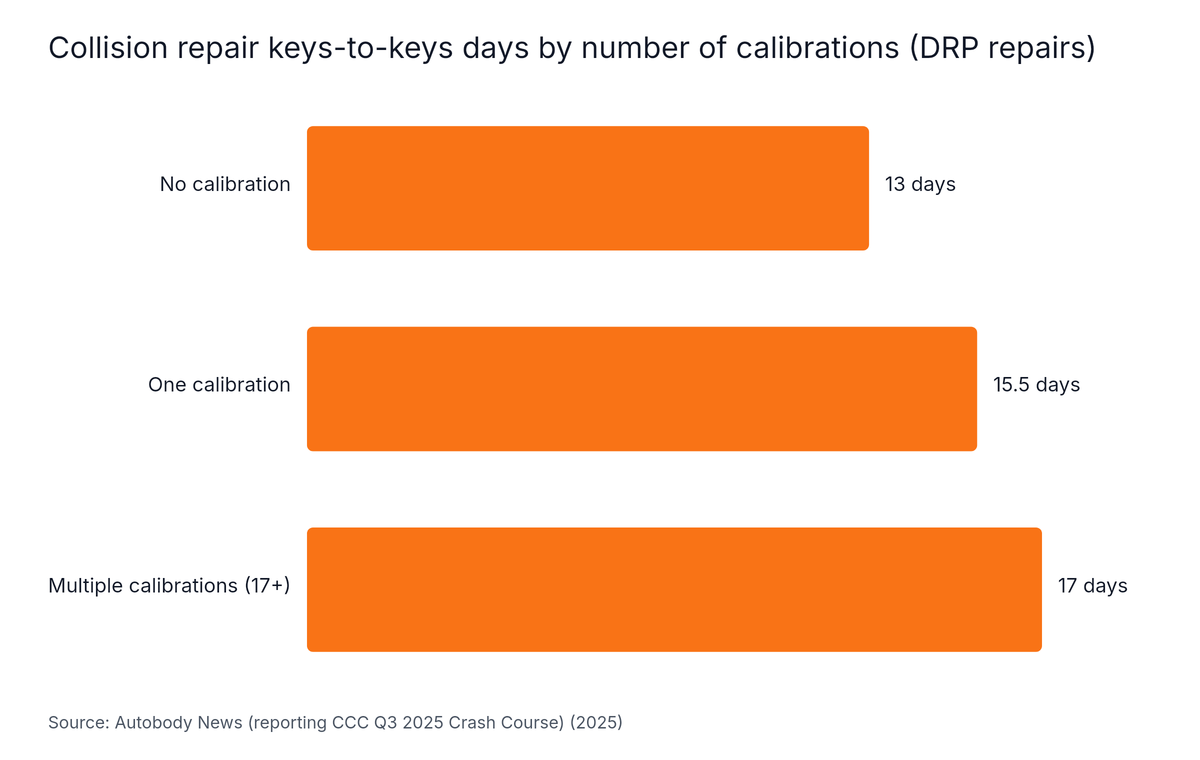
Calibrations appeared on 32.2% of collision DRP repairs in Q3 2025, up from 23.9% in the same quarter of 2024 (CCC Intelligent Solutions, 2025). By Q4 2025, only 48.5% appeared on the initial estimate and 51.5% showed up on supplements (Autobody News, 2025), so cars wait while approvals are chased. Cycle time also climbs with calibrations: collision repairs with none averaged 13 days, with one 15.5 days, and with multiple more than 17 days (Autobody News, 2025). The chart plots the multiple-calibration bar at 17, the lower bound of that 17-plus figure.
Horizontal Bar chart: Collision repair keys-to-keys days by number of calibrations (DRP repairs). Highest: Multiple calibrations (17+) at 17 days.
Scan and calibration targets, equipment and floor space belong in Set in Order, not only paint and prep.
Adjust for workshop size
A small satellite shop scores fewer zones and a shorter time budget. A multi-bay main dealer scores every bay. A collision centre weights Shine and Set in Order heavily. Keep the core block identical and change only the zone list and the weights you have locked per tier.
Where does a 5S audit checklist fall short?
A 5S audit checklist does not fix workshop discipline by itself, and the evidence for software benefits is thin. The 2026 figures cited here come from a Washington State DOT study reported by a vendor (Clappia, 2026) and a survey of 823 technicians in fire protection and mechanical service (ServiceTrade, 2026). Neither is a dealership 5S study.
Pilot a template at a few sites before standardising. Three limits are worth stating plainly:
Not for single-site workshops that audit rarely. A well-built spreadsheet may be enough.
Not a substitute for follow-through. Sustain is the weak point of every 5S programme. A checklist records the slip; only owners and deadlines fix it.
Not an independent proof of savings. Claims such as fewer incidents or less searching time are mostly vendor assertions. Use process-level arguments: no transcription delay, photo evidence and a trend.
AutoSmart Audit restricts evidence photos to live capture with date, time and location stamps, which stops old images being reused. It does not stop a team tidying up the day before an audit, so keep the owner, due date and trend fields in the template.
Frequently Asked Questions
Where do most 5S templates fall short for workshops of different sizes?
Most 5S templates fall short because they use one unspecified work area and one item list for every site. A small satellite shop and a multi-bay main dealer then get scored on different things. A better template scores per zone, sets a minimum zone list, and adds size-based extra zones.
How do you stop different auditors scoring the same bay differently?
Different auditors score the same bay differently when score levels are described only in words. Fix it with anchor photos for each score level, a paired audit where two auditors score the same zone and compare, and a rule that every low score needs a photo and an owner.
What score counts as a pass on a 5S audit?
A pass on a 5S audit is whatever threshold the network sets once and locks for every site. No universal number exists. What matters is that the threshold, the score scale and the weights stay identical across auditors, so a pass at one workshop means the same as a pass at another.
What is the difference between a 5S audit and a 5S daily checklist?
A 5S audit is a scored review by someone outside the workshop team, while a 5S daily checklist is a short self-check the team runs itself. The daily check keeps the area tidy between visits. The audit produces the scored, comparable record that management trends over time.
Conclusion
A 5S audit checklist works when it produces numbers you can compare, not a pile of annotated sheets.
Capture the same eight fields at every visit, scored per zone and per S.
Lock wording, anchors, weights, pass threshold, photo rule and action deadline; keep zones, hazards and owners local.
Split the template into a core block, a service bay module and a body shop module.
Choose the tool against seven criteria, and pilot it at a few sites first.
Close the loop: every low score gets a photo, an owner and a due date.
Next step: take your current paper checklist and run it through the locked-versus-local table above. If you want to see it running on one of your own audit programmes, Schedule a Free Demo. For wider standards work, see franchise compliance across 50-plus sites.
Written by
Naseef Umar
Founder | CEO
Naseef Umar is an automotive industry expert and the Founder & CEO of AutoSmart, with over a decade of experience working across automotive operations, dealer standards, network performance, audits, and digital transformation.
Company
KERALA Full Address - Pulikillam W Rd, Kakkanad West, Chembumukku, Edappally, Kochi, Kerala 682030; DUBAI Full Address - Dubai Silicon Oasis, UAE

 Naseef UmarOct 25, 2026