Request a quote and our experts will contact you within 24 hours with tailored solutions and pricing.
Audit Schedule Software: How Often to Audit Each Site and How to Schedule It
Audit schedule software is a system that sets how often each site is audited, assigns the auditor and tracks overdue audits, so many programmes share one calendar. Picture 17 audit programmes running at daily, weekly, monthly, quarterly and yearly frequencies across several regions, each tracked in its own file. Sites get visited twice in one week and missed for a quarter. Nobody can say which audits are overdue. This guide covers how often to audit each site, how to give 5S its own step-down cadence, and what to configure so the calendar holds. If your tracker is already breaking, this look at when spreadsheets fail is a useful companion.
By Naseef Umar, Founder and CEO of AutoSmart.
Key Takeaways
Audit schedule software keeps daily to yearly audit programmes on one calendar, with named auditors, reminders and overdue flags.
A 5S audit works best weekly for the first 90 days of a rollout, then monthly or quarterly once scores are stable.
Cadence should rise with risk and with closeness to the floor: layered process audits run daily, weekly, monthly and quarterly by layer.
Multi-site networks can rotate a sample of sites each cycle, and should track schedule adherence per site to catch gaps.
What does audit schedule software solve when you run 17 audit programmes?
Audit schedule software solves three problems that spreadsheets handle badly once programmes multiply: it keeps one calendar across daily to yearly programmes, assigns each audit to a named auditor, and flags missed audits before they become coverage gaps. That matters because 86% of audit leaders work with 1 to 24 full-time auditors (Journal of Accountancy, 2026), so there is little slack.
Wall calendar crowded with overlapping coloured audit tags across several weeks
AutoSmart's buyer research found one automotive team running approximately 17 to 18 audit programmes across daily, weekly, monthly, quarterly and yearly frequencies, with audit planning kept in separate Excel records.
What breaks in a spreadsheet calendar
Spreadsheets fail in predictable ways once programmes overlap. Each one is a failure you can name before you fix it:
Collisions. Two programmes land on the same site in the same week because each lives in a separate file.
Silent gaps. A site goes a full quarter without a visit and nobody sees it until the next review.
Lost ownership. Staff change, and the auditor assignment leaves with them.
Manual follow-up. According to AutoSmart's buyer research, each audit generates 8 to 20 findings, and each finding can need 4 to 5 follow-ups before closure.
Scheduling is only the front of the cycle. The same software should carry each finding through to a closed corrective action, which is covered in field audit software for dealer networks.
Our data: AutoSmart's customer data shows audit cycle compression from 10 days to 3 days. AutoSmart's buyer research also found that some dealership teams spend 3 to 4 hours after an audit preparing and consolidating Excel calculations, sign-off sheets, PowerPoint reports and photo evidence.
How often should you run a 5S audit for it to actually change anything?
A 5S audit changes behaviour when it runs weekly in the first 90 days of a rollout, then steps down to monthly or quarterly once scores hold. Intelycx's 2026 guidance pairs weekly formal audits in that first 90 days with daily operator-level checklists (Intelycx, 2026). No independent study tests this interval, so treat it as practitioner guidance.
Row of workshop tool boards with labelled outlines, one board neatly organised
A 5S audit plan is the written schedule and method for checking Sort, Set in order, Shine, Standardise and Sustain in each area: who audits, how often, with which checklist and scoring, and what triggers an extra audit. The frequency is the part most plans get wrong.
The 5S cadence ladder
Practitioner sources agree on the shape of the ladder, even if none publishes measured results. One guide says early-stage 5S needs "weekly or biweekly" audits to build habits, with monthly audits often enough once stable (Eviview, 2026). Another sets monthly as the standard baseline (Fabriq, 2024).
Stage or zone
Formal audit cadence
Source
First 90 days of rollout
Weekly
Intelycx, 2026
Early-stage 5S, building habits
Weekly or biweekly
Eviview, 2026
Active production zones
Weekly
Fabriq, 2024
Standard baseline
Monthly
Fabriq, 2024
Stable, mature environments
Quarterly
Fabriq, 2024
Daily operator checklists sit underneath every row. For what each audit should assess in a dealer workshop, see 5S audits in a dealer network.
When to step back up
A step-down rule needs a step-up rule. These triggers are our recommended starting set, not benchmarks:
A site's 5S score drops between two audits.
The same finding repeats in consecutive audits.
The layout changes or new equipment arrives.
A new site joins the rollout.
A corrective action plan closes, which justifies an unannounced spot check.
How do you set a different cadence for each audit programme?
Set each audit programme's cadence by how close the audit sits to the work and how risky that work is: the closer to the floor, the more often. Layered process audits, the AIAG CQI-8 model, run daily at Layer 1, weekly at Layer 2, monthly at Layer 3 and quarterly at Layer 4 (Certainty Software, 2026).
Four concentric rings in graduated sizes representing audit layers of different frequency
A layered process audit is a short, frequent check run at several levels of an organisation, with frequency rising the closer the auditor is to the floor. Certainty Software's guide says frequencies should be tuned to process criticality and maturity.
A starting matrix for one calendar
The matrix below puts 5S next to other programmes. Where the research gives a sourced interval it is shown; otherwise the owner of the standard sets it.
Programme
Self-check
Formal audit
Fixed anchor
5S
Daily operator checklist
Weekly for 90 days, then monthly or quarterly
None
Layered process audit
Daily (Layer 1)
Weekly, monthly, quarterly by layer
AIAG CQI-8
Dealer Operating Standards (DOS)
Dealer self-assessment where suitable
Set by the Original Equipment Manufacturer (OEM) standard
OEM annual standards visit
Safety and HSE
Site self-checks
Raised straight after an incident
Regulator or contract dates
IATF-certified site
None
Two surveillance audits per 3-year cycle, 12 months apart
IATF Rules 6th edition (NSF, 2025)
IATF Rules 6th edition, effective 1 January 2025, fixes surveillance audits at two per 3-year cycle, 12 months apart (NSF, 2025). Fixed anchors go on the calendar first. Internal programmes then fill the space around them so they don't collide in the same site or week. A multi-standard view is explored in running DOS, 5S and mystery audits in one platform.
Tie cadence to priorities, not a flat calendar
Internal audit functions closely aligned to organisational strategy report much higher funding sufficiency: 59% for those fully or almost fully aligned against 29% for those only somewhat aligned (Internal Audit Foundation via PR Newswire, 2026). Priority-based scheduling is easier to defend than a flat calendar.
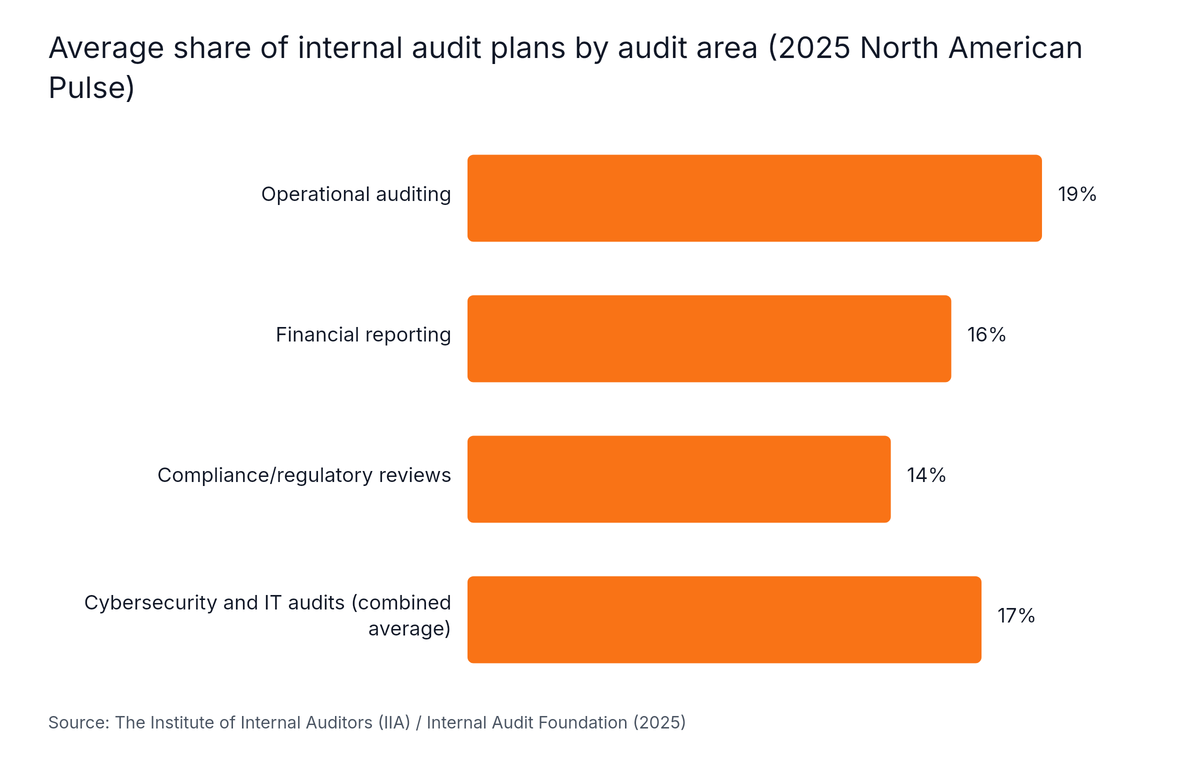
Programme mix matters too. In the 2025 North American Pulse survey, operational auditing averaged 19% of audit plans, financial reporting 16%, compliance and regulatory reviews 14%, and cybersecurity and IT combined 17% (IIA, 2025).
Horizontal Bar chart: Average share of internal audit plans by audit area (2025 North American Pulse). Highest: Operational auditing at 19%.
Risk assessments need a refresh cycle as well. The IIA's explainer on Standard 9.4 says of the risk assessment behind the audit plan: "that assessment must be performed at least annually" (The IIA, 2025). ISO 19011:2026, published in May 2026, keeps the risk-based approach and mainly updates remote auditing guidance (CQI, 2026), so record why each programme gets its frequency.
How do you schedule audits across multiple sites and regions?
Multi-site audits are scheduled by sampling and rotating sites, not by visiting every site every cycle. Under IAF MD 1, a client with 36 sites gets a sample of 6 sites plus the central function, and the sample rotates (CheckFirst, 2025). Sample sizes start from the square root of the number of sites and are adjusted for risk.
Regional map with a few highlighted site pins on a rotating sample schedule
IAF MD 1 sampling is the multi-site certification rule under which only some sites are visited each cycle. Many OEM dealer programmes contractually require every site to be visited, so use sampling for internal programmes and self-checks, and keep contractual visits fixed.
Fit the calendar to auditor capacity
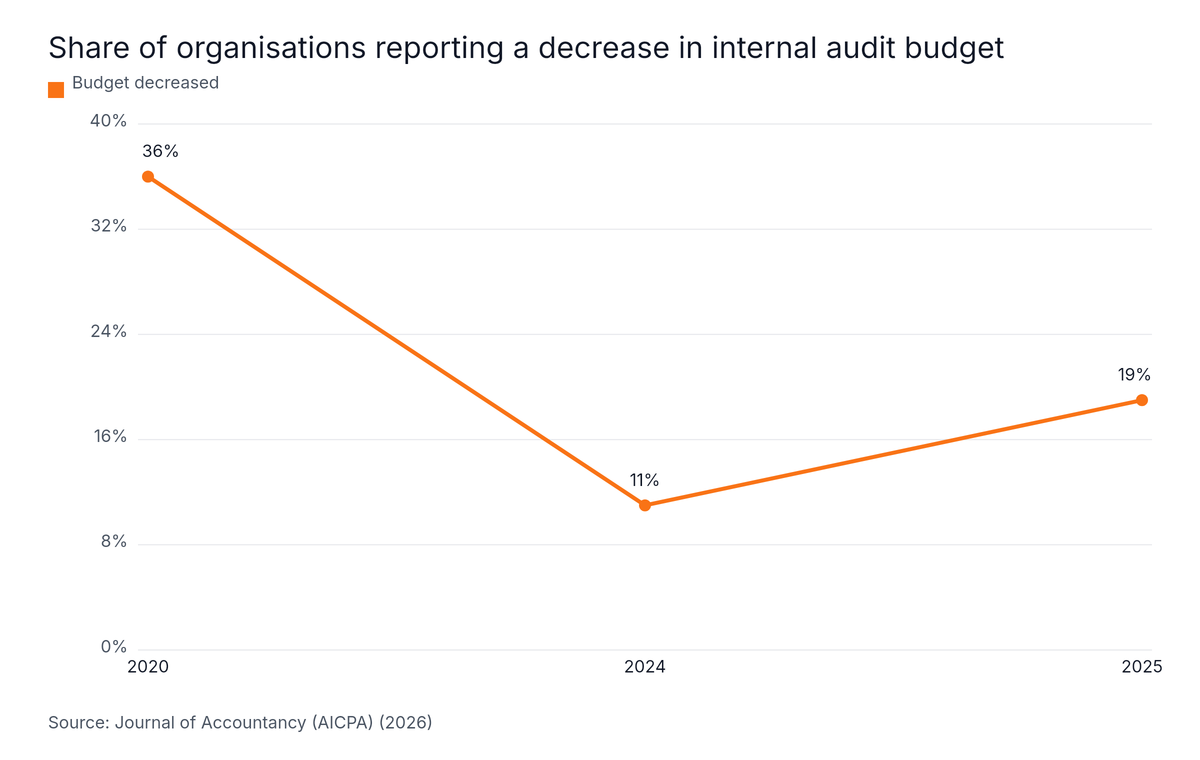
Capacity decides what is realistic. The Journal of Accountancy reports that 86% of audit leaders worked at organisations with the equivalent of 1 to 24 full-time auditors (Journal of Accountancy, 2026). Budgets are tightening: "Nineteen percent said their organizations’ budget for internal audit decreased in 2025" (Journal of Accountancy, 2026), up from 11% in 2024.
Line chart: Share of organisations reporting a decrease in internal audit budget. Highest: 2020 at 36%.
Separately, roughly 86% of chief audit executives oversee at least one area beyond internal audit (Internal Audit Foundation via PR Newswire, 2026), so one calendar often covers several programmes with the same few people.
Stagger by region
These four rules are our recommended practice for regional scheduling, not published benchmarks. The last one draws on the remote and hybrid methods that ISO 19011:2026 now covers (CQI, 2026):
Stagger dates so one region's holidays don't stall a whole cycle.
Assign regional auditors to routine visits and central auditors to high-risk sites.
Keep some visits unannounced, especially after a corrective action plan.
Alternate remote and on-site checks where the standard allows it.
Self-assessment can cut travel. AutoSmart estimates an average of $500 per physical visit, or $50,000 per 100 visits, and estimates that moving suitable checks to self-assessment could reduce visits by 30 to 40%, saving roughly $15,000 to $20,000 per 100 visits. These are estimates, not measured results. Offline capture matters for remote sites, as covered in mobile audit software for dealer networks.
What should you configure in audit schedule software?
Audit schedule software should be configured with five settings: recurring evaluation cycles per programme, named auditor assignment, reminder lead times, missed-audit escalation, and a schedule adherence view by site. Schedule adherence is the share of planned audits completed on time, tracked per site and per programme. IATF Rules 6th edition requires audit dates confirmed at least 90 days ahead (NSF, 2025).
Tablet showing a calendar with reminder alerts beside a field auditor's hard hat
The configuration checklist
Evaluation cycles. Set weekly, bi-weekly, monthly, quarterly, half-yearly or custom frequencies per programme, so results group into comparable cycles and trends are measurable.
Auditor assignment by role. Scope auditors to their dealerships or regions, and rotate them so scores aren't inflated by familiarity.
Reminder lead times. Remind the Person-In-Charge (PIC) and the auditor ahead of each due date, then repeat until the audit or action is done.
Missed-audit escalation. Route any overdue audit to a named manager automatically.
Date locking. Confirm dates well ahead, at least 90 days for IATF-certified sites.
Adherence reporting. Show planned versus completed audits, overdue audits and coverage gaps in a drill-down dashboard.
Audit schedule software is not worth buying for a single site, a network audited once a year, or a team that has not agreed its audit standard. It orders and tracks audits but can't fix a weak checklist or a cadence nobody chose. With 19% of organisations reporting an internal audit budget cut in 2025 (Journal of Accountancy, 2026), spend only where the calendar is the bottleneck.
Be honest about these limits before you evaluate tools:
Thin evidence on intervals. The 5S ladders above come from vendor guides without stated methodology. Test them on your own scores.
Small networks. A single site or a small network may manage with a well-kept shared calendar.
Unsettled standards. If the checklist changes every quarter, fix that first.
Contractual visits. Sampling doesn't replace OEM-mandated visits to every site.
Before committing, run a pilot on one existing programme using the scenarios in this demo stress-test guide.
Frequently Asked Questions
What is a 5S audit plan?
A 5S audit plan is a written schedule and method for checking Sort, Set in order, Shine, Standardise and Sustain in each area. It names who audits, how often, which checklist and scoring they use, and what triggers extra audits. The plan should also set the daily checks that operators run themselves between formal audits.
How often should 5S audits be scheduled?
Schedule 5S audits weekly for the first 90 days of a rollout, then monthly or quarterly once scores are stable, with daily operator checklists in between (Intelycx, 2026). Practitioner guides use the same ladder, with monthly as the standard baseline (Fabriq, 2024). Step back up after a score drop, repeat findings or a layout change.
How often should a 5S audit be done in a new area versus an established one?
A new area needs weekly or biweekly 5S audits to build habits, while an established, stable area is often well served by monthly audits (Eviview, 2026). Mature, stable environments can move to quarterly. Treat these as starting points and adjust to the area's scores and risk.
How do you schedule audits across multiple sites and regions?
Tier sites by risk, audit high-risk sites more often, and rotate a sample of the rest, as IAF MD 1 does for multi-site certification. Stagger dates around regional holidays and auditor capacity, lock dates well ahead, and track planned versus completed audits per site so overdue visits are visible.
Conclusion
Audit schedule software earns its place when programmes, sites and regions outgrow a spreadsheet. The cadence itself still needs your judgement.
Run 5S weekly for the first 90 days, then step down to monthly or quarterly, and step back up on defined triggers.
Give every programme its own cadence, with fixed anchors placed first.
Rotate samples across regions where the standard allows it, and fit the calendar to auditor capacity.
Configure reminders, escalation and schedule adherence reporting from day one.
Keep the limits in mind: the interval evidence is practitioner guidance, so test it on your own scores.
Next step: take one programme, map its cadence against the matrix above, and see how it behaves on a shared calendar. For the wider picture of standards across many sites, read franchise compliance software. Then Schedule a Free Demo to run it on one of your existing audit programmes.
Written by
Naseef Umar
Founder | CEO
Naseef Umar is an automotive industry expert and the Founder & CEO of AutoSmart, with over a decade of experience working across automotive operations, dealer standards, network performance, audits, and digital transformation.
 Naseef UmarNov 6, 2026