Blog
Dealer Audit Software: A Buyer's Checklist for OEMs and Dealer Groups
Dealer audit software explained: what it replaces, how it differs from generic inspection apps, and eight tests to run in a demo before you buy.

Running 17-18 audit programmes in separate tools creates blind spots. Learn what auto audit software needs to manage DOS, 5S and mystery shopping on one platform.
 Naseef UmarOct 9, 2026
Dealer audit software explained: what it replaces, how it differs from generic inspection apps, and eight tests to run in a demo before you buy.
Score a 3-bay workshop and a flagship showroom fairly on one retail audit checklist: format profiles, N/A arithmetic, weighting and guardrails.
A brand standards audit scores a dealer against OEM facility, process and customer experience rules. See who sets standards, what they cost and how audits run.
Request a quote and our experts will contact you within 24 hours with tailored solutions and pricing.
You can also send us a quick email at info@autosmarts.co.
AutoSmart Technology
Last updated: Oct 1, 2026
Auto audit software is a digital platform that replaces paper checklists, spreadsheets and email chains with a structured mobile workflow for conducting, scoring and reporting field audits across a branded dealer network - and one platform can run Dealer Operating Standards (DOS), 5S and Mystery Shopping simultaneously when built with programme-level access separation, flexible scoring models and a unified corrective-action tracker.
Most automotive networks do not run one or two audit programmes. They run closer to 17 or 18: DOS, 5S workplace organisation, Mystery Shopping, bodyshop, health and safety, corporate identity, aftersales process and more, each at its own frequency. When those programmes live in separate tools or spreadsheets, the data never talks to each other. A dealership can fail its 5S audit and its mystery shopping assessment in the same month, and nobody sees the pattern because the scores sit in different systems.
This article explains what a single-platform architecture for multiple concurrent audit types actually requires, where single-purpose tools create blind spots, and what network development and field operations teams should look for when evaluating auto audit software.
Key Takeaways
- A typical automotive network runs roughly 17-18 concurrent audit programmes; separate tools for each make cross-programme analysis impossible.
- Dealer Operating Standards (DOS), 5S and Mystery Shopping require different scoring models, different access rules and different corrective-action routes - a unified platform handles all three without forcing them into a single mould.
- Disconnected audit ecosystems are 40% more likely to miss targets on cost, scope or schedule (Gartner, cited in Celoxis, 2025).
- The corrective action problem is as important as the audit itself: DOS findings belong with the dealer principal, 5S findings with the workshop manager, mystery shopping findings with the CX or training team.
- AutoSmart Audit's case study with Almajdouie Motors documents a 10-day audit cycle cut to 3 days after platform consolidation (AutoSmart).
Auto audit software is a digital platform for conducting, scoring and reporting field audits across a branded dealer network from a single mobile workflow. A typical automotive network runs roughly 17-18 concurrent audit programmes - DOS, 5S, Mystery Shopping, bodyshop, health and safety and more. Each audit generates 8-20 findings; manual follow-up requires 4-5 chases per finding. Fragmented tools make cross-programme analysis structurally impossible.

The scale of what needs auditing is significant. U.S. franchised light-vehicle dealers alone wrote more than 276 million repair orders in 2025, with service and parts sales exceeding $164 billion (NADA, 2025). The automotive compliance audit market was valued at $1.2 billion in 2024, projected to reach $3.8 billion by 2033 at a 13.7% compound annual growth rate (CAGR) - meaning the market is expected to nearly triple in under a decade (Researchintelo, 2024).
The problem is not finding an audit tool. It is finding one built to run programmes with genuinely different structures, access rules and corrective-action workflows on the same platform - without degrading any of them. Most tools are built for a single audit type and bent into shape for others. The result is a platform that technically runs everything but gives network managers no coherent view across programmes.
For a closer look at how field audit software handles evidence capture and scoring, see Field Audit Software for Dealer Networks: Evidence Capture, Scoring and Dealer Visit Reports in One Mobile Workflow.
Dealer Operating Standards (DOS) auditing is a declared, collaborative inspection where a field auditor scores a dealership against a weighted Original Equipment Manufacturer (OEM)-defined checklist covering sales process, aftersales, facility presentation and customer experience. DOS auditing requires weighted scoring, digital dual sign-off, and automatic corrective actions routed to the dealer principal. PwC's 2025 Global Compliance Survey found 82% of companies plan to increase compliance technology investment (PwC, 2025).

DOS programmes share three structural requirements that any auto audit platform must accommodate:
A typical DOS audit generates 8 to 20 findings. Each finding, unmanaged, requires 4 to 5 manual follow-ups before closure. Multiply that by 100 dealers audited quarterly. The follow-up burden alone exceeds what a field team can absorb without a system.
"Compliance isn't just about checking a box - it's about building a foundation of trust and transparency that supports long-term success," (Robert Newman, Director of Performance Management, Cox Automotive, 2025). DOS audits are the mechanism that makes that transparency operational at network scale.
5S auditing in an automotive dealership applies the five pillars - Sort, Set in Order, Shine, Standardise, Sustain - to service bays, parts stores and customer areas rather than a production line. Manufacturing 5S targets cycle time; dealership 5S targets technician safety, customer perception and workshop efficiency. Facilities sustaining 5S practices report 30% fewer safety incidents and 25% faster material retrieval within six months (OxMaint, 2025).
The scoring model also differs. A manufacturing 5S audit typically uses a 1-to-5 rating per pillar per zone, producing a matrix score. A dealership 5S audit runs the same pillar structure but adds mandatory photo evidence per zone. A parts bin without a label needs a before-and-after photo, not just a deducted point, because the evidence goes to a workshop manager who must act - not just a number that sits in a report.
A 2025 peer-reviewed study validated an AI-based 5S audit system in automotive manufacturing and found it delivered 50% faster audits compared to manual methods, with strong alignment to human assessors (arXiv, 2025). That study was conducted in a controlled manufacturing environment; the arXiv research points to the direction AI-assisted auditing is taking in settings where 5S programmes are most mature.
For a detailed breakdown of 5S audit structure in dealer network contexts, see 5S Audits in a Dealer Network: What They Assess and How to Run Them Consistently Across Sites.
The platform implication is specific: 5S scores should not be averaged into a combined DOS score on the management dashboard. They represent different programmes with different owners. A unified platform presents each on its native scale and allows drill-down separately, while also letting a manager check whether low 5S scores at specific sites correlate with lower mystery shopping scores at the same locations.
Mystery shopping is a covert audit mode where a trained assessor poses as a real customer to evaluate sales or service behaviour against a scripted scenario, invisible to dealership staff until the programme owner releases results. The platform must enforce strict programme-level access separation so dealers cannot see scores or scenarios in advance. Automotive service retention fell from 72% to 54% in two years - representing $12,000 in lifetime value per lost customer (Cox Automotive, cited in Reality Based Group, 2025).
The execution gap is well documented. 43% of qualified leads in automotive dealerships were mishandled - not logged in CRMs, calls missed or follow-up delayed - in the Foureyes 2024 Automotive Dealer Benchmarks Report (Foureyes, 2024). Mystery shopping audits surface the specific interaction failures behind that number before they compound into lost customers.
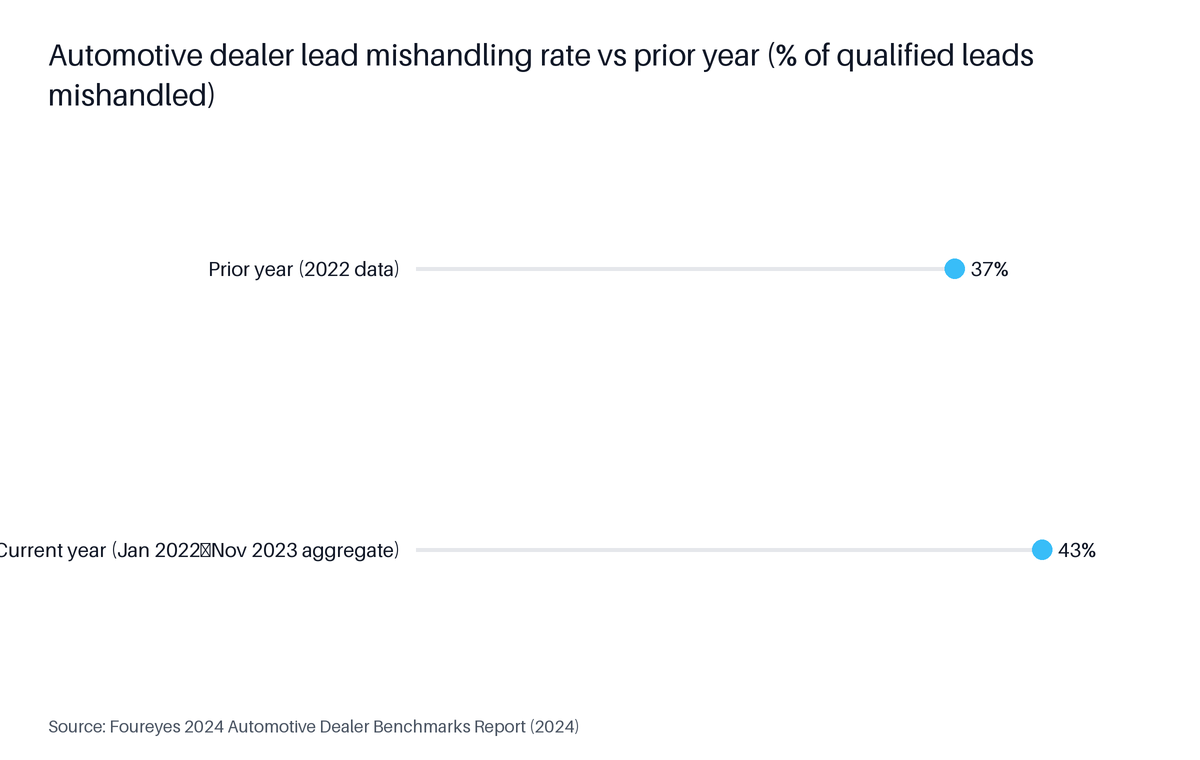
Source: Foureyes 2024 Automotive Dealer Benchmarks Report, 2024
Running Dealer Operating Standards, 5S and Mystery Shopping in separate tools means scores cannot be correlated at the same location - a dealer failing both 5S and mystery shopping appears as two unconnected problems, not one systemic failure. Disconnected ecosystems are 40% more likely to miss targets on cost, scope or schedule (Gartner, cited in Celoxis, 2025). Manual consolidation adds 3-4 hours of post-audit work per dealership per cycle.
The full range of blind spots created by programme fragmentation:
| Blind Spot | What Is Missed | Platform Consequence |
|---|---|---|
| Cross-programme correlation | Low 5S + low mystery shopping at same site signals systemic underperformance | Two separate reports; no combined view |
| Repeat failure tracking | A finding closed in one tool reappears in another; no shared history | Auditor sees no prior failure record |
| Consolidated action status | Findings tracked across spreadsheet, tool and email simultaneously | No single owner, deadline or escalation |
| Management dashboard | Leadership manually combines exports from 3-5 systems per cycle | 3-4 hours post-audit consolidation per dealership |
| Scoring drift | Auditors score the same item differently across separate tools with no calibration | Network-wide score inconsistency |
A further factor: 77% of compliance leaders identify data silos as their primary barrier to effectiveness, per a 2025 Clarity Factory survey (Onspring, 2025). With U.S. dealers writing more than 276 million repair orders in 2025 (NADA, 2025), bodyshop and aftersales audit programmes carry the same cross-programme coherence requirement as DOS and 5S.
Our data: Almajdouie Motors cut a 10-day audit cycle to 3 days after consolidating onto a single platform. The field team was spending nearly two weeks on every audit cycle; after switching to AutoSmart Audit, they completed full audit reports in 3 days without adding headcount (AutoSmart case study).
A single auto audit platform must route corrective actions to the right role for each programme: DOS findings to the dealer principal, 5S findings to the workshop manager, mystery shopping findings to the customer experience or training team. The Action Plan Tracker assigns each finding to its Person-In-Charge (PIC) automatically at audit close, with separate escalation rules per programme. Foureyes found 43% of qualified dealer leads were mishandled in 2024 (Foureyes, 2024) - closed-loop corrective action on process findings directly addresses that gap.
Without a closed-loop system, the audit team becomes the chasing team. A finding identified in November, requiring 4 to 5 follow-ups before closure, with no system record of owner, deadline or status, typically reappears unchanged in the next audit cycle.
"We would never go back to the old auditing method. It's like going back from a Cadillac to a camel," (M Samee Ul Haq, National Field Operations and Support Manager, AutoSmart customer testimonial). That shift reflects what happens when follow-up moves from email threads to a tracked system with owners and deadlines.
The platform also supports external agency auditors with limited, configurable scope. Where a third-party audit firm conducts mystery shopping visits, their findings enter the same Action Plan Tracker and the same management dashboard - without giving the agency access to DOS or 5S programme data.
Scoring drift is the tendency for different auditors to score the same checklist item differently over time - common across any multi-country dealer network where auditors work independently and calibration is informal. Three platform-level mechanisms control it: mandatory photo evidence anchored to each checklist question, historical cycle comparison surfacing prior scores before each new evaluation, and calibration benchmarks built into the scoring model. When evidence is required per question, subjective variance narrows because auditors justify scores with visible proof rather than judgement alone.
For multi-country networks, auditor bias compounds with language variation. Multi-language checklists - Arabic, English, French, German, Italian, Spanish - ensure the question is read the same way across markets, not interpreted differently because the translation is informal.
A platform running 17-18 concurrent audit programmes needs four elements: a flexible checklist builder supporting different scoring models per programme; role-based access control enforcing programme-level data separation; a unified drill-down dashboard presenting each programme on its native scoring scale; and an Action Plan Tracker routing findings by programme type to the correct PIC. AutoSmart Audit is rated 4.8/5.0 from 17 reviews on G2 (March 2025 through September 2026), with recurring praise for centralising all audit types in one place (G2).
| Audit Programme | Scoring Model | Access Mode | Corrective Action Owner | Evidence Requirement |
|---|---|---|---|---|
| Dealer Operating Standards (DOS) | Weighted KPI percentage | Declared; shared with dealer | Dealer Principal | Photo per failed item; dual sign-off |
| 5S | 1-to-5 per pillar per zone | Declared; shared with workshop | Workshop Manager | Before/after photo per zone |
| Mystery Shopping | Percentage compliance vs script | Covert; dealer invisible | CX / Training Team | Assessor notes; recording if applicable |
| Health and Safety | Pass/fail with mandatory items | Declared; shared with site manager | HSE Manager / Site Manager | Photo evidence; corrective deadline mandatory |
| Bodyshop | Weighted process checklist | Declared; shared with bodyshop manager | Bodyshop Manager | Photo; technician sign-off |
| Corporate and Brand Identity | Weighted visual standards | Declared; shared with dealer | Dealer Principal / Marketing | Photo per non-compliant element |
Networks across GCC markets (UAE, Saudi Arabia, Kuwait, Qatar, Bahrain, Oman) and APAC (India, Southeast Asia) carry platform requirements beyond the core four. Multi-country distributor structures require regional hierarchy configurations. An Area Service Manager (ASM) in India operates within a different distributor tier than a Zonal Service Manager (ZSM) in Saudi Arabia. Multi-language checklists are functional, not optional. Data residency - the requirement that data is stored and processed within a specific country or region - differs by market: Saudi Arabia and UAE both carry data localisation expectations, and Indian deployments operate under their own regulatory context.
DMS (dealer management system) integration also comes up in architecture discussions. Auto audit software does not replace a DMS; it layers structured qualitative judgements on top of quantitative DMS data. The audit captures what the DMS cannot: whether the workshop is clean, whether the sales consultant followed the process, whether the signage is compliant.
| Specification | Detail |
|---|---|
| Hosting | AWS cloud; data residency options including local hosting |
| Mobile | iOS and Android native apps; offline-first with auto-sync |
| Security | ISO 27001, SOC 2 Type II, GDPR compliant (TÜV SÜD badges displayed on site) |
| Authentication | Single Sign-On (SSO) via SAML/OAuth (authentication protocols connecting the platform to existing corporate identity systems) |
| Languages | Arabic, English, French, German, Italian, Spanish |
| Roles | Admin, Auditor, External Auditor, Viewer, PIC; custom roles at Enterprise tier |
| Implementation | Go-live typically 5-10 working days from configuration inputs received |
| Pricing tiers | Starter, Growth, Enterprise, AI Plan; network-based subscription (per outlet) |
Our data: Luai Felemban, Network and Dealer Development Manager, documented that evaluation previously took 5 days plus 5 more to prepare and share reports. After moving to AutoSmart Audit, the whole process including the action plan takes 3 days (video testimonial).
For networks moving off manual reporting cycles entirely, see Paperless Audit Software for Dealer Networks: What Changes Day to Day.
Auto audit software built for multi-programme dealer network management is not the right fit for every organisation. Networks with fewer than roughly 10 sites are manageable without a platform. At that scale, one manager walks the floor and knows the status of every site; a spreadsheet covers the record-keeping.
It also does not apply to:
The platform is also not a substitute for an external audit consultancy's team. Where a network uses a third-party audit firm, the approach is different: digitise and centralise while keeping existing auditors in place. Management gets direct visibility into findings, scores, trends and action plans - without depending on the consultancy's own reporting cycle.
AutoSmart Audit supports Dealer Operating Standards, Customer Experience, Corporate and Brand Identity, 5S, Infrastructure and Process, Mystery Shopping, Internal, Health and Safety, Environmental, Government Compliance, Bodyshop, Technical, Standard Operating Procedure, and Risk Management audits - all configurable within the same platform without separate tools for each programme type.
Yes. Auto audit software built for multi-programme management separates programme data at the access-control level, so mystery shopping scenarios remain invisible to dealership staff while Dealer Operating Standards and 5S results are shared collaboratively. Role-based permissions and separate programme containers enforce that separation within the same platform, with no crossover between declared and covert programme data.
A unified auto audit platform stores each programme's native scoring model - weighted KPI percentages for DOS, 1-to-5 pillar ratings for 5S, percentage compliance for mystery shopping - separately and presents each on its own scale. Cross-programme views compare trend direction and finding severity at the same location rather than forcing a single shared score across different methodologies.
Go-live typically takes 5-10 working days once configuration inputs are received. Onboarding includes guided setup, auditor training, a dedicated Customer Success Manager, and a no-cost pilot on one existing audit programme to reduce switching risk before full deployment across the network.
Every failed item automatically becomes an action item in the Action Plan Tracker, assigned to the correct Person-In-Charge (PIC) with a due date, Kanban progress status (Pending, In Progress, Completed, Approved), escalation rules and overdue alerts. The next evaluation cycle surfaces unresolved prior-cycle findings so repeat failures are visible to the auditor before the new evaluation begins.
The practical floor is approximately 10 sites. Below that threshold, spreadsheets remain workable. The sweet spot is 25-500 sites under one brand or group; enterprise deployments cover 500-plus sites across multiple countries and brands, with multi-language checklists and multi-region hierarchies built in.
AutoSmart Audit is ISO 27001, SOC 2 Type II and GDPR compliant (TÜV SÜD badges displayed on site). The platform is AWS-hosted, supports data residency options including local hosting, uses evidence integrity controls - live-capture enforcement, geotagging and timestamps - and supports Single Sign-On (SSO) via SAML/OAuth. Ongoing vulnerability assessment and penetration testing is maintained. The CTO and CISO are available for customer security review.
Scoring drift is controlled through mandatory photo evidence anchored to each checklist item, historical cycle comparison that surfaces prior scores to the auditor before each new evaluation, and calibration benchmarks built into the platform's scoring model. When evidence is required per question, subjective variance narrows because auditors justify scores with visible proof rather than judgement alone.
Running Dealer Operating Standards, 5S, Mystery Shopping, bodyshop and health and safety audits in separate tools is not a neutral choice. It creates blind spots at the location level, adds 3-4 hours of manual consolidation per dealership per audit cycle, and makes it structurally impossible for leadership to correlate failures across programme types at the same site.
A single-platform architecture for multi-programme audit management requires four things: a flexible checklist builder per programme, programme-level access control, a unified drill-down dashboard on native scoring scales, and a closed-loop Action Plan Tracker routing findings to the right Person-In-Charge. Networks that have made that consolidation cut their audit cycle times from weeks to days - Almajdouie Motors from 10 days to 3, and Luai Felemban's network from 10 days of evaluation and reporting to 3, including the action plan.
If your network runs more than a handful of audit programmes and leadership still works from compiled spreadsheets, the question is not whether to consolidate. It is which platform was built for the way automotive dealer networks actually operate.
Schedule a Free Demo to see how AutoSmart Audit handles your specific mix of audit programmes on a single platform.
Written by Naseef Umar, Founder and CEO, AutoSmart. Naseef has over a decade of experience in automotive operations, dealer standards, network performance and field audit digital transformation across MENA and APAC markets.
© 2026 AutoSmart Technology All rights reserved.