Auto Dealership Compliance Checklist: Operations, Customer Experience and Health & Safety Across a Franchised Network
By Naseef Umar, Founder & CEO, AutoSmart Solutions
An auto dealership compliance checklist is a structured evaluation framework that tells a franchised network whether every site meets required standards across operations, customer experience, and health and safety - and what happens next when one site does not.
Most checklists in circulation cover one domain. The ops team builds a workshop inspection form. The brand team runs a corporate identity audit. The health and safety manager carries a separate PPE checklist. None of those three forms talk to each other. In a network of 50 or more sites, that fragmentation costs real money. Consistent branding across channels increases franchise revenue by up to 23% (Webtonic, 2026). A network where standards enforcement is patchy leaves that upside unprotected.
This article details what each domain must contain, how the checklist design for a franchised network differs from a single-site form, and why running it on a PDF template breaks at scale.
Key Takeaways
A complete auto dealership compliance checklist covers three domains: operations and brand standards, customer experience, and health and safety. Treating any one in isolation leaves measurable gaps.
A network-level checklist differs from a single-site form through weighted scoring, aggregation logic, auditor calibration, and corrective-action workflows - not just more line items.
Automotive dealers rank 11th out of 13 consumer industries for customer experience (Capgemini Research Institute, 2024), making CX items as critical as workshop compliance.
Motor vehicle dealers recorded 2.8 total recordable injury cases per 100 full-time employees in 2024, above the all-industry average of 2.3 (U.S. Bureau of Labor Statistics, 2025).
70% of corrective actions across multi-site automotive groups are incomplete without named owners and due dates (AutoSmart Audit, 2025). The checklist and corrective-action system must be one workflow.
What Should an Auto Dealership Compliance Checklist Cover?
An auto dealership compliance checklist is a structured evaluation framework that measures whether a dealership meets required standards across three domains: operations, customer experience, and health and safety. A checklist covering only one domain leaves the others untracked. On a franchised network of 50 or more sites, any uncovered domain is a blind spot. Consistent branding across channels increases franchise revenue by up to 23%, per a 2026 analysis of franchise branding data (Webtonic, 2026).
Three overlapping compliance domain rings for a dealership network — operations, CX, health and safety
"A single non-compliant location can erode customer trust across the entire network because the public associates negative experiences with the brand name." (FieldPie editorial team, 2026)
The three domains are not independent. A workshop passing every safety check but failing handover scoring still produces a dissatisfied customer. A showroom with perfect brand presentation but expired fire extinguishers carries regulatory and insurance risk. The checklist structure must reflect that interdependence.
Three elements separate a working network checklist from a template: weighted scoring, a corrective-action workflow attached to each finding, and aggregation logic that converts site-level scores into a management view. The sections below work through each domain in turn.
Domain 1: Operations and Brand Standards
The operations domain of a dealership compliance checklist covers corporate identity, workshop process adherence, parts bay organisation, staff certification, recall management, and data security controls. These items form the backbone of Dealer Operating Standards (DOS) audits that Original Equipment Manufacturers (OEMs) mandate across their networks. From January 2024 through March 2025, the average vehicle recall completion rate across automakers was only 48% (QT9 Software, citing NHTSA data, 2025), making recall tracking a critical gap on any network-level checklist.
Dealer Operating Standards audit form with scored checklist sections at a dealership service desk
"Standards are set globally, but enforcement is managed at the regional or country level. Regional field reps work directly with dealerships." (AutoSmart editorial team, 2025)
How Do CI Audits Differ From BRI Audits in OEM Dealer Network Compliance?
Two audit types cover the operations and brand domain. They measure different things.
Corporate Identity (CI) audit is a structured evaluation of whether a dealership's physical environment, exterior and interior signage, and branded materials conform to the OEM's visual standards. Line items include sign dimensions, typeface, illumination level, and point-of-sale material currency.
Brand Retail Identity (BRI) audit is a structured evaluation of the in-store customer journey, staff behaviour, and digital touchpoint consistency against the OEM's retail experience requirements. It covers how staff engage customers, whether the sales process follows defined steps, and whether digital kiosks reflect current brand assets.
A CI audit catches a missing logo. A BRI audit catches a broken process. Both belong on a network checklist. They are scored and weighted separately because their remediation paths differ. A CI failure needs a physical fix. A BRI failure needs coaching or a process change.
Corporate Identity and Brand Presentation
Line items in the CI section of an auto dealership compliance checklist include:
External signage - correct typeface, dimensions, illumination, and placement per brand guidelines
Internal signage - product displays, price boards, and directional signage in brand-approved formats
Point-of-sale materials - current campaign materials, no outdated pricing or model references
Staff presentation - uniform compliance, name badge policy, appearance standards
Showroom layout - vehicle display zones configured per planogram, no unapproved additions
Workshop and Service Operations
Workshop process items cover the structured steps from vehicle reception to job completion:
Job card completion - accurate capture of customer complaint, work authorised, and technician sign-off
Technician certification - current OEM-mandated skill levels for the work performed
Courtesy and loan vehicle process - condition checks, documentation, fuel level recording
Parts bay organisation-5S compliance, stock rotation, separation of new and returned parts
Recall management - open recall tracking, customer notification records, parts availability confirmation
Data Security and Regulatory Items
Data security is now an operational compliance item. A 2024 FTC enforcement action placed a regional dealer network under a 10-year external security audit requirement following a data-safeguards violation (Burgitech, 2025). Checklist line items include:
Customer data handling procedures at the point of sale
Identity verification process at the finance desk
Network access controls for dealership systems
Disposal of customer documents containing personal data
MENA and APAC Regulatory Context
Dealer networks in the Middle East and Asia-Pacific carry additional regulatory line items. In Saudi Arabia, ZATCA (Zakat, Tax and Customs Authority) e-invoicing requirements mean dealer billing processes must produce a verifiable digital record. In the UAE, Federal Consumer Protection Law requires transparent pricing and warranty disclosure at the point of sale. OEM compliance programmes in MENA increasingly incorporate local regulatory obligations alongside brand standards. An audit checklist that omits them creates a gap the brand audit will not catch (DemandLocal, 2025).
Domain 2: Customer Experience Checklist Items
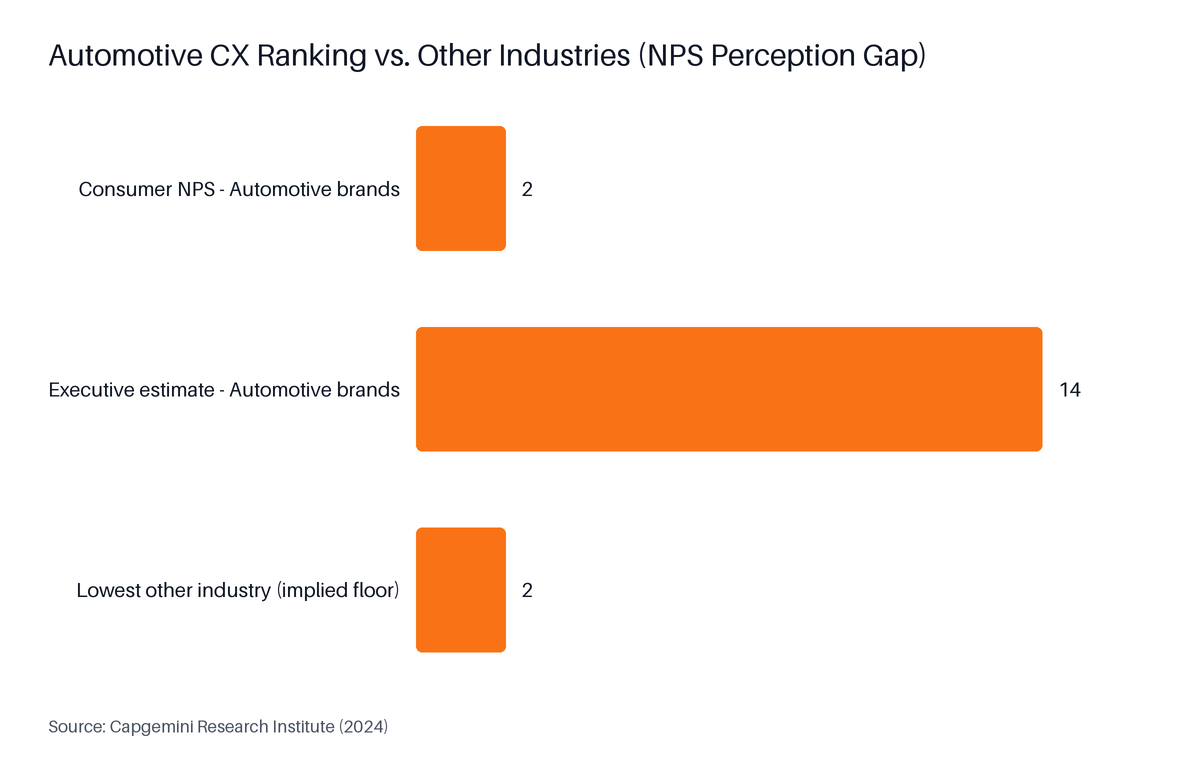
The customer experience domain of a dealership compliance checklist covers showroom presentation, test-drive process, vehicle handover quality, post-sale follow-up cadence, and digital touchpoint consistency. Automotive dealers rank 11th out of 13 consumer industries for customer experience. Consumers give automotive brands an average Net Promoter Score (NPS) of just 2, against an executive estimate of 14, per the Capgemini Research Institute's October 2024 survey of 10,000 consumers and 600 executives (Capgemini Research Institute, 2024).
Field auditor reviewing customer experience checklist on tablet at a vehicle handover bay
Horizontal Bar chart: Automotive CX Ranking vs. Other Industries (NPS Perception Gap). Highest: Executive estimate — Automotive brands at 14.
That 12-point gap between what executives believe and what customers report is exactly what a CX checklist domain exists to close. As Laurence Noël, Head of Global Automotive Industry at Capgemini, noted: "When it comes to delivering a consistent customer experience 'one size does not fit all'." (Capgemini Research Institute, 2024) The consumer NPS figure for automotive is 2. The executive estimate is 14. That gap does not close without structured, consistent measurement.
57% of automotive consumers dissatisfied with post-purchase services consider switching brands within 6 to 18 months (Capgemini Research Institute, 2024). After-sales process compliance is a direct retention lever. Franchise locations with standardised review frameworks score 23% higher on customer satisfaction benchmarks than those using informal evaluations (Myfieldaudits, cited in FieldPie, 2025).
CX Checklist Line Items
The following items belong on the customer experience section of a dealership compliance audit checklist:
Pre-delivery inspection (PDI) checklist completed and signed
Document review
Handover process
Vehicle features explained, customer signed off
Digital sign-off record
Post-sale follow-up
Call or message logged within 48 hours of delivery
CRM log extract
Digital consistency
Website pricing matches showroom pricing
Cross-check observation
Complaint handling
Complaint acknowledged and logged within 24 hours
System record
Mystery Audit Integration
A mystery audit is an evaluation conducted by an undisclosed assessor posing as a customer. It measures the actual experience against the checklist standard - not the prepared version. Mystery audits cover items a declared audit cannot capture honestly. Was the customer greeted without prompting? Was the test drive offered proactively? Were finance products presented transparently?
For compliance managers designing a network checklist, mystery audit items and declared audit items should be tracked in the same system. That way, the gap between observed and actual performance is visible by site and by region. For networks combining operational standards and mystery shopping in one platform, auto audit software for dealer operating standards and mystery shopping covers how those programme types run together.
Domain 3: Health and Safety Checklist Items
The health and safety domain of a dealership compliance checklist covers PPE compliance, ventilation and exhaust extraction, chemical and hazardous material storage, hydraulic lift inspection, emergency preparedness, and spill response. Motor vehicle dealers recorded 2.8 total recordable cases per 100 full-time employees in 2024, above the all-industry average of 2.3 (U.S. Bureau of Labor Statistics, April 2025). These figures make structured H&S items non-negotiable on any dealer audit.
Workshop health and safety compliance showing PPE station and bunded chemical storage pallets
For single-site H&S item detail, the AutoSmart page on health and safety checklists for automotive dealerships covers core items. The additional requirement for a franchised network is consistency. A failing pattern at 12 workshops in one region must be visible to management - not buried in 12 separate paper forms.
H&S Checklist Line Items by Zone
Workshop Zone
Checklist Item
Audit Method
All areas
PPE available and in use per task type
Visual observation
Service bays
Vehicle exhaust extraction system operational
Physical test
Service bays
Hydraulic lift inspection record current
Document review
Chemical store
Secondary containment (bunded pallets) in place
Visual inspection
Chemical store
Incompatible substances separated
Visual inspection
Chemical store
Safety Data Sheets accessible at point of use
Document review
All areas
Fire extinguishers within service date
Physical inspection
All areas
Emergency exits clear, signage visible
Visual observation
First aid station
First aid kit stocked, contents in date
Physical inspection
Workshop ventilation
General and source-capture extraction functioning
Physical test
Waste handling
Oil, coolant, and solvent disposal records current
Announced vs. Unannounced Audit Design
H&S items split into two categories. They need different audit designs.
Point-in-time observation items - PPE actually being worn, exits actually clear, extraction actually running - must be checked unannounced. Staff behaviour changes when an audit is scheduled. Document and record items - lift inspection logs, Safety Data Sheets, waste disposal records - can be reviewed in a declared visit or through self-assessment.
A well-structured H&S checklist flags which items require unannounced checking and which can be validated remotely. That distinction belongs in the checklist design itself. For networks managing safety audit cadence and escalation at scale, safety audit management software for dealer networks covers how those programmes are structured.
How Does a Network-Level Checklist Differ From a Single-Site Form?
A network-level dealership compliance checklist differs from a single-site inspection form in four ways: weighted scoring applied identically across every site, aggregation logic producing a regional and network average, auditor calibration keeping scores consistent, and risk-tier segmentation directing audit frequency toward higher-risk sites. A checklist that aggregates is the structural answer - one that accumulates paper is not.
PwC's Global Compliance Survey 2025 found that 76% of executives say growing compliance complexity has negatively impacted their ability to manage third-party dealer relationships (PwC, via Secureframe, 2025). That figure explains why the network checklist exists as a system problem, not a content problem.
Weighted scoring is a method of assigning greater numerical value to high-risk or high-impact checklist items than to minor observations. Without consistent weighting, two auditors visiting sites of equal compliance can return different total scores. Cross-site comparison becomes meaningless.
Auditor calibration is the process of ensuring different field auditors apply the same scoring interpretation to the same observation. On a 50-site network with five regional auditors, calibration exercises and locked scoring definitions are part of checklist governance.
Risk-tier segmentation means classifying sites by risk level based on past compliance history, size, or market. Sites that have failed the same item across three consecutive audit cycles get inspected more often than consistently compliant ones. This directs auditor time where it delivers the most value.
Checklist Feature
Single-Site Form
Network Checklist
Scoring
Pass/Fail or simple total
Weighted, auto-calculated, consistent
Aggregation
None
Regional and network average in real time
Auditor calibration
Not required
Structured calibration and locked scoring
Corrective action
Manual email or note
Closed-loop with named PIC and due date
Frequency management
Fixed schedule
Risk-tier segmentation
Evidence
Photos on device
Geotagged, timestamped, attached to finding
Management view
Prepared report
Drill-down dashboard, live
For networks evaluating software against these requirements, the field audit software guide for dealer networks details evidence capture, scoring, and dealer visit reports in a single mobile workflow.
Why a PDF Template Fails at 50 or More Sites
A PDF template fails at network scale because it produces isolated snapshots, not comparable aggregated data. PwC's Global Compliance Survey 2025 found 76% of executives say growing compliance complexity has negatively impacted their ability to manage third-party dealer relationships (PwC, via Secureframe, 2025). Each site returns a form. Someone consolidates it manually, reconciles scoring differences, and prepares a management report. AutoSmart's data shows teams spend 3 to 4 hours after each audit on consolidation alone.
Our data: At an average of $500 per physical visit, a 100-site network spends roughly $50,000 per inspection cycle on travel alone. AutoSmart's operational framing of self-assessment programmes suggests moving suitable checks to controlled self-assessment could reduce physical visits by 30 to 40%, saving approximately $15,000 to $20,000 per 100 visits - without reducing coverage.
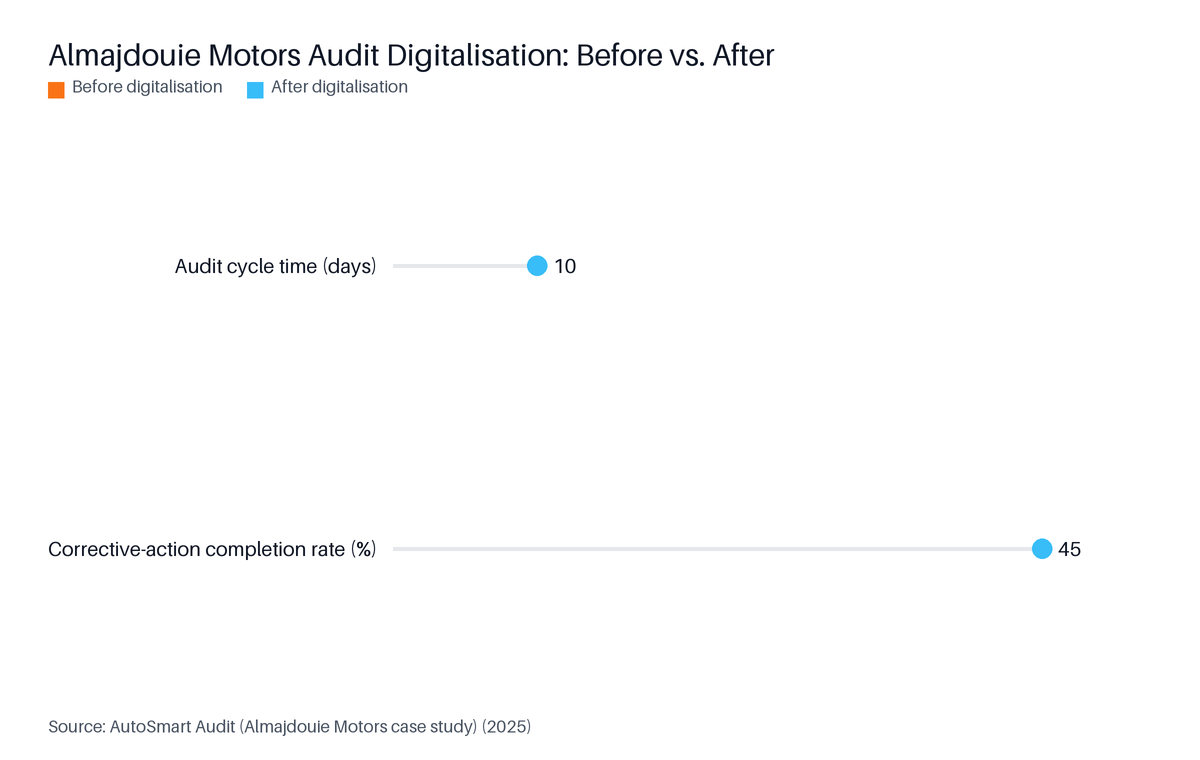
Lollipop chart: Almajdouie Motors Audit Digitalisation: Before vs. After. Highest: Corrective-action completion rate (%) at 45.
Source: AutoSmart Audit (Almajdouie Motors case study), 2025
Almajdouie Motors cut its audit cycle from 10 days to 3 days and improved corrective-action completion from 45% to 89% after moving from a manual process to a digital field audit platform (AutoSmart Audit, Almajdouie Motors case study, 2025). The Almajdouie audit cycle ran 10 days before digitisation. It runs 3 days now.
"Aggregated data across the entire franchise network is transformative. Patterns reveal systemic training gaps, underperforming regions, or supplier quality issues." (FieldPie editorial team, 2026)
A platform built for this applies scoring the moment an auditor submits a response. It stores evidence against the specific finding it documents. It surfaces recurring failures across the network in real time. And it converts every non-compliance into a tracked corrective action. Reviewing whether your current tool is holding the network back? The dealer audit system guide covers where spreadsheets break down and what to evaluate next.
Network compliance dashboard showing real-time dealer scores across multiple regions on a monitor
How to Build Corrective-Action Tracking Into the Checklist
Corrective-action tracking is built into a dealership compliance checklist by converting every failed item into an action with a named Person-In-Charge (PIC), a due date, and required closure evidence before the finding can be marked resolved. AutoSmart Audit's analysis of multi-site automotive groups found that 70% of corrective actions are incomplete without named owners (AutoSmart Audit, 2025). Almajdouie Motors improved corrective-action completion from 45% to 89% after replacing a manual process with a digital field audit platform (AutoSmart Audit, 2025).
Our data: A typical dealer audit generates 8 to 20 findings. Under a manual process, each finding requires 4 to 5 follow-ups - including escalations - before closure. Luai Felemban, Network and Dealer Development Manager, reported that evaluation previously took 5 days plus 5 more to prepare and share reports. After moving to a digital platform, the whole process including the action plan takes 3 days.
A Corrective Action and Preventive Action (CAPA) workflow requires four elements embedded in the checklist system:
Automatic action creation: when a finding is marked non-compliant, an action item is created without manual intervention, with the finding description, evidence, and scoring impact attached.
Named ownership: the system assigns the action to the correct PIC by role or site - not to the auditor who raised it.
Escalation rules: if the action passes its due date without closure, the system notifies the regional manager or network quality manager automatically.
Closure evidence: the PIC must upload photographic or documentary proof that the issue has been resolved. The action cannot be marked complete without it.
For compliance managers building or evaluating a corrective-action workflow, the automotive network audit software guide covers what generic tools miss at dealer network scale.
Who This Checklist Approach Is Not For
A network-level dealership compliance checklist framework is not suited to single-site or very small operators with fewer than roughly 10 sites under one brand. At that scale, a spreadsheet is workable. The practical sweet spot is 25 to 500 sites, where franchise locations with standardised review frameworks score 23% higher on customer satisfaction benchmarks than those using informal evaluations (Myfieldaudits, cited in FieldPie, 2025). Weighted scoring, aggregation dashboards, and closed-loop corrective-action workflows return clear value at that scale.
This framework is also not the right fit for purely quantitative audit use cases: warranty claims adjudication, inventory counts, or financial reconciliation. Those processes need different tools. A dealership compliance checklist evaluates whether qualitative standards were met. Did the technician follow the process? Was the showroom presented correctly? Were PPE items actually being used? The answer comes from a human judgement made on site, justified with evidence - not from a number pulled from a system.
Frequently Asked Questions
What goes on a compliance audit checklist for a franchised dealership network?
A franchised dealership network compliance audit checklist covers three domains: operations (corporate identity, workshop process, parts bay, recall tracking, data security), customer experience (showroom presentation, test-drive process, vehicle handover, post-sale follow-up, digital touchpoint consistency), and health and safety (PPE compliance, chemical storage, ventilation, emergency preparedness, hydraulic lift inspections). Each item is weighted, scored, and tied to a corrective-action workflow so findings do not stop at a report.
How is a network-level dealer compliance checklist different from a single-site inspection form?
A single-site inspection form records whether a standard is met at one location on one day. A network-level checklist applies identical weighted scoring across every site so results are comparable, aggregated into a management dashboard, and linked to a corrective-action workflow. It also accounts for regional benchmarking, risk-tier site segmentation, and auditor calibration - none of which a single-site form requires.
How often should a franchised dealership network be audited for compliance?
Audit frequency depends on domain and risk level. Health and safety checks often run weekly or monthly for high-hazard items. Operational and brand standards audits typically run quarterly or bi-annually per OEM programme cycles. Customer experience mystery audits commonly run monthly or on a rolling cycle. High-risk or repeatedly failing sites should be audited more frequently than compliant sites, using risk-tier segmentation.
What health and safety items must appear on an auto dealership compliance checklist?
At minimum: PPE availability and actual usage, ventilation and exhaust extraction systems, chemical and hazardous material storage with secondary containment, hydraulic lift and vehicle hoist inspection records, fire extinguisher and exit signage checks, first aid kit currency, and spill response procedures. Motor vehicle dealers recorded 2.8 total recordable cases per 100 full-time employees in 2024, above the all-industry average of 2.3, per U.S. Bureau of Labor Statistics data published April 2025.
What are the most common OEM audit failures in a dealer network?
The most common failures are in corporate identity (non-compliant signage, incorrect brand colours, outdated point-of-sale materials), corrective-action closure (findings raised but never actioned), workshop process adherence (job card completion, technician certification), and customer experience consistency (handover process, post-sale follow-up cadence). AutoSmart Audit's analysis found 70% of corrective actions across multi-site automotive groups are incomplete without named owners and due dates.
What are the penalties for non-compliance in a franchised automotive dealership network?
Penalties operate at two levels. Regulators can impose fines, consent decrees, and mandatory external audits. A 2024 FTC enforcement action required a dealer group to undergo external security audits for 10 years after a data-safeguards violation (Burgitech, 2025). At the franchise level, repeated non-compliance can trigger withheld incentive payments, programme disqualification, or termination of the dealer agreement. OEM brand-standards scores are increasingly tied to commercial consequences, not just advisory feedback.
Conclusion
A working auto dealership compliance checklist covers three domains. Operations and brand standards keep the OEM relationship intact and recall exposure tracked. Customer experience items address the structural CX deficit automotive brands carry across most markets. Health and safety items protect staff, customers, and operating licences. Separating those three into siloed forms means a network manager can never see the full picture at any site.
Checklist design matters as much as checklist content. Weighted scoring, auditor calibration, risk-tier segmentation, and a closed-loop Corrective Action and Preventive Action (CAPA) workflow are what separate a network compliance programme from a collection of site-level inspections. The paperless audit software guide for dealer networks covers what changes day to day once paper forms are replaced.
The next step is testing your existing audit programme against a platform that closes the corrective-action loop.
Schedule a Free Demo to see how AutoSmart Audit runs a complete dealership compliance audit checklist - operations, CX, and H&S - in a single workflow.
Written by
Naseef Umar
Founder | CEO
Naseef Umar is an automotive industry expert and the Founder & CEO of AutoSmart, with over a decade of experience working across automotive operations, dealer standards, network performance, audits, and digital transformation.
Company
KERALA Full Address - Pulikillam W Rd, Kakkanad West, Chembumukku, Edappally, Kochi, Kerala 682030; DUBAI Full Address - Dubai Silicon Oasis, UAE

 Naseef Umar