
Blog
Field Audit App: What to Test Before You Commit
Test a field audit app on offline-first behaviour, evidence capture and report-before-you-leave-site, with a timed bake-off and weighted scorecard.

Rebuild your brand standards audit template when an OEM republishes standards: layered structure, clause crosswalk, dual-scoring and a Honda quality map.
 Naseef UmarOct 30, 2026

Test a field audit app on offline-first behaviour, evidence capture and report-before-you-leave-site, with a timed bake-off and weighted scorecard.
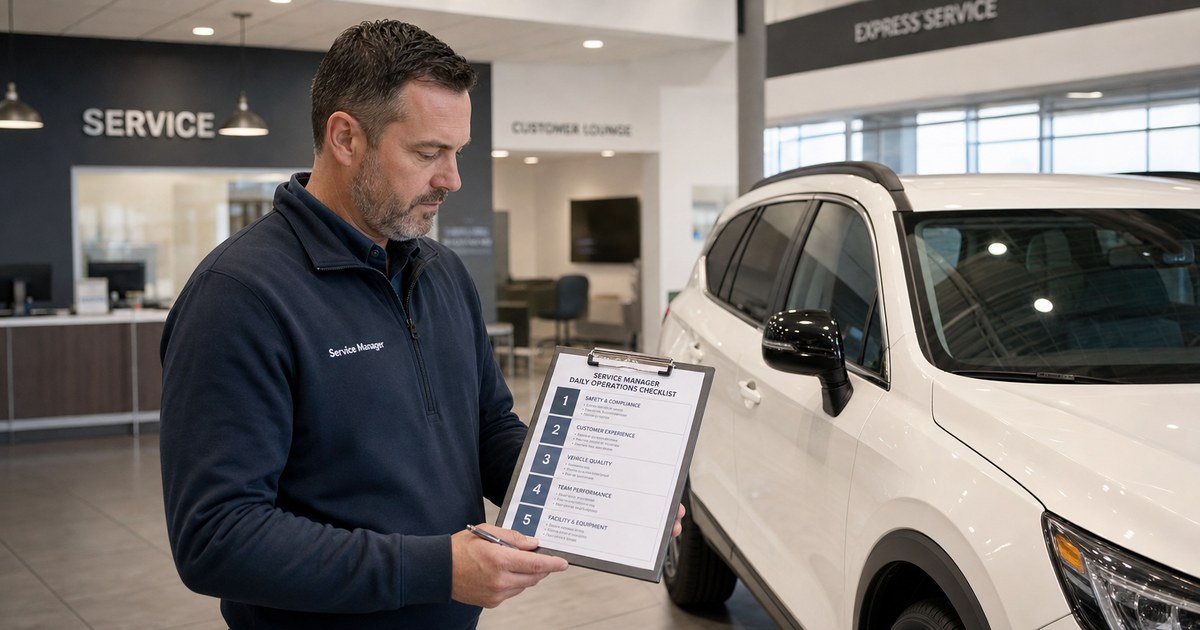
Define SOPs for automobile dealers, clear up what SOP means in the auto industry, and follow six steps that make SOPs stick, with or without SOP software.
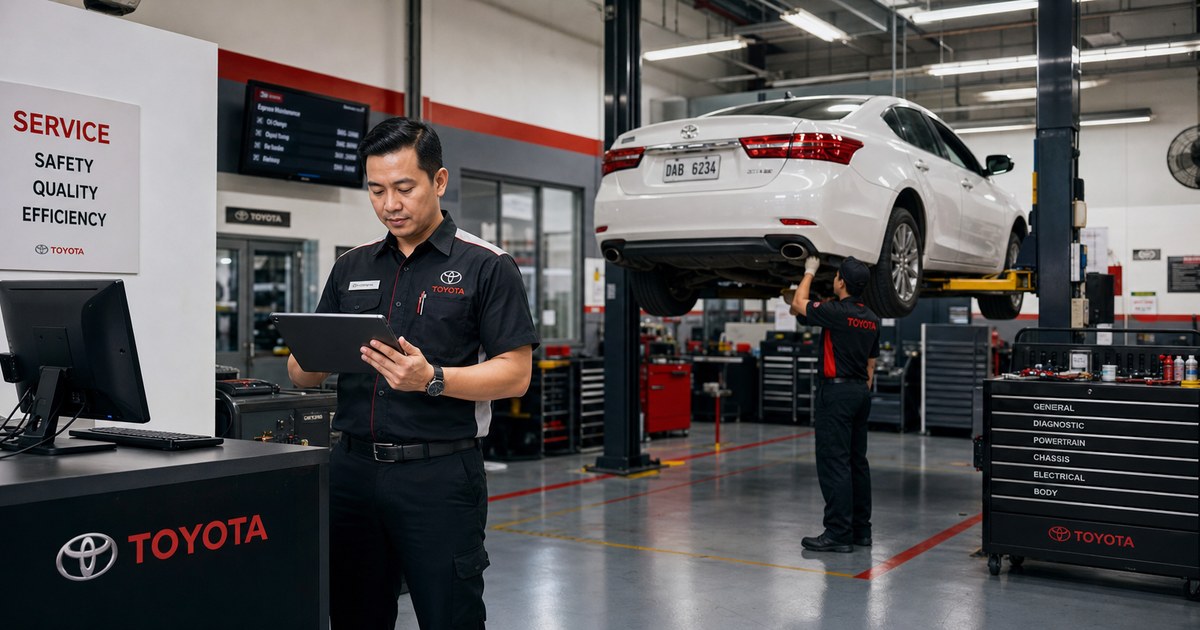
Toyota's digital service evaluation has no public program name. See how TSM, Kodawari and Image USA II differ and how a Toyota dealer audit works.
Request a quote and our experts will contact you within 24 hours with tailored solutions and pricing.
You can also send us a quick email at info@autosmarts.co.
Last updated: Oct 30, 2026
By Naseef Umar, Founder & CEO, AutoSmart. Naseef has over a decade of experience across automotive operations, dealer standards, network performance and audits.
A brand standards audit template is the structured checklist, scoring rubric and evidence rules a network uses to measure dealers against an OEM's published standards, and it needs a planned rebuild when those standards change. Revisions land hard: 53% of dealers agree brand compliance requirements are difficult to keep up with (Urban Science, 2026). Rebuild the template badly and last year's scores stop meaning anything. This guide shows how to layer the template, how Honda's quality requirements are organised, how to build a clause crosswalk, and how to dual-score one cycle. For wider context, see how OEMs structure dealer performance audits.
Key Takeaways
- A brand standards audit template survives an OEM revision when criteria are split into a comparable core, a new baseline and a retired archive, each with a stable ID.
- Honda's dealer requirements sit in separately administered layers, and G-HQS is a global quality standard for Honda facilities, not a dealer audit checklist.
- A requirement crosswalk labels every old clause as unchanged, reworded, split, merged, new or retired, so history can be restated.
- Dual-scoring one audit cycle on the old and new rubrics keeps year-on-year trend lines honest.
A brand standards audit template should be rebuilt in three layers: a comparable core of unchanged criteria, a new baseline for added or reworded requirements, and a retired archive. Each criterion keeps a stable ID, weight and version tag. That matters because 53% of dealers say brand compliance requirements are difficult to keep up with (Urban Science, 2026).
The table below covers every clause in a revised standard. A comparable core is the set of criteria whose intent has not changed between standard versions. It is the part of the template that carries your trend line.
| Layer | What goes in | Scoring rule | Year-on-year use |
|---|---|---|---|
| Comparable core | Criteria with unchanged intent | Same ID, same weight | Trend line continues unbroken |
| Reworded | Same intent, new wording | Map to the old ID, rescore | Comparable after restatement |
| New baseline | Requirements the OEM has added | Scored from the effective date | First year is the baseline |
| Retired archive | Requirements the OEM removed | Archived, never deleted | History kept, excluded from new totals |
OEM facility standards rarely stay still. In the Kerrigan OEM Survey 2026, 61% of OEM executives expect current facility standards to hold and 8% anticipate a decrease. Yet 31% project an increase in facility requirements over the next five years, up six percentage points from 25% in 2025 (CDG News, 2026). A further 43% said their organization will require a new image facility of dealers within five years (CDG News, 2026), so facility sections will keep changing.
Erin Kerrigan, managing director of Kerrigan Advisors, said of the roughly 150 respondents: "It's anonymous, but I'd venture to guess that virtually every non-Chinese OEM is represented." (CDG News, 2026). Build the template for repeated change, not a one-off patch. A purpose-built automotive network audit platform lets administrators edit checklists without a vendor ticket.
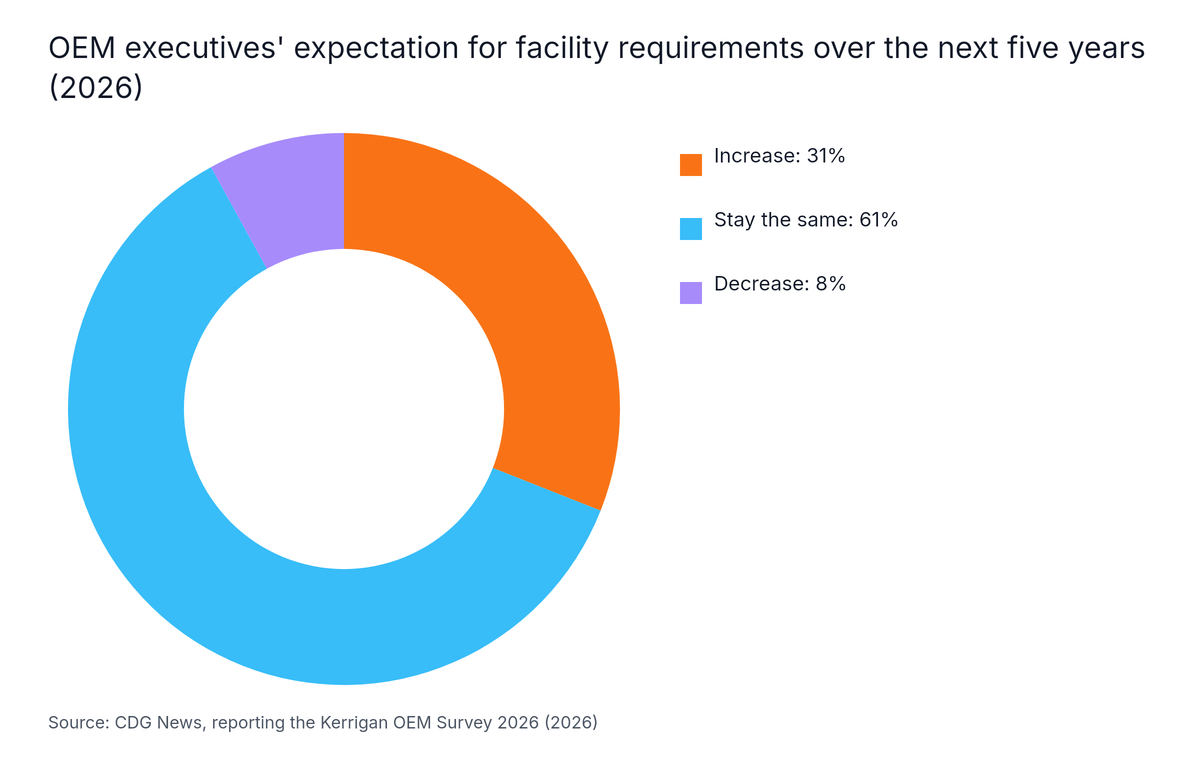
Source: CDG News, reporting the Kerrigan OEM Survey 2026, 2026
Honda's quality management system for dealers is not one document. It is a stack of separately administered layers: dealer agreement provisions, a facility image programme, customer satisfaction recognition, internet and certified programmes, vendor and tool programmes, and G-HQS, the global quality standard that governs Honda facilities and the quality cycle.
Honda's layer map below is a guide to verify, not a substitute for Honda's documents. Honda's dealer manuals are not public, so source the clause text from your own network's copy. The programme names come from trade and vendor overviews, and the "confirm in" column names the document type to check for each one.
| Layer | What it covers | Confirm in |
|---|---|---|
| Dealer agreement standard provisions | Premises satisfactory to Honda, effective sales and service | Signed Dealer Sales and Service Agreement and its standard provisions |
| Facility image programme | Store design, signage, reception and service layout | Facility image programme guidelines issued to your store |
| Customer satisfaction recognition | CSI and CSE/FFV recognition criteria | Annual recognition programme rules |
| Internet and process programmes | Internet sales process (AHIP) and annual updates | Current AHIP programme guide |
| Certified programmes | Collision and certified pre-owned | Collision and certified pre-owned programme requirements |
| Vendor and tool programmes | Snap-on-administered tool programme, i-HDS-approved diagnostic devices | Tool and equipment programme list from its administrator |
| G-HQS | Global quality cycle for Honda facilities | Honda sustainability report, current edition |
G-HQS is Honda's Global Honda Quality Standard, a global standard built on the Honda Quality Cycle. Honda's 2024 sustainability report describes sales and service feeding market-quality issues back through dealerships, with the Global Management Division setting goals and requirements (Honda, 2024). Check for a newer edition. Do not load G-HQS clauses into a dealer checklist as if they were dealer requirements.
Honda's dealer requirements differ by market and change every year. Honda UK confirmed a refreshed H logo from 2027, rolling out across the network including dealership locations (AM Online, 2026). Honda's powersports division released 2026 co-op guidelines on April 1 (Motorcycle & Powersports News, 2026). A June 2026 vendor overview shows Honda's requirements split across separately administered programmes (Vendormotive, 2026). Tag each template section with its programme and region. If your template also holds Dealer Operating Standards and 5S checks, keep Honda programmes as separate modules.
A requirement crosswalk is a clause-level map from every old standard ID to its new equivalent, labelled unchanged, reworded, split, merged, new or retired. Building it takes six steps, and it lets you restate historical scores against the new structure instead of discarding them.
Plan the work as a project, because audit programmes already run at a high cadence. 58% of organizations conducted 4 or more audits in 2025, per the A-LIGN benchmark as relayed by Secureframe (2025). That figure covers general compliance audits, not dealer audits, so verify it upstream. The point stands: a template change lands in a live programme.
| Relationship | Example | Scoring treatment |
|---|---|---|
| Unchanged | Same requirement, same wording | Carry the score forward |
| Reworded | Same intent, new phrasing | Rescore old evidence against the new wording |
| Split | One old clause becomes two | Score both, report the average against the old ID |
| Merged | Two old clauses become one | Report the new score against both old IDs |
| New | Requirement did not exist | Baseline year, no history |
| Retired | Requirement removed | Archive, exclude from new totals |
Spreadsheets handle this badly once several programmes run at once; see when spreadsheets break down in dealer audits.
Audit scores stay comparable year on year when every criterion keeps a stable ID and the first cycle on a revised standard is scored twice, once on the old rubric and once on the new. The overlap produces a restated history, so a dealer's trend line shows real movement rather than the effect of changed wording or weights.
Dual-scoring is scoring the same audit once on the old rubric and once on the new rubric for one cycle. The auditor visits once and records evidence once. Only the scoring runs twice.
Mid-cycle rule changes show why this matters. In a Hyundai sales incentive programme, documents reviewed by CDG News show the prior two months now carry 75% of the weight in setting targets, up from 50%, while the prior-year component dropped from 50% to 25% (CDG News, 2026). The same documents show per-vehicle bonuses at the 100% attainment threshold cut from $800 to $600, and the 110% tier cut from $1,000 to $800 (CDG News, 2026).
That is an incentive formula, not a quality audit, and the source is an anonymous dealer, so treat it as illustrative. The lesson holds: when weights move, last year's numbers no longer mean the same thing.
Use this routine:
Our data: AutoSmart's data shows audit cycle time reduced from 10 days to 3 days.
An audit calendar for a revised standard should tie each audit cycle to the OEM's effective date and to incentive documentation deadlines, with version tags and a change log governing every edit. Timing carries money: 72% of dealers say late compliance documentation can delay facility incentives (Urban Science, 2026).
Plan the dual-scored cycle before the first deadline, not after it. The same 2026 Harris Poll found 82% of dealers say their networks need a simpler way to manage brand contracts (Urban Science, 2026). Give dealers the crosswalk and the effective date early.
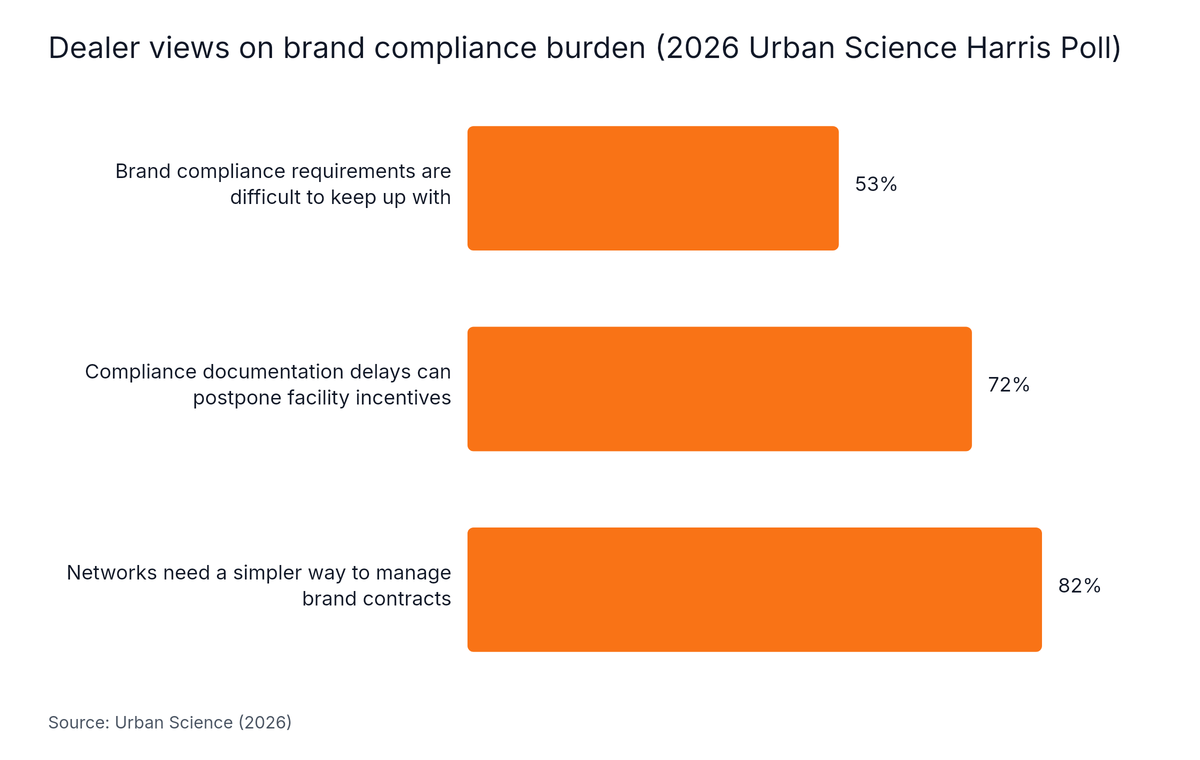
Source: Urban Science, 2026
Regulatory checks should sit apart from OEM standards so a revision does not disturb them. On March 13, 2026, the Federal Trade Commission sent warning letters to 97 auto dealership groups over total-price advertising, per vendor commentary from Ekho (2026). Verify the FTC letters against the FTC's own release. Give regulatory items their own module and version tag.
A brand standards audit template should be sanity-checked against customer outcomes such as J.D. Power's Customer Service Index (CSI). When overall satisfaction is 950 or higher, 86% of mass market customers say they "definitely will" return to the dealer for paid service, and 88% of premium customers say the same (CarPro, 2026, reporting the J.D. Power 2026 U.S. Customer Service Index). J.D. Power's Stewart Stropp points to KPI delivery: "more consistently deliver on top key performance indicators (KPIs) like keeping customers informed of service status" (CarPro, 2026). If a revised template moves scores but customer measures do not, look for rubric drift.
AutoSmart's data shows each audit generates 8 to 20 findings, and under a manual process each finding needs 4 to 5 follow-ups, including escalations, before closure. A revision adds new findings on top of that. See replacing the manual reporting cycle.
Auditing guidance is moving too. ISO 19011:2026 was published in May 2026 and, per one consultancy summary (2026), adds emphasis on remote and hybrid audits and risk-based programme design. Verify against the ISO page.
A crosswalk and dual-scoring approach to a brand standards audit template has limits. It assumes you hold the OEM's current standards document, it adds auditor effort for one cycle, and it cannot rescue comparability when an OEM changes the intent of a requirement rather than its wording.
No, G-HQS is not a dealer audit standard. Honda's own sustainability reporting describes the Global Honda Quality Standard as a global standard built on the Honda Quality Cycle, covering Honda facilities. Dealers feed market-quality information back, but dealer audit criteria sit in separate dealer agreement and programme documents.
Keep a stable ID for every criterion, build a clause-level crosswalk from old to new requirements, and score one full cycle on both the old and new rubrics. The overlap lets you restate prior-year results on the new structure, so trend lines reflect dealer performance rather than changed wording or weights.
Yes, run both for one audit cycle where the revision changes scoring or weights. Dual-scoring costs extra auditor effort once, but it gives each dealer a bridge score on both rubrics. Skip it only when the crosswalk shows every criterion as unchanged or newly added.
Honda and Acura dealers find current operating standards in their signed dealer agreement and their own dealer-portal copy. A 2026 Vendormotive overview lists the Honda iN portal as one programme channel, but Honda's dealer manuals are not public, so build your template from your network's copy and confirm regional variants.
A brand standards audit template for an automotive dealership includes criterion IDs, requirement text, weights, scoring scale, evidence rules, a version tag and a corrective-action field. Sections typically cover facility and brand identity, sales and service process, customer experience, and certified or tool programmes, with regulatory checks kept in separate modules.
An OEM revision is a planned event, not an emergency. Handle it with a repeatable method:
Next step: take your current template and the OEM's republished document and draft the crosswalk for one section this week. Then stress-test the result with demo scenarios in a live programme, or Schedule a Free Demo.
© 2026 AutoSmart Technology All rights reserved.