car dealership sales audit criteria effectivenessdealer performance scorecardsales audit criteria
Car Dealership Sales Audit Criteria Effectiveness: A Test
Test whether your car dealership sales audit criteria measure outcomes or just presence. A five-step diagnostic with tables, data and a scorecard hand-off.
Naseef UmarOct 29, 2026
Last updated: Oct 29, 2026
Car Dealership Sales Audit Criteria Effectiveness: A Test
Car dealership sales audit criteria effectiveness is the degree to which a scored audit line predicts better customer or sales results among the dealers who pass it, compared with dealers who fail it.
Picture a network whose audit comes back almost entirely green while customer satisfaction stays flat. The checklist is ticked. The customers are not moved. That gap usually means the criteria confirm that a step exists, not that it works. This post gives you a short diagnostic to find which criteria earn their place. You'll learn the three levels of criterion, a five-step pass-versus-fail test, and how survivors feed a scorecard. For the wider picture, see how OEMs structure dealer performance audits.
By Naseef Umar, Founder and CEO of AutoSmart, with over a decade of experience in automotive operations, dealer standards, network performance and audits.
Key Takeaways
A sales audit criterion is effective only if dealers who pass it get better customer or sales results than dealers who fail it.
Criteria sit at three levels: presence (it exists), quality (it was done well) and outcome (the customer got a result).
A five-step test, run on one evaluation cycle of data, shows which criteria to keep, rewrite or retire.
A dealer performance scorecard should carry criteria that pass the test, combined with outcome measures.
The test needs enough dealers to compare, and legal criteria stay on the checklist regardless.
How do you tell whether your sales audit criteria are actually measuring anything?
You can tell whether car dealership sales audit criteria measure anything by checking whether dealers who pass a criterion get better results than dealers who fail it. J.D. Power's 2025 study put industry satisfaction at 802 on a 1,000-point scale, up 1 point (CarPro, reporting J.D. Power, 2025). If pass and fail groups perform the same, the criterion confirms presence, not performance.
Pen tip resting beside a ticked checkbox grid on a printed audit sheet
Sales audit criterion is a single scored line in a dealer sales audit, such as "follow-up made on every internet lead." Discrimination is how well a criterion separates dealers who get good results from dealers who don't. A criterion with no discrimination is a tick, not a measure.
Three warning signs tell you a criterion probably has none:
Nearly everyone passes. If almost every dealer scores full marks, the criterion can't rank anyone.
Pass rate and results are unrelated. Dealers who pass perform no better than dealers who fail.
Paperwork can satisfy it. A document produced for audit day clears the line, whether or not the behaviour happens on the floor.
One sign is a prompt to look closer. Two or three means the criterion is a candidate for a rewrite.
What is the difference between presence, quality and outcome criteria?
Presence, quality and outcome are the three levels of a sales audit criterion. A presence criterion checks that something exists or was done, a quality criterion checks how well it was done, and an outcome criterion checks what the customer got. Among trade-in buyers, 28% said the value was less than expected (CarPro, reporting J.D. Power, 2025).
Three stacked cardboard tiles of increasing height on a bench representing three criterion levels
Presence criterion is a line that confirms a step exists or was completed. Quality criterion is a line that checks the step was done well, usually through observation or a mystery audit. Outcome criterion is a line that checks the customer or business result. The table shows one topic, trade-in handling, at all three levels.
Level
What it checks
Example criterion
Weakness or strength
Presence
The step exists or was done
"Appraisal sheet completed for every trade-in"
Easy to tick; says nothing about the buyer
Quality
The step was done well
"Mystery shopper received a clear explanation of how the trade-in value was set"
Observed behaviour; costs more to collect
Outcome
The customer result
"Trade-in buyers who say they understood how the value was set"
Closest to what the OEM wants; lags the behaviour
The rewrite matters. J.D. Power found satisfaction was notably higher when the dealer clearly justified the trade-in value. An appraisal sheet on file would not have caught that gap. A buyer who understood the number would.
Quality criteria need a method behind them. A mystery audit run alongside Dealer Operating Standards (DOS) is one way to collect them without extra paperwork.
Why can a sales audit pass sit beside flat customer satisfaction?
A sales audit can score green while customer satisfaction stays flat because presence criteria confirm activity, not results. J.D. Power's 2025 U.S. Sales Satisfaction Study put industry satisfaction at 802 on a 1,000-point scale, up just 1 point year over year (CarPro, reporting J.D. Power, 2025), despite extensive process standards across networks.
A steady green indicator lamp beside a flat gauge needle on a panel
Buyers are not short of good news. In Cox Automotive's 16th annual Car Buyer Journey Study, 76% of new-vehicle buyers were highly satisfied with the buying process, an all-time high (Cox Automotive, 2026). Lori Wittman of Cox Automotive said "buyers know exactly what they need: efficiency, transparency and tools that actually help them easily navigate their vehicle purchase" (Cox Automotive, 2026). Those are outcomes. A criterion that asks whether a process document exists doesn't test any of them.
What do mystery shops show about process steps?
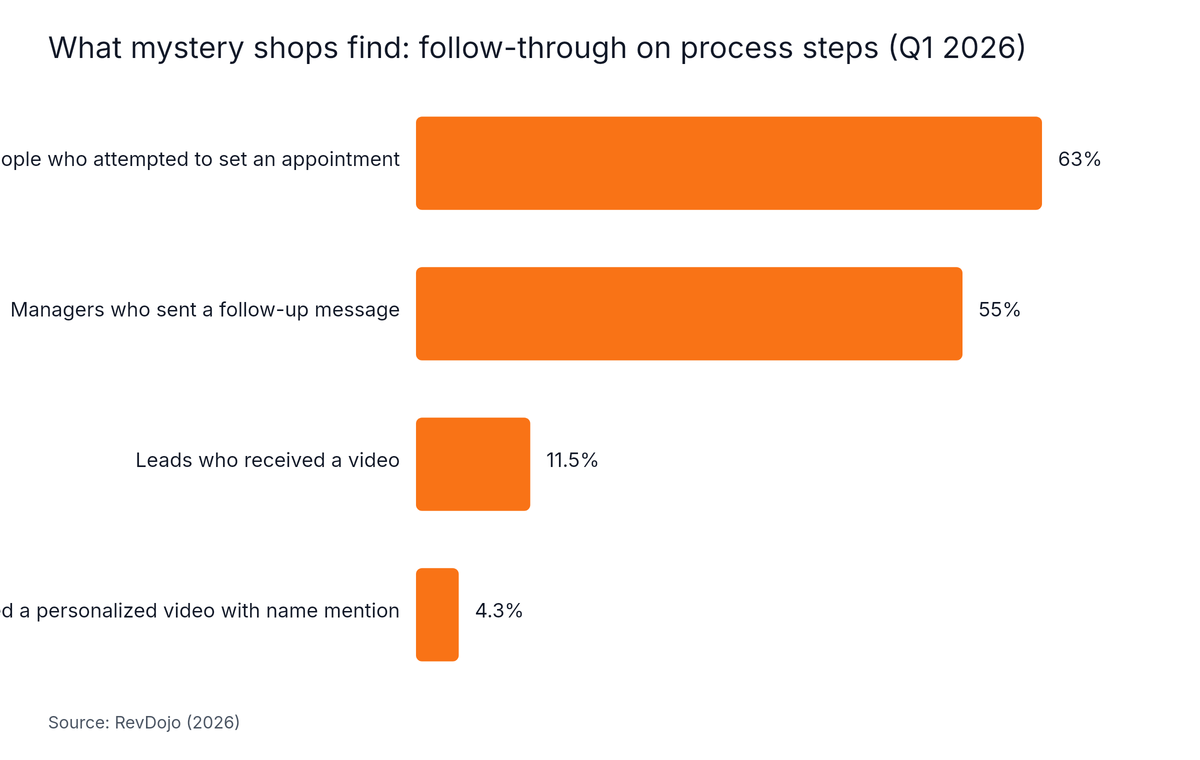
Q1 2026 mystery shops show uneven follow-through on steps that most process standards list. Only 55% of managers sent a follow-up message and 63% of salespeople attempted to set an appointment (RevDojo, 2026). RevDojo also found 11.5% of leads received a video and 4.3% received a personalized one with a name mention (RevDojo, 2026). This is vendor data with no visible shop count, so treat it as indicative.
Horizontal Bar chart: What mystery shops find: follow-through on process steps (Q1 2026). Highest: Salespeople who attempted to set an appointment at 63%.
The same gap shows up after the sale. In J.D. Power's 2025 data, 53% of the buyers who wanted a post-delivery follow-up never received one (CarPro, reporting J.D. Power, 2025). A standard can say "follow-up required" and a dealer can still pass it on paper.
How do you test whether a sales audit criterion works?
To test a sales audit criterion, pull its pass and fail results for one evaluation cycle, pair each dealer with an outcome measure, and compare the two groups. Keep the criterion when passing dealers outperform failing ones. Rewrite it when the groups look alike, and retire it when nearly every dealer passes.
Two sorted piles of paper forms on a desk, one pile taller than the other
The five-step test
Pick one criterion and one outcome. Choose a criterion you suspect is weak, and one outcome it should influence, such as Sales Satisfaction Index (SSI) factors, lead conversion or retention.
Pull one evaluation cycle of results. Use a single evaluation cycle so every dealer was scored on the same version of the standard.
Split dealers into pass and fail groups. If almost no one fails, stop here: the criterion has no spread.
Compare the outcome across the groups. Look at the average and the range for each group.
Check the evidence behind the pass. Compare audit evidence with CRM records and mystery-shop findings, to see whether the behaviour was real.
Here's an illustrative example, with no real figures. A criterion reads "lead follow-up process documented." Nearly every dealer passes, and passing dealers convert no better than the few that fail. The criterion is a presence tick. Rewrite it to "internet leads receive a personal follow-up, verified in the CRM," then re-test next cycle.
Gaming happens when a dealer satisfies the wording of a criterion without the behaviour behind it. An auto-responder can clear a lead-response standard. Documents can be prepared for audit day. Adi Patel, CEO of Clearline, put the risk plainly: "If follow-up depends on individual discipline, it will eventually break." (Clearline, 2026)
Detect it by cross-checking audit results against CRM records and mystery-shop data. Live photo capture with date, time and geotag on evidence also helps; field audit software can enforce it on site. A criterion is weaker still if a failed finding never gets fixed.
Our data: AutoSmart's data shows each audit generates 8-20 findings, and each finding requires 4-5 follow-ups including escalations before closure under the manual process.
When should you rewrite or retire a criterion?
Rewrite a criterion when passing and failing dealers get the same results. Retire it when almost every dealer passes with no spread, or when its pass rate bears no relation to outcomes across several evaluation cycles. Keep a short log of why each change was made, so dealers can see the standard is being tuned, not shifted without notice.
What is a dealer performance scorecard and how do audit criteria feed it?
A dealer performance scorecard is a single weighted view of how a dealer performs against the standards and results an OEM cares about. It combines audit scores with outcome measures such as customer satisfaction, which Cox Automotive found at 76% highly satisfied in 2026 (Cox Automotive). Criteria that pass the test earn a line on it.
A balance scale holding a small weight on one side and a larger weight on the other
Dealer performance scorecard is the network-level summary that lets a Dealer Standards Manager compare dealers on one scale. The audit tells you what a dealer did. The scorecard tells you whether it mattered. Treat them as two layers, not one list.
Scorecard input
Source
Level
Treatment
Validated sales-process criteria
Audit
Quality
Include, weighted by test results
Customer satisfaction and SSI factors
Survey data
Outcome
Include as the anchor measure
Presence-only checks (documents on file)
Audit
Presence
Keep on checklist, exclude from score
Mystery-shop results
Mystery audit
Quality
Include, and use to verify audit evidence
Weighting deserves a second look. Audits often give facility items heavy weight while buyers value the delivery process first. Check your weights against what customers say, not against what is easy to inspect.
Scoring only helps if it's consistent. Weighted auto-scoring applied identically across every auditor and site removes scoring disputes, and a drill-down dashboard saves the manual consolidation behind each management report. If you still run audits in spreadsheets, this guide to when they break down is a sensible next read.
When is this test not the right tool?
The pass-versus-fail test is not the right tool for networks with too few dealers to compare, or for criteria that exist for legal reasons. Pass and fail groups need enough dealers to show a real difference, and regulatory items must stay on the checklist whatever the outcome data says.
Three limits to keep in mind:
Small networks. With a handful of dealers, one outlier can swing a comparison. Use mystery-shop evidence and judgement instead.
Compliance criteria. The Federal Trade Commission (FTC) formally withdrew the CARS Rule on February 12, 2026, after it was vacated in January 2025, so pricing and add-on disclosure now rest on existing FTC and state authority (J. Feygin, Esq., 2026). Keep these items on the checklist.
Lagging outcomes. Satisfaction data arrives late. A pass-versus-fail result is a signal to investigate, not proof of cause.
Frequently Asked Questions
What is a dealer performance scorecard?
A dealer performance scorecard is a single weighted view of how a dealer performs against an OEM's standards and results. It combines audit scores with outcome measures such as customer satisfaction and sales conversion, so a network manager can compare dealers on one scale and see which need support.
How do you know if a dealer audit criterion is effective?
A dealer audit criterion is effective when dealers who pass it get better results than dealers who fail it. Compare pass and fail groups on a customer or sales outcome over one evaluation cycle. If the groups perform the same, or nearly everyone passes, the criterion is not separating good dealers from poor ones.
What is the difference between leading and lagging indicators in dealer standards?
A leading indicator in dealer standards is a behaviour you can measure before results arrive, such as follow-up on a lead. A lagging indicator is the result itself, such as customer satisfaction or sales conversion. Good criteria link the two: the behaviour should predict the result.
How can dealers game OEM standards, and how do you detect it?
Dealers can game OEM standards by producing proof for audit day, such as an auto-responder that satisfies a lead-response rule without improving results. Detect it by checking audit evidence against CRM records and mystery-shop findings, and by asking whether passing dealers actually get better customer outcomes.
Conclusion
A green audit is only worth something if it predicts a result. Run the test on your weakest criterion this cycle, then work through the rest.
Sort every criterion into presence, quality or outcome.
Compare pass and fail groups on one outcome measure.
Rewrite criteria where both groups perform the same.
Retire criteria that nearly every dealer passes.
Put the survivors on your dealer performance scorecard.
If your audits still live in spreadsheets, scoring and evidence are hard to compare across sites. Franchise compliance software shows what visibility across a large network looks like. To see how this works on your own standard, Schedule a Free Demo.
Written by
Naseef Umar
Founder | CEO
Naseef Umar is an automotive industry expert and the Founder & CEO of AutoSmart, with over a decade of experience working across automotive operations, dealer standards, network performance, audits, and digital transformation.
Company
KERALA Full Address - Pulikillam W Rd, Kakkanad West, Chembumukku, Edappally, Kochi, Kerala 682030; DUBAI Full Address - Dubai Silicon Oasis, UAE

 Naseef UmarOct 29, 2026