corrective action plan templatecorrective action plancorrective action plan example
Corrective Action Plan Template: Write One a Dealer Will Close
A corrective action plan template for dealer audits: the owner, PIC, evidence, date and verifier fields that close 8-20 findings without 4-5 follow-ups.
Naseef UmarNov 1, 2026
Last updated: Nov 1, 2026
Corrective Action Plan Template: Write One a Dealer Will Close
By Naseef Umar, Founder and CEO of AutoSmart, with over a decade in automotive operations, dealer standards, network performance and audits.
A corrective action plan template is a structured form that turns each audit finding into a named owner, a Person-In-Charge (PIC), a due date, required closure evidence and an independent verifier, so the finding closes without repeated chasing. Most templates list those fields but never show a good entry. A dozen findings leave every audit, and the audit team becomes the follow-up team. This guide shows what each field must say, sets a weak and a closeable entry side by side, and covers findings that arrive in batches. For the wider tooling picture, see our guide to operational audit management software.
Key Takeaways
A corrective action plan template should force eight fields per finding: reference, owner, Person-In-Charge (PIC), root cause, action, evidence, due date and verifier.
AutoSmart's data shows each audit generates 8 to 20 findings, and under a manual process each finding needs 4 to 5 follow-ups before closure.
In a corrective action plan, the owner is accountable, the PIC does the work and the verifier is someone else. Merging these roles is why closures bounce back.
Closure evidence must be defined before the work starts, with acceptance criteria a reviewer can check without calling the dealer.
Audit batches close faster when findings are triaged by severity, grouped by root cause and given staggered due dates.
Why do audit findings need 4 to 5 follow-ups before they close?
Audit findings need repeated follow-ups because most corrective action plans name a department rather than a person, define no closure evidence and set no independent check. AutoSmart's data shows each audit generates 8 to 20 findings, and under a manual process each finding needs 4 to 5 follow-ups, including escalations, before it closes.
A stack of audit finding cards on a desk, several tagged with coloured flags and a pile of follow-up notes beside them
Our data: AutoSmart's data shows each audit generates 8 to 20 findings. Tracked manually, the same finding may need 4 to 5 follow-ups, including escalations, before closure. Some action items are missed entirely, and others pass their deadlines before anyone resolves them.
The arithmetic is blunt. Eight findings at four follow-ups each is 32 touches per audit. Twenty findings at five follow-ups is 100. Every touch is an email, a spreadsheet update or a line in a meeting, and every one lands on the audit team.
Closure is never automatic
Even auditors with formal tracking see gaps. The U.S. Government Accountability Office (GAO) reported that 77 percent of its recommendations made five years earlier had been implemented (NASA Watch, quoting GAO, 2026). About a quarter were still open.
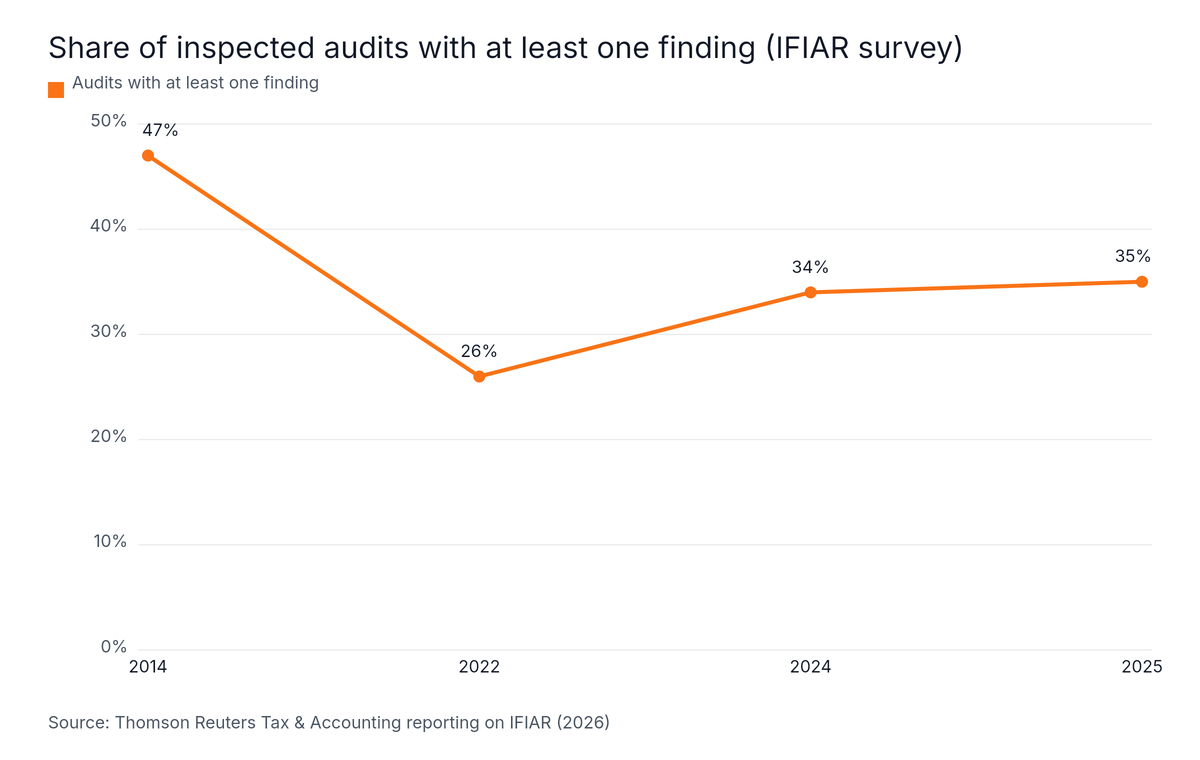
Findings also recur. The share of inspected audits with at least one finding was 35% in 2025, up from 34% in the 2024 survey (Thomson Reuters Tax & Accounting, reporting on IFIAR, 2026). That share had fallen from 47% in 2014 to 26% in 2022 before rising again (Thomson Reuters Tax & Accounting, reporting on IFIAR, 2026). The data covers financial audit regulators, not dealers, so read it as context: findings do not trend steadily downward on their own.
Line chart: Share of inspected audits with at least one finding (IFIAR survey). Highest: 2014 at 47%.
The nearest hard evidence on why corrective actions fail comes from drug and device regulation, not dealer networks. An analysis of 267 FDA warning letters issued between January 2025 and August 2026 found that FDA judged at least part of the earlier response inadequate in 224 of them, or 83.9% (RAPS, 2026).
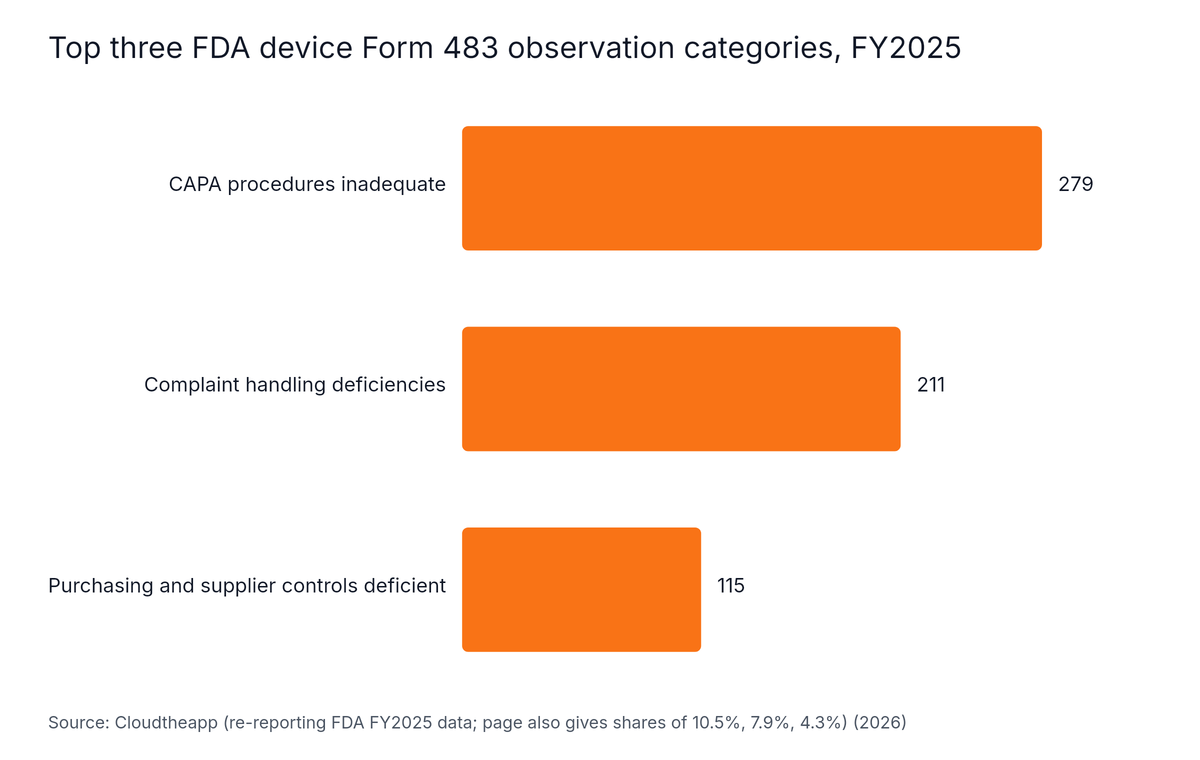
Weak corrective-action systems also top the citation lists. Inadequate CAPA procedures were the most-cited FDA device Form 483 observation in FY2025, at 279 observations or 10.5% of the total (Cloudtheapp, 2026). That is secondary reporting of FDA data, so check the FDA original before reusing the figure.
Horizontal Bar chart: Top three FDA device Form 483 observation categories, FY2025. Highest: CAPA procedures inadequate at 279.
One law firm summarises FDA's stated reason for new guidance as "many inadequate, poor quality, and incomplete 483 responses" (Alston & Bird, 2026). A dealer whose plan is submitted but never accepted is in the same loop. As one quality-software vendor puts it, "a closed CAPA is a status, not an outcome" (Clinplex, 2026).
What should a corrective action plan template capture?
A corrective action plan template should capture eight fields per finding: the finding reference, the accountable owner, the Person-In-Charge (PIC) doing the work, the root cause, the corrective action, closure evidence with acceptance criteria, a due date, and an independent verifier. Each field removes one reason a reviewer would otherwise go back to the dealer.
A printed corrective action form with labelled blank fields lying on a clipboard next to a pen
A corrective action plan (CAP) is a written commitment that turns an audit finding into specific fixes, stating what will change, who owns it, what evidence will prove it and by when. The owner is the single accountable person, usually the dealer principal or a department manager. The Person-In-Charge (PIC) is the named individual who does the work and submits the evidence. The verifier is someone other than the owner who accepts or rejects the closure.
Field
What it must say
Why it matters
Finding reference
The audit question or finding ID, linked to the audit record
Ties the action to one finding, not to a vague theme
Owner
One named person, never a department
Someone to hold to the date
PIC
The person doing the work, with acknowledgement
Separates accountability from execution
Root cause
Procurement, process, training or facility gap
Stops "retrain staff" being the answer to everything
Corrective action
A specific, measurable deliverable
Lets a reviewer judge completion
Closure evidence
Evidence type plus acceptance criteria, set upfront
Lets the reviewer close without asking again
Due date
A date, tiered by severity
Makes escalation automatic
Verifier
A named reviewer who is not the owner
Prevents self-certified closure
Regulators already push toward this level of structure. FDA's March 2026 draft guidance on Form 483 responses asks for a response that is "timely, comprehensive, and easy for FDA to evaluate" (Venable, 2026). Law firm Arnold & Porter notes a response "may include an executive summary table to organize remediation information" (Arnold & Porter, 2026). A one-row-per-finding table is the dealer equivalent.
What does a good corrective action plan example include?
A good corrective action plan example names one finding, one accountable owner, one Person-In-Charge (PIC), one specific action tied to the root cause, defined closure evidence, a dated deadline and a separate verifier. The test is simple: a reviewer at head office can accept or reject the closure from the entry alone, without phoning the dealer.
Two printed action entries side by side, one nearly blank and one fully completed with a stamp and signature
Here is one illustrative workshop finding written two ways. The details are an example, not data from a real audit.
Field
Weak entry
Closeable entry
Finding
Tools not maintained properly
Finding W-14: torque wrenches in bays 1 to 4 have no valid calibration certificate
Owner
Service department
Service Manager, named person
PIC
Workshop team
Workshop Supervisor, acknowledged before the due date is set
Root cause
Staff negligence
Process gap: no calibration schedule exists
Action
Remind staff to calibrate tools
Calibrate all four wrenches with an accredited provider and add a six-monthly schedule to the workshop calendar
Evidence
Proof of calibration
Dated certificates per tool serial number, plus a photo of the schedule on the workshop wall
Due date
ASAP
A fixed date, set at audit close
Verifier
Not stated
Regional Aftersales Manager, who is not the owner
The weak entry cannot be closed because nobody can say what done means. The closeable entry can be rejected on specific grounds, which is exactly what makes it closeable. Vague entries are costly in practice: FDA found at least part of the earlier response inadequate in 224 of 267 warning letters reviewed (RAPS, 2026).
Why a CAP needs both an owner and a PIC
Owner and PIC are different jobs. If the dealer principal owns the action but the workshop supervisor does the work, the principal answers for the date and the supervisor answers for the evidence. Collapse the two and either nobody is accountable or the person accountable never touches the task. Keeping both on the entry also shows who to chase first and who to escalate to.
What counts as acceptable evidence that a corrective action is closed?
Acceptable closure evidence is proof that a reviewer who was not on site can check against a stated criterion: a dated, location-tagged photo, a signed training roster with a competency check, a dated calibration certificate, an updated SOP with a version number, or a system report export. A note saying "done" is not evidence.
A mechanic photographing a calibration certificate beside a torque wrench on a workshop bench
Standard Operating Procedure (SOP) updates, certificates and photos all work, but only when the criterion is written before the work starts. Use a menu like this one when you build the template.
Finding type
Acceptable evidence
Acceptance criterion
Equipment gap
Dated calibration or installation certificate
Serial number matches the equipment on site; date is after the audit
Training gap
Signed roster plus a competency check result
Named staff listed; pass recorded, not just attendance
Process gap
Updated SOP with version number and sign-off
Version is newer than the audited one; staff briefing recorded
Housekeeping or safety gap
Photo captured live, with date, time and location
Taken after the audit date, at the audited site, showing the full fix
System or data gap
Report export or screenshot
Shows the corrected record with a visible date
Weak evidence is the dominant failure pattern in the regulatory data. The RAPS review tagged 671 rejected-response findings, grouped into 193 compliance themes, and rejections clustered around missing evidence, unverified fixes and missing training proof (RAPS, 2026). Retraining with no proof of competence is the dealer version of the same mistake. If evidence is collected on paper and chased later, a paperless auditing workflow keeps the photo attached to the finding it answers.
How do you handle 8 to 20 findings from one audit?
Handle a batch of 8 to 20 findings in three moves: triage by severity so safety items start first, group findings that share a root cause under one action, and stagger due dates by tier. Fewer, better-specified actions mean fewer of the repeated follow-ups each finding otherwise attracts.
Finding cards sorted into three labelled trays by urgency on a table
Triage, group and tier
Start by sorting. Safety-critical findings leave the standard queue and trigger immediate containment. Three findings that trace to one missing procedure become one action with three references, not three separate chases.
Tier
Typical content
Due-date logic
Immediate containment
Safety-critical gaps, such as lapsed certification or a faulty emergency stop
Before the visit ends or within days
Root-cause fix
Equipment, process or training changes
A fixed date, scaled to lead time
Effectiveness check
Confirming the fix still holds
At the next audit cycle
Fixed external clocks do exist elsewhere. FDA's draft guidance asks for one organized written response within 15 business days (Venable, 2026). Your network's window will differ, but the principle holds: one response, one deadline, no open-ended promise to get back later.
Build an escalation ladder before the due date
Decide the ladder in advance so nobody improvises it:
A reminder to the PIC ahead of the due date.
A reminder to the owner on the due date.
An overdue notice to the dealer principal, logged on the entry.
Escalation to regional management, with the overdue item visible in the standards review.
Items that touch safety can follow a faster version of this ladder, as covered in this guide to safety audit management software. Never let an overdue item roll forward silently. A silent rollover is how a finding becomes an unexplained repeat at the next visit.
Who is this corrective action plan approach not for?
A full eight-field corrective action plan is not for every finding. One-off observations, purely informational notes and small single-site audits can use a shorter form. The approach also cannot fix a missing standard, and its regulatory figures, such as 224 of 267 FDA warning letters citing inadequate earlier responses, come from regulators, not dealer networks.
Be honest about the limits:
No dealer benchmark exists. The research behind this guide found no verifiable public figures for dealer CAP closure, overdue or repeat-finding rates. The 8 to 20 findings and 4 to 5 follow-ups figures are the only dealer-network numbers used, and they are AutoSmart's own.
Regulatory data is an analogue. FDA, GAO and audit-regulator figures show how corrective actions fail under external review. For example, 35% of inspected audits in 2025 had at least one finding (Thomson Reuters Tax & Accounting, reporting on IFIAR, 2026), but that covers financial audits, not dealers.
Some figures are secondary. Cloudtheapp and NASA Watch re-report FDA and GAO data, so confirm originals before quoting them.
Proportion matters. A cosmetic finding does not need a root-cause study. Match the depth of the entry to the risk.
A template is not a workflow. Someone still has to enforce dates, escalate and verify, or the form becomes another file.
Frequently Asked Questions
What is a corrective action plan?
A corrective action plan (CAP) is a written commitment that turns an audit finding into specific fixes. It states what will change, who owns it, who does the work, what evidence will prove completion, and by when. A CAP is closed only after someone other than the owner verifies the evidence.
Who should own a corrective action: a person or a department?
A corrective action should be owned by one named person, never a department. A department cannot be chased, cannot confirm acceptance and cannot be held to a date. In a dealer network, the accountable owner is usually the dealer principal or a manager, and a separate Person-In-Charge (PIC) does the work.
When can a corrective action be closed?
A corrective action can be closed when its pre-agreed evidence has been submitted and a verifier who is not the owner has accepted it against stated criteria. Completion of the task is not enough. Confirming the fix still holds at the next audit cycle shows the closure was an outcome, not just a status.
What is the difference between a CAP and CAPA?
A corrective action plan (CAP) fixes problems an audit has already found. CAPA stands for corrective and preventive action, and it adds a second job: stopping the same problem from appearing elsewhere or returning later. Dealer audits usually use a CAP per finding, with preventive steps added when a finding repeats across sites or cycles.
Closing a corrective action plan without chasing
Corrective action plans close without chasing when each entry removes ambiguity before the dealer starts work: one owner, one Person-In-Charge (PIC), pre-agreed evidence, a fixed date and an independent verifier. AutoSmart's data shows manual tracking needs 4 to 5 follow-ups per finding across 8 to 20 findings per audit, so ambiguity costs the audit team dozens of touches.
Use these five points as your checklist:
Name one owner and one PIC for every finding.
Define the evidence and the acceptance criterion upfront.
Put a verifier on every entry, never the owner.
Triage and group the batch so 8 to 20 findings become fewer, clearer actions.
Agree the escalation ladder before the first due date.
If you want the tracking handled for you, AutoSmart Audit's Action Plan Tracker turns each non-compliance into an action with a PIC, due date and required closure evidence before it can be marked complete. To pressure-test any tool before buying, use these demo scenarios for dealer compliance audit software.
Schedule a Free Demo
Written by
Naseef Umar
Founder | CEO
Naseef Umar is an automotive industry expert and the Founder & CEO of AutoSmart, with over a decade of experience working across automotive operations, dealer standards, network performance, audits, and digital transformation.
Company
KERALA Full Address - Pulikillam W Rd, Kakkanad West, Chembumukku, Edappally, Kochi, Kerala 682030; DUBAI Full Address - Dubai Silicon Oasis, UAE

 Naseef UmarNov 1, 2026