Blog
Dealer Audit Software: A Buyer's Checklist for OEMs and Dealer Groups
Dealer audit software explained: what it replaces, how it differs from generic inspection apps, and eight tests to run in a demo before you buy.

Score customer experience in the same visit as the standards audit. A dealer network checklist, weighted scorecard and pre-opening gate for new dealers.
 Naseef UmarOct 21, 2026

Dealer audit software explained: what it replaces, how it differs from generic inspection apps, and eight tests to run in a demo before you buy.
Score a 3-bay workshop and a flagship showroom fairly on one retail audit checklist: format profiles, N/A arithmetic, weighting and guardrails.
A brand standards audit scores a dealer against OEM facility, process and customer experience rules. See who sets standards, what they cost and how audits run.
Request a quote and our experts will contact you within 24 hours with tailored solutions and pricing.
You can also send us a quick email at info@autosmarts.co.
Last updated: Oct 21, 2026
By Naseef Umar, Founder and CEO of AutoSmart. Naseef started his career as a field auditor and has over a decade of experience across automotive operations, dealer standards and network performance.
A customer experience audit checklist is a scored list of observable behaviours, from meet-and-greet to first-service booking, that an auditor checks during a dealer visit to measure what customers actually experience. Customer scores slip, and the network average rarely says where. Forrester's 2026 CX Index shows how averages mislead at brand level: 26% of brands gained significantly while 7% declined (Forrester, 2026). The worked example below shows the same arithmetic hiding one weak dealer. This guide covers what the checklist should ask, how to score it inside the same visit as a dealer performance audit, and what to check before a new dealer opens.
Key Takeaways
- A customer experience audit checklist should ask observable behaviours tied to survey items, so audit scores explain CSI and NPS movement.
- Network-level CSI hides a weak site because an average blends every rooftop, and sales and service, into one figure.
- One weighted CX section inside the Dealer Operating Standards (DOS) checklist gives one visit, one scorecard and one dealer visit report.
- A new dealer should pass a pre-opening go/no-go gate, then be audited again at 30, 60 and 90 days.
- A customer experience audit explains survey results but cannot replace them.
A customer experience audit checklist for a dealer visit should ask observable, evidence-backed questions across five journey stages: arrival, needs and product discussion, handover, service reception and follow-up. Each question maps to something customers later score in surveys. J.D. Power's 2026 U.S. CSI Study put dealer service satisfaction at 868, up 3 points (J.D. Power, 2026).

A customer experience audit is an on-site evaluation that scores observable customer-facing behaviours against a defined standard, with evidence for each finding. Most dealer checklists stop at facilities, signage and 5S. Those matter, but customers don't score the carpet. They score whether someone met them at the vehicle and explained the work.
| Journey stage | What the auditor observes | Evidence to capture |
|---|---|---|
| Arrival | Greeting at the door or vehicle within the brand's time standard; customer addressed by name | Timestamped note, photo of reception area |
| Needs and product | Needs questions asked before any product pitch; test drive offered per procedure | Auditor note, test drive log |
| Handover | Feature walkthrough completed; first-service booking raised before the customer leaves | Photo of handover bay, booking record |
| Service reception | Advisor explains work and cost; multi-point inspection (MPI) shared with photo or video | MPI record, advisor note |
| Follow-up | Post-delivery or post-service contact made within the standard | CRM contact log |
J.D. Power's read of its 2026 service study points the same way. Stewart Stropp, vice president of customer success, said:
"Another opportunity is to more consistently deliver on top key performance indicators (KPIs) like keeping customers informed of service status and explaining the work performed." (J.D. Power, via CarPro, 2026)
Those two behaviours are easy to observe. Put both on the checklist as yes/no items with a required photo or note, and capture the evidence live on site. A field audit platform with offline-first evidence capture keeps that workable in workshops with weak signal. See mobile audit software for dealer networks for what to expect.
Network-level CSI hides the site causing an NPS decline because an average blends every rooftop, and sales and service, into one number. A single weak site barely moves a network mean while its customers still leave. Forrester's 2026 CX Index shows the same averaging effect at brand level: 26% of brands gained significantly and 7% declined (Forrester, 2026).

The Forrester analysis covers brands across industries in the US and Canada, not dealers, so read it as an analogy: a stable average can sit on top of very different individual results. Net Promoter Score (NPS) measures willingness to recommend, calculated as the share of promoters minus the share of detractors. Leadership sees it fall and asks which sites are responsible. The network figure can't answer.
The table below is illustrative arithmetic, not measured data. It shows how little a failing site moves the headline.
| Group | Sites | Site score | Contribution |
|---|---|---|---|
| Healthy sites | 19 | 80 | 1,520 |
| Problem site | 1 | 40 | 40 |
| Network average | 20 | 78 | 1,560 / 20 |
A 40-point failure at one site shows up as a 2-point dip. Most dashboards would call that noise. Meanwhile the customers of that one site are the ones leaving, and the cost is real. Among owners of vehicles two years old or newer, the share who returned to the selling dealership for service fell to 54% in 2025, from 72% in 2023 (Cox Automotive, 2025).
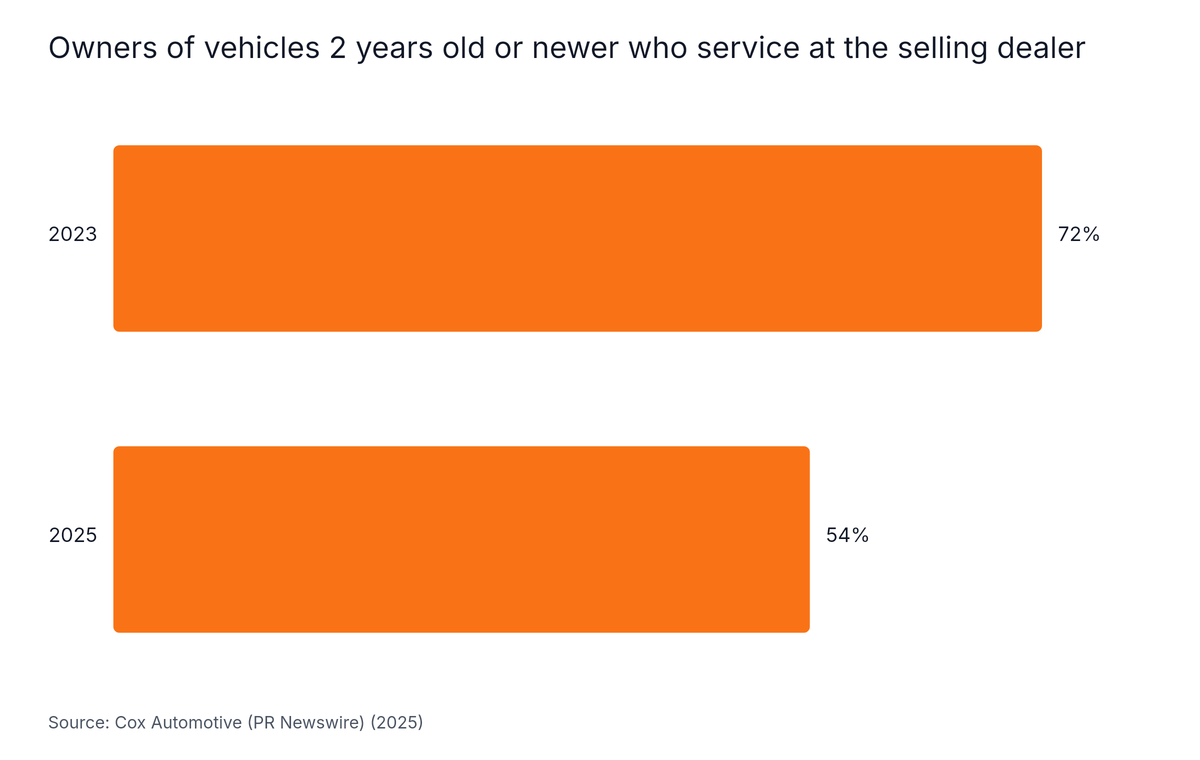
Source: Cox Automotive (PR Newswire), 2025
Cox Automotive's Skyler Chadwick described an "urgent need for dealerships to reassess their service strategies to recapture market share and enhance customer retention" (Cox Automotive, via PR Newswire, 2025). Retention also carries revenue. When overall satisfaction is 950 or higher, 86% of mass market and 88% of premium customers say they "definitely will" return to the dealer for paid service (J.D. Power, via CarPro, 2026).
Customer experience is evaluated across a dealer network by combining four lenses: customer surveys such as CSI and NPS, unannounced mystery audits, on-site standards audits and complaint data. Surveys capture what customers felt, audits show which behaviour caused it. In ACSI's 2026 study, the luxury-vehicle complaint rate rose 14% to 32% (ACSI via CarPro, 2026).

Satisfaction with complaint handling in the same ACSI study fell 4% to 73 (ACSI via CarPro, 2026). The study ran from July 2025 to June 2026 across 6,699 consumers. Complaint handling is a network capability, so it belongs on the audit.
| Method | What it measures | Blind spot | Best use |
|---|---|---|---|
| Customer survey (CSI, NPS) | How customers felt after a sale or visit | Small samples per site; no cause | Spotting which sites and months moved |
| Mystery audit | One unannounced customer-style visit | A single day's sample | Validating a survey signal |
| On-site standards audit | Observable behaviour and process against DOS | Announced visits can be staged | Finding the cause and assigning fixes |
| Complaint data | Failures customers escalated | Silent dissatisfaction | Checking recovery quality |
The dealer performance audit is the lens most OEMs already run on a fixed cycle, which is why it is the natural carrier for CX scoring.
The customer satisfaction index (CSI) is a score built from customer surveys after a purchase or service visit. Three versions circulate, and they are often mixed up.
| Version | Level | Scale | Use |
|---|---|---|---|
| OEM dealer CSI | Dealer | OEM-defined top-box survey score | Ranks dealers; often feeds bonuses |
| J.D. Power CSI Study | Brand | 1,000-point scale; 868 for dealer service in 2026 (J.D. Power, 2026) | Industry benchmark |
| ACSI | Brand | 0 to 100 | Cross-industry benchmark |
Benchmark your dealers against the OEM version. Use the other two for context only.
Folding customer experience scoring into the standards visit means adding one weighted CX section to the existing Dealer Operating Standards (DOS) checklist, completed by the same auditor with evidence captured once. One visit then produces one scorecard and one dealer visit report. AutoSmart's own data shows audit cycles compressed from 10 days to 3 days.

Dealer Operating Standards (DOS) are the OEM's defined requirements for how a dealership must operate, audited at each visit. Two audits double the travel, the dealer's disruption and the reporting. They also produce two scores that disagree.
The weights below are a suggested starting point, expressed as points out of 100. Adjust them to match your OEM standard.
| Scorecard section | Suggested points (of 100) | What it covers |
|---|---|---|
| Facility and 5S | 25 | Showroom, lounge, workshop, safety |
| Process compliance | 25 | Test drive, finance disclosure, trade appraisal, warranty |
| Sales journey behaviours | 20 | Greeting, needs analysis, handover walkthrough |
| Service journey behaviours | 20 | Advisor explanation, MPI sharing, status updates |
| Follow-up and complaints | 10 | Post-delivery contact, complaint recovery |
Keep 5S checks in their own section. The 5S audit guide for dealer networks covers how to score them consistently.
Our data: AutoSmart's own figures: audit cycle compression from 10 days to 3 days (the metric category, audit cycle or reporting turnaround, is not specified). Separately, AutoSmart estimates an average of $500 per physical visit, so every 100 visits represents about $50,000 in direct travel costs.
According to AutoSmart's customer pain-point research, each audit typically generates 8 to 20 findings, and manual follow-up can take 4 to 5 contacts per finding. A closed-loop Action Plan Tracker removes that chasing. Running DOS, 5S and mystery shopping in one platform keeps one scorecard instead of three.
A pre-opening onboarding checklist for a new dealer should work as a go/no-go gate covering seven checks: survey and CSI enrolment, process standards, system and response standards, staff certification, delivery-day first-service booking, a pre-opening mystery audit and final sign-off. Cox Automotive found a 50-point gap between stated intent to return for service and an actual first-service booking (Cox Automotive, 2026).

A go/no-go gate is a sign-off point where the dealer must meet defined criteria before trading under the brand. Generic franchise guides cover permits and insurance. This gate covers the customer side.
| Check | Pass condition | Evidence |
|---|---|---|
| Survey and CSI enrolment | Site registered in the OEM survey programme; sample process agreed | Enrolment confirmation |
| Process standards | Meet-and-greet, MPI sharing and handover walkthrough demonstrated | Observed role-play, photos |
| System and response standards | DMS and CRM configured; enquiry response time met in test | Test log |
| Staff certification | Advisors and sales staff certified on the standard | Training records |
| First-service booking | Booking raised at delivery as default step | Process walkthrough |
| Pre-opening mystery audit | Score at or above the OEM pass threshold | Mystery audit report |
| Sign-off | Auditor and dealer principal sign digitally | Signed dealer visit report |
The first-service check matters because service is where the dealer keeps the customer. Dealers' share of service visits has fallen to 29%, but among customers who do visit a dealer service lane, 89% consider returning, versus 20% of those servicing elsewhere who consider switching to a dealer (Cox Automotive, 2026).
| Visit | Focus | Escalate if |
|---|---|---|
| Day 30 | Process adherence on the full journey | Any critical item fails |
| Day 60 | Repeat failures and corrective-action closure | Actions open past due date |
| Day 90 | Full combined scorecard, compared with survey results | Audit score and CSI diverge |
The cadence is a recommended starting point. Hold it for every new site, and reuse the same checklist so the first 90 days are comparable. For the wider picture on keeping many sites on one standard, see franchise compliance software.
A combined dealer standards and customer experience scorecard is not suited to networks that need statistically reliable dealer-level CSI, or to teams expecting an audit to replace customer surveys. An audit samples one day at one site, so it explains survey results but cannot stand in for them. ACSI's 2026 study, by comparison, surveyed 6,699 consumers at brand level (ACSI via CarPro, 2026).
Be honest about four limits:
A customer experience audit is a structured on-site evaluation that scores observable behaviours, such as greeting, handover and service communication, against a defined standard, with photo or note evidence for each finding. It differs from a survey because the auditor sees what happened rather than what customers remember, and it can be scored identically at every site.
The customer satisfaction index (CSI) is a score built from post-purchase or post-service customer surveys, used by OEMs to rank dealers and by J.D. Power to rank brands. J.D. Power's 2026 U.S. CSI Study put dealer service satisfaction at 868, up 3 points (J.D. Power, 2026). ACSI uses a separate 0 to 100 scale.
CSI measures satisfaction with a specific purchase or service visit, usually on a survey scale, while Net Promoter Score (NPS) measures willingness to recommend, calculated as promoters minus detractors. Both are lagging indicators, so pair them with audit scores that show which dealer behaviour caused a movement.
Combine a customer experience audit with a dealer standards visit by adding one weighted CX section to the same checklist, scoring it with the same auditor, and issuing one dealer visit report with one set of corrective actions. Keep CX questions observable, so a different auditor would score them the same way.
A customer experience audit checklist earns its place when it explains the numbers leadership already sees. Keep these points:
Next step: test the combined scorecard on one live audit programme before rolling it out. The demo scenarios for dealer compliance audit software show what to stress-test. When you're ready, Schedule a Free Demo of AutoSmart Audit.
© 2026 AutoSmart Technology All rights reserved.