Dealer Audit Reporting System: What the Dealer Visit Report Must Contain
What a dealer audit reporting system should generate itself, what the dealer and head office each need, and one report format for every audit programme.
Dealer Audit Reporting System: What the Dealer Visit Report Must Contain
By Naseef Umar, Founder and CEO, AutoSmart
A dealer audit reporting system is software that turns field audit data into a finished dealer visit report, with scores, evidence, trend and action plans generated automatically, so auditors write only the judgement calls. Most teams still build that report by hand. Scores sit in Excel, photos get pasted into PowerPoint, and the deck reaches the dealer days after the visit. This guide sets out what the report must carry for the dealer and for head office, what should generate itself, and how to keep one format across every audit programme. For the wider reporting cycle, see operational audit management software.
Key Takeaways
A dealer audit reporting system should generate scores, pass/fail results, photo evidence, trend, repeat findings and the action-plan shell. The auditor writes the narrative, root cause and praise.
A dealer visit report works best as one template with two layers: a short action layer for the dealer and a comparable-data layer for head office.
One report format can cover sales, aftersales and brand audits through a shared skeleton plus programme-specific modules.
Sales audit findings should be checkable process steps, such as lead response, CRM logging and trade-in explanation.
Automation does not replace auditor calibration, evidence rules or a dealer's right of reply.
What should a dealer audit reporting system produce automatically?
A dealer audit reporting system should generate everything that is arithmetic or retrieval: weighted scores, pass/fail results, time-stamped photo evidence, trend against the last visit, repeat findings and an action-plan shell with owner and due date. AutoSmart's data shows some teams spend 3 to 4 hours after each audit assembling these by hand. The auditor writes only the narrative, root cause and praise.
The test is simple. If a task needs no opinion, a person should not be doing it. If it needs an opinion, the system should leave space for it and stay out of the way.
Report element
Generates itself?
Why
Section and overall score
Yes
Weighted scoring is a method where each question carries a set weight, so identical answers always give an identical score.
Pass/fail by question
Yes
Captured at the time of the visit, with no re-keying.
Photo evidence with date, time and location
Yes
Attached to the question or finding it supports.
Trend against the last evaluation cycle
Yes
Pulled from stored cycle data. An evaluation cycle is one scheduled round of audits against the same standard.
Repeat findings
Yes
Matched against earlier failures on the same question.
Action-plan shell (owner, due date, status)
Yes
Every non-compliance becomes an action item. A Person-In-Charge (PIC) is the named owner responsible for closing it.
Narrative summary
Auditor writes
Needs context only the auditor saw.
Root cause
Auditor writes
A judgement, not a data point.
Praise and best practice
Auditor writes
Recognition lands only when it is specific.
Why the last row matters
Reports that list only failures read as a charge sheet. A short, specific note on what the dealer did well gives the dealer a reason to engage with the rest.
What to expect from a working system
The formal report should exist at the end of the visit, with digital sign-off by both the auditor and the dealer. That removes the gap between visit and delivery, and it gives both sides a time-stamped record of what was assessed and acknowledged. For the mobile side of this workflow, see field audit software for dealer networks.
What should a sales audit report tell a dealer?
A sales audit report should tell a dealer what to fix, in what order, by when, and what went well. For sales, that means findings on checkable process steps, such as lead response, CRM logging and trade-in explanation, each with a score and evidence. J.D. Power's 2025 study scored deal-making satisfaction at 800 when trade-in value was justified and 672 when it wasn't.
That gap applies to buyers whose trade-in offer fell below expectations (CarPro, reporting J.D. Power, 2025). One process step can swing a satisfaction score, which is why a mystery-shop or audit finding on "justified the trade-in value" belongs in the report.
Sales findings worth quantifying
Lead handling is the clearest example of a process-compliance finding. These benchmarks give a dealer context for its own result:
Sales finding
Benchmark
Source and period
Qualified leads mishandled (not logged, delayed or skipped)
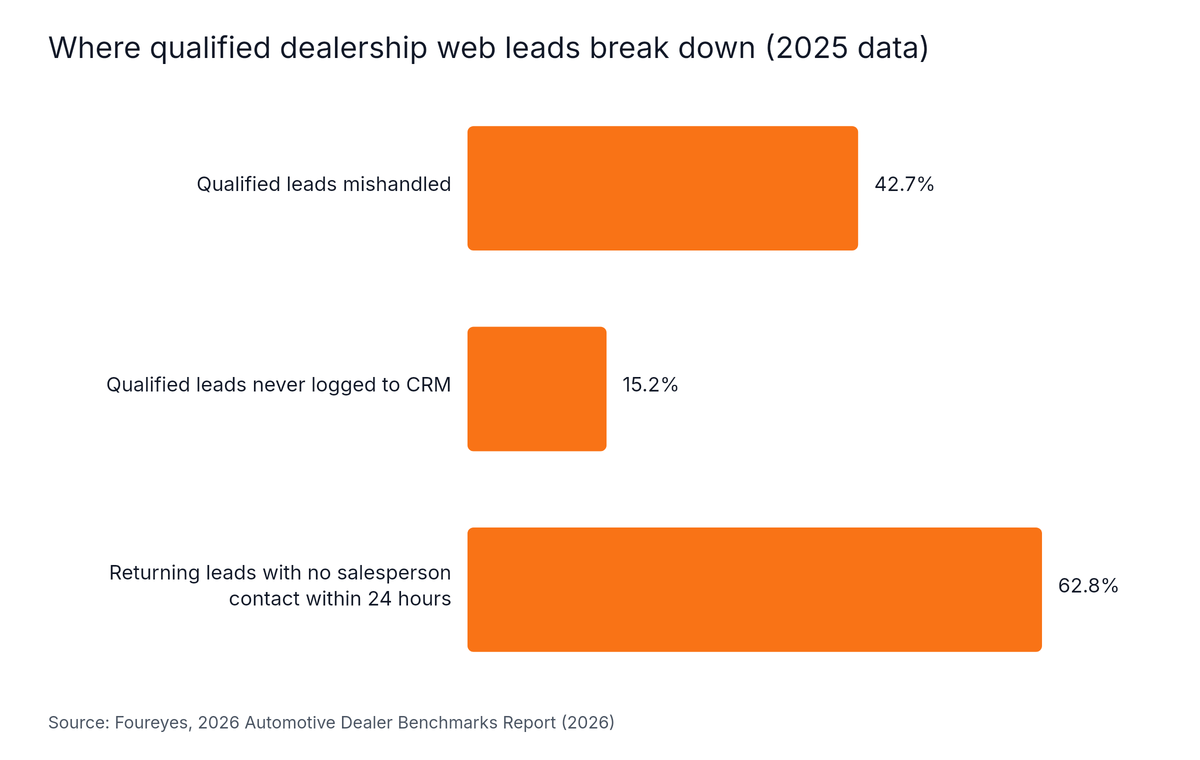
Horizontal Bar chart: Where qualified dealership web leads break down (2025 data). Highest: Returning leads with no salesperson contact within 24 hours at 62.8%.
Foureyes found 42.7% of qualified leads mishandled and 15.2% never logged to the CRM in 2025, across more than 22,900 dealer websites (2026 report). It also found 62.8% of returning leads heard nothing from a salesperson within 24 hours. Foureyes is vendor research, and a "qualified lead" there means a prior form, chat or call. DAS Technology reported that 61% of dealerships replied to a web lead within 15 minutes, while 19% took more than an hour (2025).
How a sales finding should read
Each finding should answer four questions: what was checked, what was found, what evidence supports it, and what the dealer should do next. Illustrative example: "Lead response: 3 of 10 test enquiries answered inside 15 minutes, call logs attached, owner: sales manager, due in 14 days" is usable. "Lead handling needs improvement" is not.
What should one report format across every audit programme contain?
One report format across every audit programme should have a shared skeleton: a common header, scoring scale, finding structure, evidence rules, action-plan block and follow-up record, plus programme-specific modules for sales, aftersales, brand standards, 5S or safety. The dealer reads a top-priorities layer, while head office reads comparable scores, trend and repeat failures from the same data.
The shared skeleton
Header: dealer, site, date, auditor, programme, and the version of the Dealer Operating Standards (DOS) used.
Score: overall and by section, on one scale for every programme.
Findings: each with question, result, evidence, severity and the clause of the standard it relates to.
Evidence rules: live capture, date and time stamp, location.
Action-plan block: owner, due date, status and the closure evidence required.
Follow-up: change since the last visit, repeat failures and the next scheduled evaluation cycle.
Sign-off: auditor and dealer, with space for the dealer's response.
A repeat finding is a question a site has failed in more than one evaluation cycle. Flagging it in the follow-up block tells head office where an action plan never worked.
Programme-specific modules then sit on top: lead response for sales, workshop process for aftersales, signage and facility for brand identity. Because the skeleton never changes, head office can compare a sales audit and an aftersales audit without translating between formats. The same logic applies to running Dealer Operating Standards, 5S and mystery shopping in one platform.
Why the version of the standard belongs on the report
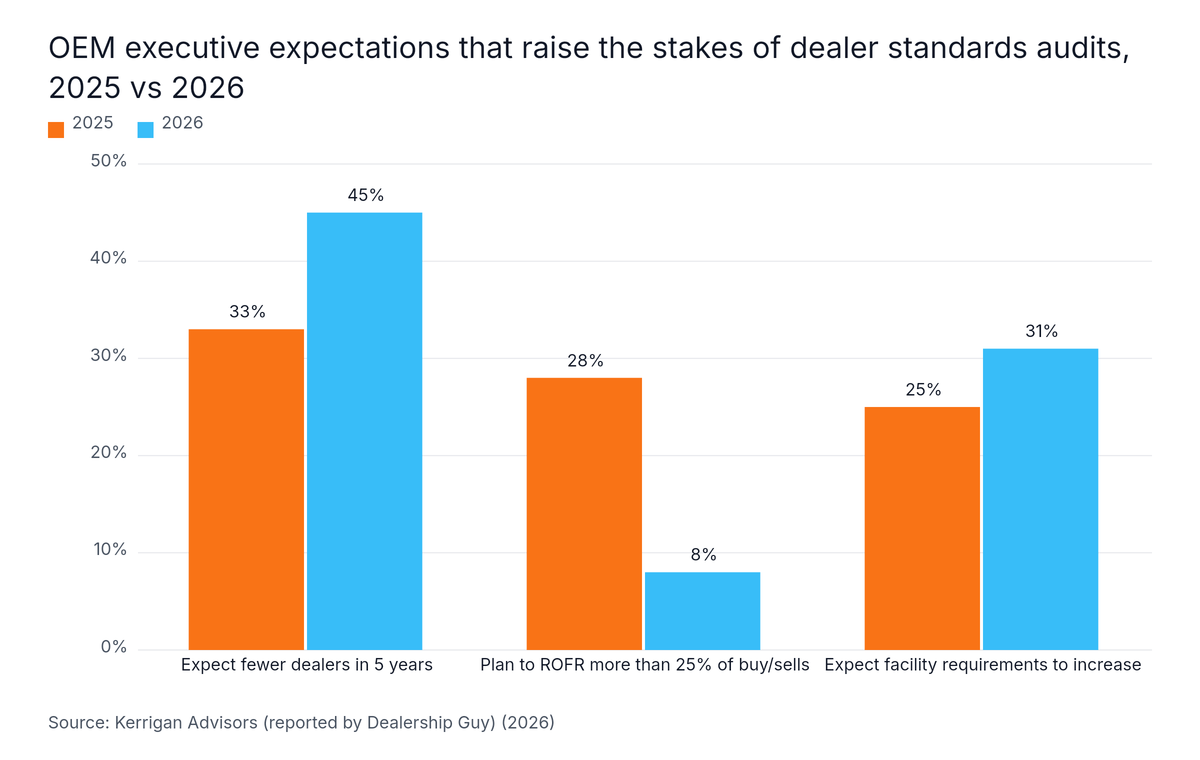
Standards are moving. In the 2026 Kerrigan OEM survey, 31% of Original Equipment Manufacturer (OEM) executives expected facility requirements to increase over five years (Kerrigan Advisors, via Dealership Guy, 2026), up from 25% in 2025 (Kerrigan Advisors, via Dealership Guy, 2025 comparison). Another 43% said their organisation would require a new image facility within five years, and 45% expected fewer dealers, up from 33% in 2025 (Kerrigan Advisors, via Dealership Guy, 2026).
Grouped Bar chart: OEM executive expectations that raise the stakes of dealer standards audits, 2025 vs 2026. Highest: Expect fewer dealers in 5 years at 33%.
Dealers will be scored against a standard that changes, and with fewer dealers expected, scores carry more weight. A report that does not state the version used invites disputes. Regulation is shifting too. Of its review of the motor vehicle block exemption, European Commission Executive Vice-President Teresa Ribera said: "With this evaluation, we want to make sure that our antitrust framework keeps pace with the rapid changes in the motor vehicle market" (Plesner, 2025).
Who reads the dealer visit report, and what does each reader need?
A dealer visit report is the formal record of what an auditor assessed at a site, scored and agreed with the dealer. It has two readers. The dealer principal needs the top three priorities, evidence, an owner and a date. Head office needs comparable scores, trend, repeat failures and network ranking. One template with two layers serves both.
Reader
Needs
Should not have to wade through
Dealer principal or sales manager
Top three priorities, what went well, evidence, owner and date
Network rankings, full question-level data
Department manager
Findings for their function, closure evidence required
A dealer scorecard is a one-page summary of scores and trend by section. It is a useful cover sheet for the head-office layer, but it is not the report: the visit report adds the findings, evidence and actions behind each score.
Why the dealer layer must be short
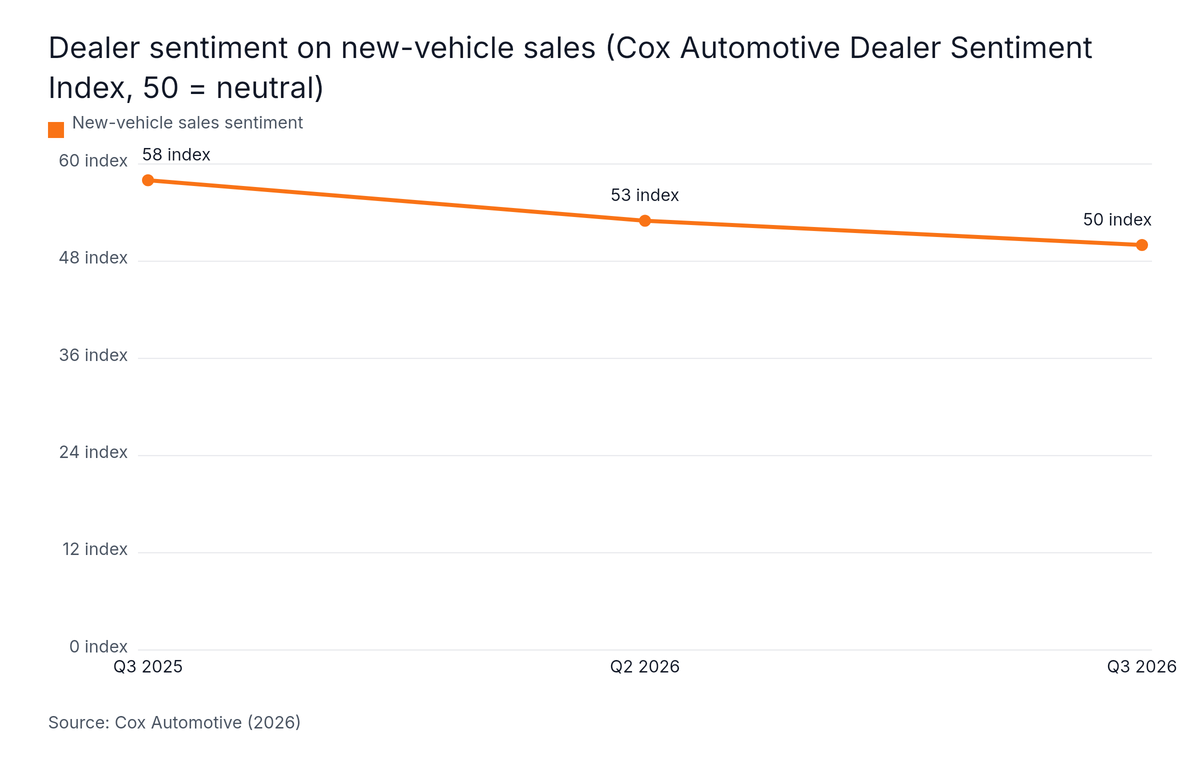
Dealers are under pressure. Cox Automotive's Q3 2026 index put new-vehicle sales sentiment at 50, the neutral threshold, down from 53 in Q2 and 58 a year earlier (Cox Automotive, 2026). Cox deputy chief economist Mark Strand said: "Dealers are seeing a market that remains resilient but increasingly difficult for consumers to navigate" (WardsAuto, 2026).
Line chart: Dealer sentiment on new-vehicle sales (Cox Automotive Dealer Sentiment Index, 50 = neutral). Highest: Q3 2025 at 58 index.
A report that adds admin burden will be resented. Put the action layer first, keep it to one screen, and let the detail sit behind it for those who want it. For head office, the same data should feed a drill-down view from network to region to dealer to individual finding, as covered in dealer performance audits and OEM standards.
How much time does manual dealer visit reporting cost?
Manual dealer visit reporting costs some audit teams 3 to 4 hours after each audit, AutoSmart's data shows, spent on Excel calculations, sign-off sheets, PowerPoint reports and photo evidence. No independent study quantifies this, so teams should time their own reports before judging what a reporting system needs to save.
Our data: AutoSmart's data shows that for some dealerships, teams spend 3 to 4 hours after each audit preparing and consolidating Excel calculations, sign-off sheets, PowerPoint reports and photo evidence. Separately, AutoSmart's data shows audit cycle compression from 10 days to 3 days.
The cost does not stop at the report. Each audit typically generates 8 to 20 findings, and under a manual process a single finding can need 4 to 5 follow-ups, including escalations, before closure. Management teams also spend several hours per reporting cycle consolidating data across dealers, regions and audit frequencies. Where a team runs 17 to 18 audit programmes at daily, weekly, monthly, quarterly and yearly frequencies, that load repeats constantly.
Delay costs more when dealers are stretched. With new-vehicle sales sentiment at 50 in Q3 2026 (Cox Automotive, 2026), a report that arrives late is competing with everything else on a dealer principal's desk.
How to measure your own baseline
Time five recent reports from end of visit to delivery to the dealer.
Split the time into assembly (scores, photos, charts) and judgement (narrative, root cause).
Count the days between visit and the dealer receiving the report.
Record how many findings had an owner and date at the time of delivery.
The assembly share is what a reporting system should remove. For teams still on spreadsheets, when spreadsheets break down covers the point at which the manual approach stops scaling.
Who is a dealer audit reporting system not for?
A dealer audit reporting system will not fix a weak standard, uncalibrated auditors or a network where dealers have no right of reply. Scoring stakes are rising, with 45% of OEM executives expecting fewer dealers in five years (Kerrigan Advisors, via Dealership Guy, 2026), so disputed scores cost more. Teams running only a handful of audits a year may find a well-built template is enough.
Be honest about these limits before you buy:
Weak standards stay weak. If a question can be read two ways, software will score both readings consistently wrong.
Calibration still matters. Auditors need a shared evidence standard, and it helps to review a sample of scored visits together.
Right of reply. Dealers should be able to sign, comment or challenge before a report is final. That is the best defence against score disputes.
Adoption in the field. If the tool is slow or fails without a signal, auditors will keep a parallel record. Offline capability should be tested on real sites, as in mobile audit software for dealer networks.
Low volume. A small network with few audits gains less from automation.
Frequently Asked Questions
What should a dealer visit report include?
A dealer visit report should include a header with site, date, auditor and the version of the standard used, an overall and section score, findings with photo evidence, comparison with the last visit, repeat failures, an action plan with owner and due date, positive findings, and sign-off by both auditor and dealer.
Can one audit report template work for sales, aftersales and brand-identity audits?
One audit report template can work for sales, aftersales and brand-identity audits if it uses a shared skeleton and programme-specific modules. The header, scoring scale, finding structure, evidence rules and action-plan block stay identical, while each programme adds its own question set and weightings.
What parts of a dealer audit report can be automated?
Scores, pass/fail results, time-stamped photo evidence, trend against the previous visit, repeat findings and the action-plan shell with owner and due date can all be automated. The narrative, root cause and recognition of good practice should stay with the auditor, because they need human judgement.
How soon after the visit should the dealer visit report reach the dealer?
A dealer visit report should reach the dealer as soon as the visit ends, ideally in the room. A report that arrives days later loses the conversation and delays corrective action. When the report is generated from data captured during the visit, no assembly step is left to cause delay.
How do you stop dealers disputing audit scores?
Dealers dispute audit scores less often when weighting is configured once and applied identically to every auditor and site, each finding carries time-stamped evidence, and the dealer can sign or respond before the report is final. Auditor calibration against the same evidence standard also matters.
Conclusion
The hours-in-PowerPoint problem is an assembly problem, not a judgement problem. Fix it by letting the system build what needs no opinion and keeping the auditor's time for what does.
Generate scores, evidence, trend, repeat findings and the action-plan shell automatically.
Write the narrative, root cause and praise by hand.
Use one skeleton for every programme, with modules for sales, aftersales and brand audits.
Build two layers into one report: a short action layer for the dealer and a comparable-data layer for head office.
Time your own baseline first, then test any system against it.
To see how a dealer visit report generates at the end of a visit, run a pilot on one of your existing audit programmes. Schedule a Free Demo with AutoSmart Audit, or compare options in demo scenarios to stress-test dealer compliance audit software.
Written by
Naseef Umar
Founder | CEO
Naseef Umar is an automotive industry expert and the Founder & CEO of AutoSmart, with over a decade of experience working across automotive operations, dealer standards, network performance, audits, and digital transformation.
Company
KERALA Full Address - Pulikillam W Rd, Kakkanad West, Chembumukku, Edappally, Kochi, Kerala 682030; DUBAI Full Address - Dubai Silicon Oasis, UAE

 Naseef UmarNov 1, 2026