Blog
Mobile Audit Software for Dealer Networks: Offline-First Evidence Capture and Sync
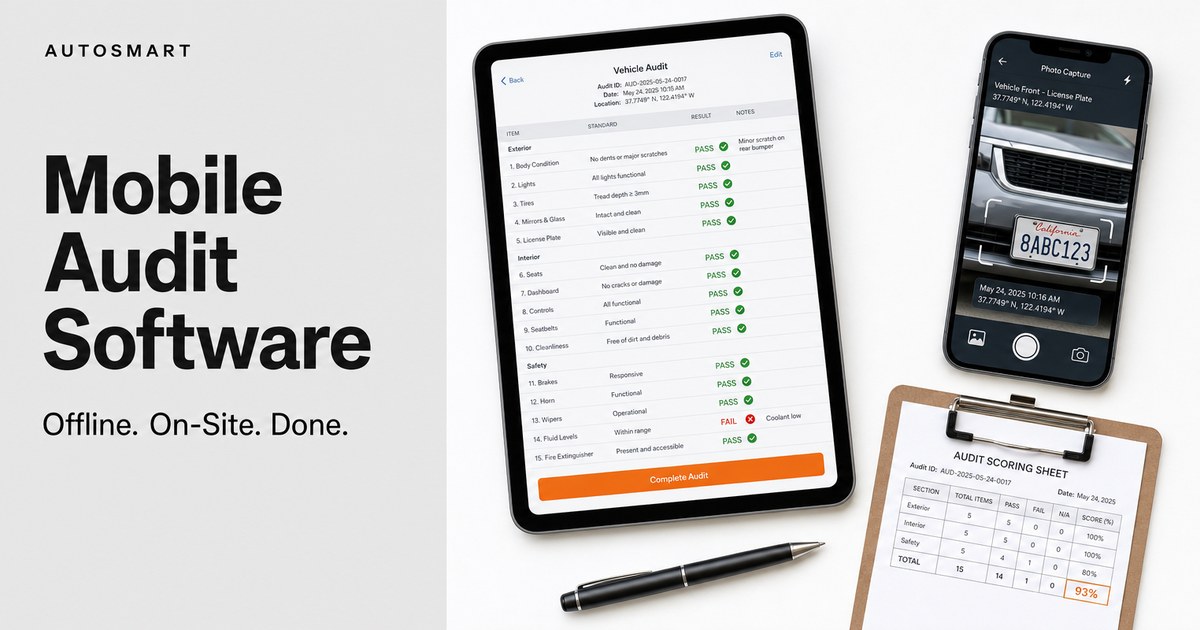
Cut 3-4 hours of post-audit consolidation with offline-first mobile audit software. Evidence capture, auto-scoring, and sync before you leave the car park.

What dealer performance audits measure, how OEMs structure CI, DOS and BRI audits across a network, and how scores feed into corrective action and franchise consequences.
 Naseef UmarOct 13, 2026
Cut 3-4 hours of post-audit consolidation with offline-first mobile audit software. Evidence capture, auto-scoring, and sync before you leave the car park.
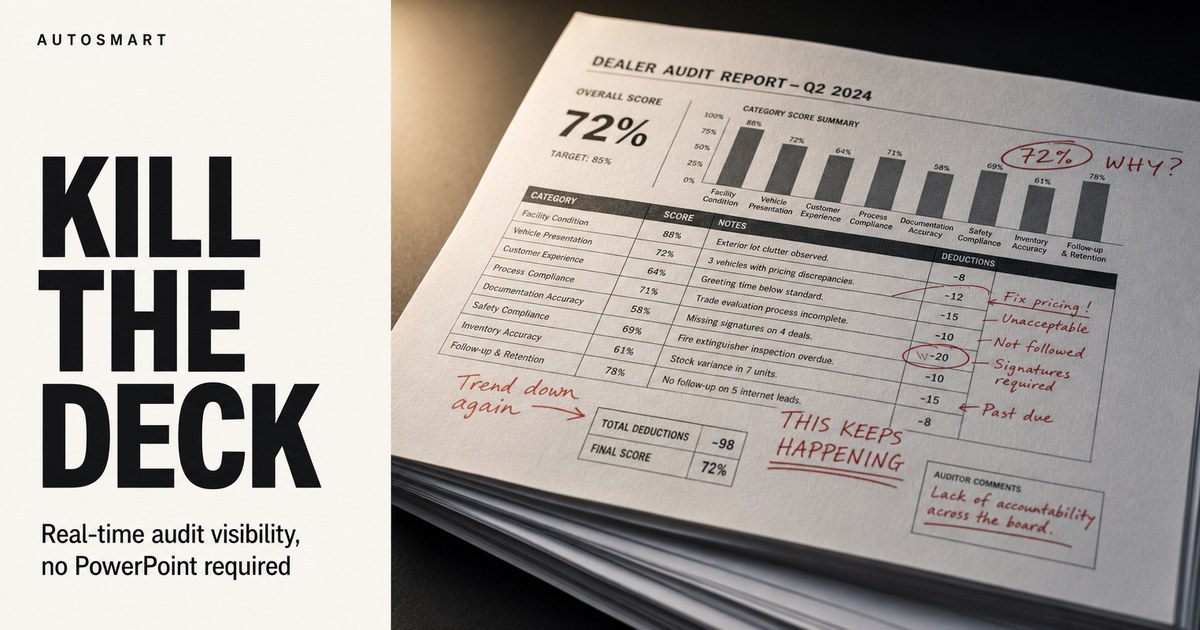
Operational audit management software replaces hand-built PowerPoint decks and emailed reports - giving network operations heads real-time visibility the moment an audit closes.
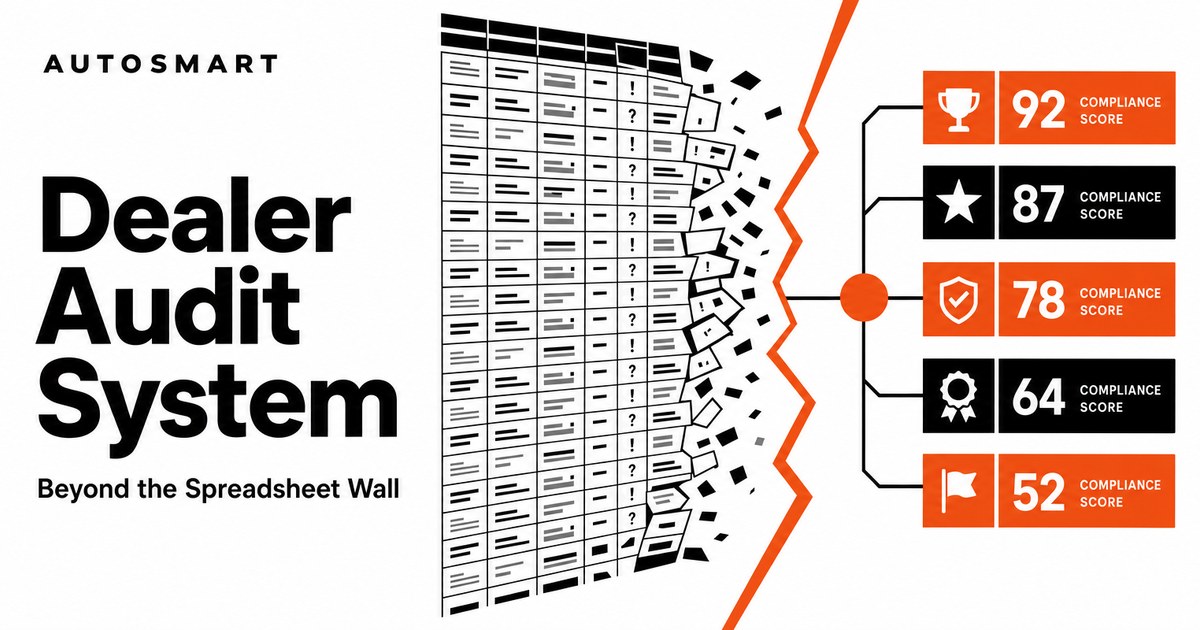
Networks hit the spreadsheet wall at 50-100 sites. Five functional tests separate genuine dealer audit software from a checklist builder dressed up as one.
Request a quote and our experts will contact you within 24 hours with tailored solutions and pricing.
You can also send us a quick email at info@autosmarts.co.
AutoSmart Technology
Last updated: Oct 13, 2026
By Naseef Umar, Founder & CEO, AutoSmart
Dealer performance audits are structured, scored evaluations of every franchised dealership against an Original Equipment Manufacturer's (OEM's) documented standards, covering facilities, processes, customer experience and financial controls, with results feeding directly into franchise decisions and dealer development investment.
The stakes are measurable. Dealer service retention for vehicles under two years old dropped from 72% in 2023 to 54% in 2025, per Cox Automotive's 2025 Service Industry Study. That 18-point collapse followed a predictable pattern: process standards drift, corrective actions go untracked, and audit cycles produce reports nobody acted on.
This article maps what each audit type covers, how OEMs layer them across a regional or multi-country network, and how scores translate into dealer development plans and contract consequences.
Key Takeaways
- Dealer performance audits divide into three canonical types: Corporate Identity (CI), Dealer Operating Standards (DOS) and Business Readiness and Integrity (BRI). Each measures the same network against a different domain of the same branded standard.
- Most OEM networks layer audits at three frequencies: annual comprehensive audit, quarterly regional review and monthly dealer self-assessment, each feeding scores upward into a consolidated management view.
- Audit scores feed directly into dealer development: low scores trigger corrective-action plans; strong scores unlock co-op funding, capex support and certification eligibility.
- OEM enforcement follows a documented escalation ladder from corrective-action plans through to franchise termination. FTC penalties for compliance violations reach $51,744 per violation (Demand Local, 2025).
- Under a manual process, each audit typically generates 8 to 20 findings, and each finding requires 4 to 5 follow-ups before closure. A closed-loop corrective-action workflow is the single biggest efficiency gap in most networks.
Dealer performance audits are structured, scored evaluations of every dealership in a branded retail network against an OEM's documented standards, covering facilities, processes, customer experience and financial controls. Most networks layer audits at three frequencies: annual comprehensive audit, quarterly regional review and monthly self-assessment. Dealer service retention fell from 72% to 54% in two years, per Cox Automotive's 2025 Service Industry Study, making audit cadence a direct business priority.

AutoSmart's data: Under a manual audit process, teams typically spend 3 to 4 hours per dealership after each visit consolidating Excel calculations, sign-off sheets, PowerPoint reports and photo evidence before anything reaches management.
| Domain | What audits assess | Why it is measured |
|---|---|---|
| Physical brand presentation | Signage, showroom layout, branded materials, facility condition | Inconsistent CI damages brand equity and customer trust |
| Operational processes | Sales flow, service reception, workshop SOP adherence, staff certification | Process failures drive the 12% first-time-fix failure rate |
| Customer experience | Appointment wait time, communication at each stage, complaint handling | 60-70% of consumers choose a dealer for CX over price (J.D. Power via SurveySparrow, 2025) |
| Financial and warranty integrity | Warranty claim accuracy, parts traceability, financial controls | Protects OEM warranty spend and prevents fraudulent claims |
Most OEM networks, based on AutoSmart's experience across automotive retail programmes, structure frequency around network scale and risk:
For the broader context on running these cycles in practice, the dealer audit system evaluation guide covers when manual coordination breaks down and what to evaluate next.
Dealer network audits divide into three canonical types that OEM dealer performance audit frameworks run as distinct but connected programmes. Corporate Identity (CI) audits measure physical brand compliance: signage, showroom layout, branded materials. Dealer Operating Standards (DOS) audits evaluate sales and aftersales process adherence, staff certification and Standard Operating Procedure (SOP) execution. Business Readiness and Integrity (BRI) audits cover financial controls, warranty claim accuracy and fraud prevention. New vehicle brand loyalty reached 51.4% in 2025, a five-year high, per LexisNexis Risk Solutions - yet nearly half of buyers still switched brands, making CI consistency a direct loyalty protection mechanism.

Corporate Identity (CI) audit is a scored evaluation of how accurately a dealership presents the OEM's physical brand. It covers exterior and interior signage to specification, showroom lighting and furniture to planogram, branded uniforms, approved marketing materials and digital screen content. CI failures are the most visible to customers. They are also politically sensitive for OEMs, because a non-compliant showroom is a brand risk that every visitor sees.
Dealer Operating Standards (DOS) is the documented set of OEM requirements governing how the dealership runs day to day. It covers the sales consultation process, the service reception workflow, workshop bay organisation including 5S compliance, technician certification levels and SOP adherence at each customer touchpoint.
Business Readiness and Integrity (BRI) audit covers the financial and administrative controls underpinning the franchise. It assesses warranty claim accuracy and documentation, parts traceability, financial record integrity and fraud prevention triggers. BRI findings carry the heaviest contractual weight. They are the most likely to surface in franchise termination proceedings.
The three types are not independent. A CI failure often predicts a DOS failure. A DOS failure in the service lane - untrained technicians, disorganised workshop bays - predicts poor warranty claim accuracy, which surfaces in BRI. OEMs running all three as an integrated cycle get the complete picture. Those running them in silos miss the connections between physical, process and financial compliance.
| Audit type | Primary focus | Typical auditor | Consequence of repeated failure |
|---|---|---|---|
| Corporate Identity (CI) | Physical brand compliance | OEM field rep or third party | Facility upgrade requirement, co-op funding suspension |
| Dealer Operating Standards (DOS) | Process and staff compliance | NSC area manager | Training mandate, enhanced monitoring |
| Business Readiness and Integrity (BRI) | Financial and warranty controls | Independent third party | Financial penalties, franchise review |
OEM dealer compliance audits operate in a three-tier cadence: an annual deep-dive covering all audit types, conducted by OEM field staff or third parties; a quarterly review focused on process and customer-experience KPIs; and a monthly self-assessment by the dealership. Each tier feeds scores into a consolidated management view. The OEM can then distinguish a site-level issue from a regional pattern before committing resources or triggering enforcement.

Dealerships hold only 31% of service market share, while general repair shops hold 33%, per Cox Automotive's 2025 Fixed Ops Ownership Study. That competitive reality means OEMs cannot afford audit programmes that produce data nobody acts on between cycles.
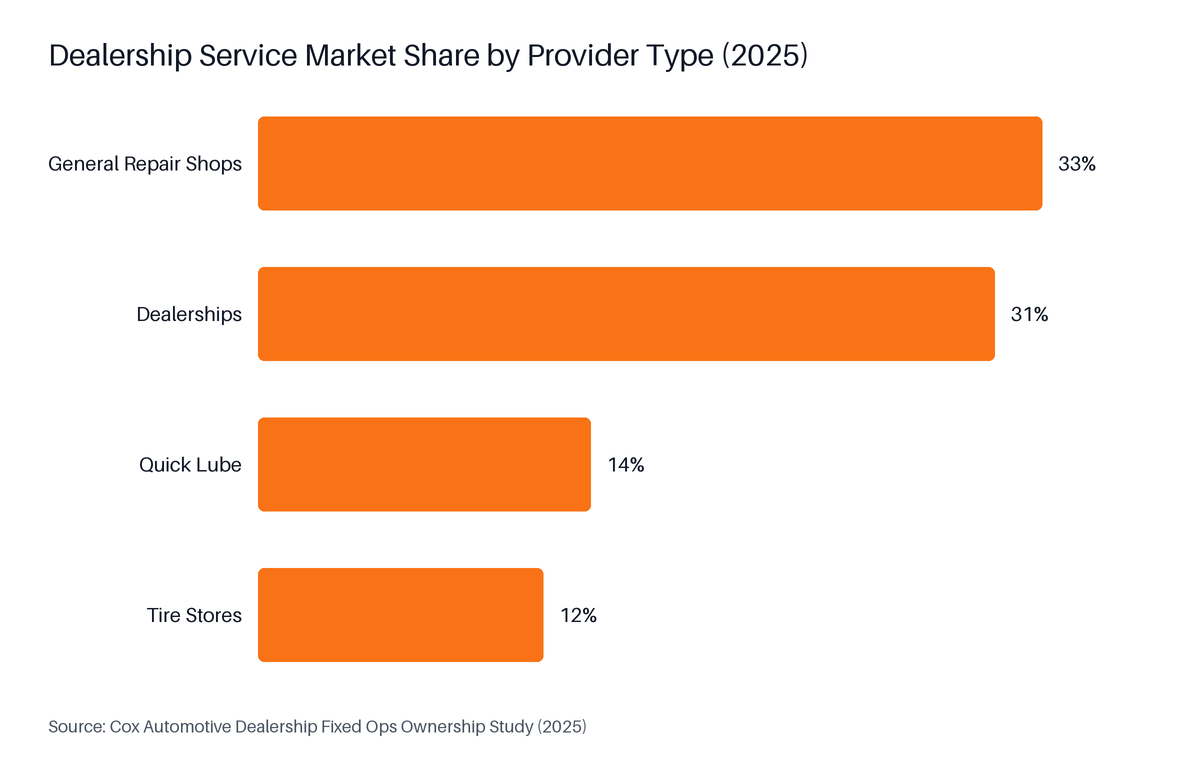
Source: Cox Automotive Dealership Fixed Ops Ownership Study, 2025
A premium car dealership audit measures two parallel standard sets. Facility standards cover exterior signage to OEM specification, showroom lighting and layout, reception and customer lounge quality, workshop bay organisation including 5S compliance and branded collateral placement. Process standards cover the sales consultation flow, service appointment communication and first-time-fix rate. J.D. Power's 2025 CSI Study found 12% of repairs were not completed correctly the first time (J.D. Power via Flai, 2025), one in eight visits ending in a return.
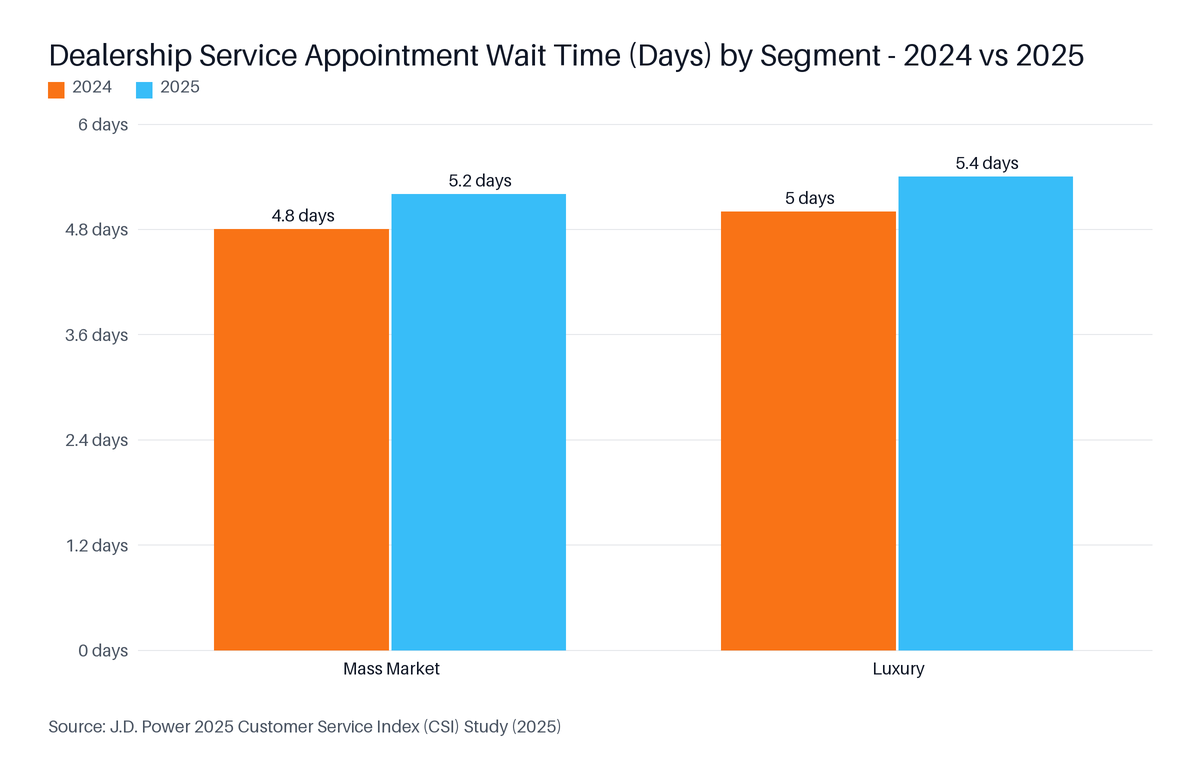
Source: J.D. Power 2025 Customer Service Index (CSI) Study, 2025
OEM audit scores feed into dealer development through two direct channels. Low scores trigger a corrective-action plan with named ownership, a remediation timeline and a follow-up verification audit. Strong scores unlock commercial incentives: co-op marketing funding, capex support approvals and certification programme eligibility. Cox Automotive's 2025 Fixed Ops Ownership Study found that customers who service at the selling dealership are 74% more likely to purchase their next vehicle there, making service audit performance a measurable sales pipeline metric.

AutoSmart's data: Al Majdouie Motors cut its audit cycle from 10 days to 3 days after moving to a digital field audit platform (AutoSmart case study). That compression matters: a faster cycle means corrective actions are assigned and tracked weeks earlier.
The practical feedback loop runs in five steps:
As Ketan Bhatia, Lincoln Regional Manager at Ford Motor Company, puts it: "The biggest Rolodex is right there at the dealer's hands… It's their DMS" (TVI-MP3, 2025). Audit data and dealer management system (DMS) data work together - audit scores surface the process gaps; DMS data shows the revenue consequences of those gaps.
U.S. dealerships also handle 12% fewer service visits than they did in 2018, per Cox Automotive, even as vehicles in operation grew. The fixed-ops absorption rate averaged approximately 63.9% in 2025 against a NADA benchmark of 75%, per Chris Collins Inc.. That 11-point gap is recoverable. Audit-identified process failures in the service lane are one of the most direct levers to close it.
Strong audit scores also unlock access to capex grants for facility upgrades, priority allocation in new model launches and inclusion in OEM certification programmes that carry their own marketing and customer satisfaction benefits.
As AutoSmart's own network-quality analysis notes: "Growth without governance creates fragile networks. OEMs that expand rapidly without enforcing standards often face inconsistencies that are difficult to correct later" (AutoSmart Technology, 2025).
OEM dealer standards enforcement follows a documented escalation ladder. Based on AutoSmart's experience across automotive retail networks in MENA and APAC, enforcement typically moves through five stages triggered by repeated or severe audit failures: corrective-action plan, score improvement targets, co-op funding suspension, enhanced monitoring and franchise termination. FTC penalties for compliance violations reach $51,744 per violation, per Demand Local's 2025 analysis. A timestamped, evidence-backed audit trail is the OEM's legal foundation at every stage.
The five stages:
60-70% of automotive consumers say they would choose a dealership for its customer experience even at a higher cost (J.D. Power via SurveySparrow, 2025). Enforcement that protects that experience also protects the OEM's competitive position in the market.
For a deeper look at how safety and quality audits integrate within the same dealer visit framework, the safety audit management software guide covers cadence, escalation and corrective-action tracking in those specific contexts.
Multi-layer dealer networks in MENA and APAC face structural audit complexity that single-importer networks do not. New vehicle brand loyalty reached a five-year high of 51.4% in 2025-yet nearly half of buyers still switched brands, per LexisNexis Risk Solutions - making cross-market Corporate Identity (CI) consistency a board-level OEM priority. MENA networks were also expanding toward EV and software-defined vehicle products as of December 2025, per AMENA Auto, adding EV readiness as an emerging fourth audit pillar in new and renewed dealer agreements.
An OEM standard in a multi-layer network must pass from the OEM through the NSC, a national distributor, regional sub-distributors and individual dealers before reaching the showroom floor. Each layer can adapt - or dilute - the original requirement.
Cross-border CI variance is also a structural challenge. A showroom standard built for a single-importer European market rarely transfers to a multi-distributor MENA network without reconfiguration. Audit frameworks that ignore local specification variants produce scores that are not comparable across markets. Non-comparable scores cannot drive meaningful development decisions.
Dealer network audits are conducted by four distinct parties: OEM field representatives or National Sales Company (NSC) area managers for annual and quarterly reviews; independent third-party firms such as SGS for impartial BRI verification; mystery shoppers for customer-experience checks; and the dealership itself for monthly self-assessments. Each auditor type brings a different perspective. Most OEM programmes blend at least two of these sources within a single audit cycle.
AutoSmart's data: Each physical audit visit carries an average direct travel cost of approximately $500. Moving suitable checks to controlled dealer self-assessment could reduce physical visits by 30 to 40%, saving approximately $15,000 to $20,000 per 100 visits, based on AutoSmart's network cost analysis.
| Auditor type | Audit types typically conducted | Key advantage |
|---|---|---|
| OEM field representative | Annual CI and DOS | Brand authority, direct corrective-action mandate |
| NSC / distributor area manager | Quarterly process and CX review | Regional context, ongoing relationship |
| Independent third party (e.g. SGS) | Annual BRI, CI verification | Impartiality, evidential weight in disputes |
| Mystery shopper | Customer experience, sales process | Reveals actual versus performed compliance |
| Dealer self-assessment | Monthly process checks | Coverage at scale without travel cost |

For an operational view of how field audit evidence capture, offline-first mobile execution and geotagged photo verification work across a distributed network, the field audit software guide covers evidence, scoring and dealer visit report generation in a single mobile workflow.
The most common dealer performance audit failure is not a poor score but a broken corrective-action loop. Each audit typically generates 8 to 20 findings; under a manual process, each finding requires 4 to 5 follow-ups before it reaches closure, and some items miss their deadline entirely. CDK's April 2026 fixed-ops analysis found dealership service NPS dropped from +59 to +47 in 2025 and that 58% of shoppers experienced a problem at the dealership, up from 47% the prior year (CDK via Flai, 2026). That trajectory is what sustained corrective-action failures produce.
Gap 1: No closed-loop corrective-action workflow. Findings end at a report. Without a system that converts each non-compliance into an owned, dated action item with a named Person-In-Charge (PIC) and a closure-evidence requirement, the finding exists on paper but not in practice.
AutoSmart's data: Each audit generates 8 to 20 findings. Under a manual process, each finding requires 4 to 5 follow-ups - including escalations - before closure. Some items miss their deadline entirely; others are never resolved at all.
Gap 2: Evidence not connected to findings. Under a manual process, auditors collect photos separately. They compile them into a PowerPoint after the visit and attach the deck to an emailed report. Teams spend 3 to 4 hours per dealership after each audit consolidating outputs before anything reaches management.
Gap 3: No real-time management visibility. Management receives a consolidated picture at scheduled review meetings, not continuously. By the time a deteriorating site appears on the radar, several audit cycles may have passed. A drill-down dashboard showing network compliance in real time - from overall score down to individual finding - closes this gap without requiring manual consolidation.
AutoSmart's data: Luai Felemban, Network and Dealer Development Manager, describes the shift: evaluation previously took 5 days plus 5 more to prepare and share reports - now the whole process including the action plan takes 3 days (video testimonial).
Closing these gaps requires a platform built for networks rather than individual sites. The automotive network audit software guide covers what generic tools miss when applied to multi-dealer, multi-country environments.
Dealer performance audits, as structured by OEMs for franchised retail networks, are not the right framework for every operator. Single-site independent dealers with no OEM franchise obligation, networks of fewer than roughly 10 sites where manual coordination remains workable, and quantitative or transactional inspection use cases - vehicle defect checking, warranty claims arithmetic - fall outside the scope this audit structure is designed to address.
Specifically, dealer performance audits as described here do not apply to:
OEM dealer compliance audits cover three pillars: Corporate Identity (CI) standards such as signage and facility appearance; Dealer Operating Standards (DOS) covering sales and aftersales processes and staff training; and Business Readiness and Integrity (BRI) checks covering financial controls and warranty claim accuracy. Across a regional network, OEMs layer these into an annual deep-dive, quarterly regional reviews and monthly dealer self-assessments, each feeding scores into a consolidated management dashboard.
A dealer network audit is a structured, scored evaluation of every dealership in a branded retail network against the OEM's defined standards. Depending on audit type and frequency, it is conducted by OEM field representatives, NSC area managers, independent third-party inspection firms such as SGS, mystery shoppers, or the dealership's own management for self-assessment cycles. Each visit produces a dealer visit report with scored findings, photographic evidence and assigned corrective actions.
Dealer standards are the documented requirements - covering facilities, branding, staff qualifications, customer processes and financial controls - that a franchised dealership must meet as a condition of its OEM agreement. OEMs enforce these through a documented escalation ladder: corrective-action plans, score improvement targets, co-op funding suspension, enhanced monitoring and, in persistent cases, franchise termination. FTC penalties for compliance violations reach $51,744 per violation, making documented enforcement essential.
A premium car dealership audit measures facility standards - exterior signage to OEM specification, showroom lighting and layout, branded materials and 5S-compliant workshop bays - alongside process standards covering the sales consultation flow, service communication and first-time-fix rate. In 2025, J.D. Power's CSI Study found 12% of repairs were not completed correctly the first time, making first-time-fix a core OEM process audit metric that every premium dealer is held to.
An OEM audit assesses compliance with branded standards across facilities, processes, customer experience, financial controls and staff qualifications. Low scores trigger a corrective-action plan with defined timelines and a follow-up audit. Strong scores unlock co-op funding, capex support and certification eligibility. Customers who service at the selling dealership are 74% more likely to repurchase there, per Cox Automotive's 2025 study, making audit-driven service quality a direct sales metric.
OEMs and national distributors ensure compliance by running structured audit cycles - annual deep-dives, quarterly regional checks and monthly self-assessments - scored against a defined checklist that mirrors the franchise agreement. Each non-compliant finding generates a corrective action assigned to a named Person-In-Charge (PIC) with a due date and closure-evidence requirement. Digital field audit platforms close the loop so findings do not remain unresolved between audit cycles.
Dealer standards audits are scheduled evaluations measuring every site in a branded retail network against the OEM's documented requirements for facilities, customer experience, processes and financial integrity. They track compliance at dealer, regional and national level, flag chronic non-conformities and provide the evidentiary basis for franchise decisions. SGS notes that "Audit results may also serve as evidence in legal cases following a contract termination" (SGS, 2025), which is why timestamped documentation matters at every finding.
Dealer performance audits, OEM compliance audits and dealer standards audits all measure the same network against the same branded requirements. The label changes; the job does not. What separates networks that improve from those that stagnate is not the audit itself. It is what happens after: whether findings become owned actions, whether evidence is timestamped and traceable, and whether management sees a live compliance picture rather than a report assembled at quarter's end.
The core takeaways:
If your network runs audits but findings are not closing, schedule a free demo to see how AutoSmart Audit replaces the manual follow-up cycle with an automated, evidence-backed corrective-action workflow across your entire dealer network.
© 2026 AutoSmart Technology All rights reserved.