dealer site pre inspection checklistdealership self assessment templatedealer self-assessment
Dealer Site Pre-Inspection Checklist: What to Send Ahead of a Field Audit
Dealer site pre-inspection checklist and self-assessment template for OEM field audits: what to send ahead, what to verify remotely, how to stop box-ticking.
Naseef UmarOct 23, 2026
Last updated: Oct 23, 2026
Dealer Site Pre-Inspection Checklist: What to Send Ahead of a Field Audit
A dealer site pre-inspection checklist is a structured self-assessment that a dealership completes, with dated evidence, before an Original Equipment Manufacturer (OEM) field auditor visits, so the visit verifies rather than discovers. This is the OEM version, not the state DMV licensing form that shares the name. The US alone has 16,990 franchised light-vehicle dealers (NADA, 2026), and each physical visit to one costs hours your team can't get back. Below you'll find what to send ahead, a self-assessment template, a worked travel-cost model and the controls that stop the form becoming box-ticking. For how audits are structured in the first place, see dealer performance audits.
Key Takeaways
A dealer site pre-inspection checklist works when every item has a typed answer, required evidence, a weight and a named owner.
AutoSmart estimates that one on-site visit averages 6 to 12 hours of travel and about $500, or roughly $50,000 per 100 visits.
Moving suitable checks to dealer self-assessment could cut physical visits by 30 to 40%, by AutoSmart's estimate.
Dealer self-assessment stays honest only with evidence per item, a different person completing it, random sample checks and consequences that reward honest fails.
Self-assessment narrows visits to targeted ones; it does not replace on-site verification of safety and equipment.
By Naseef Umar, Founder and CEO of AutoSmart.
What should a dealer site pre-inspection checklist include?
A dealer site pre-inspection checklist should cover eight sections: site and signage, showroom, service reception and workshop, parts and bodyshop, safety and environment, people and training records, information security, and a signed declaration. Each item carries an answer type, a required piece of evidence and a weight. The numbered list below shows what the dealer completes and returns before the visit date.
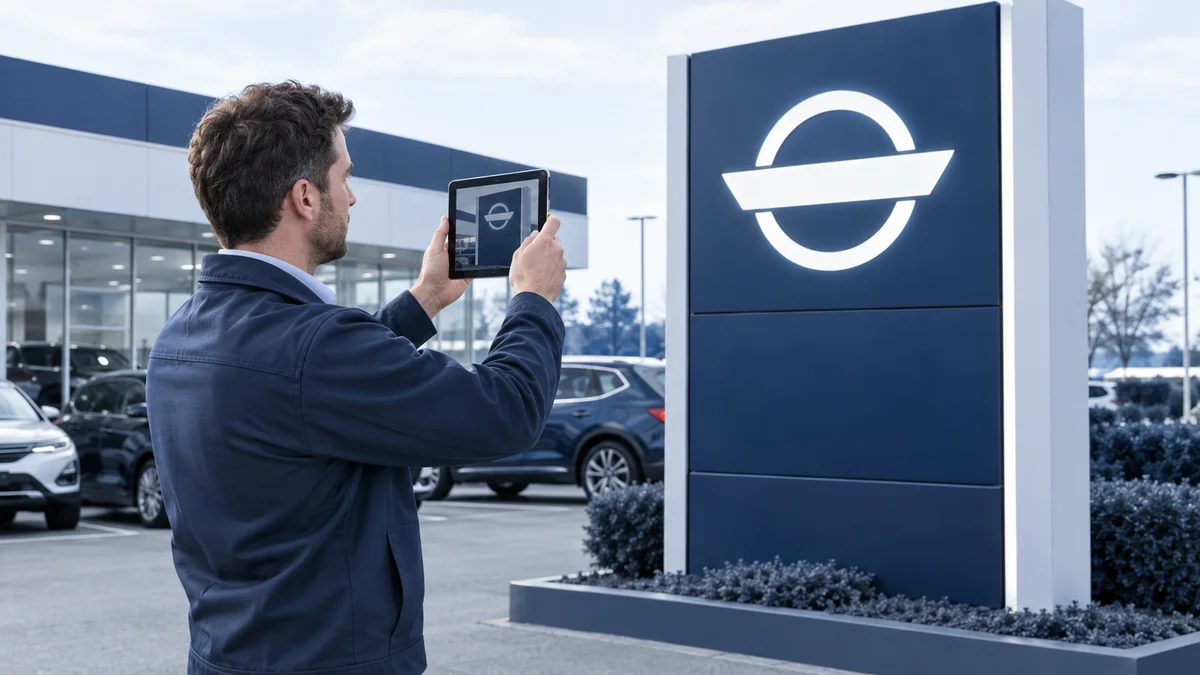
Dealer service manager photographing a signage panel with a tablet for a pre-visit checklist
Franchised light-vehicle dealerships' total sales topped $1.3 trillion in 2025 (NADA, 2026), which is how much revenue sits under brand-standards compliance. Build the sections around your written Dealer Operating Standards (DOS), so the dealer answers the same questions the auditor will score. Teams running several programmes can keep DOS, 5S and mystery audits in one place with auto audit software.
Site and signage: illumination, condition, brand-standard dimensions, parking and charging bays.
Showroom: vehicle positioning, lighting, display and digital pricing, customer areas.
Service reception and workshop: bay readiness, equipment calibration records, tool and lift status.
Parts and bodyshop: storage, stock records, paint and spray area compliance.
People and training: certification records, role coverage, training completion.
Information security: access controls and any certification your OEM requires. Check each requirement against your own standard before you ask for it.
Declaration: general manager sign-off on the whole return.
Our data: AutoSmart's customer data shows each audit typically generates 8 to 20 findings, and under a manual process each finding can need 4 to 5 follow-ups, including escalations, before closure. A clean pre-visit return shortens that chase.
What to send ahead
Send a package, not just a form. A dealer who gets a bare spreadsheet will guess.
The template, with the scoring and weights explained.
A fixed return deadline before the visit date.
The name of the completer for each section and the general manager's sign-off.
Last cycle's open failures, so the dealer sees what you'll check first.
The evidence rules: what counts as a valid photo or document.
What the dealer gets back: their score, a benchmark and a faster sign-off.
What does one on-site dealer audit visit really cost?
A single on-site dealer audit visit averages 6 to 12 hours of travel and about $500 in direct cost, so every 100 visits adds up to roughly $50,000 (AutoSmart's estimate). Moving suitable checks to self-assessment could remove 30 to 40% of physical visits, which is about $15,000 to $20,000 saved per 100 visits.
Field auditor's car on a long highway toward a distant dealership at dusk
These are company figures, so test them against your own expense data. Public rates show the direction of travel. The IRS raised the business mileage rate mid-year to 76 cents per mile for July 1 to December 31, 2026, after 72.5 cents for January 1 to June 30 (IRS, 2026). The first-half rate was itself up 2.5 cents on 2025 (IRS, 2025).
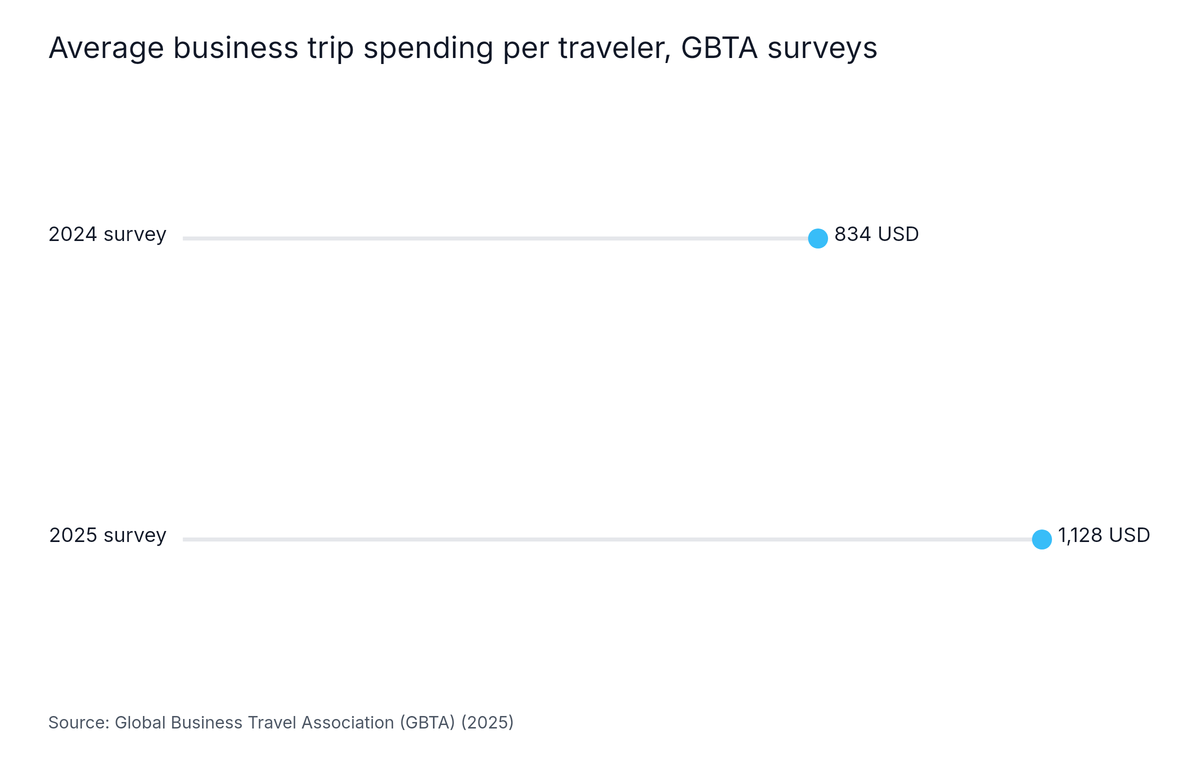
Overnight trips add more. Average business trip spending rose to $1,128 in the 2025 survey from $834 in 2024 (GBTA, 2025). That is an all-industry benchmark, not a field-audit figure, so treat it as context only.
Lollipop chart: Average business trip spending per traveler, GBTA surveys. Highest: 2025 survey at 1,128 USD.
The table lists public anchors for pricing an overnight visit.
Cost component
Public benchmark
Source
Driving
76 cents per mile, July 1 to Dec 31, 2026
IRS
Hotel night
$113 standard lodging, FY2027
GSA
Meals
$68 a day standard rate, FY2027
GSA
Big-city routes
295 non-standard areas allow more than the standard lodging rate
GSA
The General Services Administration (GSA) notice says "After a rate freeze in FY 2026, for FY 2027 GSA will increase the standard lodging per diem rate by $3 to $113" (Federal Register, 2026). The same notice keeps the standard meals rate at $68 a day and lists 295 non-standard areas above the lodging baseline.
A worked example: one overnight visit
This is an illustration, not a measurement. Assume a 200-mile round trip by car and one night away, priced at the public rates above.
Line
Calculation
Cost
Driving
200 miles at $0.76
$152
Hotel
One night at the FY2027 standard rate
$113
Meals
One day at the standard rate
$68
Total
$333
That is $333 before staff time, parking, a pricier city or a longer route, so a figure near AutoSmart's $500 average is plausible for a longer or costlier trip. Swap in your own mileage, nights and city rates to get your number.
What the savings look like
Using the company figures above, the arithmetic is simple.
What should a dealership self-assessment template look like?
A dealership self-assessment template is a fixed set of questions, each with a typed answer, a required piece of evidence, a weight and an owner. It uses five item types: yes or no with a photo, numeric reading, document upload, photo with the date visible, and a written explanation on any fail. AutoSmart's customer data shows each audit typically generates 8 to 20 findings, so scores roll up by section.
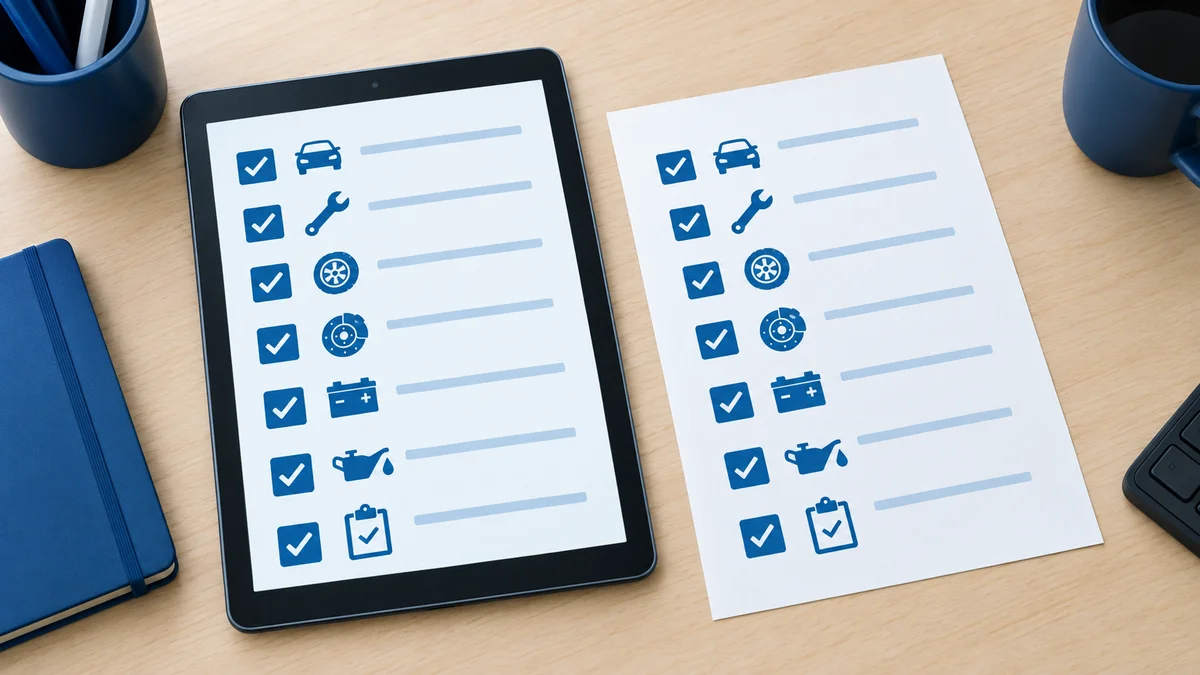
Tablet showing a structured self-assessment form beside a printed checklist in a dealership service office
The template borrows from a formal precedent. The Institute of Internal Auditors describes it this way: "A Self-assessment with Independent Validation (SAIV) involves the completion of a rigorous self-assessment by an internal audit activity" (The IIA, 2025). Self-assessment with independent validation is a model where the party scores itself and a second party checks a sample of the answers. For dealers, your sample check is the validation.
The five item types are laid out below. For a new-site launch rather than the cycle between visits, the pre-opening inspection checklist covers readiness before the doors open.
Item type
Example
Evidence required
Scoring
Yes or no with photo
Brand signage fully illuminated
Photo of the panel with the date visible
Pass or fail, weighted
Numeric reading
Workshop fire extinguishers in service
Count plus photo of one service tag
Score by threshold
Document upload
Technician certification records
Current certificate file
Pass if valid and in date
Photo with date visible
Spill kit stocked and accessible
Photo showing location and contents
Pass or fail, weighted
Written explanation
Any failed item
Cause, owner and target date
Opens a corrective action
Weights, owners and sign-off
Weight items by risk. A safety or equipment item should outweigh a cosmetic one, and the template should say so. Name a Person-In-Charge (PIC) for each section: the PIC is the individual who owns an item or corrective action and closes it. Add a general manager declaration at the end.
Build the template in the same tool your auditors use, so scores compare like with like. A field audit software workflow keeps checklist, scoring and evidence together. Then tell dealers how long the return should take and publish what they get back. Dealers who see a benchmark and a faster sign-off treat the form as a service rather than extra paperwork.
How do you stop dealers from just ticking boxes?
You stop box-ticking by making every answer costly to fake and cheap to verify: require photo or document evidence per item, have someone other than the process owner complete it, sample answers at random, and reward honest fails. Confidence is a poor guide, since 96% of surveyed organizations felt sure their self-attested score would hold (Kiteworks, 2026).
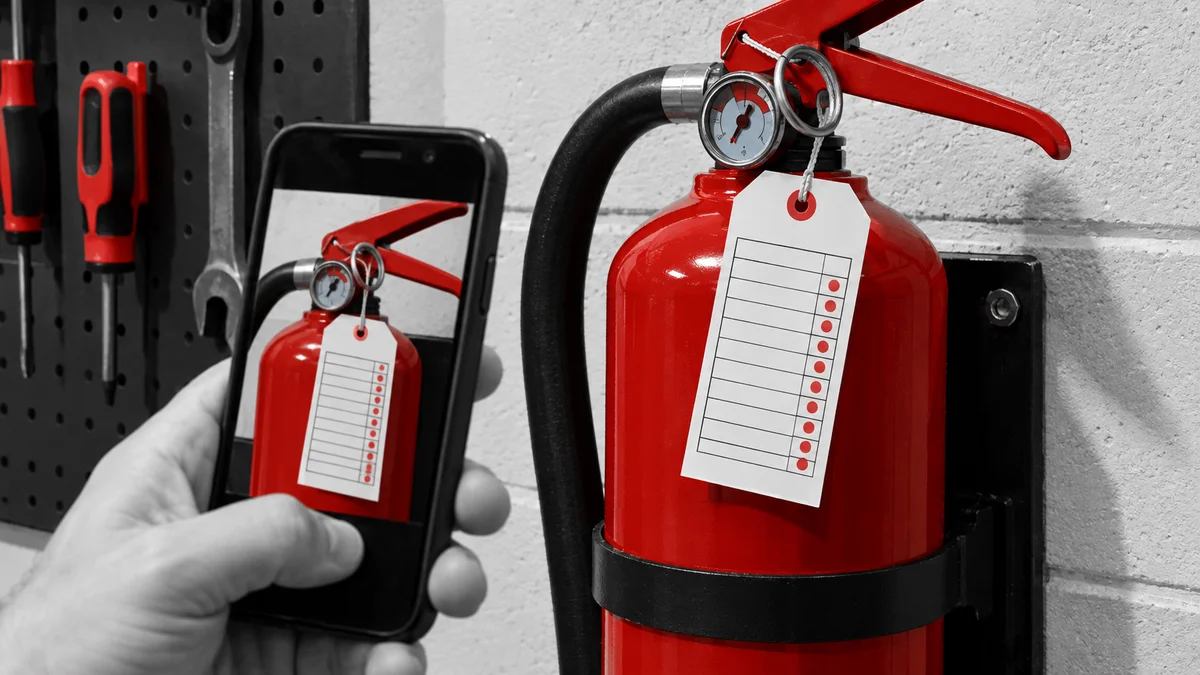
Hand holding a phone to photograph a fire extinguisher service tag
That survey covered defence-industrial-base organizations and came from a vendor, so use it as an illustration, not a dealer benchmark. Kiteworks' same survey found stated confidence did not track tested knowledge of the requirements (Kiteworks, 2026). The lesson carries over: a dealer can be sincere and still wrong. An evidence-backed self-assessment is a dealer self-check in which every answer carries dated photo or document proof.
Five controls that work
Evidence per item. No photo or document, no credit. Set the rule in the template, and use whatever capture controls your tool allows. Mobile audit software is one route.
A different completer. The person who runs the process shouldn't be the only one who scores it.
Random sampling. Pick a share of answers per dealer, ask for fresh evidence remotely, and visit if it fails.
Specific answers. Mix in numeric and document items so a blanket "yes" doesn't fit.
Consequences that reward honesty. An honest fail with an action plan should cost less than a failed spot check. Publish the rules before the first cycle.
Which checks can be cleared remotely, and when do you still visit?
Documents, photos, training records and signage can be cleared remotely, while equipment function, workshop safety and physical condition still need an auditor on site. The aim is a hybrid model: dealer self-assessment first, then a risk-tiered visit calendar, so field auditors spend their hours where scores, evidence quality or past failures point to risk.
Two-post vehicle lift raised in a service bay awaiting an on-site inspection
A hybrid audit is a model where remote self-assessment and evidence review come first and on-site visits are targeted. A risk-tiered visit calendar is a schedule that sets visit frequency and depth by each dealer's self-assessment score, evidence quality and failure history. Remote review is gaining ground in other audit fields too. In a survey with 2,275 usable responses from auditors in China, respondents expected remote auditing to make up about 86 per cent of audit practice in future (CUHK Business School, 2025). That covers financial audits and is an expectation, not a result, so read it as direction only.
Check
Clear remotely
Needs a visit
Signage and branding
Dated photos from set angles
Illumination or damage doubts
Training and certification
Uploaded records
Gaps found in the records
Safety equipment
Photo of service tags
Function and placement checks
Workshop equipment
Calibration certificates
Condition and working order
5S housekeeping
Photo series by zone
Repeated failures across cycles
Housekeeping suits photo evidence, as covered in 5S audits in a dealer network. Newer items such as ADAS calibration or EV readiness vary by OEM, so confirm each against your own standard before adding it.
Turning a score into a visit decision
Self-assessment result
Evidence quality
Action
Pass, no repeat fails
Complete and dated
Skip the visit; sample remotely
Pass
Thin or inconsistent
Remote follow-up, then decide
Fail on safety or equipment
Any
Targeted visit
Repeated fails across cycles
Any
Full visit
When is dealer self-assessment not enough?
Dealer self-assessment is not a replacement for on-site audits, and it won't suit networks with no field team, no agreed standard or dealers who can't capture evidence on site. In the 2025 GBTA survey, 86% of business travelers rated trips worthwhile (GBTA, 2025), so the goal is fewer, targeted visits rather than none.
Be honest about three limits. First, a self-assessment only measures what the dealer can show; condition and function still need a person. Second, a form with no enforcement drifts into box-ticking within a cycle or two. Third, the cost figures here are company estimates, not independent research, so model your own network before you promise a saving.
Frequently Asked Questions
What should a dealer self-assessment include before an OEM or field audit visit?
A dealer self-assessment should include a fixed set of questions covering site and signage, showroom, workshop, parts and bodyshop, safety, training records and information security. Each question needs a typed answer, required photo or document evidence, a weight and a named owner, plus a signed declaration from the general manager.
Can a self-assessment replace an on-site dealer audit?
A self-assessment cannot fully replace an on-site dealer audit, but it can replace a share of visits. Documents, photos, training records and signage can be cleared remotely. Equipment function, workshop safety and physical condition still need an auditor present, so the realistic goal is fewer, targeted visits.
How do you stop dealers from just ticking boxes on a self-assessment?
You stop box-ticking by requiring photo or document evidence for each item, having someone other than the process owner complete the form, verifying a random sample of answers, and rewarding honest fails. Add numeric and specific-answer items so a blanket yes is impossible, and publish consequences for misreporting.
How often should dealers complete a self-assessment between OEM visits?
Dealers should complete a self-assessment on a fixed evaluation cycle that follows their place in the risk-tiered visit calendar. No public benchmark sets one frequency, so treat this as a suggestion: monthly for dealers who scored low or failed safety items, quarterly for dealers with clean, well-evidenced returns.
Conclusion
A dealer site pre-inspection checklist earns its keep when it changes what happens on the visit. Keep these points:
Send a package: template, deadline, named completers, last cycle's failures and evidence rules.
Give every item a typed answer, evidence, a weight and an owner.
Control honesty with evidence, a different completer, random sampling and fair consequences.
Triage by risk: clear documents and photos remotely, visit for safety and equipment.
Model your own travel costs before committing to a saving.
If your checklist still lives in spreadsheets, start with when spreadsheets break down. To see a self-assessment run end to end, Schedule a Free Demo.
Written by
Naseef Umar
Founder | CEO
Naseef Umar is an automotive industry expert and the Founder & CEO of AutoSmart, with over a decade of experience working across automotive operations, dealer standards, network performance, audits, and digital transformation.
Company
KERALA Full Address - Pulikillam W Rd, Kakkanad West, Chembumukku, Edappally, Kochi, Kerala 682030; DUBAI Full Address - Dubai Silicon Oasis, UAE

 Naseef UmarOct 23, 2026