A dealer standard is a written requirement set by a manufacturer or distributor that a dealership must meet, covering areas such as facility image, sales process, aftersales workflow and customer handling, and checked through scheduled audits. Across the US alone, 16,991 franchised light-vehicle dealers answer to programmes like this (NADA, 2026). This guide explains what a dealer standard is, what dealer standards compliance involves, and how dealer standards audits work on the day an auditor walks in. For a deeper look at how OEMs structure the scoring, see our guide to dealer performance audits.
Key Takeaways
A dealer standard is a written manufacturer requirement for how a dealership looks, sells and services, and Dealer Operating Standards (DOS) is the full set of them in one programme.
Dealer standards compliance means meeting the standard and proving it with evidence. It is different from legal compliance and from mystery shopping.
A dealer standards audit typically follows a repeatable sequence: notification, opening meeting, floor walk, document sampling, scoring, close-out, report and a corrective action plan.
Facility and image requirements carry the largest costs, with new construction estimated at $250 to $600 per square foot in 2026.
Audit findings without a named owner and a deadline tend to stay open, so a corrective action plan needs both.
By Naseef Umar, Founder and CEO, AutoSmart Solutions. Naseef has over a decade of experience across automotive operations, dealer standards, network performance and audits.
What Is a Dealer Standard?
A dealer standard is a written requirement that a manufacturer or distributor sets for how an authorised dealership looks, sells, services and treats customers. Dealer standards sit inside a wider programme and are checked by audit. In the US, 16,991 franchised light-vehicle dealers operate under such programmes (NADA, 2026).
Dealer Operating Standards (DOS) is the name for the full set of operating requirements a manufacturer or distributor places on a dealership, bundled into one programme and scored through audits. One standard is a single rule. DOS is the whole rulebook plus the method for measuring it.
What a dealer standard typically covers
Programmes differ by brand, but most group their requirements into the same few areas:
Facility and image: signage, showroom layout, workshop appearance and brand identity.
Sales process: lead handling, test drives, handover and documentation.
Aftersales and bodyshop: workshop flow, parts handling, technician training and repair-order discipline.
Customer experience: follow-up, complaint handling and satisfaction targets.
Safety and housekeeping: 5S, health and safety, and environmental checks.
The aftersales scale shows why that list matters. US franchised dealers handled more than 136 million repair orders, with service and parts sales of nearly $83 billion (NADA, 2026). Every one of those orders is a chance to follow the standard or miss it.
Why Do Dealer Operating Standards Matter?
Dealer Operating Standards matter because they protect the customer experience that keeps service revenue at the franchised dealer. Cox Automotive's 2026 fixed operations study found that 88% of consumers say their service experience affects their likelihood to buy again from that dealer (Cox Automotive, 2026), and 80% of new-car buyers are likely to service at the selling dealership.
The money follows the customer. Each lost service customer costs a dealer an estimated $12,000 over time (Cox Automotive, 2026). Dealer share of total service visits fell from 33% to 29% since 2018, even as average dealer service and parts revenue rose to $9.23M per store (Cox Automotive, 2026). Revenue per store is up. Share of the customer is down. Process standards are what hold the line.
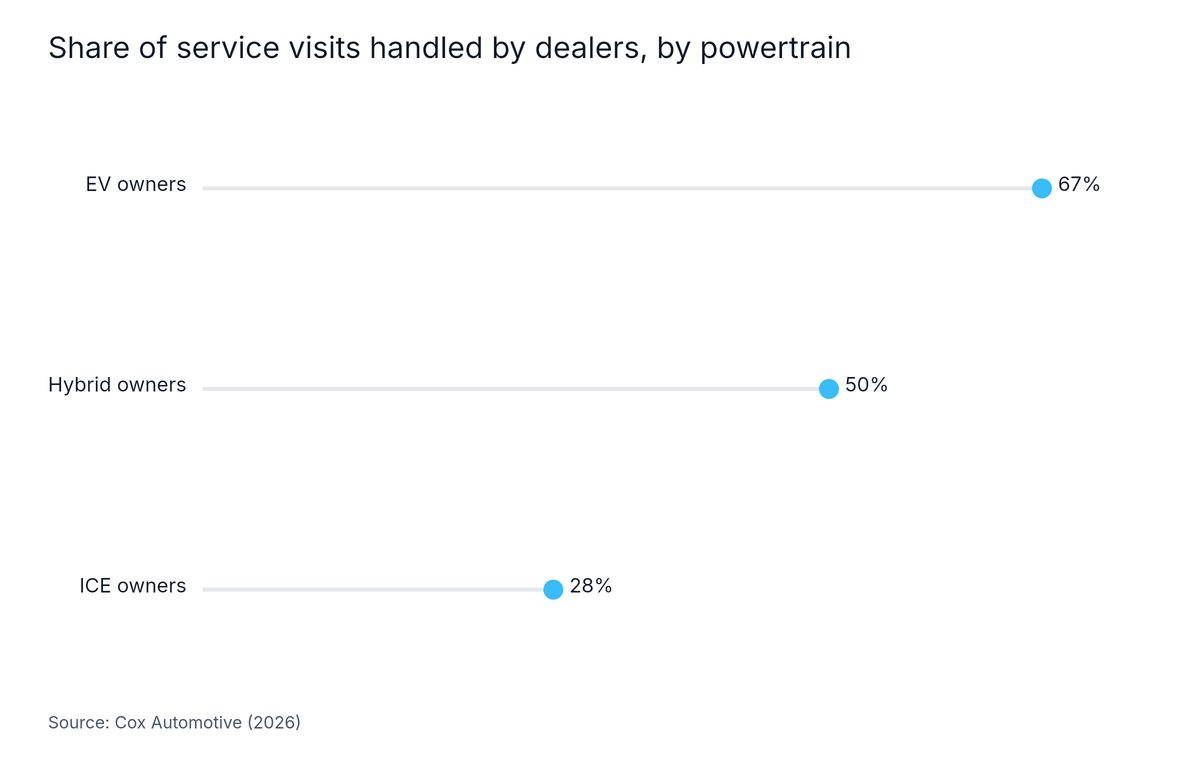
Powertrain changes the picture too. EV owners rely on dealers for 67% of service visits, against 50% for hybrid owners and 28% for ICE owners (Cox Automotive, 2026). That is why high-voltage safety and technician training are moving into audit scope.
Lollipop chart: Share of service visits handled by dealers, by powertrain. Highest: EV owners at 67%.
Dealer standards compliance is the ongoing work of meeting a manufacturer's written requirements and proving it with evidence. It is separate from regulatory compliance, which covers law, and from mystery shopping, which tests the customer journey. In practice it means an owner for every standard, regular self-checks, stored evidence and corrective actions closed by their deadlines.
Three things get blurred in search results and in boardrooms. Keep them apart:
Type
What it checks
Who sets the rules
Typical evidence
OEM standards audit
Facility, process and people against the brand's written checklist
Manufacturer or distributor
Dated photos, records, sampled documents
Regulatory compliance
Advertising, pricing, privacy and consumer law
Regulators and state or federal law
Policies, disclosures, training logs
Mystery shop
The customer journey as a customer experiences it
Brand or the dealer itself
Recorded responses, timings, scores
The legal layer sits on top
Regulation adds a separate cost. Fines for non-compliant advertising can run $16,000 to $17,000 per instance, per day, per party (CBT News, 2026). California's CARS Act took effect on October 1, 2026, adding state-level pricing and advertising obligations (Car Dealership Guy, 2025). Passing a brand audit does not cover any of it.
Mystery shops expose the gap between policy and practice
A mystery shop is an unannounced test of the customer journey, run by someone posing as a genuine customer. In an April 2026 study of 53 Canadian dealerships, only 13.2% responded to a genuine inbound lead within five minutes, and the average first response took 9.01 hours (Clearline, 2026). The author's reason for running it: "So we decided to replace opinions with data." (Adi Patel, Clearline, 2026). It is a small, Canada-only sample, but the gap between written process and real behaviour is what a mystery shop is built to find.
What the compliance owner actually does
Dealer standards compliance work comes down to four habits:
Assign an owner to every checklist item, so a failed question has a name against it.
Run an internal audit rhythm between manufacturer visits, so the audit day holds no surprises.
Keep evidence (dated photos, records, signed forms) where the auditor can find it.
Track every corrective action to closure, with a deadline and proof of the fix.
A dealer standards audit is a structured visit in which an auditor scores a dealership against the manufacturer's written checklist, collects evidence and issues a report with corrective actions. The sequence runs from pre-notification through an opening meeting, a floor and workshop walk, document sampling, scoring and close-out, to a corrective action plan with named owners and deadlines.
Audits look at measurable process gaps. In the J.D. Power 2026 U.S. Aftermarket Service Index study, as reported by Car Dealership Guy, only 17% of same-day dealer service visits had work completed within an hour (Car Dealership Guy, 2026). Service speed is the kind of process result an auditor samples from repair orders.
The audit day, step by step
The sequence below is typical. It is not drawn from one specific OEM programme, and programmes differ.
Pre-notification. The dealer receives the date, scope and evidence requirements. Mystery shops skip this step by design.
Opening meeting. The auditor confirms scope, introduces the checklist and agrees who will accompany the walk.
Floor and workshop walk. The auditor inspects the showroom, workshop, parts area and bodyshop against each checklist question and photographs what they see.
Document and CRM sampling. The auditor pulls a sample of repair orders, sales files and customer records to check that written process matches practice.
Scoring. Each question is marked compliant or non-compliant, with evidence attached, and section scores roll up to a total.
Close-out meeting. The auditor walks the dealer principal through the findings before leaving. Disputes get raised here, with evidence.
Report. A formal dealer visit report records what was assessed and what the dealer acknowledged.
Corrective action plan and re-audit. Each finding becomes an action with an owner and a deadline, and a later visit confirms it was closed.
Auditors with a mobile app that works offline can finish step 7 before they leave the car park. Field audit software for dealer networks is built around that single workflow.
How scoring works
Scoring rules vary by manufacturer. The table below is an illustrative model based on AutoSmart's experience with weighted scoring, not a published OEM rule, and no independent source documents these mechanics.
Scoring method
How it works
Effect on the result
Weighted sections
Each section carries a share of the total score
A weak, heavily weighted section drags the total down
Pass or fail items
Each question is marked compliant or non-compliant
Every non-compliance becomes a finding
Critical items
Safety, legal or brand-integrity questions with automatic failure
One failure triggers corrective action even if the total passes
A critical item is a question, usually on safety, legal or brand integrity, that triggers a corrective action when failed, regardless of the overall score. That is how a dealer can pass overall and still be marked down in one area. Weighting configured once and applied identically to every auditor and every site also removes a common score dispute: "your auditor marked it harder than mine."
After the audit: the corrective action plan
A corrective action plan is the list of fixes a dealership commits to after an audit, each with a named owner and a deadline. This is where manual programmes break down.
AutoSmart's own pain-point data, which describes manual processes, indicates that each audit typically generates 8 to 20 findings, and that each finding can need 4 to 5 follow-ups, including escalations, before closure when tracked by hand. A tracker that turns every failed item into an owned, dated action stops the audit team from becoming the chasing team. See paperless auditing for multi-site dealer networks for what that change involves day to day.
Our data: AutoSmart's customer data shows audit cycle compression from 10 days to 3 days. This is AutoSmart's own outcome metric for its customers, not an industry benchmark.
Schedule a Free Demo
What Does Meeting Dealer Standards Cost?
Meeting dealer standards costs most where facility and image requirements apply. Contractor estimates for new dealership construction range from $250 to $600 per square foot (CBT News, 2026), and manufacturers typically refresh image programs every seven to 10 years. Smaller costs, such as audit time and follow-up, repeat every cycle.
The figures below frame the burden from the dealer's side:
Figure
What it shows
Source
$250 to $600 per square foot
Contractor estimates for new dealership construction
Kerrigan Advisors' 2026 OEM Survey found that 43% of OEMs expect to impose a new image-facility requirement on dealers within five years (Kerrigan Advisors, 2026). Dealers have noticed the pressure. Ryan Kerrigan of Kerrigan Advisors put it this way: "The challenge with these new image mandates is the lack of clear financial rationale" (CBT News, 2025). CBT News reported that "Facility image compliance has become one of the most critical variables in automotive buy-sell negotiations" (CBT News, 2026).
The market they land in
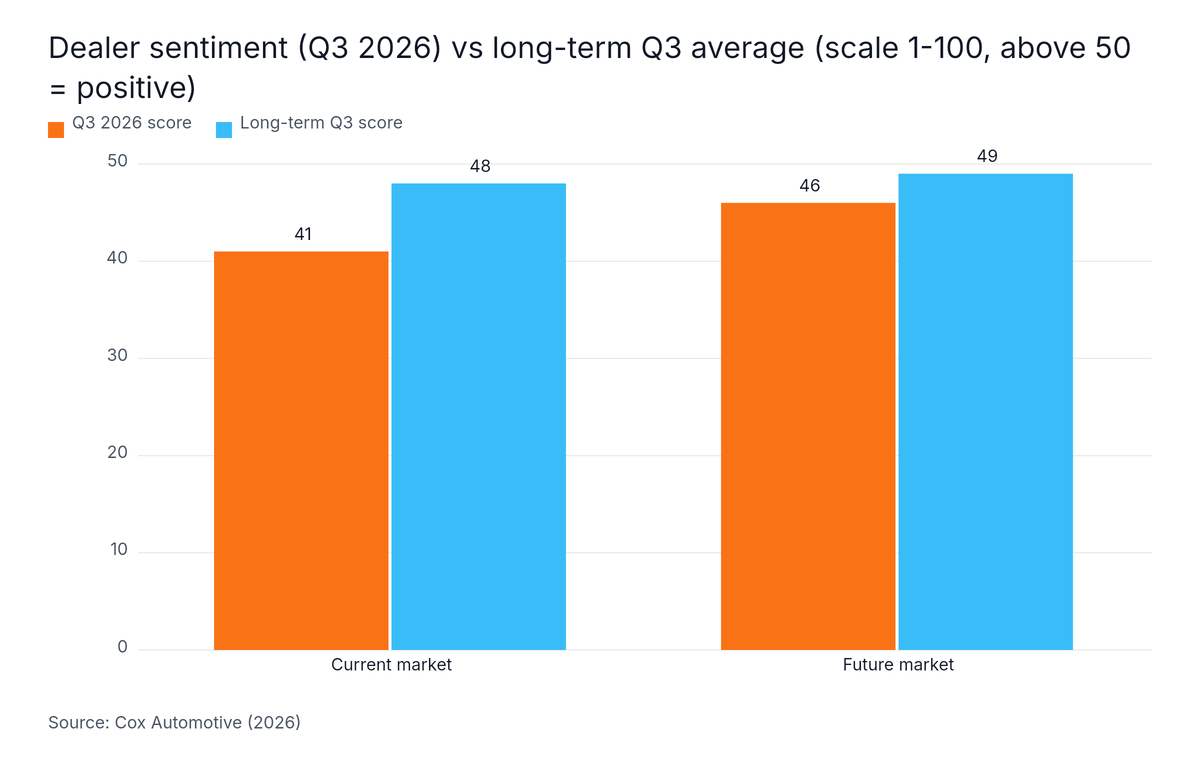
Compliance costs arrive when dealers feel least confident. The Q3 2026 Cox Automotive Dealer Sentiment Index current-market score was 41, against a long-term Q3 score of 48 (Cox Automotive, 2026). The future-market score was 46. A reading above 50 means more dealers see conditions as strong, so both sit below neutral.
Grouped Bar chart: Dealer sentiment (Q3 2026) vs long-term Q3 average (scale 1-100, above 50 = positive). Highest: Future market at 46.
A general explainer on dealer standards does not replace a specific manufacturer's checklist, legal advice or audit benchmarks. Programmes differ widely by brand and market, and no independent source found publishes audit pass rates or audit frequency, so none are quoted here.
Be clear about the limits before you use it:
Brand-specific programmes: requirements, weightings and thresholds change by manufacturer, so always work from your own written standard.
Legal advice: advertising, pricing and privacy rules need counsel, not an audit checklist.
Single-site shops without a manufacturer programme: the process still helps, but the consequences described here assume a franchise or distributor agreement.
Dealer standards compliance involves meeting a manufacturer's written requirements and proving it with evidence. A dealership assigns an owner to each standard, runs regular self-checks, keeps dated photos and records, and closes every corrective action by its deadline. It is separate from legal compliance, such as advertising and pricing rules, and from mystery shopping.
What happens in a dealer standards audit?
In a dealer standards audit, an auditor scores the dealership against the manufacturer's checklist and records evidence. The visit usually moves from an opening meeting to a floor and workshop walk, document sampling, scoring and a close-out meeting. A report follows, with a corrective action plan that names an owner and a deadline for each finding.
What is a Dealer Operating Standards (DOS) audit?
A Dealer Operating Standards (DOS) audit measures a dealership against the full set of operating requirements in its manufacturer's programme. It typically covers facility and image, sales process, aftersales and customer handling. Each question is scored with evidence, and failed items become findings that the dealer must correct.
Can a dealer pass overall but still be marked down in one area?
Yes, in programmes that combine weighted sections with critical items. A dealership can reach the overall pass mark and still fail one critical item or a weak section. That failure triggers a corrective action even though the total score passes, and it is reviewed again at the next audit cycle.
Conclusion
A dealer standard is a written requirement. Dealer Operating Standards is the programme that measures it. The work that decides your results happens between audits, not on audit day.
Know the three layers: brand standards, regulation and mystery shopping each need their own owner.
Give every checklist item a named owner and keep dated evidence ready.
Run the audit sequence the same way every time, from notification to corrective action plan.
Track every finding to closure, because an open action with no owner tends to stay open.
Plan for cost: image programmes refresh every seven to 10 years (CBT News, 2026).
Your next step: take your last audit report and count how many findings were closed with evidence. If you cannot answer quickly, look at mobile audit software for dealer networks and see what a closed loop would change.
Written by
Naseef Umar
Founder | CEO
Naseef Umar is an automotive industry expert and the Founder & CEO of AutoSmart, with over a decade of experience working across automotive operations, dealer standards, network performance, audits, and digital transformation.
Company
KERALA Full Address - Pulikillam W Rd, Kakkanad West, Chembumukku, Edappally, Kochi, Kerala 682030; DUBAI Full Address - Dubai Silicon Oasis, UAE

 Naseef UmarOct 22, 2026