digital vs manual pre delivery inspection which one saves oem costsdigital audit tool automotive
Digital vs Manual Pre-Delivery Inspection: Which Saves OEM Costs?
Digital vs manual pre delivery inspection compared for OEMs: where travel and admin savings come from, a cost formula, and the limits of remote audits.
Digital vs Manual Pre-Delivery Inspection: Which Saves OEM Costs?
By Naseef Umar, Founder and CEO of AutoSmart
Digital pre-delivery inspection (PDI) is the recording of a new vehicle's handover checks on a phone or tablet, with time-stamped photo evidence, instead of on paper and spreadsheets. In the digital vs manual pre delivery inspection debate, digital saves OEM costs mainly through cheaper dealer oversight, not through the inspection itself. Most of the saving sits in the audit around it: the flights, the hotel nights, the evening spent building a deck from photos. This guide shows where each cost sits, gives a formula you can fill with your own numbers, and covers the evidence for a hybrid approach. If you are also weighing paperless auditing across a multi-site network, the same logic applies.
Key Takeaways
Digital pre-delivery inspection saves OEMs money mainly by letting auditors verify dealer PDI records remotely, not by changing the inspection a dealer performs.
AutoSmart estimates $500 per physical audit visit, so every 100 visits costs about $50,000 and a 30 to 40% cut saves roughly $15,000 to $20,000.
A travel-and-admin case needs your own inputs: audits per dealer, auditor days, day rate, airfare, hotel, car and the share of visits replaced.
Remote audits can miss problems: a field study of nearly 35,000 audits found fewer violations reported remotely, so plan for risk-based visits.
Warranty savings are real but are a separate quality case, not a travel saving.
Where does digital PDI actually save OEMs money?
Digital pre-delivery inspection saves OEMs more than manual PDI, but mostly through how dealers are audited, not the inspection itself. A dealer-run digital PDI saves little OEM travel. The saving appears when field teams verify time-stamped records remotely and skip trips whose costs keep rising: economy fares are projected to reach $536 in 2026 (GBTA, 2026).
Pre-delivery inspection (PDI) is the check a dealer carries out on a new vehicle before handing it to the customer. The dealer does the inspecting. The OEM pays for the oversight: field auditors who travel to dealerships to confirm the PDI process is followed and evidenced. Many cost comparisons blur these two jobs, so keep them apart.
Where the costs sit under each method
Cost line
Manual (paper) PDI
Digital PDI with a digital audit tool
Who mostly saves
Audit travel
Auditor visits to inspect records and sample vehicles
Records reviewed remotely; visits aimed at higher-risk dealers
OEM
Evidence compilation
Auditors and head teams spend several hours per audit compiling photos and PowerPoint slides
Evidence attached to the checklist item at capture
OEM and auditor
Post-audit reporting
3 to 4 hours after each audit consolidating Excel, sign-off sheets and photos for some dealerships
Report available at the end of the visit
Auditor
Corrective-action follow-up
8 to 20 findings per audit, each needing 4 to 5 follow-ups before closure
Findings become owned, dated action items
Audit team
The figures in the table come from AutoSmart's own customer research, not independent studies. Treat them as the company's operating estimates and replace them with your own timesheets where you can.
Our data: In AutoSmart's company-reported figures, the audit cycle was compressed from 10 days to 3 days. This is AutoSmart's own number, not independent research.
Can a digital audit tool be justified on travel savings alone?
A digital audit tool for an automotive network can be justified on travel savings alone when the OEM runs many physical visits and can move suitable checks to self-assessment. AutoSmart estimates $500 per visit, so every 100 visits costs about $50,000 in direct travel, and a 30 to 40% cut saves roughly $15,000 to $20,000 per 100 visits.
A digital audit tool is software that runs checklists, scoring, evidence capture and reporting on a phone or tablet instead of on paper and spreadsheets. Self-assessment is a structured check a dealership completes itself against a defined standard, with no auditor on site. The travel case depends on the second idea. A tool that only digitises the checklist does not remove a single trip.
What the travel-only case usually looks like
The usual case has four parts:
Count visits. Take every physical audit visit across all audit programmes in a year.
Cost a visit. AutoSmart's proxy is $500 on average per visit. Add your own travel-time records for the hours lost on the road.
Pick the replaceable share. AutoSmart estimates that moving suitable checks to self-assessment could cut physical visits by 30 to 40%.
Net it against licence cost. Ask for a quote, because no independent licence benchmark exists.
Airfare alone approaches that proxy. GBTA's forecast has economy fares rising 8.7% in 2026 to $536 (GBTA, 2026), before a hotel or car is added. The mix varies, though: many dealer visits are road trips, so use your own split of flights and drives.
Pitch the case as a floor. Travel savings alone may clear the bar for a network with hundreds of sites. They will not for a network with few.
How do you build a travel and admin baseline across a dealer network?
A baseline multiplies audits per dealer per year by auditor days, then by the daily cost of travel (day rate, airfare, hotel and car), then by the share of visits you could replace. Seed each input with your own expense records, then sanity-check against 2026 forecasts: economy fares near $536 and car rental near $46.50 per day.
$46.50 per day average, forecast 3.6% rise in 2026 (GBTA, 2026)
Hotel
Nightly rate times nights
About $289 per recorded night in H1 2026, U.S. cohort (Emburse, 2026)
Share of visits replaced
Self-assessment or remote review
AutoSmart estimate: 30 to 40%
Your formula: audits per dealer per year x auditor days x (day rate + airfare + hotel + car) x share of visits replaced. The GBTA and Emburse numbers are global or U.S. benchmarks, so adjust for your region.
Why volume beats price
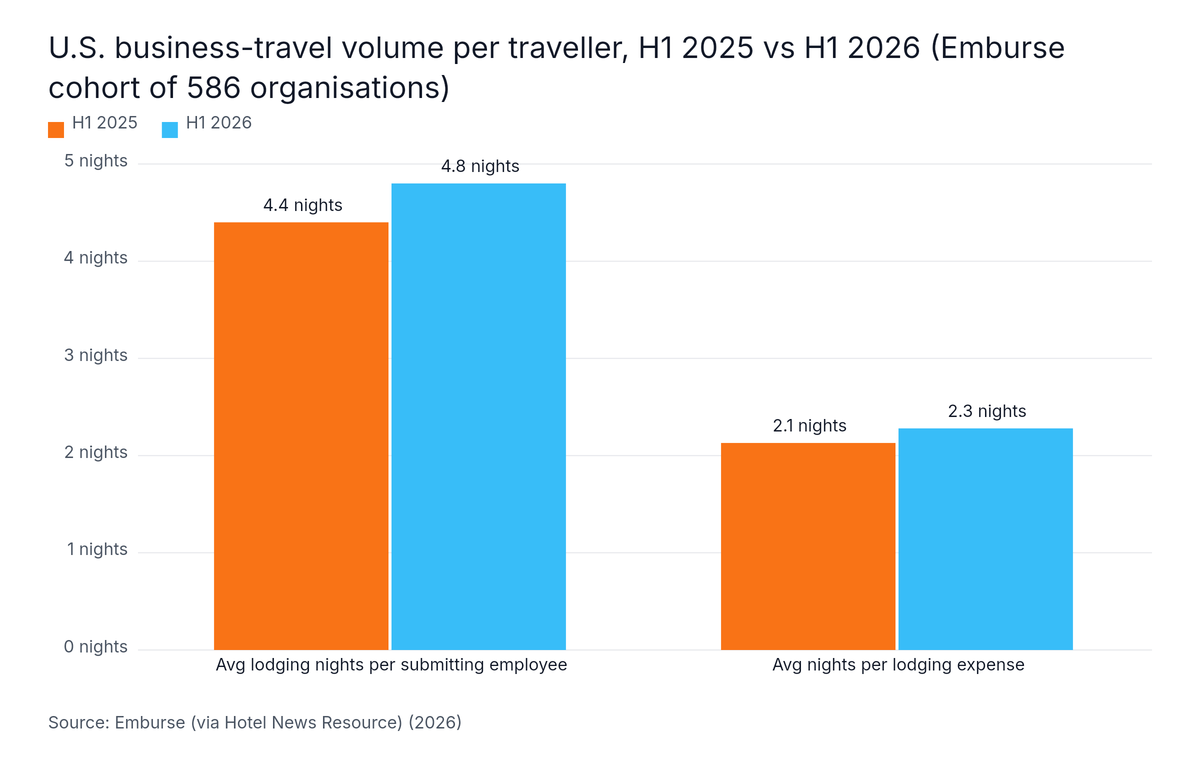
Hotel rates are flat. Emburse found average lodging expense per recorded night fell 1.2%, from about $292 to $289, yet submitting employees logged 4.8 lodging nights in H1 2026 against 4.4 in H1 2025 (Emburse, 2026). Staff are spending more nights away. A model built on visit volume therefore holds up better than one built on price.
Grouped Bar chart: U.S. business-travel volume per traveller, H1 2025 vs H1 2026 (Emburse cohort of 586 organisations). Highest: Avg lodging nights per submitting employee at 4.4 nights.
Admin cost is harder to see because it hides in evenings and weekends. Count three items: post-audit report assembly (3 to 4 hours per audit for some dealerships, per AutoSmart's research), management consolidation across dealers and regions (several hours per reporting cycle), and corrective-action chasing. With 8 to 20 findings and 4 to 5 follow-ups each, simple multiplication gives roughly 32 to 100 follow-up touches per audit.
For a cross-industry sanity check only, a July 2025 survey of 500 U.S. professionals put manual data entry at $28,500 per employee per year (Parseur, 2025). That survey was commissioned by an automation vendor and is not automotive-specific, so apply a heavy haircut. For more on the reporting cycle, see how operational audit management replaces manual PowerPoint reporting.
Do remote and digital audits catch as many problems as on-site visits?
Not always. A Harvard Business School working paper covering nearly 35,000 compliance audits found that remote audits reported fewer violations than in-person audits, especially where inspectors must observe conditions directly. For an OEM, that means a digital audit tool should replace routine travel, not every visit, and a hybrid model is the safer design.
The study covered audits against six management-system standards, including ISO 9001 and ISO 14001, at sites in about 100 countries between 2019 and 2021 (Harvard Business School, 2025). It is a working paper and not automotive-specific. It still deserves a place in your business case, because a board member will ask about it.
A hybrid audit model combines digital capture and self-assessment for routine checks with risk-based physical visits. It is also where the digital PDI record earns its keep: a time-stamped photo gives a remote reviewer something to check, which a tick on paper does not.
Which checks stay on site
Observation-based items: bay layout, tool condition, vehicle handling and workshop safety.
Dealers with repeat failures: historical cycle data shows who fails the same item cycle after cycle.
Self-assessment gaps: where a dealer's own score sits well above the independent audit score.
High-consequence checks: anything tied to certification or contractual penalties.
Evidence integrity matters just as much. AutoSmart Audit's live photo capture adds a date and time stamp and a geotag to each image, which supports remote review. Field teams working in low-connectivity sites also need offline-first mobile evidence capture that syncs later.
What else sits in the business case beyond travel and admin?
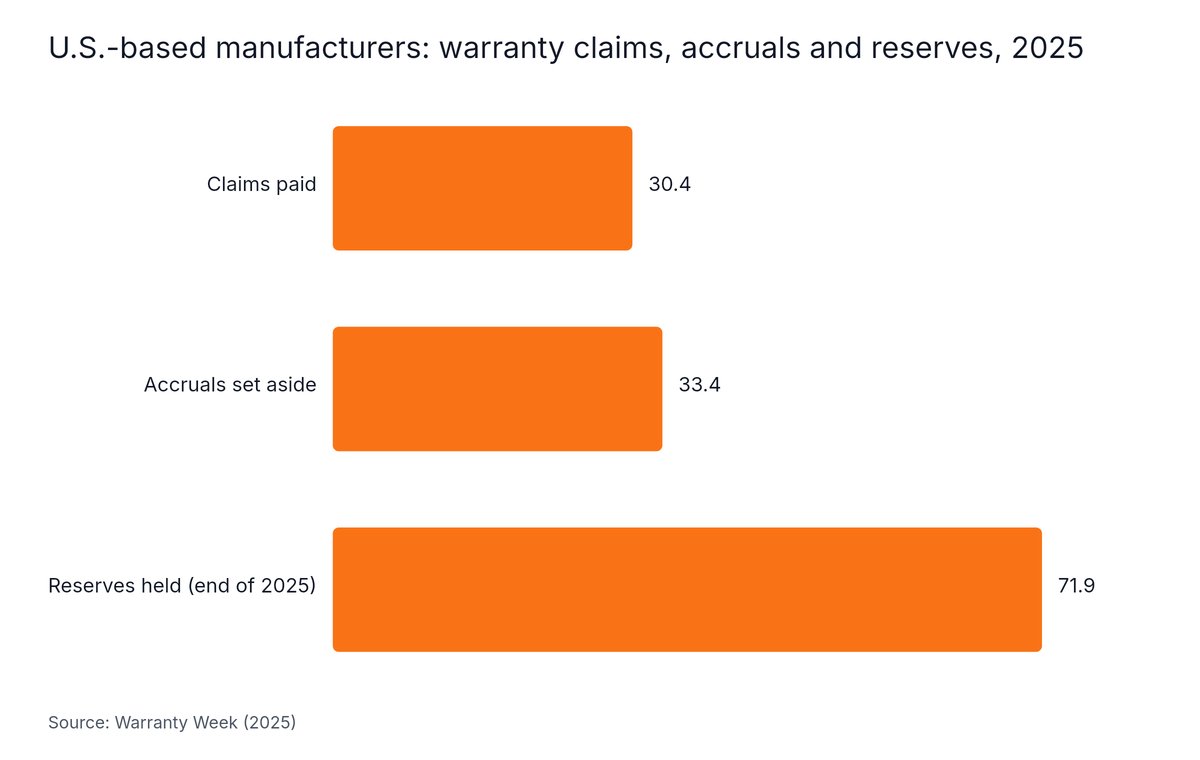
Beyond travel and admin, the business case for digital PDI evidence rests on warranty cost. U.S.-based manufacturers paid $30.37 billion in limited warranty claims in 2025, up 4% from 2024 (Warranty Week, 2026). That cost pool is large and growing, but it is a quality saving, so keep it separate from the travel case.
Warranty Week compiled that figure from the annual reports of over 1,400 warranty-issuing U.S.-based manufacturers. The same report puts accruals set aside at $33.41 billion and reserves held at the end of 2025 at $71.89 billion (Warranty Week, 2026).
Horizontal Bar chart: U.S.-based manufacturers: warranty claims, accruals and reserves, 2025. Highest: Reserves held (end of 2025) at 71.9.
Quality problems turn into balance-sheet cost quickly. Stellantis booked €11.65 billion in warranty accruals in 2025, an 84% increase on 2024 (Warranty Week, 2026). The automaker described its changes of estimate as "resulting from the reassessment of the estimation process, taking into account recent increases in cost inflation and a deterioration in quality" (Stellantis 2025 annual report, via Warranty Week, 2026). Warranty Week's own summary for U.S. automakers: "Inflation and tariffs drove up warranty costs for the largest U.S.-based automakers in 2025." (Warranty Week, 2026)
How to use warranty in the pitch
Present warranty as upside, not as the base case. A finance reviewer will not accept a savings claim that depends on an unproven reduction in claims. Travel and admin can be measured from your own ledgers within one audit cycle. Warranty movement takes much longer to attribute. For the wider structure of these programmes, see how OEMs structure dealer performance audits.
Who is this business case not for?
The travel-and-admin case for a digital audit tool is not for OEMs with few dealers, short drives or mostly observation-based audits. Car rental is forecast to average only $46.50 per day in 2026, up 3.6% (GBTA, 2026), so drive-based networks save less per visit. Where visit counts are low, the case must rest on consistency and corrective-action follow-through.
Be straight about the limits:
Small or compact networks. One hundred visits a year at $500 a visit is $50,000. A 30 to 40% reduction saves $15,000 to $20,000, which may not clear licence and rollout cost.
Inputs are estimates. The $500 proxy and 30 to 40% reduction are AutoSmart estimates, not independent benchmarks. No independent data on audit tool licence cost or payback was found, so build that line from a quote.
Observation-heavy audits. Remote review is weakest where inspectors must see conditions directly, so those checks keep their visits.
Dealer-run PDI alone. If only dealers digitise PDI and the OEM's audit routine stays the same, OEM travel will not fall.
Self-assessment honesty. Management needs confidence that self-assessments are honest and comparable to independent audits. Plan to test them.
Rollout effort. AutoSmart's go-live typically takes 5 to 10 working days once configuration inputs arrive, but adoption by field auditors is the real risk.
Can you justify a digital audit tool on travel savings alone?
Yes, if the network runs enough physical visits and can move suitable checks to self-assessment. AutoSmart estimates $500 per visit, so 100 visits cost about $50,000, and a 30 to 40% cut saves roughly $15,000 to $20,000. Treat that as a floor and test it against your own visit counts.
Which saves OEMs more money, digital or manual PDI?
Digital pre-delivery inspection saves OEMs more, mainly because field teams can verify time-stamped PDI records remotely and visit only high-risk dealers. A dealer-run digital PDI alone saves the OEM little travel. The saving comes from auditing the PDI process with digital evidence instead of paper.
Do remote audits catch as many problems as on-site audits?
Not always. A Harvard Business School working paper on nearly 35,000 compliance audits from 2019 to 2021 found remote audits reported fewer violations, especially for items inspectors must observe directly. The safer design is hybrid: digital capture and self-assessment for routine checks, plus risk-based physical visits.
How do you build a baseline for audit travel cost across a dealer network?
Multiply audits per dealer per year by auditor days, then by day rate plus airfare, hotel and car costs, then by the share of visits you could replace. Use your own expense records first, and benchmark airfare, lodging and car rental against current published travel forecasts.
Conclusion
Digital PDI wins on cost, but only if you build the case in the right place. Keep these points in front of the budget holder:
The saving sits in the OEM's audit of PDI, not in the dealer's inspection.
Build the baseline from your own visits, auditor days and expenses, then apply a conservative replacement share.
Add admin hours: report assembly, consolidation and corrective-action chasing.
Keep risk-based physical visits, because remote audits can report fewer violations.
Treat warranty as upside, not the base case.
Next step: run the formula on one audit programme, then test it on your own checklist. A field audit platform for dealer networks is easier to judge against real numbers. Schedule a Free Demo and bring your visit counts.
Written by
Naseef Umar
Founder | CEO
Naseef Umar is an automotive industry expert and the Founder & CEO of AutoSmart, with over a decade of experience working across automotive operations, dealer standards, network performance, audits, and digital transformation.
Company
KERALA Full Address - Pulikillam W Rd, Kakkanad West, Chembumukku, Edappally, Kochi, Kerala 682030; DUBAI Full Address - Dubai Silicon Oasis, UAE

 Naseef UmarNov 4, 2026