Blog
SOP Software for Automobile Dealers: Write SOPs That Get Followed
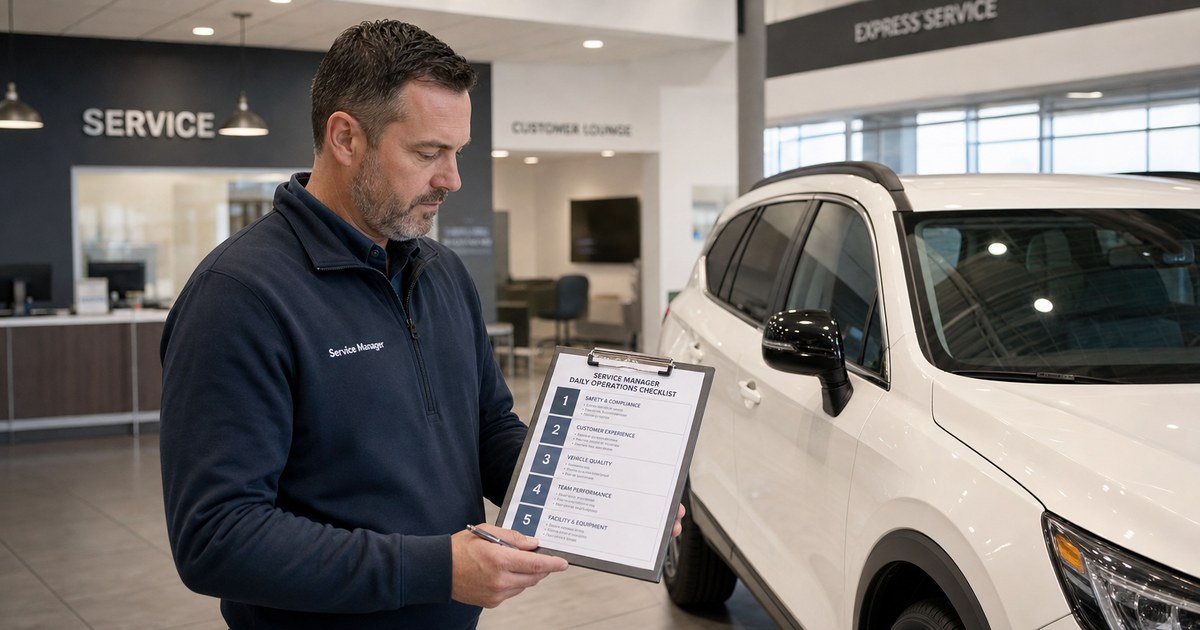
Define SOPs for automobile dealers, clear up what SOP means in the auto industry, and follow six steps that make SOPs stick, with or without SOP software.

Test a field audit app on offline-first behaviour, evidence capture and report-before-you-leave-site, with a timed bake-off and weighted scorecard.
 Naseef UmarOct 27, 2026
Define SOPs for automobile dealers, clear up what SOP means in the auto industry, and follow six steps that make SOPs stick, with or without SOP software.
Toyota's digital service evaluation has no public program name. See how TSM, Kodawari and Image USA II differ and how a Toyota dealer audit works.
How Mercedes-Benz evaluates dealer aftersales: what a standards audit checks, how it differs from CSI scores, and how dealers can prepare for it.
Request a quote and our experts will contact you within 24 hours with tailored solutions and pricing.
You can also send us a quick email at info@autosmarts.co.
Last updated: Oct 27, 2026
By Naseef Umar, Founder & CEO of AutoSmart
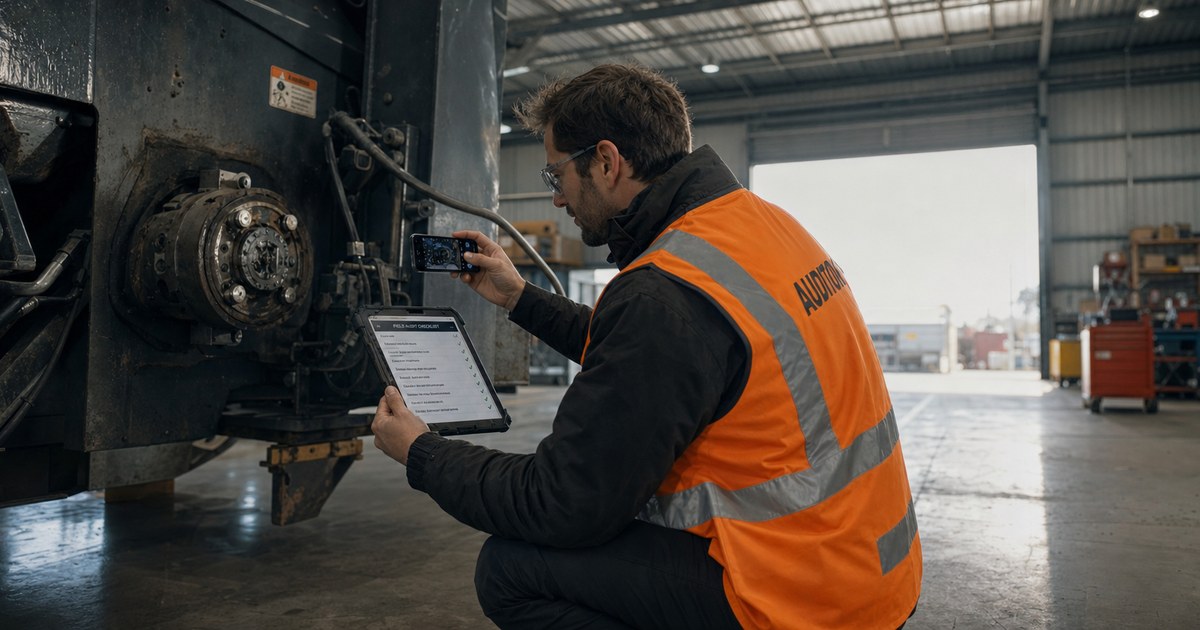
A field audit app is a mobile tool that lets auditors score a site, capture photo evidence and issue the report on the spot, and the best ones keep working when the signal drops. Your shortlisted demos probably look identical because every vendor shows a clean checklist on good Wi-Fi. This guide gives you three tests that separate real field tools from form builders: offline-first behaviour, evidence capture and report-before-you-leave-site. It adds a timed bake-off, a weighted scorecard and a check for dealer-standards fluency. Disclosure: AutoSmart sells audit software, so every test below is written as a pass/fail check you can run on any vendor, including us. If you are still on spreadsheets, read when spreadsheets break down first.
Key Takeaways
- A field audit app should let an auditor start, complete, photograph and score an audit with no signal: 69% of 100 surveyed field service leaders named data-synchronization or offline gaps their top mobile workforce challenge (TrueContext, 2026).
- Compare field audit platforms in airplane mode, on the same checklist, phones and stopwatch, with a tester who did not configure the tool.
- Field audit software should finish the scoring, photo placement, actions and signatures before the auditor leaves site; severity calls and the written summary stay human.
- A field audit vendor that understands dealer standards loads your own Original Equipment Manufacturer (OEM) checklist unchanged, and 53% of dealers say brand compliance requirements are hard to keep up with (Urban Science, 2026).
A field audit app should keep working invisibly when the signal drops: the auditor keeps answering questions, attaching photos and scoring in a local database, and the app syncs the finished audit once a connection returns. Offline-first is the design where the device, not the server, holds the working record during the visit. Even in the UK, 4G from at least one operator reaches only 96% of landmass (European Commission, 2025).
That 96% is Ofcom's operator-predicted figure as of July 2025, and it is UK-only. Check it against your own markets. Workshops with steel roofs, basements and rural sites fail first. Microsoft's Dynamics 365 team states the field reality plainly: "A technician may have a 5G connection at 9:00 AM and no signal by lunch." (Microsoft Dynamics 365 Blog, 2025)
Vendors use "offline" loosely. Offline-capable is a mode where cached forms or work orders prepared while connected can be completed without signal. Offline-first is stricter: the app creates, edits, captures media and produces output from a local database for hours or days. The table shows how to tell them apart on a phone.
| Behaviour | Typically offline-capable | Offline-first | How to test it |
|---|---|---|---|
| Start a new audit with no signal | Blocked unless prepared earlier | Works for any assigned site | Switch on airplane mode before opening the app |
| Photo capture | Few photos, queue may fail | Large photo queue stored locally | Attach 30+ photos to separate items |
| App closed mid-audit | Answers may be lost | Answers persist on relaunch | Force-quit, then reopen |
| Score and report | Waits for the server | Generated on the device | Generate the report in airplane mode |
| Reconnect | Partial uploads possible | Resumes cleanly and handles conflicts | Two auditors edit one site |
For how offline evidence capture and sync work in a dealer network, see the mobile audit software guide.
Sync-on-return is enough only for sites where the auditor opens the audit while connected and loses signal later. It fails on sites with no signal at all. Among 100 field service leaders surveyed, 69% named data-synchronization issues or offline functionality gaps as their top mobile workforce challenge, ahead of security and compliance (55%) and legacy integration (53%) (TrueContext, 2026). Among respondents planning to raise mobile technology spend, 56% named real-time sync and offline enhancements a top priority (TrueContext, 2026). That is a vendor-published survey, so treat it as direction, not proof. Ofcom says "4G coverage continues to provide the backbone of mobile experience for consumers." (Ofcom, 2025) A backbone is not blanket coverage, and your worst site is the one that matters.
Yes, one app can handle both, provided a field equipment audit checklist app binds each fault photo to the checklist line it documents. A field equipment audit checklist app is a mobile checklist where a failed item opens the camera, stores the image against that line and carries both into the report. If photos sit in a separate camera roll, the auditor still matches them up by hand later.
The clipboard-plus-camera habit creates the afternoon of rework. Someone has to work out which photo belonged to which bay, lift or tool. Four checks tell you whether a field audit app removes that step.
The fourth test matters because equipment records have to be produced on request. Under UK LOLER guidance (as summarised by Cryotos in 2026), accessories and people-lifting equipment need examination every 6 months and other lifting equipment every 12 months, with the written report kept and producible (Cryotos, 2026). That is a vendor-adjacent summary, so verify it against Health and Safety Executive guidance for your market. The same logic applies to any equipment standard in your dealer network.
| Workflow | Clipboard plus camera roll | One-app record |
|---|---|---|
| Linking a fault to its photo | Matched by hand after the visit | Photo stored against the failed item |
| Time to a usable record | After the auditor rebuilds it | Available at the end of the visit |
| Retrieving a past equipment record | Search files and folders | Open the item's history |
For workshop-specific programmes, see how 5S audits run across a dealer network and how safety audit management tracks corrective actions.
Field audit software should automate everything that is arithmetic or assembly: scoring, photo placement, action creation, signatures and distribution, so the report exists before the auditor leaves the site. Salesforce research found technicians waste over 7 hours every week on administrative tasks (Salesforce, 2025), the rebuild-the-report problem in numbers.
Our data: AutoSmart's customer data shows audit cycle compression from 10 days to 3 days. For some dealerships, teams spend 3 to 4 hours after each audit preparing and consolidating Excel calculations, sign-off sheets, PowerPoint reports and photo evidence.
Mobile workers say 18% of their working hours go on admin such as filling out forms and hunting for information, and 37% say admin keeps them from their actual job (Salesforce, 2025). Those are self-reported figures for field service generally, not audit teams, but the pattern matches what dealer networks describe.
A dealer visit report is the formal record of what was assessed, found and agreed during a site visit. The test is whether it is complete when the auditor stands up to leave.
| Step | Automate? | Why |
|---|---|---|
| Weighted scoring | Yes | Arithmetic, identical for every auditor and site |
| Placing photos in the report | Yes | Assembly, if photos are bound to items |
| Creating corrective actions from failed items | Yes | Rule-based, with owner and due date |
| Digital sign-off by auditor and dealer | Yes | Time-stamped record at the visit |
| Distributing the report | Yes | No manual download and email |
| Severity of a borderline finding | No | Needs the auditor's judgment |
| Narrative summary | No | Needs context only the auditor has |
| Interpreting an ambiguous standard | No | Needs the brand standards manager |
For the reporting side, the operational audit management guide looks at replacing the manual PowerPoint reporting cycle.
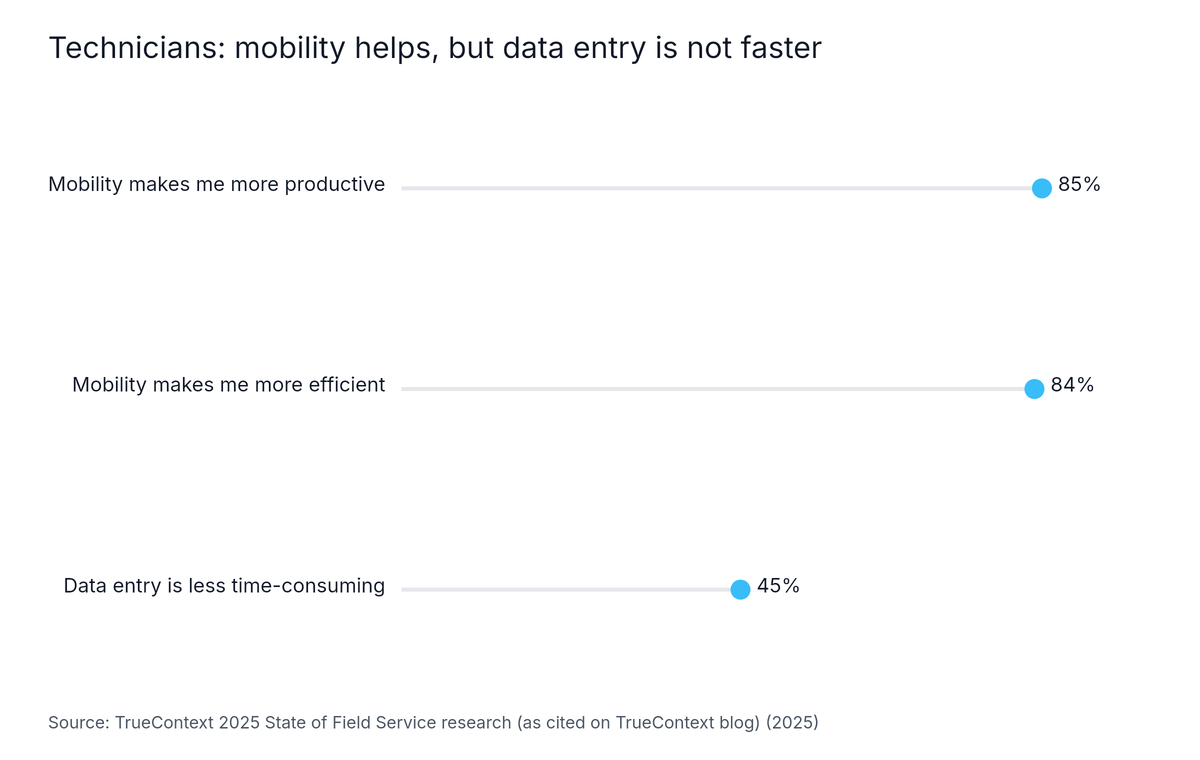
Going digital is not the same as removing the work. In TrueContext's 2025 State of Field Service research, 85% of technicians say mobility makes them more productive and 84% more efficient, but only 45% say data entry is less time-consuming (TrueContext, 2025). That is vendor-commissioned research, but the finding is useful: a form builder moves the clipboard onto glass and leaves the rebuild in place.
Source: TrueContext 2025 State of Field Service research (as cited on TrueContext blog), 2025
Technicians estimate AI systems could handle 35% of their administrative tasks (Salesforce, 2025). That is an expectation, not measured savings, so use it to temper "fully automated" claims. Rule-based steps such as scoring, photo placement and action creation do not depend on AI at all. Judge a platform on what it finishes today, not on roadmap promises.
Test all three field audit platforms on the same checklist, the same phones and the same stopwatch, in airplane mode, with someone who did not configure the tool. Score each on offline-first behaviour, evidence capture and time to a finished report. Salesforce's 2026 research found 66% of field service leaders report rising mobile worker turnover, so a fresh auditor should run the test.
Demos hide failures because the vendor controls the network, the device and the template. Your pilot should remove all three advantages. In that Salesforce research, insufficient training on new technology was the top driver of turnover (Salesforce, 2026). The same research found 61% of field service leaders say mobile workers have limited access to the customer data they need on site (Salesforce, 2026). Both point the same way: a new auditor should be able to finish the audit unaided, with the site context on the phone.
The weights below are a suggested starting point, not sourced data. Adjust them to your network.
| Test | Pass/fail measure | Suggested weight |
|---|---|---|
| Offline-first behaviour | New audit, 30 photos and relaunch all work with no signal | 30 |
| Evidence capture | Live, timestamped, geotagged photo bound to the checklist item | 25 |
| Report before leaving site | Score, photos, actions and signatures complete in minutes | 25 |
| Dealer-standards fit | Your OEM checklist and weightings load unchanged | 10 |
| New-user usability | Untrained auditor completes the audit unaided | 10 |
Pair this with the demo scenarios for dealer compliance audit software for further stress tests before you decide.
A field audit vendor understands dealer standards when it can load your own Original Equipment Manufacturer (OEM) checklist, with its weightings and section structure intact, and score it identically for every auditor. More than half of dealers (53%) say brand compliance requirements are hard to keep up with (Urban Science, 2026), so fluency matters.
Urban Science, which ran the 2026 Harris Poll behind that figure, puts it this way: "More than half (53%) of dealers agree brand compliance requirements are difficult to keep up with" (Urban Science, 2026). The poll was vendor-commissioned, so read it as direction.
Dealer Operating Standards (DOS) are the written requirements an OEM sets for how a dealership must operate. Generic Environmental, Health and Safety (EHS) tools usually handle single-site checklists well and struggle with a dealer network's tiers and brands.
The last question is where many tools stop at the report, and closure is where manual follow-up leaks.
Our data: Each audit typically generates 8 to 20 findings. Under a manual process, the same finding may need 4 to 5 follow-ups, including escalations, before closure.
Closed-loop tracking means each failed item becomes an owned, dated action with closure evidence. For more on what generic tools miss, read about audit software built for dealer networks, or see how one approach covers Dealer Operating Standards, 5S and mystery shopping.
A form builder is enough for teams with one site, a short checklist and no scoring. The three field audit app tests are for networks that need offline-first behaviour, evidence capture and a report before the auditor leaves. The evidence has limits: the 69% figure from a 2026 survey of 100 field service leaders (TrueContext, 2026) is vendor-published and covers field service, not audits.
Specific limits to keep in mind:
Most of the arithmetic and assembly in a field audit can be automated: scoring, photo placement, action creation, signatures and distribution. Judgment calls such as severity and the written summary stay with the auditor. Technicians estimate AI systems could handle 35% of their administrative tasks (Salesforce, 2025), which is an expectation, not measured time saved.
A field audit tool needs offline-first behaviour, not just sync-on-return, whenever any site has weak signal. Sync-on-return works only if the audit was opened while connected. In a 2026 survey of 100 field service leaders, 69% named data-synchronization issues or offline functionality gaps as their top mobile workforce challenge (TrueContext, 2026).
Field audit software should automate scoring, photo placement, corrective-action creation, digital sign-off and report distribution, so the auditor leaves with a finished report. Mobile workers say 18% of their working hours go on admin such as filling out forms (Salesforce, 2025). Software cannot replace the auditor's severity calls or written summary.
Ask the vendor to load your own checklist, with weightings and sections unchanged, then run a real audit on a phone. A platform that understands dealer standards handles Dealer Operating Standards (DOS), multi-brand programmes and distributor tiers without custom development. In 2026, 53% of dealers said OEM brand compliance requirements are hard to keep up with (Urban Science, 2026).
Run all three retail audit platforms on the same checklist, phones and conditions: airplane mode, 30 photos, a force-quit mid-audit and a stopwatch from last answer to finished report. Use a tester who did not configure the tool. Salesforce's 2026 research found 61% of field service leaders say mobile workers have limited on-site data access (Salesforce, 2026).
Choosing a field audit app comes down to behaviour you can measure, not features on a slide. Keep these takeaways:
Run the scorecard on all three shortlisted platforms, then compare the results with how field audit software for dealer networks handles one mobile workflow. AutoSmart's data shows go-live is achievable in 5 to 10 working days once configuration inputs are shared, so a pilot on your own checklist is realistic. Schedule a Free Demo and bring your toughest site.
© 2026 AutoSmart Technology All rights reserved.

