Blog
Dealer Audit Software: A Buyer's Checklist for OEMs and Dealer Groups
Dealer audit software explained: what it replaces, how it differs from generic inspection apps, and eight tests to run in a demo before you buy.

Field audit software eliminates 3-4 hours of post-visit consolidation per dealership. See how evidence capture, scoring and DVR generation work in one mobile workflow.
 Naseef UmarOct 7, 2026
Dealer audit software explained: what it replaces, how it differs from generic inspection apps, and eight tests to run in a demo before you buy.
Score a 3-bay workshop and a flagship showroom fairly on one retail audit checklist: format profiles, N/A arithmetic, weighting and guardrails.

Franchise compliance software for networks past 50 sites: self-assessment controls, multi-market visibility, corrective-action tracking and visit cost maths.
Request a quote and our experts will contact you within 24 hours with tailored solutions and pricing.
You can also send us a quick email at info@autosmarts.co.
AutoSmart Technology
Last updated: Sep 30, 2026
By Naseef Umar, Founder and CEO, AutoSmart Solutions
Field audit software is a purpose-built mobile platform that lets dealer network auditors capture geo-tagged evidence, calculate weighted scores against brand standards and generate a dealer visit report in a single mobile session, without manual assembly after leaving the site.
The problem most audit teams face is not a lack of tools. Their tools stop at data collection. Photos sit in a camera roll, scores get recalculated in Excel and the dealer visit report gets built in PowerPoint after the auditor has driven home. That post-visit consolidation typically costs 3-4 hours per dealership. Across a network running 17 to 18 audit programmes, the time cost is structural.
This article breaks down exactly what a purpose-built field audit platform eliminates, what generic mobile forms still leave to the auditor, and how the evidence-scoring-DVR workflow runs in one mobile session.
Key Takeaways
- Post-visit consolidation of 3-4 hours per dealership is caused by disconnected tools, not auditor speed. Purpose-built field audit software eliminates this by keeping evidence, scoring and the dealer visit report in one workflow.
- A 90-day time-and-motion study found mobile inspection cut total inspection time by 67% and errors by 94% - by eliminating form retrieval, photo matching and manual submission, not by working faster (Heavy Vehicle Inspection, 2024).
- Generic mobile form apps collect answers but leave scoring, DVR assembly and corrective action assignment as manual tasks outside the app.
- Every failed checklist item should automatically become an owned, dated, tracked corrective action. Most audit workflows break at this step.
- 53% of dealers say brand compliance requirements are difficult to keep up with (Urban Science / Harris Poll, 2026). Slow audit tooling makes that burden worse.
Field audit software eliminates the manual consolidation work after every dealership visit: reassembling photos, recalculating weighted scores in Excel, writing the dealer visit report and logging corrective actions separately. A 90-day time-and-motion study tracking 2,847 inspections found mobile cut inspection time by 67% and errors by 94% - not by working faster, but by removing steps that exist only because the medium is paper (Heavy Vehicle Inspection, 2024).

As the 90-day field study authors put it: "Mobile doesn't make inspectors work faster - it eliminates wasteful activities (form retrieval, physical travel, photo matching)." (Heavy Vehicle Inspection, 2024). That distinction matters for a Head of Network Development evaluating platforms. The question is not whether the app is faster to fill in. It is whether the auditor ever needs to open a second tool.
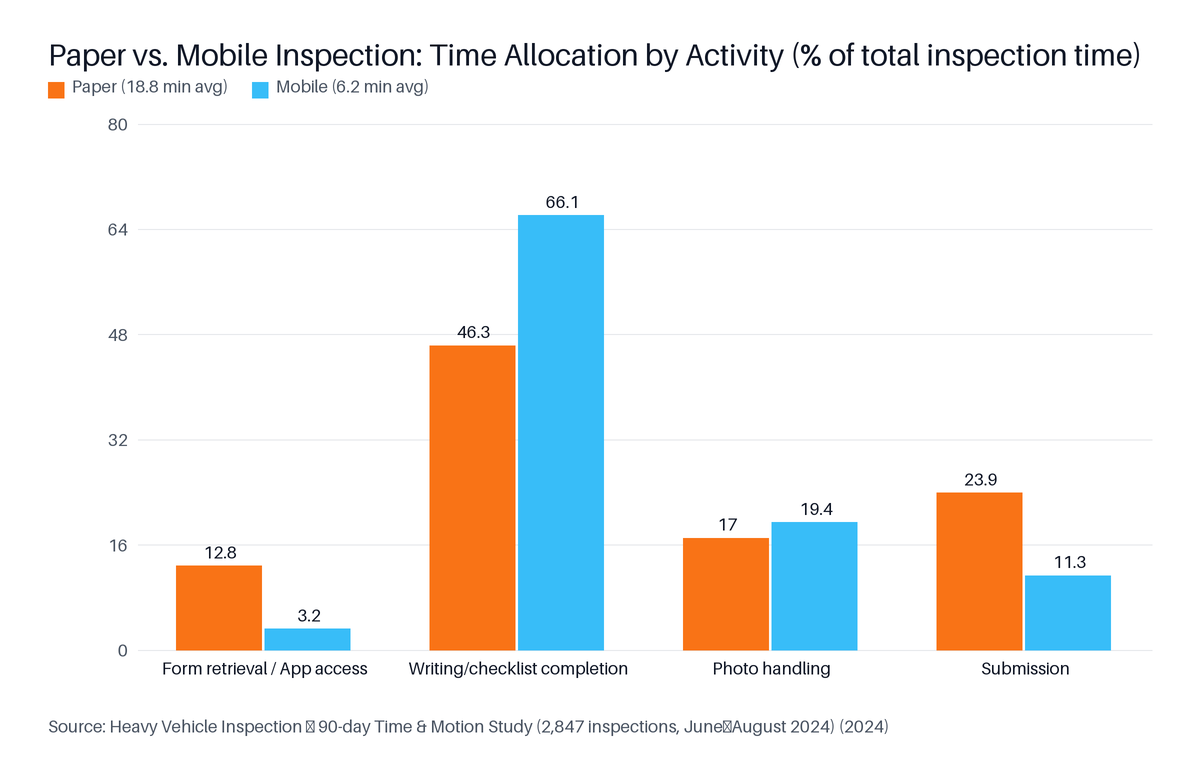
Source: Heavy Vehicle Inspection — 90-day Time & Motion Study (2,847 inspections, June–August 2024), 2024
The chart above shows where paper-based inspection time actually goes. According to the Heavy Vehicle Inspection 90-day study (2024), the breakdown across 2,847 inspections is: writing and checklist completion (46.3%), physical submission (23.9%), photo handling (17.0%) and form retrieval (12.8%). Each of these four categories represents a distinct activity a mobile-first workflow can remove or dramatically reduce. Form retrieval, photo handling and physical submission are all candidates for elimination; writing time shrinks because the auditor records answers directly in the app rather than on paper and then re-entering them later.
What a purpose-built platform removes from the auditor's post-visit task list:
A generic form app addresses item 1 partially. A purpose-built field audit platform addresses all six.
Auditors spend 3-4 hours per dealership on post-visit consolidation because the standard workflow splits evidence, scoring and reporting across tools that share no data. Photos live in a camera roll, scores sit in Excel, findings go into Word and the dealer visit report is assembled in PowerPoint after the auditor leaves the site. Nothing connects automatically, so the record is rebuilt from scratch after every visit.
The compliance burden compounds this. More than half of dealers (53%) say brand compliance requirements are difficult to keep up with, and 82% say their networks need a simpler way to manage brand contracts (Urban Science / Harris Poll, 2026). When the audit process itself adds administrative friction, the field team struggles to keep pace with Original Equipment Manufacturer (OEM) programme frequency.
| Step | Tool used | Why it takes time |
|---|---|---|
| Sort and label photos | Phone camera roll or email | No link between photos and checklist questions |
| Calculate section scores | Excel formula sheet | Weights entered manually, subject to error |
| Identify repeat failures | Previous PDF report | Must open and read the prior audit manually |
| Draft the dealer visit report | PowerPoint or Word template | Built from scratch, findings typed in |
| Log corrective actions | Separate Excel tracker | Each finding entered individually with owner and date |
| Distribute report and chase sign-off | No automated delivery or digital sign-off |
Every step above is a hand-off between tools that do not communicate. The 3-4 hours is the time required to close gaps between tools never designed to work together.
"Compliance isn't just about checking a box - it's about building a foundation of trust and transparency that supports long-term success." (Robert Newman, Director of Performance Management, Cox Automotive, 2025). A workflow that delays the report by a day or more is a compliance risk on its own. Seventy-two percent of dealers say delays in submitting compliance documentation can postpone facility incentives and negatively affect their bottom line (Urban Science / Harris Poll, 2026).
Generic mobile form tools collect checklist answers on a device but stop there. They do not calculate weighted scores against a brand standard, generate a formatted dealer visit report or convert failed items into tracked corrective actions. Every step beyond data collection remains a manual task outside the app - which is why switching from paper to a generic form app reduces physical paperwork without eliminating post-visit consolidation.

Mobile-first field service workflows can deliver 45 or more minutes of daily administrative savings per person and productivity gains of 20-30% per working day (MSI Data, 2025). Those gains materialise only when the tool is purpose-built for the task. Digitising data collection while reporting stays manual captures a fraction of the available saving.
The gap is not the checklist. It is everything between the auditor completing the form and the dealer receiving a report with owned, tracked actions. For dealer networks, a further limitation applies: generic form tools are built around a single site producing a single report. The value in a dealer network programme is comparing 50, 100 or 500 sites against one standard. That aggregate view is absent from single-site tools. For a direct comparison of field inspection versus field audit management approaches, see the AutoSmart field inspection vs audit software overview.
A purpose-built field audit platform for dealer networks runs evidence capture, auto-scoring and dealer visit report (DVR) generation inside a single mobile session on iOS or Android, online or offline. The auditor attaches geo-tagged photos to each question, weighted scores calculate in real time and the DVR generates at close-out with scores, evidence and action items - without opening a second tool.
Our data: Almajdouie Motors cut a 10-day audit cycle to 3 days after switching to AutoSmart Audit. The field team was spending nearly two weeks on every audit cycle. After the switch, they completed full audit reports in 3 days without adding headcount. (AutoSmart Audit - Almajdouie Motors case study)
The workflow runs as a single connected sequence:
AutoSmart Audit holds a 4.8/5.0 rating from 17 reviews on G2, with reviews running from March 2025 through September 2026. Recurring praise covers centralisation of all audits and action-plan follow-through (G2, 2025-2026).
Weighted scoring is a method that assigns a numerical weight to each checklist question or section, reflecting its importance under the OEM's or distributor's Dealer Operating Standards (DOS). Dealer Operating Standards (DOS) are the OEM-mandated set of operational, brand and facility criteria a dealer must meet to maintain authorisation - covering areas from showroom presentation and workshop capacity to customer experience and parts availability.
As the auditor answers each question on the mobile app, the platform multiplies the answer by the question's weight and adds it to a running total. The auditor sees the updated score in real time. The final score is graded against the brand's threshold. The breakdown by section appears in the auto-generated dealer visit report, so the dealership sees where it passed, where it failed and what carries the most weight.
Field audit apps designed for dealer networks must work offline. Many dealership sites - particularly workshops, remote service centres and petrol forecourts - have unreliable or absent mobile data coverage. An offline-first app stores the full checklist, evidence and scoring logic on the device. The auditor completes the full workflow without connectivity. When a signal is available, the app syncs automatically. Evidence integrity controls - geo-tags, timestamps and live-capture enforcement - apply identically online and offline, so there is no quality gap between a connected visit and a remote one. The evaluation cycle is the defined time interval - weekly, monthly, quarterly or annual - at which a structured audit runs against a site, with automatic rollover. An offline-capable app ensures no cycle is delayed because of a connectivity problem at the site.
The corrective action gap is where most audit workflows fail: a finding is recorded and reported, but no system assigns ownership, sets a deadline or tracks progress to closure. Each audit generates 8-20 findings; without a closed-loop system, the same finding can require 4-5 manual follow-ups before resolution. The audit team becomes a chasing team, working by email and WhatsApp rather than a system of record.

Mobile-first field management platforms deliver 45 or more minutes of daily administrative savings per person and productivity gains of 20-30% per working day (MSI Data, 2025). For field audit teams, most of that recoverable time sits in the corrective action chase - the emails, the WhatsApp messages, the follow-up calls - rather than in the audit itself.
As AutoSmart Audit's practitioner analysis puts it: "Observations are aggregated days or weeks later, shared in static documents and forgotten about before there has been time to drive any remedial action." (AutoSmart Audit, 2025). That pattern scales poorly. With 17 or 18 audit programmes running in parallel across daily, weekly, monthly, quarterly and yearly evaluation cycles, corrective actions from one cycle are still being chased when the next cycle opens.
Action Plan Tracker is the module that converts failed audit findings into owned, dated, monitored corrective actions within the same platform - without any manual transfer to a separate system. The sequence after close-out:
The next evaluation cycle opens with visibility into which prior findings were resolved, which are open and which missed their deadline. For a deeper look at how paperless workflows change the day-to-day experience for audit teams, see paperless audit software for dealer networks.
Purpose-built field audit software aggregates dealer scores into a drill-down dashboard filterable by region, brand or audit type - without manual consolidation. Leadership sees which sites are slipping and which sections fail most often, in real time. That visibility is absent when audit data lives in PDF reports or Excel exports, and 72% of dealers say compliance documentation delays can postpone facility incentives (Urban Science / Harris Poll, 2026).

Original Equipment Manufacturers (OEMs) running standards programmes across multiple markets use the network-level dashboard to compare dealer performance against one standard, regardless of country or distributor. Area Service Managers (ASMs) see their own territory. Zonal Service Managers (ZSMs) see across territories. The national or regional director sees the full picture.
When scores feed dealer excellence or incentive programmes, the platform produces the weighted section scores that determine whether a dealer qualifies for certification, performance bonuses or facility incentives. That removes the manual aggregation step that previously delayed those calculations.
| View | What it shows | Who uses it |
|---|---|---|
| Network health score | Aggregate score across all dealers, weighted by programme | Regional or national operations director |
| Dealer-level drill-down | Individual site scores by section and question | Field Audit Manager, ASM |
| Top failed questions | Questions with highest failure rate across the network | Standards manager, brand compliance lead |
| Trend by evaluation cycle | Score movement site-by-site across consecutive cycles | Dealer Development Head (DDH) |
| Open action items | Findings by status, PIC and days overdue | Aftersales Director, ZSM |
The Middle East digital transformation market reached USD 41.2 billion in 2025, forecast to grow at 14.44% annually through 2034 (IMARC Group, 2025), with manufacturing and retail as a core end-use segment. For OEMs and distributor groups in MENA and APAC, audit data feeding a live dashboard rather than a monthly PDF is part of the digital infrastructure, not a reporting add-on. For guidance on running 5S audits alongside Dealer Operating Standards in the same network, see 5S audits in a dealer network.
Field audit software is not the right tool for networks with fewer than roughly 10 sites, where an owner can walk every site personally and spreadsheets remain workable. It is also not suited to vehicle condition assessment, warranty adjudication or general survey use cases where questions are informational rather than pass/fail against a brand standard.
The inspection management software market reached USD 9.20 billion in 2024 with a 13.2% CAGR forecast through 2030 (Grand View Research, 2025). Enterprise buyers are consolidating on purpose-built platforms. Selecting the wrong category carries a real cost: a general-purpose tool missing dealer hierarchy, weighted scoring and DVR generation will not be easy to replace once embedded across a network.
Specific situations where a purpose-built dealer audit platform is not the right fit:
For teams already using an internal tool or a third-party audit firm's system, the first step is a pilot on one existing audit programme - not a full platform migration.
AutoSmart Audit handles all three in a single mobile session on iOS or Android. The auditor captures geo-tagged, timestamped photos against each checklist question, weighted scores calculate automatically as questions are answered, and the dealer visit report generates at close-out without any manual assembly. The app is offline-first, so the workflow runs in low-connectivity dealerships and syncs when connectivity returns.
A dealer visit report (DVR) is the structured outlet-level summary an auditor delivers to the dealership at the end of a field visit, covering scores by section, photographic evidence, key findings and required corrective actions. Purpose-built field audit software generates the DVR automatically at close-out, pulling scores, evidence and action items directly from the completed checklist, so nothing is assembled manually after the visit.
Generic mobile form tools handle data collection but leave scoring calculations, photo organisation, DVR assembly and corrective action assignment to the auditor after the visit. A purpose-built field audit platform embeds weighted scoring, evidence integrity controls, auto-generated reports and a closed-loop Action Plan Tracker in the same workflow. The network-level view - comparing scores across hundreds of dealers by region, brand or audit type - is absent from generic tools.
Weighted scoring in dealer audit software assigns a numerical weight to each checklist question or section, reflecting its importance under the OEM's or distributor's brand standard. As the auditor answers each question on the mobile app, the platform calculates a running score automatically. The final score is graded against the brand's threshold, and the breakdown by section is included in the auto-generated dealer visit report.
In a purpose-built dealer audit platform, every failed checklist item automatically becomes an action item in the Action Plan Tracker. The platform assigns the right Person-In-Charge (PIC), sets a due date, sends notifications and tracks progress through Kanban stages - Pending, In Progress, Completed and Approved. Escalation rules trigger overdue alerts, and closure requires the PIC to upload evidence, creating a verifiable record for the next audit cycle.
Audit scores from a purpose-built field audit platform feed directly into dealer ranking and excellence programme calculations. OEMs use weighted section scores to determine whether a dealer qualifies for facility incentives, certifications or performance bonuses. Because 72% of dealers say compliance documentation delays can postpone those incentives (Urban Science / Harris Poll, 2026), the speed and accuracy of score generation matters commercially, not just operationally.
The 3-4 hours auditors spend consolidating notes after each dealership visit is a tool-design problem, not a people problem. When evidence, scoring and the dealer visit report live in separate tools, the auditor's job does not end at the dealership.
A purpose-built field audit platform closes that gap. Evidence is captured in-app and linked to each checklist question. Weighted scores calculate as the auditor works. The dealer visit report generates at close-out. Failed items flow automatically into an owned, tracked Action Plan Tracker. The audit team stops chasing. Management gets a live dashboard instead of a monthly PDF built from email attachments.
Five key points to carry forward:
Schedule a Free Demo to see how AutoSmart Audit runs evidence capture, scoring and dealer visit report generation in a single mobile workflow for your network.
© 2026 AutoSmart Technology All rights reserved.