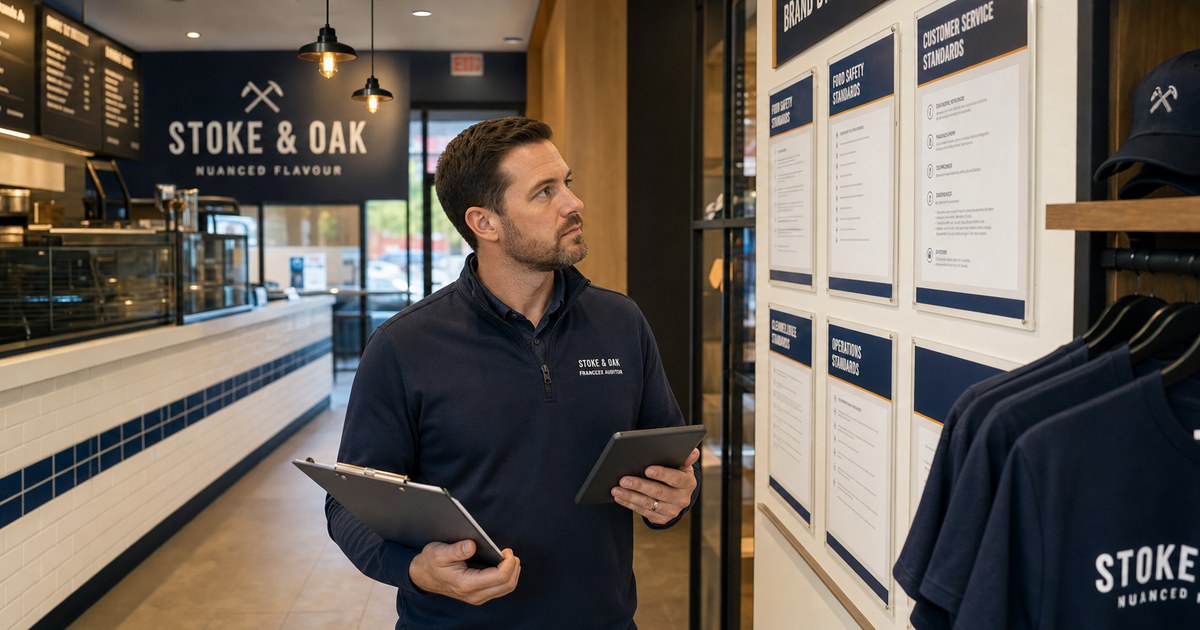
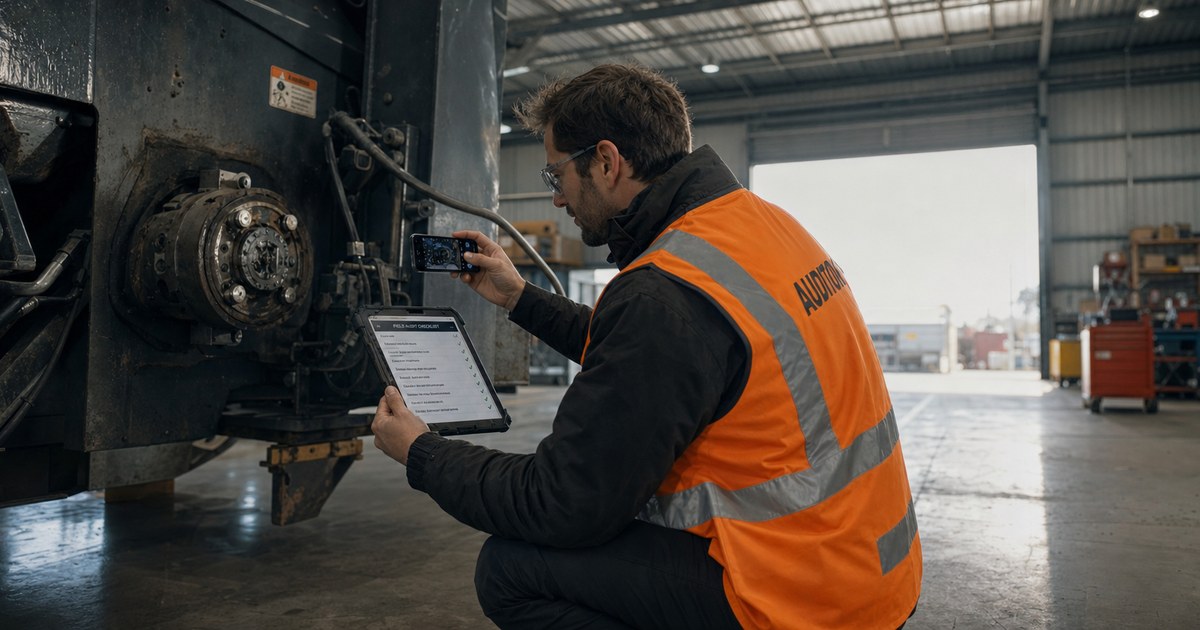
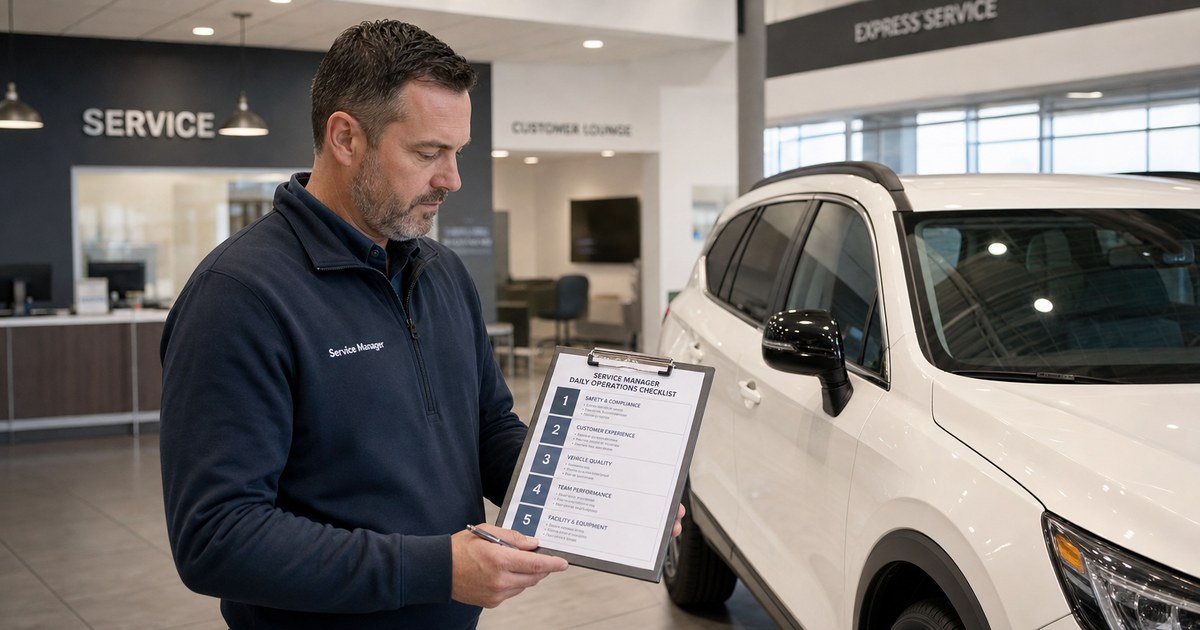
Franchise Compliance: How to Audit Sites You Do Not Own
Franchise compliance is how a brand holds independent operators to its standards. See how audit rights, cure periods and scoring differ from owned sites.
Naseef UmarNov 7, 2026
Last updated: Nov 7, 2026
Franchise Compliance: How to Audit Sites You Do Not Own
Request a quote and our experts will contact you within 24 hours with tailored solutions and pricing.
By Naseef Umar, Founder and CEO of AutoSmart, with over a decade of experience in automotive operations, dealer standards, network performance and audits.
Franchise compliance is the discipline of making sure independent franchise operators meet a brand's contractual, operational and legal standards, which means auditing sites you cannot direct the way you direct your own.
A dealer principal, a quick-service owner or a store licensee can give you the same answer when a finding lands: that's not in my agreement. If your standard isn't documented, scored and tied to a consequence, they're right. This guide covers what franchise compliance includes and how auditing franchised sites differs from auditing owned ones. It also shows what the automotive franchise model teaches other sectors, where audit scope should stop, and who runs the audits. For the tooling side, see our guide to franchise compliance software.
Key Takeaways
Franchise compliance rests on contract rights, not employment authority, so every finding must trace to a documented standard.
A consequence ladder (finding, corrective action plan, cure period, re-audit, default or non-renewal) makes enforcement defensible.
Automotive OEM dealer networks show that weighted scoring, evidence capture and published standards cycles work for any franchised brand.
A franchise audit checklist should cover brand and quality standards and stay out of hiring, scheduling and discipline.
What is franchise compliance, and what is a retail compliance audit?
Franchise compliance is the set of checks a franchisor runs to confirm that independent operators follow the franchise agreement, the brand standards and the laws that apply to both. A retail compliance audit is the structured field inspection that produces the evidence, checking whether an outlet meets a documented standard, with each question scored and backed by proof.
A retail compliance audit scores each question against a documented standard, attaches evidence such as time-stamped photos, and ends in corrective actions with owners and due dates. The audit population is large and mostly operator-owned. The International Franchise Association projects US franchise establishments will grow from 832,521 to 845,000 in 2026 (International Franchise Association, 2026).
What franchise compliance covers
Three audit types sit under the heading, and each needs its own scope and evidence:
Brand standards and operations: presentation, service, safety and product consistency at the site.
Financial and contract compliance: royalty reporting, purchasing rules and transfers.
Regulatory compliance: the federal and state rules that apply to the operator and the brand.
This guide focuses on the first type, the field audit of brand standards. That's where the owned-versus-franchised distinction bites hardest.
How does auditing a franchised site differ from auditing one you own?
Auditing a franchised site differs from auditing an owned one because authority comes from the franchise agreement, not from employment. At an owned site a manager can be told to fix a finding by Friday. At a franchised site, access needs notice, findings must trace to a documented standard, and enforcement runs through a cure period. Only 76% of franchisees trust their franchisor (Franchise Business Review, 2026).
Dimension
Owned site
Franchised site
Source of authority
Employment and ownership
Franchise agreement and brand standards
Access
Unannounced visits are routine
Governed by notice and audit-rights clauses
Fixing a finding
Instruct the manager
Corrective action plan with a cure period
Who pays for fixes
Your P&L
The operator's P&L
Enforcement
Performance management
Re-audit, then default or non-renewal
Staff direction
You direct the work
Must stay clear of employment terms
Trust is the working currency
Trust decides whether an audit lands as coaching or policing. Franchise Business Review's 2026 benchmark covered 26,000 franchisees across 330 brands. It found 78% respect their franchisor and 76% trust them (Franchise Business Review, 2026). Roughly one in four doesn't trust you when you arrive.
The gap between brands is wide. As the researchers put it, "Franchisees from the 50 brands ranked highest for franchisee satisfaction are more than twice as likely to trust their franchisor" (Franchise Business Review, 2026).
Head office tends to see a warmer picture. In the International Franchise Association's 2025 survey of 171 franchisor executives, 85% described the relationship with franchisees as positive (International Franchise Association, 2025). That's a self-report by franchisors only.
The consequence ladder
A cure period is the fixed window a franchisee has to correct a finding before the franchisor escalates. It sits inside a ladder that makes enforcement predictable:
Finding: a scored non-compliance with photo or document evidence.
Corrective action plan: an owner, a due date and a closure test for each finding.
Cure period: the agreed window to fix it.
Re-audit: a repeat check of the failed items.
Default or non-renewal: the contractual consequence if the cure fails.
Money shapes how operators react to the ladder. In the same IFA survey, 42% of franchisor executives named unit economics as the single most important factor in the franchisor-franchisee relationship (International Franchise Association, 2025). A finding that costs money lands on the operator's own P&L.
What can the automotive franchise model teach other franchise networks?
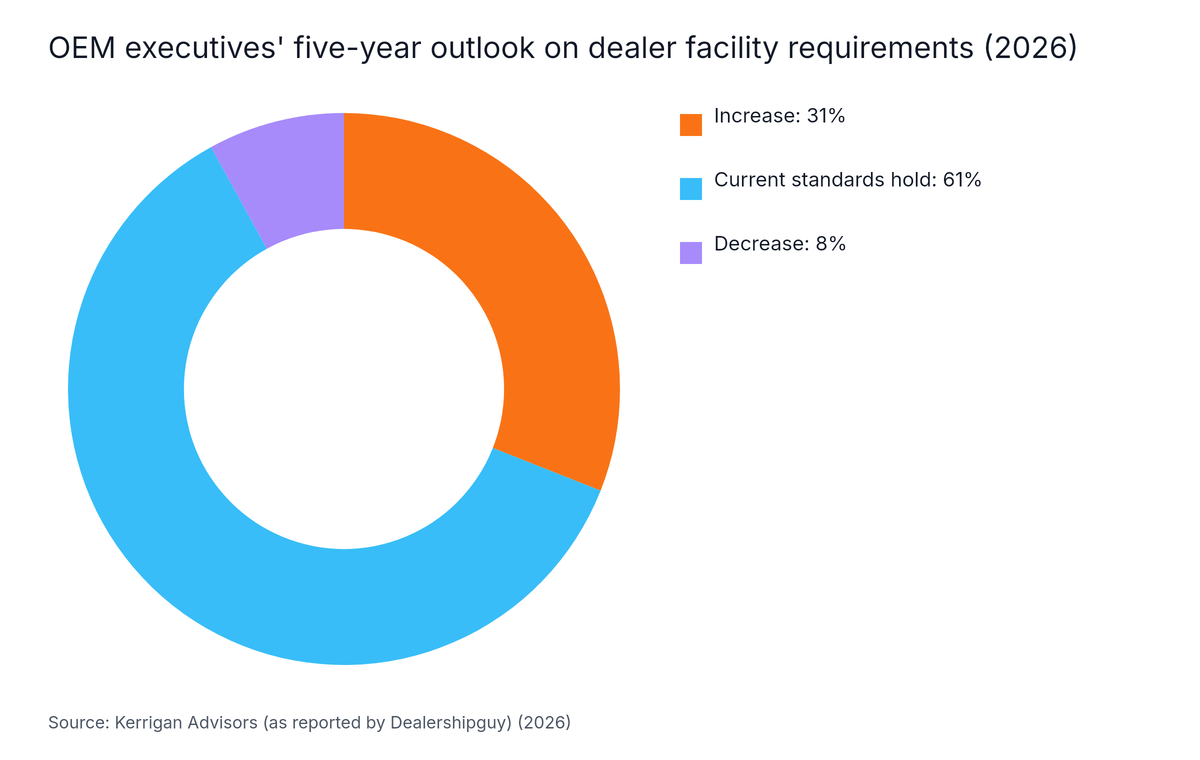
Automotive Original Equipment Manufacturer (OEM) dealer networks run a well-developed franchise audit model, and four pieces transfer to any franchised brand: a weighted scorecard, evidence captured on site, standards that escalate on a published cycle, and consequences tied to the agreement. In 2026, 61% of OEM executives expected dealer facility standards to hold and just 8% expected a decrease (Kerrigan Advisors via Dealershipguy, 2026).
The four transferable pieces
A weighted scorecard. A weighted scorecard is a checklist where each question carries a set weight, so every auditor produces the same score for the same facts. Without standard forms and scoring guidance, scores tend to drift between auditors, and a disputed score is then hard to defend.
Evidence captured on site. Live photos with date, time and location stamps make a contested finding defensible. Our guide to mobile audit software for dealer networks covers offline capture.
Standards on a published cycle. Operators can plan for a revision they've seen coming.
Consequences in the agreement. Scores that carry no contractual weight become suggestions. See how OEMs structure this in dealer performance audits.
What the standards cost the operator
Site standards are a capital negotiation, not a checklist item. An architect quoted contractor estimates of $250 to $600 per square foot for one image-compliance project. That is $10 million to $24 million for a 40,000-square-foot dealership. Manufacturers typically refresh image programs every seven to 10 years (CBT News, 2026). These are estimates, not survey results.
Dealers feel the cost of these standards. In Kerrigan Advisors' 2025 dealer survey, 42% expected OEM-required real estate and property investments, including EV infrastructure, to hurt future profits. Only 13% projected better earnings (Kerrigan Advisors, 2025).
Donut chart: OEM executives' five-year outlook on dealer facility requirements (2026). Highest: Current standards hold at 61%.
The 2026 OEM outlook on dealer facility requirements over five years splits three ways: 31% expect an increase, 61% expect current standards to hold and 8% expect a decrease (Kerrigan Advisors via Dealershipguy, 2026). The same survey found 45% of OEM executives expect fewer dealers in five years, up 12 points from 33% in 2025 (Kerrigan Advisors via Dealershipguy, 2026). Compliance now feeds consolidation decisions.
Where should a franchise audit checklist stop?
A franchise audit checklist should stop at brand, quality and safety standards and stay out of hiring, scheduling, pay and discipline. In February 2026 the National Labor Relations Board (NLRB) reinstated its 2020 joint-employer test, which needs substantial, direct and immediate control over essential employment terms (Holland & Knight, 2026). Day-to-day control of a franchisee's staff is where audit scope creates exposure.
A joint employer is a business treated as a co-employer of another firm's staff because it holds substantial, direct and immediate control over essential employment terms. Holland & Knight summarised the 2026 rule this way: "The reinstated 2020 rule applies a narrower joint employer test, requiring substantial direct and immediate control over essential terms and conditions of employment" (Holland & Knight, 2026). The rule took effect on February 27, 2026.
The Department of Labor (DOL) proposed a parallel rule on April 22, 2026. The DOL proposal says quality-control and brand-standard requirements do not, standing alone, make joint-employer status more or less likely (Sullivan & Cromwell, 2026). The DOL's final status was not confirmed at the time of writing (October 2026). Foley & Lardner warns that "a franchisor that exercises day-to-day control over a franchisee's employees could still be found to be a joint employer" (Foley & Lardner, 2026).
Usually safe to audit
Leave to the operator
Signage, layout and presentation
Hiring and firing decisions
Product and service quality
Scheduling and shift assignments
Safety and legal compliance items
Pay rates and discipline
Evidence of completed corrective actions
Day-to-day supervision of staff
This isn't legal advice. Have counsel review the checklist before it goes into the field.
Who provides franchise compliance audits?
Franchise compliance audits are provided by four groups: the franchisor's in-house field team, third-party audit firms, mystery shoppers, and franchisees through self-assessment. Third-party retail programs quote indicative prices of $50 to $150 per planogram audit visit and $40 to $150 per mystery shop visit (T-ROC, 2026), a vendor range rather than a market average.
Provider
Best for
Independence
Watch out for
In-house field team
Brand standards and corrective-action follow-up
Medium
Travel time and inconsistent scoring
Third-party audit firm
Scale, or a neutral view for disputed sites
High
Cost per visit and standard drift
Mystery shopper
Customer-experience and service behaviour
High
Narrow scope, no operational depth
Franchisee self-assessment
Frequent low-risk checks between visits
Low
Needs verification against independent audits
Self-assessment and follow-up
Self-assessment extends coverage without extending travel, but it needs a check against independent audits. Pick a random sample of self-assessed sites each cycle and send an auditor to repeat the same questions. Compare the two scores, and treat large gaps as a trigger for a full visit.
Our data: AutoSmart's data shows the audit cycle compressed from 10 days to 3 days. AutoSmart's data shows each audit generates 8 to 20 findings, and under a manual process each finding needs 4 to 5 follow-ups, including escalations, before closure. AutoSmart estimates that moving suitable checks to self-assessment could cut physical visits by 30 to 40%. At an average of $500 per visit, that would save approximately $15,000 to $20,000 per 100 visits. These are company-reported figures and estimates, not independent research.
What are the limits of franchise compliance auditing?
Franchise compliance auditing has limits: independent operators can contest scores, evidence on audit effectiveness is thin, and costly standards can push operators out. Trust is uneven, with 76% of franchisees trusting their franchisor (Franchise Business Review, 2026). This guide uses only sourced figures and flags gaps. Auditing is not built for networks of only company-owned sites.
Thin evidence on effectiveness. Claims that auditing at a set frequency lifts adherence by a set percentage are mostly vendor statements without a stated method. Treat them with caution.
Thin data on self-report accuracy. One vendor survey reports that 84% of franchisors have found franchisees using off-brand or unapproved content (Marvia, 2026). It states no sample size or method, so read it as a signal, not proof.
Legal change. The joint-employer rules are moving, and the DOL proposal's final status is unconfirmed.
Operator resistance. Costly standards test the relationship, and audits do not fix that on their own.
Who this is not for. A single-site business, or a network of only owned sites, doesn't need contract-based enforcement. A standard operating procedure and a manager's instruction will do.
Frequently Asked Questions
What is a retail compliance audit?
A retail compliance audit is a structured inspection that checks whether a store or outlet meets a documented set of standards, such as brand presentation, operations, safety and contract terms. Each question is scored, backed by evidence such as time-stamped photos, and followed by corrective actions with owners and due dates. In franchised networks, it runs under the audit rights written into the franchise agreement.
Who provides franchise compliance audits?
Franchise compliance audits are provided by the franchisor's in-house field team, third-party audit firms, mystery shoppers and, for suitable checks, franchisees assessing themselves. In-house teams know the standard best, third parties add independence, and mystery shoppers test the customer experience. Indicative vendor rates run $50 to $150 per planogram audit visit and $40 to $150 per mystery shop visit (T-ROC, 2026).
Does auditing franchisees create joint employer liability?
Auditing franchisees does not create joint employer liability on its own, but audit scope matters. The U.S. Department of Labor's April 2026 proposal says quality-control and brand-standard requirements do not, standing alone, make joint-employer status more or less likely (Sullivan & Cromwell, 2026). Day-to-day control over a franchisee's employees can still create exposure, so keep checklists on brand standards and take legal advice.
What is the difference between a brand standards audit and a financial audit?
A brand standards audit checks what customers and staff experience at the site, such as presentation, service and safety, while a financial audit checks money, such as royalty reporting. Brand standards audits are scored on a checklist and fixed through corrective actions. Financial audits examine business records. Each needs its own scope and evidence.
Conclusion
Franchise compliance works when the standard is written down, scored the same way by every auditor and tied to a consequence the operator agreed to in advance. Auditing sites you do not own is a contract exercise, run with trust, not instruction.
Trace every finding to a documented standard.
Use a weighted scorecard and stamped evidence so scores survive a dispute.
Run the consequence ladder: corrective action plan, cure period, re-audit, then default or non-renewal.
Keep the checklist on brand standards and away from employment terms.
Choose providers by scope and independence, not habit.
If your audit programme still runs on spreadsheets and email chains, the next step is to see it working on one of your own standards. Schedule a Free Demo and bring your toughest checklist. For a broader view of network audits, read about automotive network audit software built for dealer networks.
Written by
Naseef Umar
Founder | CEO
Naseef Umar is an automotive industry expert and the Founder & CEO of AutoSmart, with over a decade of experience working across automotive operations, dealer standards, network performance, audits, and digital transformation.
 Naseef UmarNov 7, 2026