franchise compliance and reporting toolswho provides automotive software with strong compliance and reporting featuresautomated compliance reporting software
Franchise Compliance and Reporting Tools: Automating the HQ Report for a Dealer Network
What franchise compliance and reporting tools replace in a monthly board deck, what stays human, and how to standardise HQ reporting across a dealer network.
Request a quote and our experts will contact you within 24 hours with tailored solutions and pricing.
Franchise Compliance and Reporting Tools: Automating the HQ Report for a Dealer Network
Franchise compliance and reporting tools are software that collect audit and standards data from every dealer, score it with one set of rules, and produce the HQ and board reports without anyone rebuilding a deck by hand. If head office has mandated identical reporting across every market, spreadsheets and a monthly slide rebuild won't hold. This guide covers what automated reporting replaces, what it can't, and which definitions to fix so the HQ report stands up. It builds on our overview of franchise compliance software. It is written for the Dealer Standards or Network Quality Manager who owns the deck today.
Key Takeaways
Standardised HQ reporting needs four layers: audit capture with scoring, corrective-action tracking, a drill-down dashboard and a named human sign-off.
Automated compliance reporting software replaces collection, scoring, formatting and chasing. It does not replace judgement, enforcement decisions or the board narrative.
Definitions come before software: one scoring rule, one submission calendar and one owner per finding across all markets.
No independent source shows one vendor covering audits, OEM data feeds, regulatory compliance and board reporting, so evaluate by criteria.
By Naseef Umar, Founder and CEO of AutoSmart. He has over a decade of experience in automotive operations, dealer standards, network performance and audits.
Our HQ has mandated standardised reporting across every market: what tooling do we need to actually deliver it?
An HQ mandate for standardised reporting needs four tooling layers: audit capture with scoring, corrective-action tracking, a drill-down dashboard and a named human sign-off. Manual upkeep is the weak point. In a 2026 Diligent survey of legal-entity compliance teams, 52% spent six or more hours a week on filing tracking, deadlines and record updates (Diligent, 2026).
Stacked printed dealer scorecards with a metal clip on a regional manager's desk
Standardised reporting is one set of data definitions, scoring rules and a submission calendar applied to every dealer in every market. The tooling has to deliver each part of that. The Diligent group is not a dealer network, so read the figure as an adjacent signal of how heavy manual tracking gets.
The four layers, in order
Audit capture and scoring. Every dealer and auditor completes the same checklist. Photos are taken live, with date, time and location stamps. Weighted scoring runs on submission, so a score in one market means the same as a score in another.
Corrective action. Each non-compliance becomes an action with an owner, a due date and closure evidence. An Action Plan Tracker is a closed-loop workflow that converts each non-compliance into an owned, dated action item tracked to closure.
Management view. A drill-down dashboard is a live view that lets a manager move from network performance to region, dealer, pillar and individual finding.
Human sign-off. A named person confirms the report is accurate before it goes to HQ or the board.
A field audit platform built for dealer networks covers the first three layers. See how automotive network audit software differs from generic checklist tools.
What HQs are asking dealers to report now
OEM requirements are becoming formal and auditable. Mercedes-Benz announced in January 2026 that its dealers must have a qualified information security program in place by September 30, 2026, and ISO 27001 or TISAX Level 2 satisfies it (A1 Ops, 2026). That source is an IT services blog, so confirm the detail against Mercedes-Benz documentation. The point for a standards manager is that each new mandate adds another line HQ will want reported in one format.
I rebuild the same compliance deck for the board every month: what does automated reporting actually replace?
Automated compliance reporting software replaces the mechanical work behind a monthly board deck: pulling data from each dealer, reconciling scores, formatting slides and chasing late submissions. In a Diligent survey, 55% of governance teams still keep compliance data in spreadsheets, Word documents and SharePoint, and only 33% use a dedicated platform (Diligent, 2026).
Laptop showing a blank slide deck beside a printed checklist with photo prints
Automated compliance reporting software is a system that collects dealer or site data, calculates scores and produces management and board reports without manual compilation. The table splits a typical monthly deck into its parts.
Deck component
How it works manually
What automation replaces
What stays human
Data pull
Emailing dealers, collecting Excel files
Direct capture in one checklist, scored on submission
Deciding why a dealer is late
Scoring
Per-auditor spreadsheet formulas
One weighted rule applied to every site
Setting the weights
Evidence
Photos pasted into PowerPoint
Evidence attached to each question, time-stamped and geotagged
Judging whether evidence is adequate
Trend slides
Last month's deck copied and edited
Evaluation cycle history compared automatically
Explaining why a trend moved
Exceptions
Hunting for failed items
Non-compliances become tracked actions
Waiver and escalation calls
Commentary
Written from scratch
Nothing
Writing the narrative and signing off
An evaluation cycle is a recurring audit period (weekly, monthly, quarterly or custom) that groups audits so trends compare like with like. For the PowerPoint step, see replacing the manual reporting cycle.
Our data: AutoSmart's customer data shows an audit cycle compression from 10 days to 3 days. The figure is AutoSmart's own, not independent research, and it is recorded at audit-cycle level without a stated audit type or customer. AutoSmart's data also shows that each audit generates 8 to 20 findings, and that under a manual process each finding needs 4 to 5 follow-ups, including escalations, before closure. After a field audit, some teams spend 3 to 4 hours on Excel calculations, sign-off sheets, PowerPoint reports and photo evidence. Go-live is achievable within 5 to 10 working days once the customer shares the required configurations.
How common is full automation?
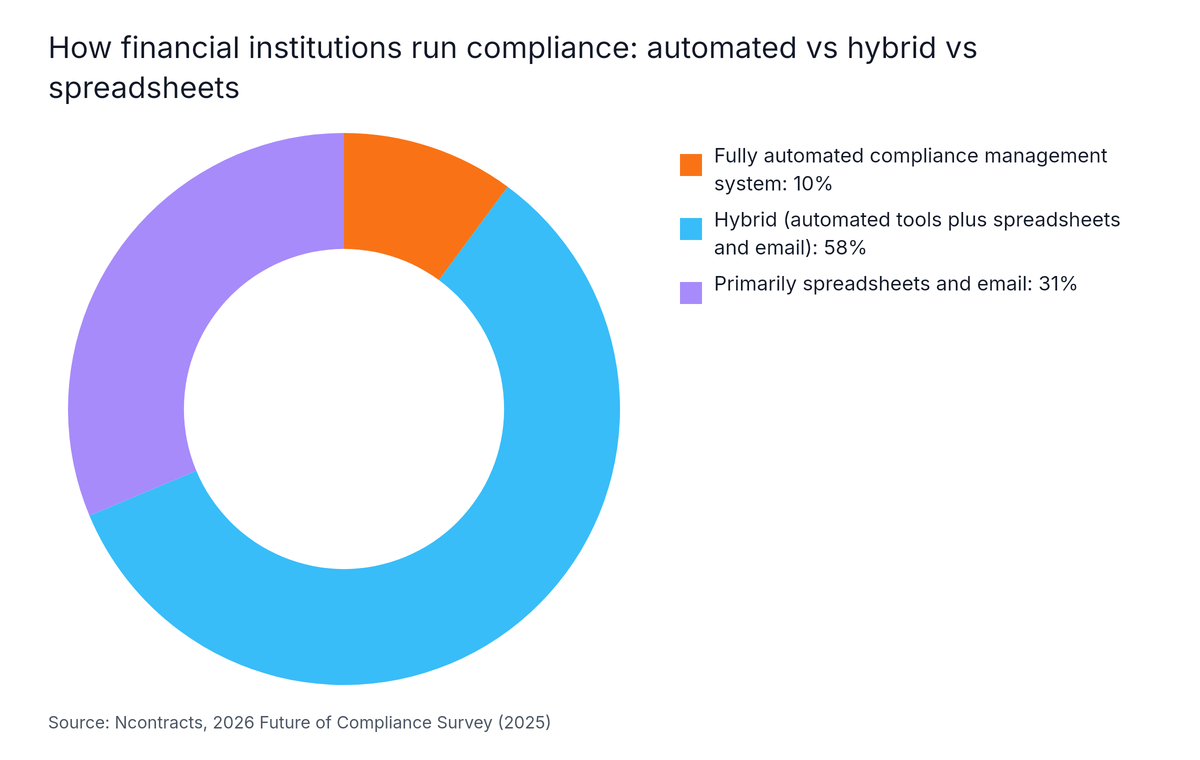
Even where automation is mature, hybrid is the norm. In the Ncontracts 2026 Future of Compliance Survey of 180+ financial institutions, only 10% run a fully automated system. Another 58% run a hybrid, and 31% rely primarily on spreadsheets and email (Ncontracts, 2025). This is lending, not dealerships. The pattern is still a fair analogy.
Donut chart: How financial institutions run compliance: automated vs hybrid vs spreadsheets. Highest: Hybrid (automated tools plus spreadsheets and email) at 58%.
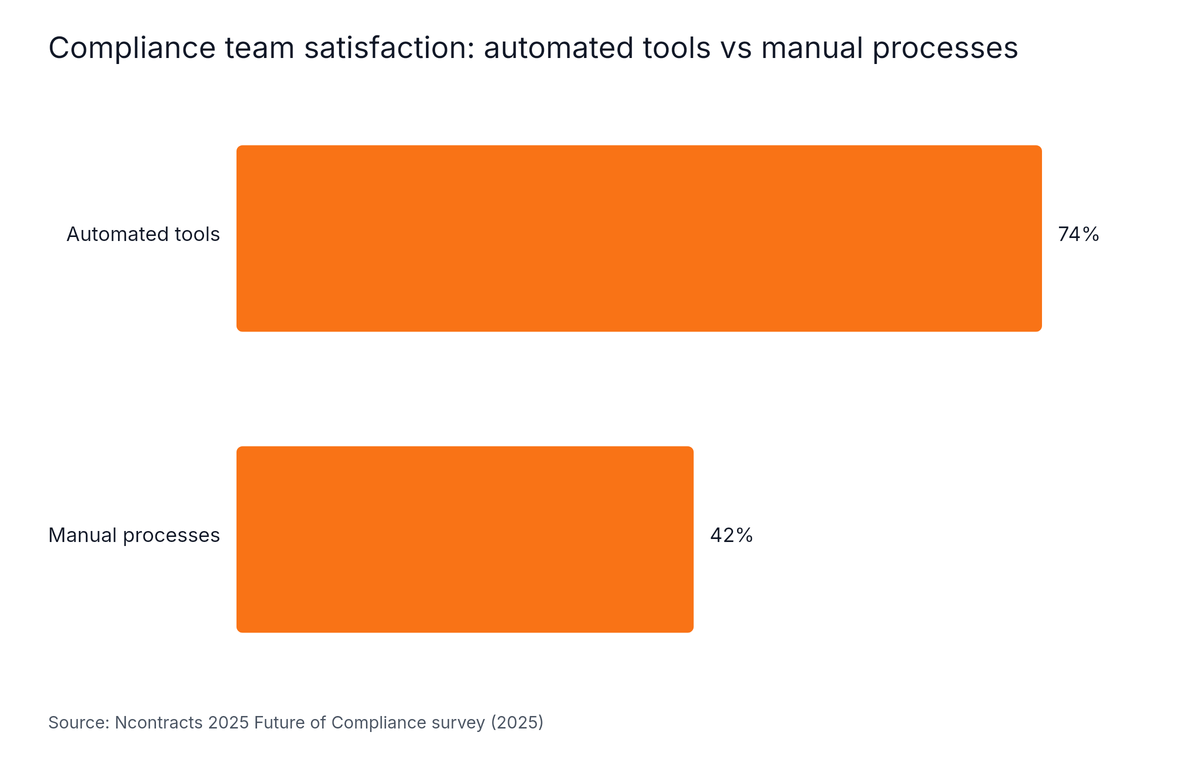
The same survey reports that teams on manual processes drew "7x more examiner questions and concerns" (Ncontracts, 2025). Satisfaction was 74% for teams on automated tools against 42% for teams on manual processes (Ncontracts, 2025). That is correlation, not proof of cause.
Horizontal Bar chart: Compliance team satisfaction: automated tools vs manual processes. Highest: Automated tools at 74%.
What can automated compliance reporting not do for a dealer network?
Automated compliance reporting cannot judge whether an exception was legitimate, repair bad source data, decide on enforcement or waivers, or write the board narrative. The Thomson Reuters Institute puts the principle plainly: "Organizations must strategically determine appropriate AI applications while maintaining rigorous human oversight and validation protocols." (Thomson Reuters Institute, 2025)
Manager's hand holding a pen over a signed report page in a boardroom
Four jobs stay with a person:
Judging exceptions. A score drop may be a real decline, a data-entry error or a changed OEM rule. Software flags it. You decide which.
Fixing source data. If dealers read a question differently, the software scores the confusion consistently. Bad inputs still give a clean-looking wrong answer.
Enforcement. Waivers, escalation and commercial consequences are management decisions.
Attestation. A named person confirms the report is accurate before it reaches the board.
Why the board still needs a narrative
Board confidence in risk reporting is low, even with tooling. Only 21% of legal leaders are very confident their board receives the right mix of risk information (Diligent Institute, cited by Diligent, 2026). Meanwhile 39% of directors name technology-enabled compliance monitoring as the single greatest improvement available for board-level oversight (Diligent, 2026). Both figures are vendor-published and cover legal compliance. Treat them as direction, not dealer benchmarks.
How do you standardise reporting across every market?
Standardising reporting across markets means fixing the definitions before choosing software: one scoring rule, one submission calendar, one evidence standard and one owner per finding. Standardised reporting is only as consistent as the rules behind it, so write them once at HQ level, build them into the checklist, and apply them identically to every dealer in every market.
Whiteboard with a reporting calendar and scoring rules sketched by a standards team
Work through five steps:
Translate the HQ template into data definitions. For every line on the template, write what is measured, the unit, and the checklist question that feeds it.
Lock the scoring rules. Agree section weights and pass thresholds once. Build them into the checklist so every auditor applies them the same way.
Set the submission calendar. Give each audit programme an evaluation cycle and a deadline, so late data is visible by date.
Assign a Person-In-Charge (PIC) per finding. Every failed item gets an owner, a due date and a closure evidence rule.
Name the attestor. One person signs the consolidated report before it goes to HQ or the board.
Element
Decision to make
Typical owner
Data definitions
What each HQ line measures
Standards manager
Scoring
Weights and thresholds
Standards manager with HQ
Cadence
Evaluation cycle per programme
Network quality lead
Actions
PIC, due dates, closure evidence
Dealer principal
Sign-off
Who attests to the board
Head of network
Pick a tool that lets your administrator edit checklists without vendor tickets, because HQ will revise the standard. See how field audit software for dealer networks handles scoring and dealer visit reports in one mobile workflow.
Who provides automotive software with strong compliance and reporting features?
No independent source shows a single vendor covering field audits, OEM data feeds, dealer-level regulatory compliance and board governance reporting. Tools split into categories. As of mid-2026, NADA counts 16,991 franchised light-vehicle dealers in the U.S. (NADA, 2026), so ask which category covers your HQ mandate at that scale.
Five labelled folders in different colours fanned out on a table
Here is a category map, not a ranking:
Category
What it does
Gap for an HQ standards report
Field audit platforms
On-site and self-assessment audits, scoring, evidence, corrective actions
May not pull DMS or sales data feeds
OEM data collection tools
Gather dealer sales and operational data for the OEM
Usually not built for evidence-based standards audits
Dealer-level regulatory compliance
Legal, safety and data duties of one dealership
No network roll-up for a standards manager
Board governance tools
Board packs and risk reporting
Not dealer-specific
Generic franchise tools
Checklists and tasks for multi-unit retail
Often restaurant-oriented, no OEM structures
Shortlist on criteria:
One weighted score applied to every site
Evidence that is captured live and stamped
Offline-first mobile use where connectivity is poor
Multi-country, multi-brand hierarchy by default
Role-based access scoped by dealer or region
Closed-loop corrective actions
Security certifications such as ISO 27001 and SOC 2 Type II
Test claims with your own checklist. These demo scenarios show how to stress-test a vendor before you decide.
When is automated compliance reporting the wrong fit?
Automated compliance reporting is a poor fit when source data is unreliable, the HQ standard is still unwritten, or the network is small enough for one person to visit every site. Diligent found 51% of surveyed teams had a near-miss on an obligation last year (Diligent, 2026), and software does not fix data nobody owns.
Be honest about these limits:
Unwritten standards. If HQ has not defined the scoring, you will automate an argument.
Field adoption risk. If auditors find the tool slow or unreliable on site, they keep a parallel record and the data loses value.
Self-assessment honesty. Dealer self-checks need comparison against independent audits.
Small networks. A handful of sites may be fine on a well-run spreadsheet. Read when spreadsheets break down before deciding.
Frequently Asked Questions
Who provides compliance and board-level reporting from one platform for automotive networks?
No independent source shows one automotive software vendor covering compliance and board-level reporting end to end. Tools split into field audit platforms, OEM data collection tools, dealer-level regulatory compliance software and board governance tools. Shortlist by criteria: one weighted score for every site, corrective actions tracked to closure, results rolled up by region and dealer, and a named person who signs off.
What does automated compliance reporting replace, and what still needs a person?
Automated compliance reporting replaces data collection, score calculation, evidence filing, slide formatting and deadline chasing. A person still decides whether an exception was legitimate, fixes bad source data, makes waiver and enforcement calls, writes the board narrative and signs the report. In practice the end state is hybrid: software builds the numbers, people own the judgement.
What is the difference between dealer audit software and dealer compliance software?
Dealer audit software runs structured on-site or self-assessment evaluations against OEM brand standards, scores them and tracks corrective actions. Dealer compliance software usually handles a dealership's own legal and regulatory obligations, such as safety and data rules. A standards manager reporting network performance to head office needs the first. A dealer principal protecting one rooftop often needs the second.
How do I get dealer data into one dashboard without chasing spreadsheets?
Replace emailed spreadsheets with one submission route. Dealers and auditors complete the same checklist on a mobile app or web form, the score is calculated on submission, and results roll up automatically into a drill-down dashboard by region, dealer and finding. Set a fixed submission calendar and an owner for every open finding so late data is visible rather than chased.
Conclusion
HQ-mandated standardised reporting is mostly a definitions problem with a tooling layer on top. Automation takes over the collecting, scoring, formatting and chasing. You keep the judgement, the enforcement and the sign-off.
Fix definitions, weights and the submission calendar first.
Replace the mechanical parts of the monthly deck with scored audits and a drill-down dashboard.
Close findings through an Action Plan Tracker, not email.
Evaluate vendors by criteria, since no source proves one platform does everything.
Keep a named person accountable for what reaches the board.
Start with one live audit programme and see what the report looks like when nobody rebuilds it. Use the dealer audit system guide to prepare, then Schedule a Free Demo with AutoSmart.
Written by
Naseef Umar
Founder | CEO
Naseef Umar is an automotive industry expert and the Founder & CEO of AutoSmart, with over a decade of experience working across automotive operations, dealer standards, network performance, audits, and digital transformation.
 Naseef UmarNov 7, 2026