Franchise Compliance Software: Keeping Standards Visible Across 50-Plus Sites Without Constant Travel
Franchise compliance software is a field audit platform that lets a franchisor score every site against one brand standard, capture photo evidence, and track corrective actions to closure without sending staff to each location. An 80-dealer network across three markets is easy to manage while one person can drive to every site. It breaks when enforcement depends on flights, spreadsheets and chasing. A single field visit costs about $500 in direct travel, by AutoSmart's estimate, and the follow-up work adds more. This guide covers what franchise compliance software must handle past 50 sites, with a capability checklist, cost maths and a pilot plan. For how manufacturers structure the audits themselves, see dealer performance audits.
Key Takeaways
Franchise compliance software replaces spreadsheets, email and WhatsApp with one scored standard, captured evidence and tracked corrective actions across every site.
AutoSmart estimates a physical inspection visit at about $500 in direct travel, so 100 visits cost roughly $50,000.
Self-assessment cuts routine travel only when it is backed by live photo evidence, geotags and sampled re-verification.
Multi-market networks need one weighted standard and drill-down dashboards from site to market to network.
Corrective actions must carry an owner, a due date and closure evidence, or the same finding returns at the next visit.
What Is Franchise Compliance Software and What Should It Handle That Spreadsheets No Longer Can?
Franchise compliance software is a digital system that scores every franchised or licensed site against brand standards and tracks each failure to a fix. Past 50 sites, it should handle what spreadsheets no longer can: one weighted standard for every auditor, time-stamped evidence capture, self-assessment compared against audits, drill-down dashboards, corrective-action tracking to closure, and role-based access.
Four terms recur in this guide:
Self-assessment is a structured check that a site completes itself against the same checklist and weighting as a field audit.
Evaluation cycle is a recurring window (weekly, monthly, quarterly or half-yearly) in which every site is scored on the same checklist, so results compare over time.
Dealer Operating Standards (DOS) is the written set of requirements an Original Equipment Manufacturer (OEM) sets for how a dealer sells, services and presents the brand.
Non-compliance is any checklist item that fails the standard and needs a corrective action.
The seven capabilities to check
Capability
What it must do past 50 sites
What a spreadsheet does
Standards builder
Version checklists and weights without vendor tickets
Copies of files that drift apart
Auto-scoring
Apply one weighting to every auditor and site
Formulas edited by each user
Evidence capture
Attach time-stamped, geotagged photos to each question
Photos pasted into slides later
Self-assessment
Let sites check themselves, then compare with audits
Why franchise networks are tightening standards now
The 2026 IFA/FRANdata outlook projects about 845,000 franchised establishments and more than $920 billion in output (FRANdata, 2026). FRANdata's summary says "franchisors and franchisees shifted toward more disciplined execution" (FRANdata, 2026).
Field capacity is the constraint. In the 2025 IFA franchisor survey, 37% of franchisors named labor availability, quality and cost as their top business challenge (International Franchise Association, 2025). Travel-heavy enforcement needs people, and people are scarce.
When Do Spreadsheets, Email and WhatsApp Stop Working for Franchise Compliance?
Spreadsheets, email and WhatsApp stop working for franchise compliance when a network crosses roughly 50 to 100 sites, adds a second market, or runs several audit programmes at once. At that point, consolidation, evidence handling and follow-up all depend on one person's time, and management sees results only at scheduled reviews.
Stacked paper audit checklists, a laptop with a spreadsheet and a phone with a chat thread on a cluttered desk
The failure is arithmetic, not effort. AutoSmart's buyer research with dealer networks records the following manual workload (framing figures, not guaranteed outcomes):
Manual step
What AutoSmart's buyer research records
Why it breaks past 50 sites
Corrective-action follow-up
8 to 20 findings per audit, 4 to 5 follow-ups per finding
Owners and deadlines get lost
Post-audit write-up
3 to 4 hours per dealership on Excel, sign-offs, slides and photos
Time grows with every site
Parallel programmes
Roughly 17 to 18 programmes at one account, from daily to yearly
Documents drift out of sync
Management consolidation
Several hours per reporting cycle across dealers and regions
Buyers rarely switch on a whim. The usual triggers are an expansion past 50 to 100 sites, a revised brand standard, and a new head of network development who cannot get clean compliance data. A headquarters mandate for standardised reporting is another. So is a dealer who disputes a score. A single contested score is often the fastest trigger, because it exposes scoring that nobody can defend.
Standards change and the spreadsheet does not
Standards also move. Manufacturers typically refresh image programs every seven to 10 years (CBT News, 2026). Nearly a third of automakers expect more dealer facility investment in the next five years, up six percentage points from 2025 (F&I Magazine, reporting Kerrigan Advisors, 2026). Each revision needs a new baseline from day one, plus version control and notice to the network. Loose files give neither.
What Is the Real Cost of a Physical Franchise Inspection Visit?
A physical franchise inspection visit costs about $500 in direct travel on average, by AutoSmart's estimate, and each visit takes 6 to 12 hours of travel. At that rate, 100 visits cost about $50,000. Moving suitable checks to controlled self-assessment could cut physical visits by 30 to 40%, saving roughly $15,000 to $20,000 per 100 visits.
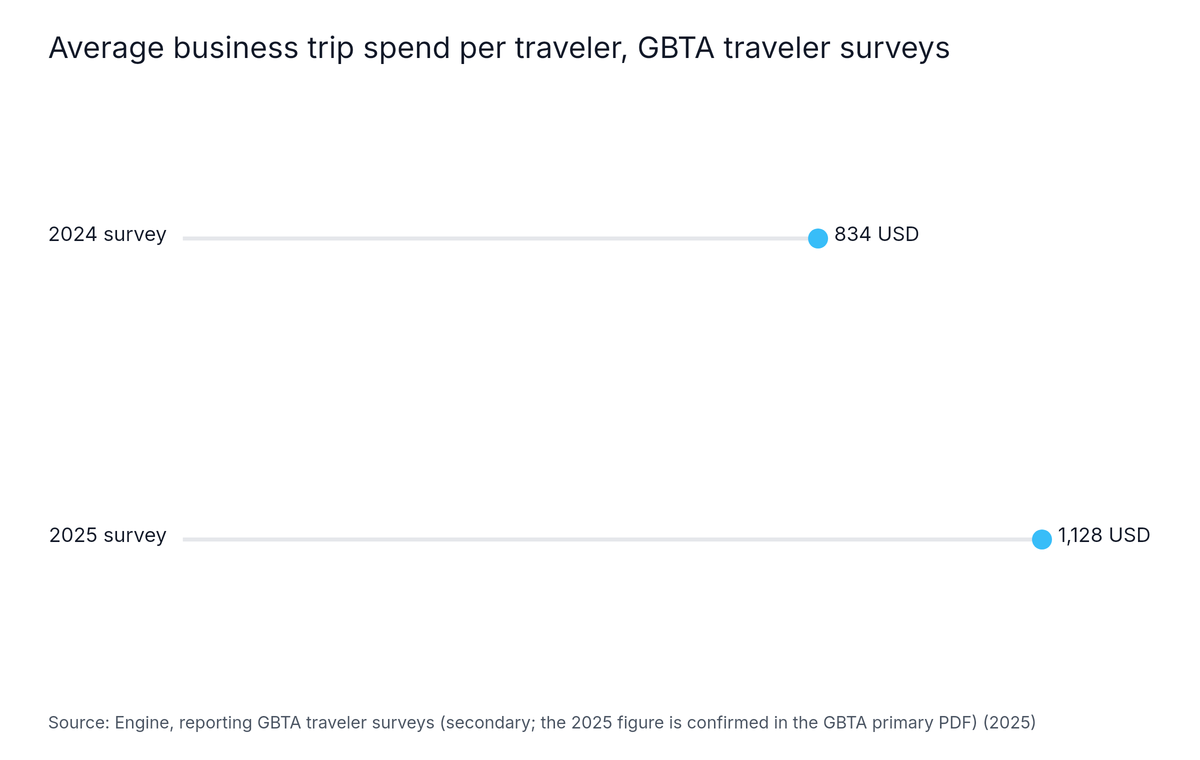
Lollipop chart: Average business trip spend per traveler, GBTA traveler surveys. Highest: 2025 survey at 1,128 USD.
No independent benchmark exists for the cost of a single audit visit, so the $500 figure is AutoSmart's own. Public travel data gives directional context only. Global business travellers reported average spend of $1,128 on their last trip in the 2025 survey, up from $834 in the 2024 survey (Engine, reporting GBTA, 2026; confirmed in the GBTA 2025 release). That is a per-person global average, not an audit-visit cost. It shows only that sending staff to sites is getting more expensive.
The cost maths, worked through
The table applies AutoSmart's $500 figure to 100 visits.
Scenario
Physical visits
Direct travel cost
Saving
Baseline, all checks on site
100
$50,000
None
30% of visits replaced
70
$35,000
$15,000
40% of visits replaced
60
$30,000
$20,000
As an illustration, an 80-site network that visits each site once per cycle spends $40,000 in direct travel per cycle at $500 per visit, before any auditor time. Travel is only part of the bill, so the next step is to count the time around the visit.
What the travel figure leaves out
Travel excludes the 3 to 4 hours per dealership that AutoSmart's buyer research records for post-audit consolidation. It also excludes the days lost before the dealer sees a report.
Our data: AutoSmart's case study with Almajdouie Motors, published on its site as of October 2026, records a 10-day audit cycle cut to 3 days.
Luai Felemban, Network and Dealer Development Manager, describes in a video testimonial (available as of October 2026) how evaluation previously took 5 days plus 5 more to prepare and share reports. He says the whole process, including the action plan, now takes 3 days.
How Do You Stop Dealers From Inflating Self-Assessment Scores?
Dealer self-assessment scores stay honest when the platform enforces live photo capture with date, time and geotag, compares each self-score with independent audit scores, flags large gaps, and sends auditors to re-verify a sample of sites. Self-assessment is a structured check that a site completes itself against the same checklist and weighting as a field audit.
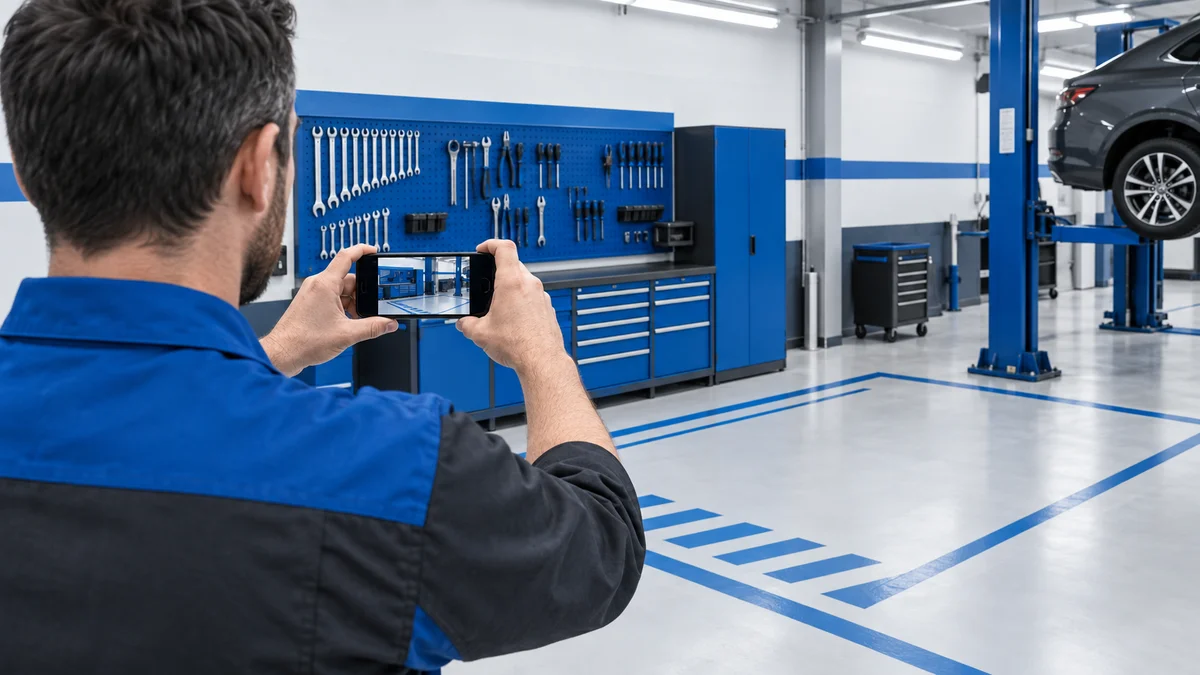
Dealer staff photographing a service bay wall with a phone to complete a self-assessment checklist
Trust is the real objection. Management needs confidence that self-assessments are honest and comparable to independent audits. Five controls provide it:
Live capture only. Block uploads of old photos, so evidence comes from the site at the time of the check.
Date, time and geotag. Stamp each photo to confirm where and when it was taken.
Identical scoring. Run the same checklist and weights as the field audit, so scores compare directly.
Variance flags. Compare each self-score with the latest independent score and flag large gaps.
Sampled re-verification. Send an auditor to a random or risk-ranked sample, so every site knows a check may follow.
AutoSmart Audit supports these controls: live photo capture, timestamps and geotagging, and a comparison of self-assessments against independent audits to find the gap. Area Service Manager (ASM) self-audits are supported.
The payoff is less time on administration. FranConnect, a franchise software vendor, reports a 65% reduction in site-visit administrative time among its customers (FranConnect, 2026). That is vendor-reported, with no sample size stated, so read it as direction rather than a benchmark.
Audits feel punitive when scores are disputed. A single weighted score applied identically to every site removes most arguments. A dealer visit report available at the end of the visit, with digital sign-off by both auditor and dealer, turns the conversation into a discussion in the room.
Governance matters too. A Greenberg Traurig 2026 market watch flags that system-wide technology standards, such as app-based data collection, raise privacy and workplace-monitoring questions (Greenberg Traurig, 2026). Agree what evidence is captured and how long it is kept before rollout.
How Do I Keep Franchise Compliance Visible Across 80 Dealers in Three Markets Without Flying Someone Everywhere?
Compliance stays visible across 80 dealers in three markets when every site is scored against one weighted standard. Results roll up by site, area, market and network in a drill-down dashboard, and physical visits go only where risk signals appear. Role-based access lets each regional manager see one market while the head of network development sees all three.
Wall map with three regional clusters of site pins connected by thin lines
A drill-down dashboard is a management view that lets a user move from overall network performance to a region, a dealer, a standards pillar and a single finding. That structure answers the questions leadership actually asks: where are we performing well, where are we failing, and which dealers need attention.
Roll-ups by level
Level
Typical user
What they see
Decision it supports
Site
Dealer principal, PIC
Own scores, open actions
Fix and close findings
Area
Area or field manager
Sites in the area, trends
Where to visit next
Market
Regional manager
Market average, chronic failures
Coaching and support spend
Network
Head of network development
All markets, one scorecard
Board reporting
Operators matter as much as sites. FRANdata reports that 19.3% of franchisees operate multiple units, collectively controlling 58.8% of all franchised locations (as of 2025) (FRANdata, 2026). A dashboard that can group sites by owner shows whether a problem belongs to one site or one operator group.
Languages, hierarchies and brands
Three markets usually mean three languages and three regional managers. AutoSmart Audit supports multi-language checklists, with Arabic, English, French, German, Italian and Spanish listed. Access can be scoped by dealership, location or geography, and multi-country, multi-brand and multi-distributor structures are the default setup. For the architecture behind this, see automotive network audit software and what generic tools miss.
Replace the fixed calendar with a risk-based visit cadence
Risk-based visit cadence is a rule that sets how often a site gets a physical visit from risk signals rather than a fixed calendar. Practitioners say much the same. MSA Worldwide advises that "Visits should be driven by risk, data, rotation, need, and the objectives of the relationship" (MSA Worldwide, 2026). A second MSA Worldwide piece adds that "Field time should flex based on key performance indicators and brand risk" (MSA Worldwide, 2026).
A practical decision rule, which is our suggested starting point rather than a published standard:
Signal
Response
Reason
Large gap between self-score and audit score
Verification visit
Self-reporting may be unreliable
Same finding fails in consecutive evaluation cycles
Visit plus coaching
Chronic failure needs hands-on help
Corrective actions overdue past escalation
Visit
Remote chasing has failed
New site, ownership change or revised standard
Baseline visit
No trusted history exists
Stable, evidence-backed high scores
Self-assessment only
Travel adds little
How Do You Track Corrective Actions Until They Are Verified Closed?
Corrective actions are tracked to verified closure when every non-compliance automatically becomes an action item. Each item carries a named Person-In-Charge (PIC), a due date, reminders, a progress status and required closure evidence. By AutoSmart's buyer research, manual tracking needs 4 to 5 follow-ups per finding, and each audit produces 8 to 20 findings.
Kanban board with cards moving across Pending, In Progress, Completed and Approved columns
The Action Plan Tracker is the AutoSmart Audit workflow that converts each non-compliance into an owned, dated action item and follows it from identification to rectification. Statuses run Pending, In Progress, Completed and Approved. Closure evidence is required before an item can be marked complete, and reminders, escalation rules and overdue alerts are configurable.
Without this, the audit team becomes the chasing team. Some items are missed entirely and others cross their deadlines, and no system record shows who owns what. The full audit trail removes the "nothing was done" discovery at the next visit.
Outcome evidence is mostly vendor-reported. FranConnect reports a 32% improvement in brand-standard compliance among customers using connected operating systems (FranConnect, 2026). The vendor states these are not guaranteed results for every franchise system, and no sample size is given.
Metrics worth reporting
Ageing buckets: how many actions are overdue by, for example, 0 to 30, 31 to 60 and 60-plus days.
Repeat-finding rate: the share of findings that fail again in the next evaluation cycle.
Escalation count: how many items needed a second or third chaser.
Closure verification time: days between "Completed" by the owner and "Approved" by the auditor.
Evidence should stay attached to the question that failed. During a current audit, an auditor can see previous failures, previous evidence and whether the issue was resolved on the same screen. That context shows whether a dealer is improving, repeatedly failing or deteriorating. Sites with safety exposure, such as forecourts, need the same discipline at a faster cadence, covered in safety audit management software.
Who Is Franchise Compliance Software Not For, and When Does Building or Waiting Make Sense?
Franchise compliance software is not for networks under about 10 sites, brands that cannot name an owner for each finding, or field teams that will keep a parallel paper or WhatsApp record. Below roughly 10 sites, spreadsheets remain workable. AutoSmart Audit's sweet spot is 25 to 500 sites under one brand or group.
Evidence strength is limited
Independent data on digital audit outcomes is thin, and much of what exists is vendor-reported. Treat any outcome claim, including AutoSmart's own cycle-time figures, as case evidence rather than a guarantee. Caution about new tooling is also common. 52% of franchisor brands already use AI tools in franchise development (Franchise Update Media, via Franchising.com, 2025). Yet 68% say it is "too soon to tell" whether AI drives more deals (Franchise Update Media, via Franchising.com, 2025). Those figures concern franchise development, not compliance, but they support a pilot-first approach.
Build, wait for a global platform, or buy
Option
Best when
Main risk
Build in-house
Headquarters IT has capacity and a firm mandate
Stalled builds leave markets on spreadsheets
Wait for a global platform
A funded rollout date exists for your market
Compliance stays manual until then
Buy a regional platform
You need results within weeks
Must match your standard exactly
Stay on Excel, email and WhatsApp
Network is small and stable
Cost grows with every site and market
Some teams already have a basic internal tool or an external consultancy that supplies both auditors and tooling. Neither blocks a pilot. The existing auditors can stay, while a platform gives management direct visibility into programmes, findings, scores, trends and action plans. For stress-testing a vendor before you commit, use these demo scenarios for dealer compliance audit software.
Adoption is the real risk
The biggest failure mode is the field team keeping a second record. If a tool is slow or fails on poor connectivity, auditors fall back on paper or WhatsApp, and the platform's data loses value. AutoSmart Audit is offline-first and syncs when connectivity returns. Security teams can also review the platform. AutoSmart states it is ISO 27001, SOC 2 Type II and GDPR compliant, hosted on AWS, with Single Sign-On (SSO) available. Ask for the certificates during review.
How Do You Get Started With Franchise Compliance Software?
Getting started with franchise compliance software takes five steps: pick one existing audit programme, rebuild its checklist and weights, split checks between self-assessment and physical visits, set owners and access, and run a pilot. Go-live typically takes 5 to 10 working days once the customer shares configuration inputs, per AutoSmart's onboarding documentation.
Auditor on a dealership forecourt using a tablet beside a row of vehicles on a clear day
Pick one programme. Start with the audit that costs the most travel or produces the most disputes.
Rebuild the standard exactly. Copy sections, questions and weightings so scores match the existing standard.
Split the checks. Mark each question as self-assessment, physical visit or both, using the cadence table above.
Set owners and access. Name a Person-In-Charge (PIC) for findings, and scope access by site and market. External agency auditors can be given limited, configurable access.
Pilot and review. Run one evaluation cycle, compare self-scores with audit scores, and check the action closure rate.
Set a target for the pilot before it starts. Vendor-reported data gives one reference point: FranConnect cites a 65% reduction in site-visit administrative time among its customers (FranConnect, 2026). It is self-reported with no sample size, so measure your own baseline first.
AutoSmart offers a no-cost pilot on one of your existing audit programmes. Onboarding includes guided setup, auditor training and a dedicated Customer Success Manager. Pricing is a subscription based on the number of facilities, disclosed during the sales process.
Ready to see your own standard in the platform? Schedule a Free Demo.
Frequently Asked Questions
We franchise our brand standards to 80 dealers across three markets, how do I keep compliance visible without flying someone everywhere?
Compliance stays visible across 80 dealers in three markets when every site is scored on one weighted checklist, results roll up into a drill-down dashboard by market, and self-assessments with photo evidence replace routine visits. Physical visits are reserved for sites where scores, variances or overdue actions signal risk. This cuts travel, which costs about $500 per visit by AutoSmart's estimate.
What is franchise compliance management software?
Franchise compliance management software is the same category as franchise compliance software: a platform that runs checklists, scoring, evidence capture, corrective actions and reporting for a network of franchised or licensed sites. The management label stresses the workflow after the audit, meaning owners, deadlines, escalation and closure, rather than the inspection form alone.
How many site visits does a franchisor need if self-assessments are in place?
A franchisor needs no fixed number of visits once self-assessments are in place, because visit frequency should follow risk. Useful triggers are a gap between self-score and audit score, repeat failures, overdue corrective actions, new sites and revised standards. Sites with stable, evidence-backed scores can move to self-assessment between periodic verification visits.
Does AutoSmart Audit work without an internet connection?
Yes. AutoSmart Audit is offline-first, so auditors can keep working with poor or no connectivity, and the mobile app syncs automatically when connectivity returns. It runs as native Android and iOS apps and as a mobile-responsive web interface, so field auditors do not need a parallel paper or WhatsApp record.
How long does it take to go live on AutoSmart Audit?
Go-live on AutoSmart Audit typically takes 5 to 10 working days once the customer has shared the required configuration inputs, such as checklists, weightings, sites and user roles. A no-cost pilot on one existing audit programme is available as a low-commitment first step.
What is the minimum network size for AutoSmart Audit?
The practical floor for AutoSmart Audit is approximately 10 sites, because below that threshold spreadsheets remain workable. The sweet spot is 25 to 500 sites under one brand or group, and enterprise deployments cover 500-plus sites across multiple countries and brands.
Conclusion
Franchise compliance software earns its place when a network outgrows what one person can see, chase and travel to. Past 50 sites, five points decide the outcome:
Score every site against one weighted standard, so markets compare fairly.
Back self-assessment with live photos, geotags, variance flags and sampled re-checks.
Set visit frequency from risk signals, not a fixed calendar.
Give every non-compliance an owner, a due date and closure evidence.
Pilot on one programme before committing the network.
The next step is simple: take your costliest audit programme and run it through a pilot. To see how manufacturers structure the standards behind it, read about dealer performance audits. Then Schedule a Free Demo to see it with your own checklist.
Written by
Naseef Umar
Founder | CEO
Naseef Umar is an automotive industry expert and the Founder & CEO of AutoSmart, with over a decade of experience working across automotive operations, dealer standards, network performance, audits, and digital transformation.
Company
KERALA Full Address - Pulikillam W Rd, Kakkanad West, Chembumukku, Edappally, Kochi, Kerala 682030; DUBAI Full Address - Dubai Silicon Oasis, UAE

 Naseef Umar