An HSE audit is a planned, independent review of whether a site's health, safety and environmental controls work in practice and meet the law, company rules and brand standards. Scale matters here. Franchised light-vehicle dealerships wrote more than 276 million repair orders in 2025 (NADA, 2026). Every one of those orders involved a bay, a lift, chemicals, compressed air or a charged battery. Yet many dealer teams hear "audit" and think brand standards, not safety. This guide defines the term, maps it zone by zone, and walks through the procedure, plan and cycle. It also shows how to run the work across a network, building on our guide to safety audit cadence and escalation.
Key Takeaways
An HSE audit checks health, safety and environmental controls against a defined standard, and ends with findings that have owners and deadlines.
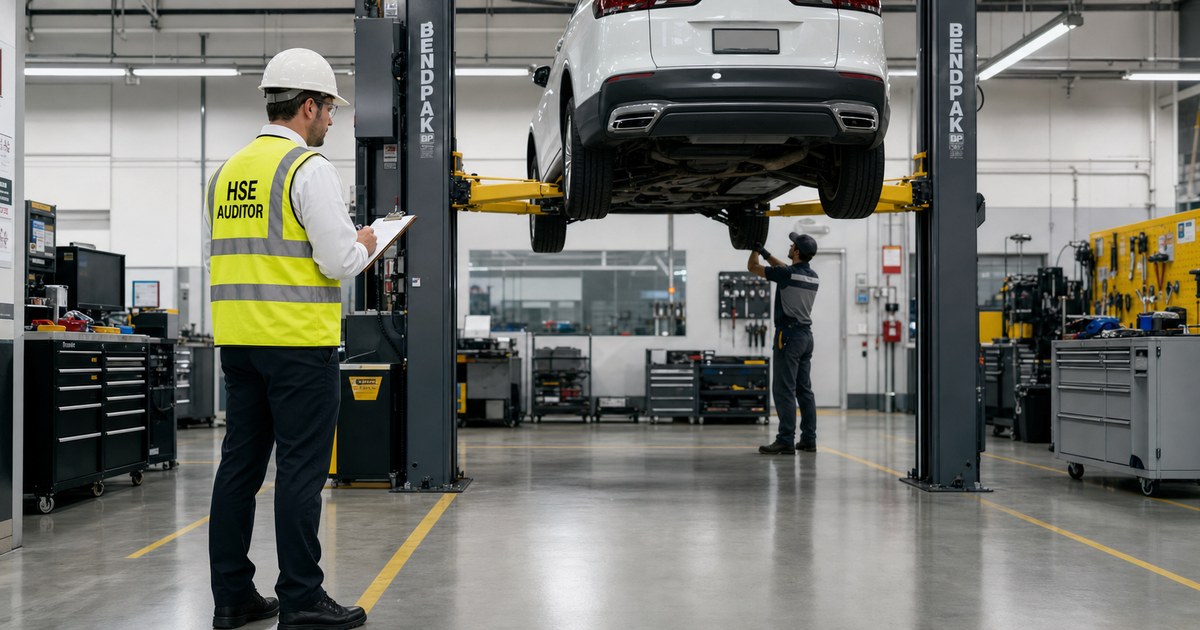
At a dealer site, the review covers service bays, paint and collision, parts and yard, storage, waste and chemicals, and customer areas.
The procedure has seven steps, and the site walk plus worker interviews matter more than the paperwork review.
The audit plan sets scope and schedule, while the audit cycle is the repeating period in which every site is audited again.
In the United States, the maximum federal penalty in 2026 is $16,550 per serious violation and $165,514 per willful or repeated violation.
What is an HSE audit?
An HSE audit is a planned, documented review of a site's health, safety and environmental controls against a defined standard such as national law, ISO 45001 or a manufacturer's requirements. It ends with findings, owners and deadlines. The stakes are concrete: OSHA's 2026 maximum is $16,550 per serious violation (OSHA, 2026).
The review compares what written procedures say with what people actually do. That gap is where injuries and spills happen.
What does HSE audit mean?
HSE stands for Health, Safety and Environment. The "H" covers injury and ill health, such as manual handling or respirator exposure. The "S" covers hazards that cause immediate harm, such as an unguarded lift. The "E" covers pollution and waste, such as used oil, solvents and refrigerants. In the United Kingdom, HSE also names the regulator, the Health and Safety Executive. A multi-market dealer group should say which meaning it uses in the audit plan.
The definition, in working terms
Audit means a systematic, independent and documented process that gathers evidence and judges it against criteria. Three words in that definition do the work:
Independent: the auditor does not audit their own work area.
Evidence: a finding rests on something seen, measured, photographed or heard from a worker, not on an opinion.
Criteria: the standard the site is judged against must be named before the audit starts.
ISO 45001 requires internal audits at planned intervals. So the audit is also how a site proves its safety management system is running. Without that proof, a certificate means little.
What does an HSE audit cover at a dealer site?
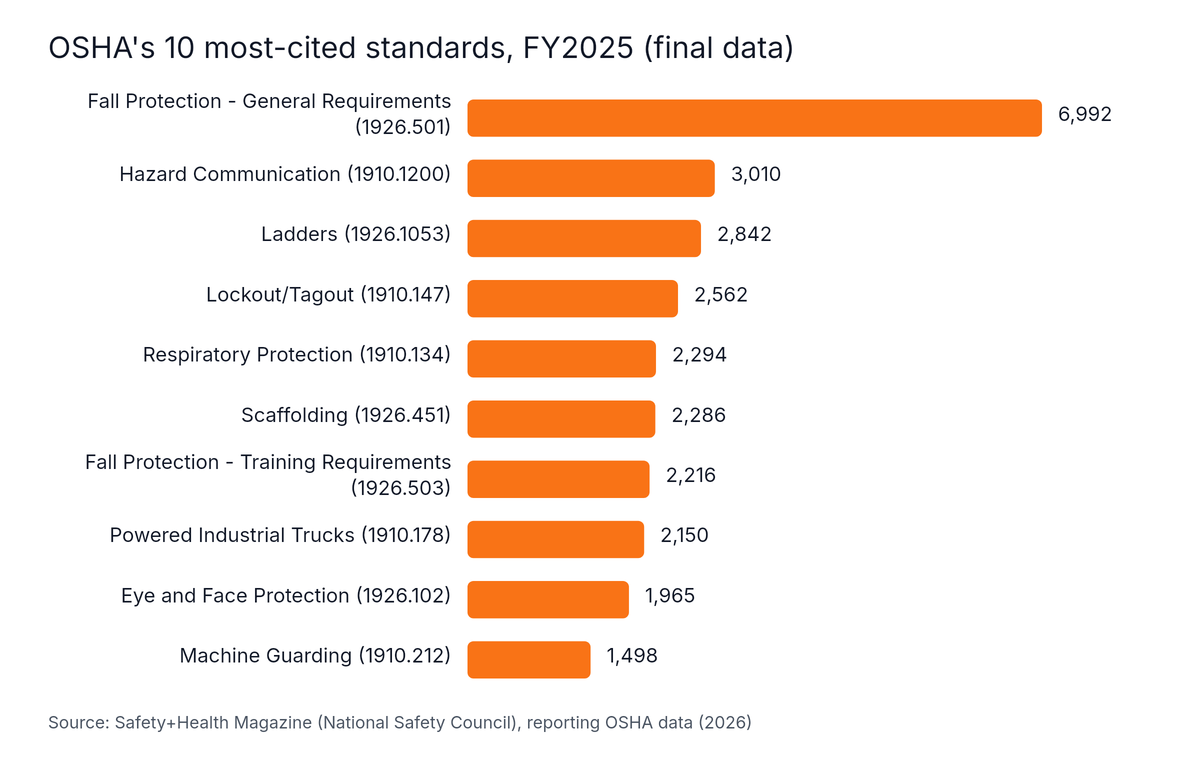
A dealer site audit covers every zone where people meet a hazard: service bays and lifts, paint and collision, parts and yard forklifts, tyre and battery storage, waste oil and chemicals, and customer areas. In the United States, Hazard Communication was the second most-cited Occupational Safety and Health Administration (OSHA) standard in FY2025, with 3,010 violations (Safety+Health Magazine, 2026).
Horizontal Bar chart: OSHA's 10 most-cited standards, FY2025 (final data). Highest: Fall Protection - General Requirements (1926.501) at 6,992.
OSHA's FY2025 list (October 1, 2024 to September 30, 2025) is general industry plus construction. It is not dealer-specific. Still, several of its standards sit inside a dealership. Lockout/Tagout is the control of hazardous energy during servicing, and it drew 2,562 violations. Respiratory Protection, relevant to paint and collision, drew 2,294. Powered Industrial Trucks, which covers forklifts in parts and yard areas, drew 2,150 (Safety+Health Magazine, 2026).
Eight of the ten most-cited standards had fewer violations in FY2025 than in FY2024. Yet the same ten stayed on the list (Schmersal USA, 2025). Gaps recur even as counts fall.
A zone-by-zone scope table
Dealer zone
What the audit checks
Related US standard
FY2025 OSHA violations (general industry and construction)
Service bays and lifts
Lift condition, lockout of compressors and equipment, guarding
Lockout/Tagout (1910.147)
2,562
Paint and collision
Respirator selection, medical evaluations, ventilation
Note: the counts are general-industry and construction figures from the final FY2025 data, not dealer-only counts.
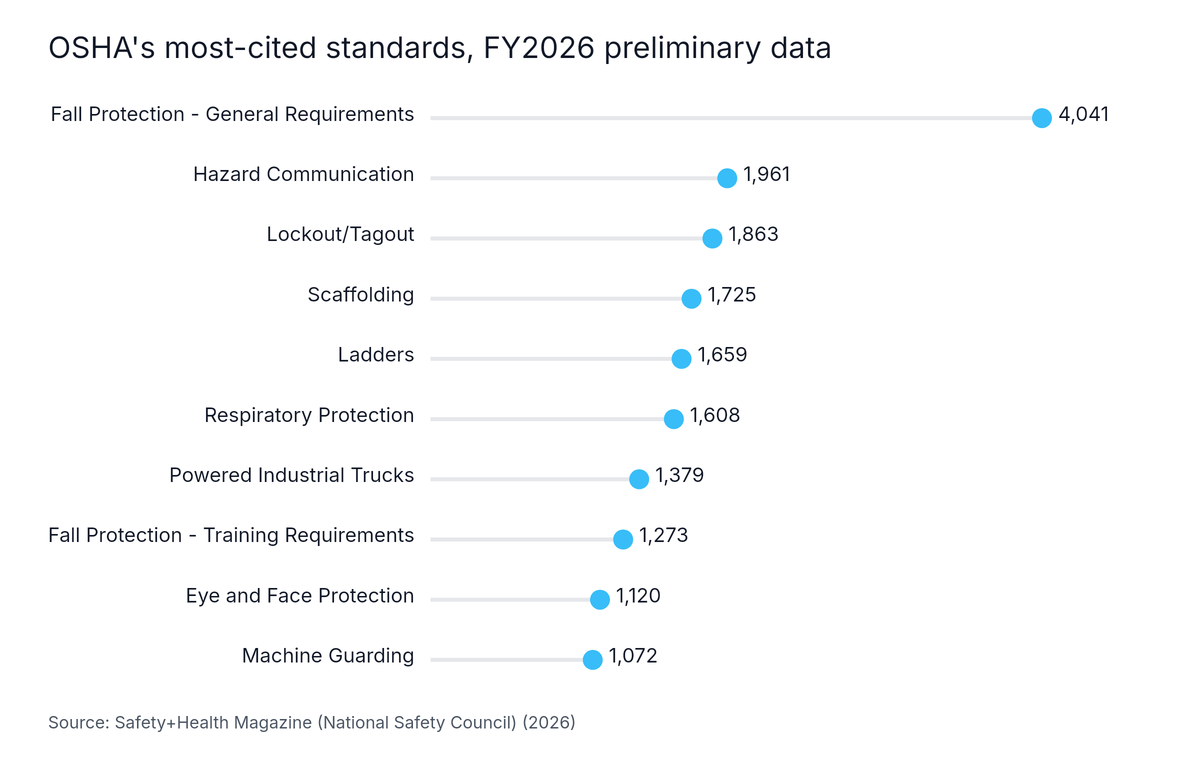
Preliminary FY2026 data, as reported in 2026, shows Hazard Communication second with 1,961 violations and Lockout/Tagout up to third with 1,863. Those are the two standards a dealer audit should weight most (Safety+Health Magazine, 2026). The count is preliminary and may change.
Lollipop chart: OSHA's most-cited standards, FY2026 preliminary data. Highest: Fall Protection - General Requirements at 4,041.
High-voltage work adds a zone that older checklists miss. Checks include training tiers, de-energisation steps, lockout and rescue arrangements. Trade coverage in 2026 shows the training shift. A Worldpac spokesperson said, "What we're seeing now is a shift in learning that goes beyond the basic skills due to the advancements of technology in high-voltage vehicles." (Aftermarket Matters, 2026)
The "E" is easy to forget. Used oil, parts-washer solvents, refrigerants and fuel storage need the same evidence as a lift does. A related audit type runs on the same checklist logic: see how 5S audits work in a dealer network.
How is an HSE audit different from an inspection or an OEM standards audit?
An HSE audit tests whether health, safety and environmental controls work, while an inspection is a quicker check of conditions on the day, a risk assessment rates hazards before work starts, and an Original Equipment Manufacturer (OEM) standards audit scores the site against brand rules. Each answers a different question, and dealers often call all four an audit.
Lockout/Tagout shows the gap. It drew 2,562 violations in OSHA's final FY2025 data (Safety+Health Magazine, 2026). An inspection can see a tag on a lift. Only an audit asks technicians how they lock out equipment and checks that the written procedure matches what they do.
Activity
Question it answers
Typically run by
Output
Audit
Do our controls work, and do they meet the standard?
Independent internal, OEM or third-party auditor
Findings, evidence, corrective actions
Inspection
Is this bay, lift or store safe right now?
Site supervisor or safety lead
Pass or fail on the day, quick fixes
Risk assessment
What could go wrong, and how bad is it?
Competent person with the workers
Rated hazards and controls
OEM standards audit
Does the dealer meet brand and facility requirements?
Brand or network auditor
Score against brand standards
Inspection is a routine check of physical conditions at a point in time. Risk assessment is the structured rating of hazards and the controls that keep them acceptable. An audit sits above both. It checks that inspections and risk assessments exist, are done, and lead to action.
The OEM standards audit deserves its own line. It scores facilities, processes and customer experience, and its results can affect franchise standing. A safety failing may appear in it, but it is not built to prove a safety management system. Our guide to dealer performance audits and how OEMs enforce standards covers the brand side.
What is the procedure for an HSE audit?
The procedure for an HSE audit follows ISO 45001 clause 9.2, which requires audits at planned intervals, and has seven steps: set scope and criteria, review documents, brief site management, walk the site, interview workers, write up findings with evidence, and track corrective actions to closure. The walk and the interviews carry the most weight.
Paperwork alone is not enough, because the stakes are real. OSHA's maximum penalty is $16,550 per serious violation (OSHA, 2025). A hazard that an auditor saw and wrote down is hard to defend later.
Set scope and criteria. Name the site, the zones, the period and the standard, such as local law, ISO 45001 or the OEM's safety requirements.
Review documents. Read risk assessments, training records, safety data sheets, previous reports and the open action list.
Brief site management. Agree the route, the people to interview and any areas that need escorts or PPE.
Walk the site. Observe real work in each zone. Compare what you see with what the documents claim.
Interview workers. Ask technicians and parts staff how they lock out a lift, who trained them and what they do after a spill.
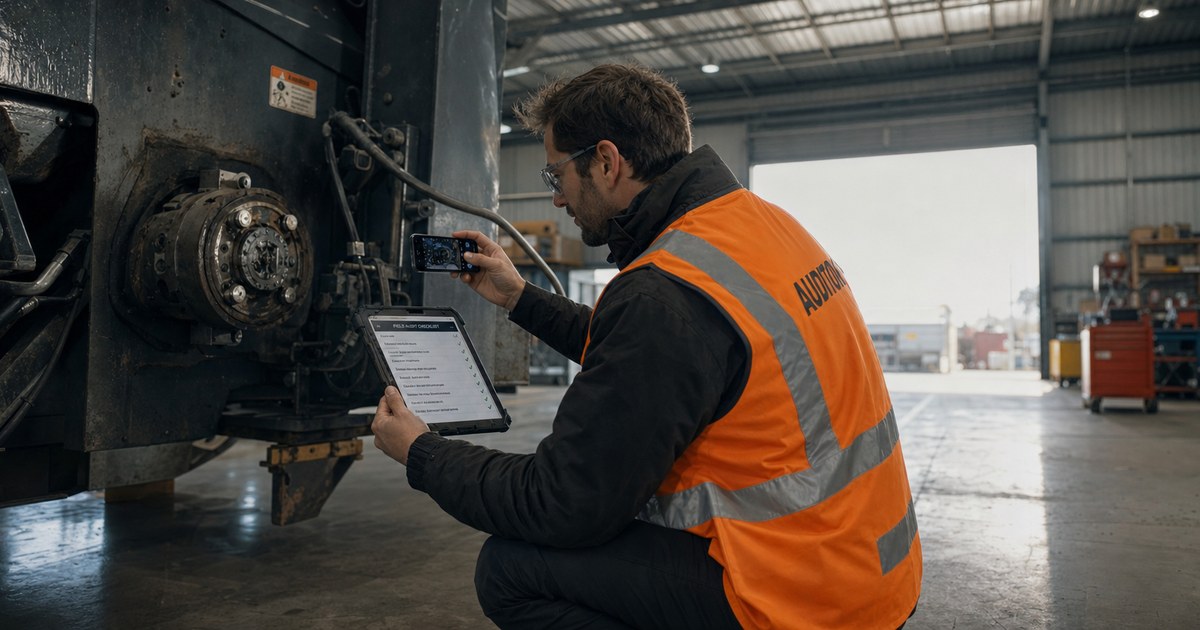
Write up findings with evidence. Each finding names the requirement, what was seen and a photo or record. Rate its severity.
Track corrective actions to closure. Each finding gets a Person-In-Charge (PIC), a due date and proof of closure. A follow-up visit verifies the fix.
Avoiding the paper-only audit
Check-the-box audits fail because documents can be perfect while practice is not. Verify by observation, ask open questions, and use dated photos. Evidence capture on a phone, with a timestamp and location, makes a finding hard to dispute. In low-signal workshops, that needs an app that works offline, as described in our guide to mobile audit software with offline-first evidence capture.
What are an HSE audit plan and an audit cycle?
An HSE audit plan is the written schedule and scope of audits for a site or network, and the audit cycle is the repeating period in which every site and topic gets audited once. ISO 45001 certification, for example, runs on a rolling three-year cycle with annual surveillance audits in between (ISOQAR, 2026).
What goes into the plan
An audit plan is the document that turns the standard into a calendar. A usable plan contains:
The scope: sites, zones and topics.
The criteria: law, ISO 45001, OEM requirements.
The method: walk, interview, document review, sampling.
Who audits, and how independence is kept.
The frequency for each site, and what triggers an extra audit.
How findings are reported and tracked.
How the cycle works in a dealer network
An audit cycle is the period after which the same site and topic are audited again. Under ISO 45001 certification, the third-party cycle is long. A dealer network usually needs a shorter internal layer on top, so problems do not wait for the next certification visit. The table shows how the layers stack.
Layer
Who runs it
Scope
Frequency basis
Dealer self-assessment
Site safety lead
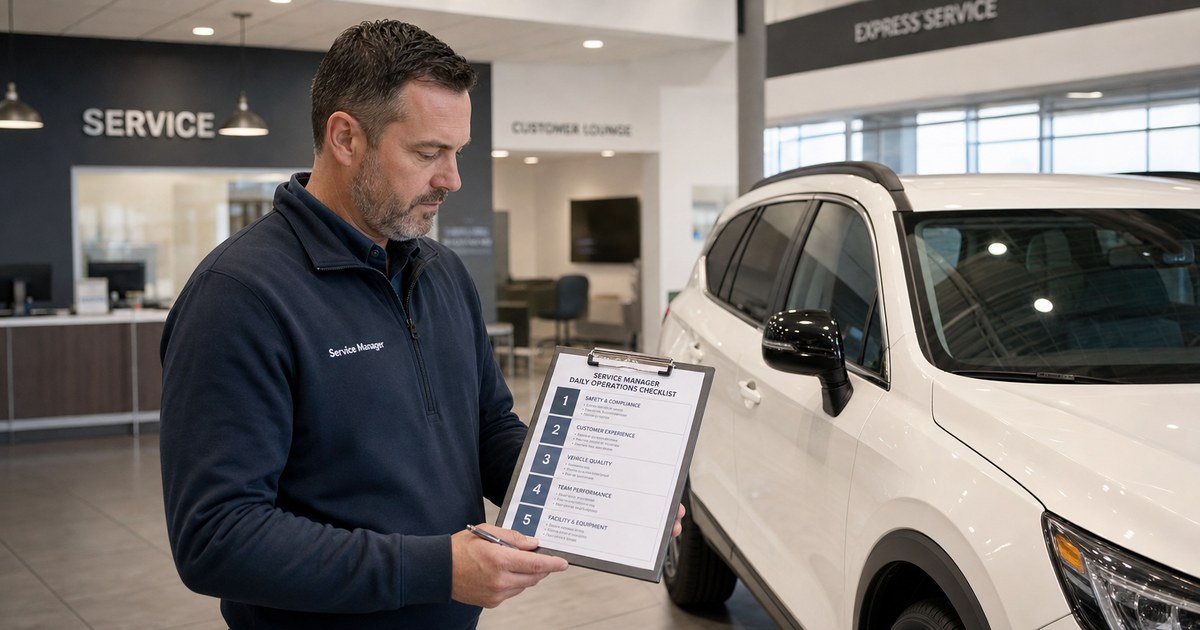
Daily and weekly bay checks, storage, chemicals
Set by the network, often monthly or quarterly
Network or OEM audit
Network quality or safety manager
Full site against the network checklist
Risk-based: higher-risk workshops more often
Third-party certification audit
Certification body
Management system conformance
Rolling three-year cycle, annual surveillance between
Follow-up audit
Original auditor or network team
Open findings only
Triggered by unclosed findings
Risk-based frequency is the practice of auditing sites more often when they carry more hazard. A site with a paint shop and an EV bay carries more than a sales-only outlet. The plan should record why each site sits at its frequency, so the choice can be defended and revised.
Why do audit findings need closed corrective actions?
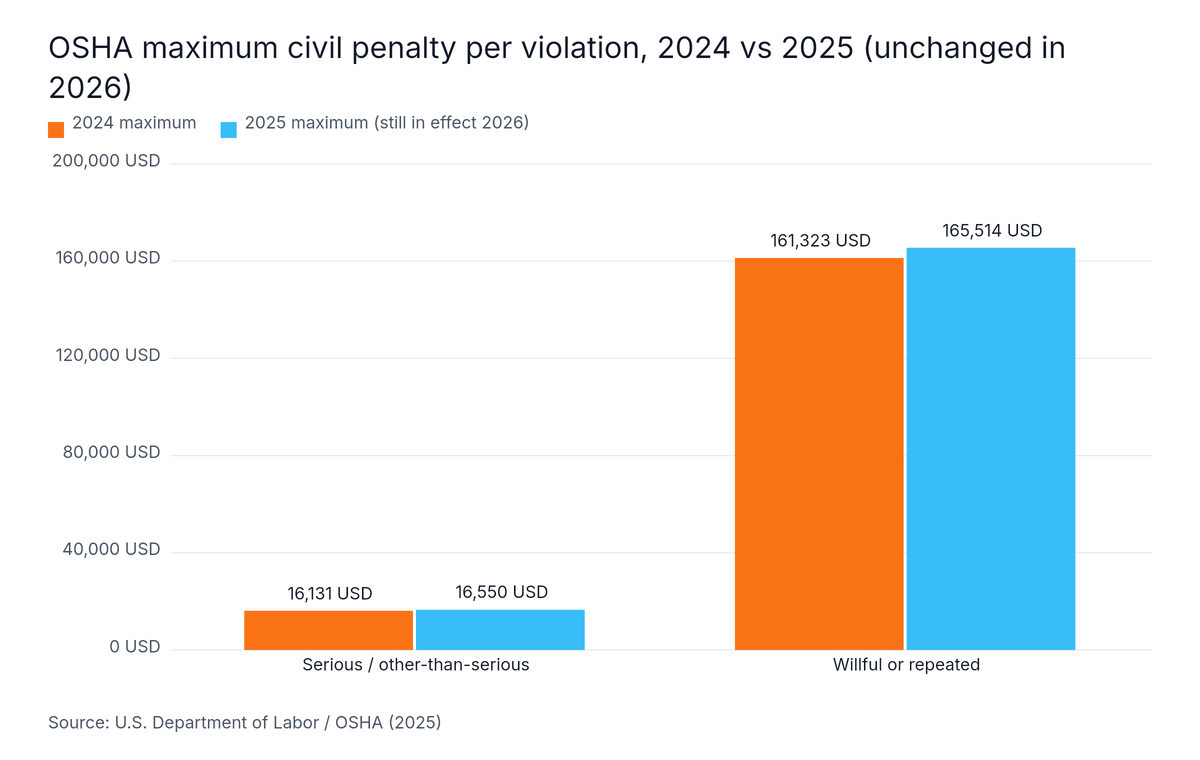
Audit findings need closed corrective actions because an open finding is a known hazard with a date on it. The United States Occupational Safety and Health Administration (OSHA) sets maximum penalties of $16,550 per serious violation and $165,514 per willful or repeated violation, and these 2025 amounts stay in force for 2026 (OSHA, 2026).
Grouped Bar chart: OSHA maximum civil penalty per violation, 2024 vs 2025 (unchanged in 2026). Highest: Willful or repeated at 161,323 USD.
The 2024 maximums were $16,131 and $161,323, so the 2025 amounts were a step up. OSHA confirmed them in its January 2025 announcement (OSHA, 2025). A May 2026 memo then froze them. Erin Gilmore, Acting Director of the OSHA Directorate of Enforcement Programs, wrote: "There are no inflation-based increases to OSHA civil penalties for 2026, so 2025 penalty amounts remain in effect for 2026." (OSHA, 2026) The next adjustment opportunity is January 15, 2027.
A willful classification can apply where an employer knew of a hazard and did not act. That is why a documented finding with no closure is the worst position to be in.
What closed means
A corrective action is a defined task that removes the cause of a non-compliance. It is closed only when four things are true:
An owner (PIC) accepted it.
A due date was set and tracked.
Closure evidence, such as a photo of the repaired guard, is attached.
A later audit or check confirmed it held.
A non-compliance is any point where practice falls short of the stated requirement. The goal is not a long findings list. It is a short list that gets closed fast, and a trend that shows it.
How do you run site audits across a dealer network?
Running safety audits across a dealer network means sampling sites by risk, scoring every site against one checklist, capturing evidence on the spot, and tracking every non-compliance to closure in one place. The scale is large: franchised light-vehicle dealerships numbered 16,990 in 2025 (NADA, 2026).
At that scale, one auditor cannot hold every site in their head. A group of any real size needs a repeatable method.
Five things a network program needs
Risk-based site sampling. Audit paint, collision and EV sites more often than showroom-only outlets.
One weighted checklist. The same questions and weights for every auditor, so scores compare across regions.
Evidence at the point of audit. Live photos with date, time and location.
Action tracking. Each finding becomes an owned, dated action with reminders and closure evidence.
A drill-down view. Management moves from network score to region, dealer, pillar and individual finding.
The manual version of this is where programs stall. Under a manual process, each audit generates 8 to 20 findings, and each finding can take 4 to 5 follow-ups, including escalations, before closure. Auditors then spend several hours per audit compiling photos and slides. See how spreadsheets break down in a dealer audit system and what to look for in field audit software for dealer networks.
Our data: AutoSmart's data shows an audit cycle reduced from 10 days to 3 days.
Self-assessment and travel
Not every check needs an auditor on site. In a structured self-assessment, the dealer completes suitable checks. Management then compares the results with independent audits to spot gaps. AutoSmart estimates an average of $500 per physical visit, so every 100 visits represents about $50,000 in direct travel cost. It also estimates that moving suitable checks to self-assessment could cut physical visits by 30 to 40%, saving about $15,000 to $20,000 per 100 visits. Treat these as estimates, and pair self-assessment with independent audits so that scores stay honest.
A digital platform such as AutoSmart Audit can run the checklist, scoring, evidence capture and the Action Plan Tracker in one workflow. To see the closed loop on your own checklist, Schedule a Free Demo.
Limitations: who an HSE audit is not for
An HSE audit program is not enough on its own for sites without a competent safety lead, for teams who expect a score to fix culture, or for dealers who need legal advice on a specific regulation. The audit finds and tracks gaps. Someone on site still has to fix them, and the figures in this guide are United States references.
Keep these limits in mind:
Jurisdiction. The OSHA data applies to US federal enforcement. Gulf, Indian and European sites follow their own laws, so map the checklist to local rules.
Preliminary data. FY2026 counts are preliminary and may change.
No dealer-only benchmark. The OSHA top-ten list covers general industry and construction. This guide did not verify dealership-specific injury rates.
Self-assessment honesty. Self-assessed scores need an independent check, or they drift upward.
Audits are not inspections. A yearly audit does not replace daily bay checks.
Frequently Asked Questions
What is an HSE audit plan?
An HSE audit plan is the written schedule that says which sites, zones and topics will be audited, when, by whom and against which standard. It sets the scope, the criteria, auditor independence and the reporting route. For a dealer network, the plan also sets risk-based frequency, so higher-risk workshops are audited more often than showroom-only sites.
What does HSE audit mean?
HSE audit means an audit of health, safety and environment: a structured check that a site's controls for people, equipment and pollution work as written. In the United Kingdom, HSE also stands for the Health and Safety Executive, the regulator, so context decides which meaning applies. At a dealership, the phrase almost always means the first.
What is the procedure for an HSE audit?
The procedure for an HSE audit is: set scope and criteria, review documents, brief site management, walk the site, interview workers, record findings with photo evidence, and track corrective actions until each one is verified closed. A follow-up visit then confirms that open findings were fixed and stayed fixed.
What is an HSE audit cycle?
An HSE audit cycle is the repeating period in which every site and topic in the plan is audited once, then audited again. Under ISO 45001 certification the cycle is a rolling three years with annual surveillance audits between, according to certification body ISOQAR. Dealer networks can run shorter internal cycles on top, set by site risk.
What is the definition of an HSE audit?
An HSE audit is a planned, documented and independent review of whether a site's health, safety and environmental controls work in practice and meet the law, company rules and brand standards. It produces findings with owners and deadlines. At a dealer site it covers service bays, paint, parts, storage, waste and customer areas.
Conclusion
An HSE audit is a repeatable way to prove that safety and environmental controls work at every dealer site, not just on the day someone visits. Five points to carry forward:
Define the audit by its standard, its evidence and its independence.
Map the scope zone by zone: bays, paint, parts, storage, waste and customer areas.
Run the seven-step procedure, and weight the site walk and worker interviews.
Set a plan and a cycle with risk-based frequency, plus follow-up visits for open findings.
Close every finding with an owner, a date and evidence.
The next step is to test your current checklist against the zone table above and count how many findings would reach closure without a chaser. To see that loop running on your own checklist, Schedule a Free Demo.
Founder | CEO
Naseef Umar is an automotive industry expert and the Founder & CEO of AutoSmart, with over a decade of experience working across automotive operations, dealer standards, network performance, audits, and digital transformation.
Company
KERALA Full Address - Pulikillam W Rd, Kakkanad West, Chembumukku, Edappally, Kochi, Kerala 682030; DUBAI Full Address - Dubai Silicon Oasis, UAE

 Naseef UmarNov 3, 2026