
Blog
Field Audit App: What to Test Before You Commit
Test a field audit app on offline-first behaviour, evidence capture and report-before-you-leave-site, with a timed bake-off and weighted scorecard.

One ISO 9001 quality management system can serve OEM dealer audits too. See how to tag one record to both, and what to shortlist for a 60-site network.
 Naseef UmarOct 28, 2026
Test a field audit app on offline-first behaviour, evidence capture and report-before-you-leave-site, with a timed bake-off and weighted scorecard.
Define SOPs for automobile dealers, clear up what SOP means in the auto industry, and follow six steps that make SOPs stick, with or without SOP software.
Toyota's digital service evaluation has no public program name. See how TSM, Kodawari and Image USA II differ and how a Toyota dealer audit works.
Request a quote and our experts will contact you within 24 hours with tailored solutions and pricing.
You can also send us a quick email at info@autosmarts.co.
Last updated: Oct 28, 2026
By Naseef Umar, Founder and CEO, with over a decade in automotive operations, dealer standards and audits.
An ISO 9001 quality management system serves both ISO 9001 and OEM audits when every inspection record is tagged to an ISO clause and an Original Equipment Manufacturer (OEM) standard item, so one photo and one corrective action satisfy both auditors. Most networks do not work that way. They keep one set of evidence for the certification body and another for the OEM, spread across sites, spreadsheets and chat threads. That is double the work for the same facts. This guide shows how to run one record, how automotive software differs from a general platform, and what to shortlist before your next certification cycle. If your audits still live in Excel, this look at when spreadsheets break down is a useful companion.
Key Takeaways
- An ISO 9001 quality management system can serve OEM audits too, if each inspection record is tagged to both an ISO 9001 clause and an OEM standard item.
- Automotive quality management software differs from a general platform mainly in how it handles dealer sites you inspect but do not own.
- A shortlist for 60 dealer sites should be tested on offline audits, OEM checklist versioning, geotagged evidence, role-based views and data export on exit.
- The OEM benefits that land are recall follow-through, warranty cost and consistent scoring, not generic "quality" claims.
An ISO 9001 quality management system can serve both audits if each inspection record carries two tags: the ISO 9001 clause it evidences and the OEM standard item it scores. ISO survey data counts 1,611,729 ISO 9001 certificates worldwide (Oxebridge Quality Resources, 2026), so the standard is the shared baseline, while the OEM standard is the dealer-specific layer on top.
ISO 9001 is the international standard for quality management systems. An OEM dealer standard is a separate, brand-specific checklist. The two overlap far more than most networks admit. A failed fire-exit check or a missing torque-wrench calibration record is one fact, yet it gets photographed, written up and filed twice.
The fix is to capture the finding once and tag it. The table below shows the idea using three ISO 9001 clauses that dealer audits touch most often.
| Inspection moment | ISO 9001 clause | OEM standard evidence | What is stored once |
|---|---|---|---|
| Workshop process check on a service bay | Clause 8, operation | Aftersales process item | Time-stamped photo and score |
| Scheduled network audit | Clause 9.2, internal audit | Dealer Operating Standards (DOS) cycle result | Weighted score and auditor sign-off |
| Failed item closed out | Clause 10.2, non-conformity and corrective action | Corrective-action closure item | Owner, due date and closure photo |
A well-built system lets an ISO auditor filter by clause and an OEM auditor filter by standard item, and both land on the same evidence. For more on running several standards in one platform, see this piece on Dealer Operating Standards, 5S and mystery shopping together.
IATF 16949 is the automotive quality standard that builds on ISO 9001. DQS, an accredited certification body, says "it requires conformance with all ISO 9001:2015 requirements and adds further requirements tailored to automotive production" (DQS Global, 2026). That points at manufacturers and suppliers. Dealer networks usually work from ISO 9001 plus OEM dealer standards, but confirm the scope with your certification body before you plan around it.
ISO 9001:2026 was published on 16 September 2026, with a three-year transition to about September 2029 reported (TÜV SÜD, 2026). The International Accreditation Forum (IAF) sets the formal rules. Pick a platform that can re-map clause tags without re-keying evidence.
Automotive quality management software treats a dealer site as a location you can inspect but not instruct. It gives a central function a way to require corrective action, lets dealers self-assess, and gives OEM and auditor roles read-only views. General quality management software assumes the company owns the site, which is why the category, worth $10.0 billion in 2024 (Verdantix, 2025), leans toward factories.
The Verdantix figure comes from a market model that included a 2025 survey of 102 quality management decision-makers. It tells you the category is large. It does not tell you the products fit a franchise network.
On a factory floor, a quality manager can stop a line. At an independently owned dealer, the OEM or distributor can only audit, score and require a fix under the dealer agreement. Multi-site certification is a certification approach where a central function is audited every time and a sample of sites is visited. Such schemes typically expect that central function to have authority to require corrective action, so check the current IAF MD 1 wording directly. Your software has to show that authority working: owners, deadlines, escalations and closure evidence.
| Capability | General QMS | Automotive network platform |
|---|---|---|
| Site model | Company-owned plants and departments | Dealer, distributor and OEM tiers, multi-brand |
| Standards | Document control and internal procedures | OEM checklists with weighting and versioning |
| Field use | Desktop-first forms | Offline-first mobile audits with live photo capture |
| Corrective action | Internal CAPA workflow | Findings become owned, dated actions per dealer |
| Access | Employees | Auditor, external auditor, dealer and management views |
Unlike generic audit tools, a network platform assumes dealer hierarchies and OEM cycle structures from day one. For a deeper comparison, read about what generic tools miss in dealer network audits.
A proper automotive quality management system pulls inspection scores, time-stamped photo evidence, corrective actions, historical cycle results and dealer sign-offs into one record per site, then rolls them up across the network. The need is real: each audit typically produces 8 to 20 findings in the platform vendor's own buyer research, and an ISO 9001 auditor and an OEM auditor should both find the same evidence for each one.
Think of it as five things in one place.
Corrective action is a logged, owned and dated fix for a non-conformity, closed only with evidence.
Our data: AutoSmart's customer data shows audit cycles compressed from 10 days to 3 days after moving from manual reporting to a single digital workflow.
The same buyer research adds detail. Under a manual process, a single finding can need 4 to 5 follow-ups, including escalations, before closure. Some teams spend 3 to 4 hours after each audit rebuilding Excel calculations, sign-off sheets, PowerPoint reports and photos. Field work can run offline, which matters in low-connectivity workshops; see offline-first evidence capture and sync for how that works.
Not every check needs a visit. The company's estimate is an average of $500 per physical visit, so every 100 visits is about $50,000 in direct travel cost. Moving suitable checks to self-assessment could cut physical visits by 30 to 40%, saving roughly $15,000 to $20,000 per 100 visits. That is an estimate, not a guarantee.
To get one quality record across 60 dealer sites, shortlist software that passes nine tests: offline mobile audits, OEM checklist import and versioning, geotagged photos, role-based views, corrective-action escalation, cross-site dashboards, spreadsheet import, data export on exit and three-year cost. A multi-site auditor may start by sampling about 8 of 60 sites, so every site's record must be audit-ready.
Sixty sites is more than informal coordination handles well. You also have a fixed deadline, which narrows the time to switch tools. Use the table as a working scorecard.
| Criterion | What to verify in the trial | Red flag |
|---|---|---|
| Offline mobile audit | Complete a full audit with the connection off, then sync | Data lost or auditors keep a paper copy |
| OEM checklist import and versioning | Load your real checklist, then revise it mid-cycle | Vendor tickets needed for every edit |
| Geotagged photo evidence | Try uploading an old photo from the gallery | Old images accepted |
| Role-based views | Log in as dealer, external auditor and OEM viewer | One login sees everything, or nothing |
| Corrective-action escalation | Fail an item and watch reminders and escalation | Actions chased by email |
| Cross-site dashboard | Drill from network to a single finding | Export-to-Excel only |
| Spreadsheet import | Bring in last cycle's results | Re-keying history by hand |
| Data export on exit | Ask for a full export, evidence included | Export limited or paid |
| Three-year total cost | Include implementation, integration and per-site fees | Costs revealed after signing |
IAF MD 1 (2023 issue) is understood to start the sample at the square root of the number of sites, rounded up, then adjust for risk. For 60 sites that is about 8 (√60 ≈ 7.75), with the central function audited every time. Treat this as a planning note and verify it against the document with your certification body. Sampling is not allowed where sites do very different work.
Ask how long go-live takes and who does the configuration. One vendor reports go-live in 5 to 10 working days once the customer shares the required configuration. Whatever vendor you test, get a date in writing. A no-cost pilot on one existing audit programme is a low-risk way to check. Demo scenarios to stress-test dealer compliance audit software gives you a script.
The benefits that land with an OEM parent are the ones it already measures: recall completion, warranty cost and audit consistency. NHTSA-mandated recall campaigns reached 447 in 2025, the highest in the Recall Masters series (Digital Dealer, 2026), so dealer-level follow-through is now a board-level topic.
Those 447 mandated campaigns came with 223 voluntary manufacturer notices, together affecting more than 28 million passenger vehicles, light trucks and vans (Digital Dealer, 2026). The 2024 comparison was 416 mandated recalls and 27 million vehicles. In 2025, about 28 million vehicles were covered by NHTSA-mandated recalls, against 27 million in 2024 and 37 million in 2019.
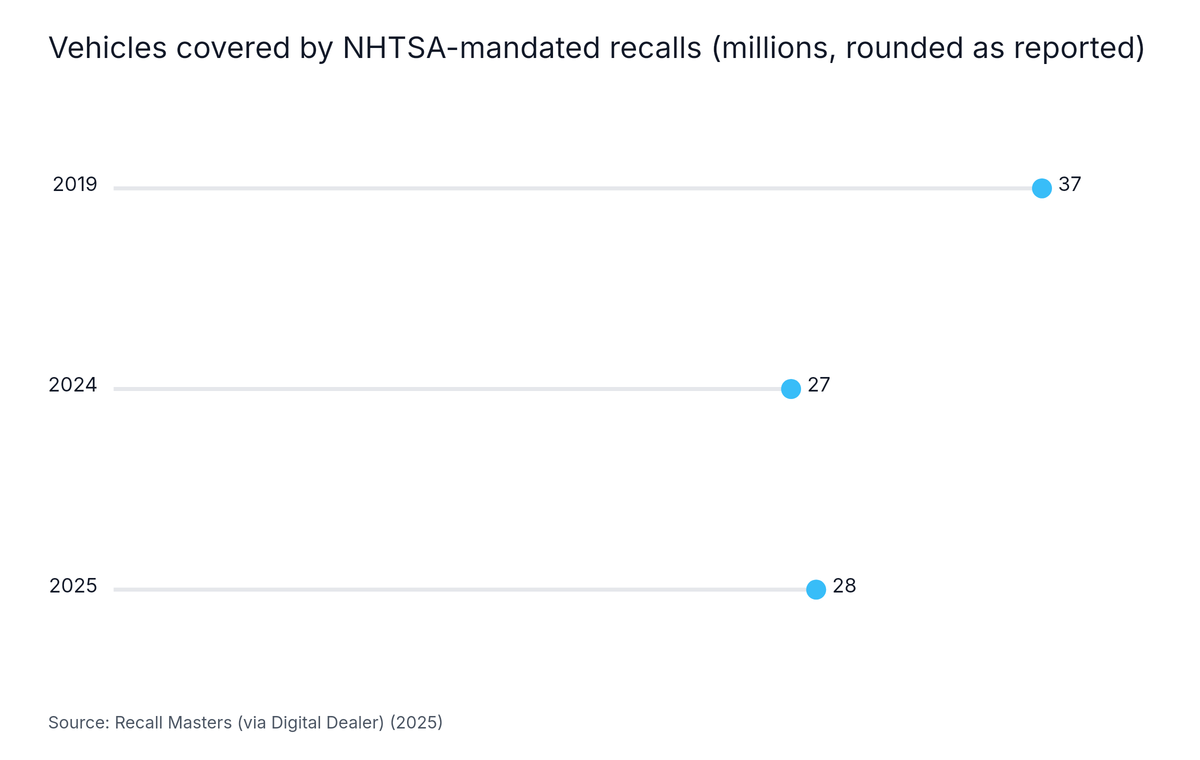
Source: Recall Masters (via Digital Dealer), 2025
Software and electronics defects were the largest category, at 119 campaigns affecting 8,192,000 vehicles (Digital Dealer, 2026). Long-run recall completion at dealers sits between 75% and 87% (Digital Dealer, 2026), well short of 100%. That gap is an evidence and follow-through problem, which a network quality record is built to address.
Concentration matters too. Ford issued 152 recalls in 2025, against a previous record of 77 by GM in 2014 (Fox Business, 2025). Other trackers count 146 to 153, so treat it as about 150.
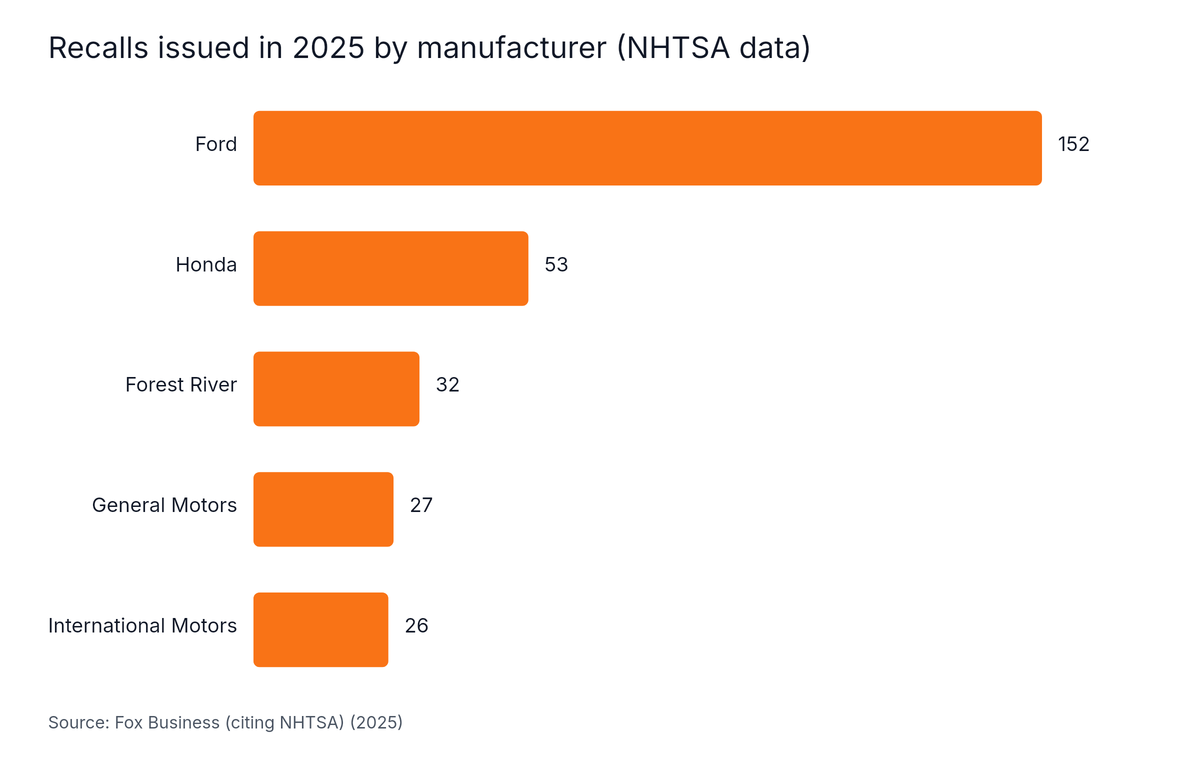
Source: Fox Business (citing NHTSA), 2025
U.S. manufacturers paid $30.37 billion in warranty claims in 2025, up 4% from 2024 (Reliamag, 2026). Reliamag is a trade-journal compilation, so use the number as context, not proof of savings.
Frame the case around what the OEM already tracks, as covered in how OEMs structure dealer performance audits. Show consistent weighted scoring, a closed corrective-action loop and one record per site. Do not promise a recall or warranty number you cannot back.
A dealer-network audit platform is not the right tool for every quality problem. It will not replace a factory quality management system for production control, and it will not certify anyone: the 1,611,729 ISO 9001 certificates worldwide (Oxebridge Quality Resources, 2026) were all issued by certification bodies. Treat the platform as the evidence layer under your ISO 9001 and OEM programmes.
Three honest caveats follow.
If your network is a handful of sites, a simple checklist app may be enough. The case for a network platform grows when an OEM mandates standardised reporting or when manual coordination visibly breaks.
ISO 9001 is the general quality management standard, while IATF 16949 adds requirements tailored to automotive production. Dealerships usually work from ISO 9001 plus their OEM's dealer standards, because IATF 16949 targets production and supply-chain organisations. Confirm the scope with your certification body before you plan evidence around either one.
A general quality management system can hold documents and run checklists, but it often lacks dealer hierarchies, versioned OEM checklists, offline mobile audits and read-only OEM views. Test it with one real OEM standard and a site you do not own before you commit. If it cannot import and version that checklist, expect re-keying.
ISO 9001:2026 was published on 16 September 2026, and a three-year transition to about September 2029 is reported. The IAF sets the formal transition rules, so ask your certification body for your date. Choose a platform that can re-map clauses without re-keying evidence, so the move costs little.
Replace the duplicate audits rather than adding one: import your current checklist, let dealers run self-assessments on a phone, and have auditors verify only the exceptions. Every corrective action should carry an owner and due date in one place. If dealers still fill in spreadsheets afterwards, the rollout has added work.
One ISO 9001 quality management system can serve both sets of evidence, but only if the record is built for it. Here is what to take away.
For the day-to-day change, read what paperless auditing involves for a dealer network. Ready to test one of your own audit programmes? Schedule a Free Demo with AutoSmart Audit and bring your real checklist.
© 2026 AutoSmart Technology All rights reserved.

