By Naseef Umar, Founder & CEO of AutoSmart, with over a decade of experience in automotive operations, dealer standards and audits.
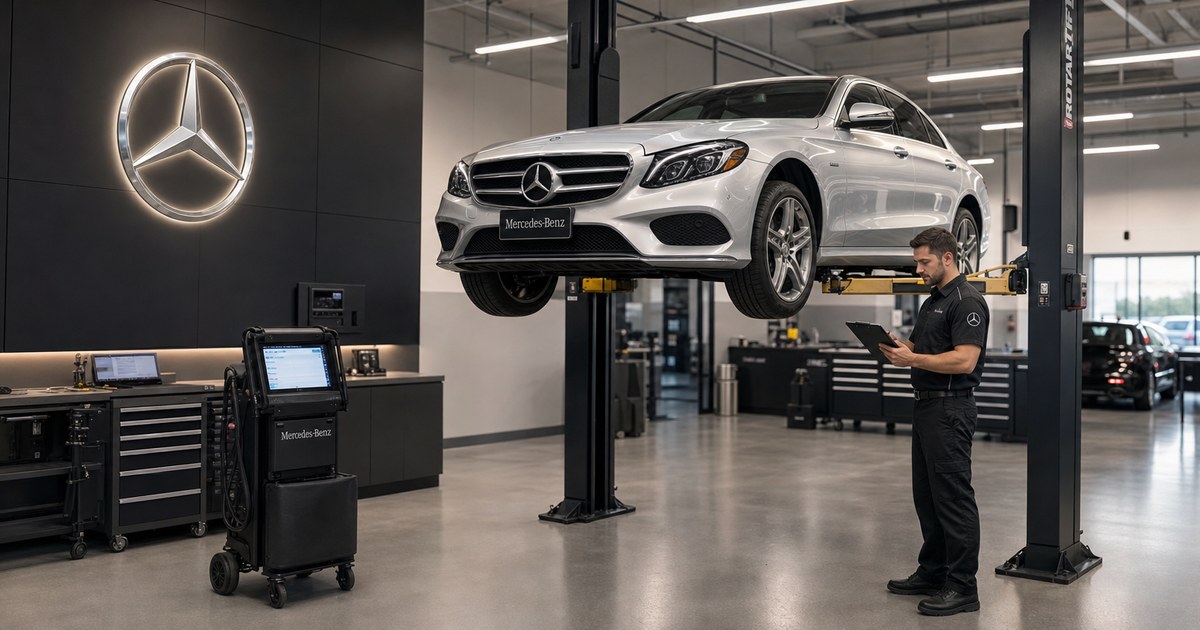
The Mercedes-Benz aftersales performance evaluation is the way the brand checks whether a dealer's service and parts operation meets factory standards, and how the results are scored, evidenced and followed up. Dealers' share of service visits fell from 33% to 29% in a 2026 study (Cox Automotive, 2026), which raises the stakes of every evaluation. Yet the programme is hard to research, because Mercedes-Benz keeps its criteria in the dealer portal. This guide separates what is publicly verifiable from what is not, and shows a Dealer Standards Manager how to prepare.
Key Takeaways
The Mercedes-Benz aftersales service evaluation is a standards check of the service and parts operation, run separately from customer-satisfaction scoring.
Public sources do not confirm MBDE weightings, audit frequency or penalties, so dealers should rely on their portal and contract for those.
A standards audit measures process and evidence; the Mercedes-Benz 5-Star-Rater and J.D. Power Customer Service Index (CSI) measure customer opinion.
Dealers prepare best with a self-audit cycle, dated photo evidence and a named owner for every finding.
What is the Mercedes-Benz aftersales service evaluation?
The Mercedes-Benz aftersales service evaluation is the assessment of a dealer's service and parts operation against Mercedes-Benz network standards, part of the wider programme the trade calls MBDE. Dealers now capture only 29% of service visits (Cox Automotive, 2026), so the evaluation carries weight. Criteria and weightings are not in public official documentation.
MBDE is the trade name for the Mercedes-Benz dealer evaluation, a standards programme that assesses how a dealership operates against brand requirements. Aftersales is one slice of it. The service department is judged on how the workshop runs, not only on how customers feel afterwards.
Dealers hold the standard for a reason. An authorised dealer is expected to have the right equipment and knowledge in place. As Richard Lechler of Silver Star Motors, an authorised Mercedes-Benz distributor in Jamaica, put it: "As an authorised dealer, we want to ensure that we have the correct tools, the correct parts catalogues and the correct training to service vehicles" (The Gleaner, 2026). An evaluation is how the brand confirms that across a network.
Digital touchpoints now sit in that picture too. Mercedes-Benz.io describes moving all aftersales features from the standalone Service App into the main Mercedes-Benz App (Mercedes-Benz.io, 2026).
How is aftersales performance evaluated in the Mercedes-Benz network?
Aftersales performance in the Mercedes-Benz network is judged on two kinds of evidence: a standards audit of how the workshop, parts and training operation runs, and customer-satisfaction scores such as the J.D. Power Customer Service Index (CSI), where Mercedes-Benz scored 841 in Canada's 2026 long-term study (Canadian Auto Dealer, 2026). Mercedes-Benz does not publish its audit sheet, so the audit areas below are the typical OEM structure, not an official list.
What does a standards audit typically check?
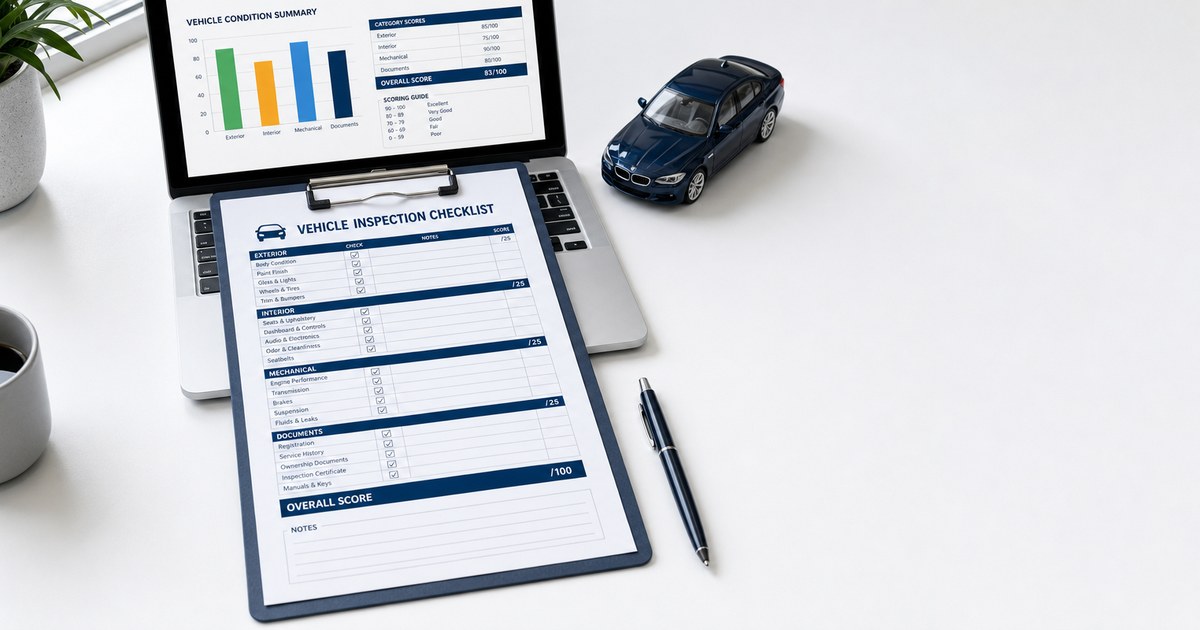
A standards audit is an on-site review that compares how a dealer actually operates with a written requirement and records evidence for each item. Original Equipment Manufacturer (OEM) aftersales audits commonly look at these five areas. This is a general outline, not a Mercedes-Benz scoring sheet:
Workshop organisation: bay allocation, workflow, cleanliness and safety.
Technician certification: training records matched to the work being done.
Parts control: stock accuracy, storage and the right catalogues.
Service-time standards: booking-to-handover times against target.
Customer-feedback handling: complaints logged, answered and closed.
Who runs it, and how often?
Public sources do not say. Frequency, auditor identity and thresholds are set by Mercedes-Benz and its importers, and they can differ by market. A dealer's franchise documents are the authority here. A call to the regional network team settles any doubt.
How does the standards audit differ from CSI and the 5-Star-Rater?
A standards audit checks how a Mercedes-Benz dealer operates against a written requirement, while the Mercedes-Benz 5-Star-Rater and the J.D. Power Customer Service Index (CSI) record what customers say about their experience. The audit is evidence-based and run by the brand or its appointed auditors. The satisfaction scores are opinion-based, so each can move without the other.
The Customer Service Index (CSI) is J.D. Power's measure of customer satisfaction with dealer service, reported on a 1,000-point scale in the Canadian study. The Mercedes-Benz 5-Star-Rater is the brand's own customer-satisfaction instrument. Network managers often mix these up with the standards audit. They shouldn't: a workshop can pass every process check and still disappoint customers, or the reverse.
Instrument
What it captures
Basis
Standards audit (MBDE-type)
Process, facilities and evidence
Written requirement, checked on site
Mercedes-Benz 5-Star-Rater
Customer satisfaction
Customer opinion
J.D. Power CSI
Customer satisfaction with dealer service
Owner survey, 1,000-point scale in Canada
External scores show where Mercedes-Benz stands, but they are not the audit result. Scales and methods vary by market, so the numbers are not directly comparable.
Market (2026 study)
Result
Source
Canada, long-term service index
Mercedes-Benz 841, tied first with Lexus 841; highest for a second consecutive year
The Canadian result is trade-press reporting of a J.D. Power study of owners of vehicles four to 12 years old. In the U.S., only 26% of customers experienced nine or ten top service KPIs (J.D. Power, 2026). Even a rising market leaves room to improve.
Why does the aftersales evaluation matter to a dealer?
The aftersales evaluation matters because dealers are competing harder for each service visit. Average dealer service and parts revenue reached about $9.23M, up 33% in eight years, according to the Cox Automotive 2026 study (Cox Automotive, 2026), yet share of visits keeps falling. Each lost customer is lost future revenue.
The same study surveyed 500 dealership fixed-ops decision makers and 2,500 consumers. Its retention figures illustrate the kind of process gaps a standards audit looks for:
80% of new-vehicle buyers say they are likely to return to the selling dealer for service (Cox Automotive, 2026).
Only about a quarter had a first service appointment scheduled at purchase.
Cox puts potential lifetime service spend at more than $12,000 per lost customer, a modelled estimate based on ownership-period assumptions.
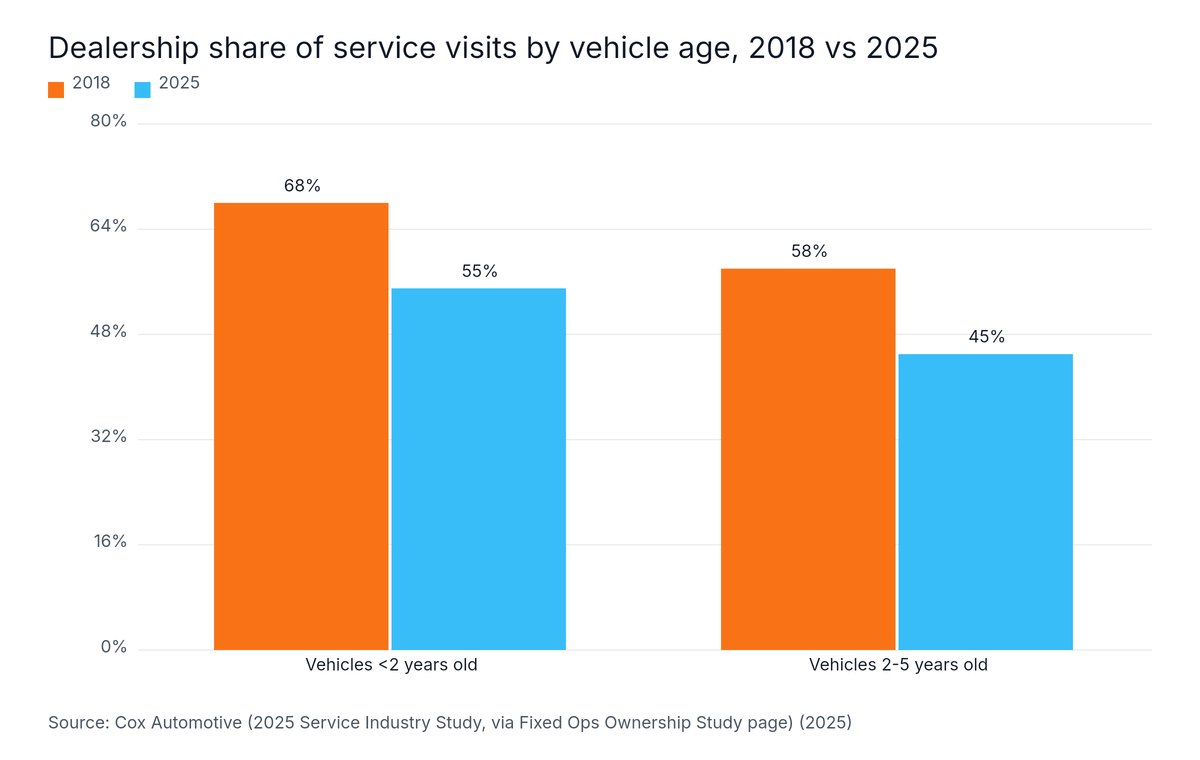
Vehicle age matters too. The chart below plots dealership share of service visits by vehicle age, 2018 against 2025. The figures are 68% for vehicles under two years old and 58% for vehicles two to five years old (Cox Automotive, 2025). They come from Cox's 2025 Service Industry Study as shown on its 2026 study page, a secondary citation.
Grouped Bar chart: Dealership share of service visits by vehicle age, 2018 vs 2025. Highest: Vehicles <2 years old at 68%.
Evaluation results can reach a dealer's finances in other ways. Many OEMs link satisfaction scores to bonuses, allocation or franchise renewal. The research behind this article found no Mercedes-Benz-specific data on that link, so check your own agreement.
How should a dealer prepare for a Mercedes-Benz aftersales audit?
A Mercedes-Benz dealer should prepare for an aftersales audit by running a self-audit against the current standard, collecting dated photo evidence, assigning every gap to a named Person-In-Charge (PIC) with a due date, and tracking each finding to closure. Evidence pays twice: 49% of customers say photos or videos make them likelier to approve recommended service (Cox Automotive, 2026).
Get the current standard from the portal. Work from the latest version, not last year's checklist, and note any revision dates.
Run a self-audit on a fixed evaluation cycle. An evaluation cycle is a recurring, comparable audit period (monthly or quarterly, for example), so results show a trend rather than a snapshot.
Capture evidence as you go. Take dated photos of bays, certificates and parts storage, and file each against the requirement it proves.
Turn every non-compliance into a corrective action. A corrective action is an assigned, dated task that fixes a finding and is closed only with proof. Name the PIC and the due date.
Follow up until closure. Review open items weekly and escalate before the deadline passes, not after.
The same Cox study found customers who get photo or video evidence spend about $230 more on the average repair order (Cox Automotive, 2026). Booking the first service at the point of sale also closes the gap between buyers who intend to return and the roughly one quarter with an appointment already booked.
Manual follow-up is where most programmes slip. AutoSmart's data shows each audit generates 8 to 20 findings, and under a manual process each finding can need 4 to 5 follow-ups, including escalations, before closure.
Our data: AutoSmart's data shows audit cycle compression from 10 days to 3 days.
A field audit platform that holds the checklist, photos and Action Plan Tracker in one place removes much of that chasing. Schedule a Free Demo to see how it works for an aftersales programme.
What can't be confirmed publicly about the Mercedes-Benz evaluation?
Public sources do not give Mercedes-Benz's MBDE scoring weights, audit frequency, pass thresholds or penalties. Customer-satisfaction data is public: Mercedes-Benz scored 813 in China's 2026 J.D. Power CSI (J.D. Power, 2026). Audit data is not. Dealers should treat their own portal documents and franchise agreement as the authority.
Specific limits worth stating plainly:
No official MBDE criteria are published. The audit-area list above is a typical OEM structure, not Mercedes-Benz's own sheet.
Consequences are unconfirmed. Whether a low score brings penalties, factory intervention or bonus changes depends on the agreement in each market.
Regional rules differ. European Union, U.S. and China frameworks shape dealer agreements differently.
Satisfaction data is not audit data. A high CSI ranking does not show that a dealer passed a standards evaluation.
This guide is not for dealers who need the official scoring sheet. That comes from Mercedes-Benz.
Frequently Asked Questions
What is the Mercedes-Benz Dealer Evaluation (MBDE)?
MBDE is the trade name for the Mercedes-Benz dealer evaluation, a standards programme that assesses how a dealership operates against brand requirements. Mercedes-Benz does not publish its criteria, weightings or consequences publicly, so dealers should rely on their own portal documentation and contract for the authoritative detail.
What does the Mercedes-Benz aftersales evaluation measure in the service department?
A typical OEM aftersales audit examines workshop organisation, technician certification, parts control, service-time standards and customer-feedback handling. Mercedes-Benz does not publish its own list or weightings, so treat those five areas as the usual structure and confirm the exact checks with the brand.
What is the difference between MBDE, the 5-Star-Rater and J.D. Power CSI?
MBDE is a standards audit of how a dealer operates, while the Mercedes-Benz 5-Star-Rater and the J.D. Power Customer Service Index (CSI) measure what customers report about their experience. One checks process and facilities against a standard; the others capture customer opinion, so a dealer can score well on one and poorly on another.
How should a Mercedes-Benz dealer prepare for a standards audit?
A dealer should run its own self-audit against the current standard, collect dated photo evidence for each requirement, assign a named owner and due date to every gap, and track each finding to closure with proof. Starting well before the audit date gives time to fix problems rather than explain them.
Conclusion
The Mercedes-Benz aftersales performance evaluation is a standards check, and it sits alongside customer-satisfaction scores rather than inside them. Keep these points in mind:
Mercedes-Benz keeps MBDE criteria, weights and consequences out of public documents, so confirm them through your portal.
Audits test process and evidence; CSI and the 5-Star-Rater test customer opinion.
Self-audits, dated photos and named owners for every finding make audit day routine.
Public satisfaction scores show where the brand stands, but they never replace the audit result.
Your next step: pull the current standard from the dealer portal and run a self-audit on your service department this month.
Written by
Naseef Umar
Founder | CEO
Naseef Umar is an automotive industry expert and the Founder & CEO of AutoSmart, with over a decade of experience working across automotive operations, dealer standards, network performance, audits, and digital transformation.
Company
KERALA Full Address - Pulikillam W Rd, Kakkanad West, Chembumukku, Edappally, Kochi, Kerala 682030; DUBAI Full Address - Dubai Silicon Oasis, UAE

 Naseef UmarOct 24, 2026