mobile audit softwaremobile audit appmobile retail audit app
Mobile Audit Software for Dealer Networks: Offline-First Evidence Capture and Sync
Cut 3-4 hours of post-audit consolidation with offline-first mobile audit software. Evidence capture, auto-scoring, and sync before you leave the car park.
Mobile Audit Software for Dealer Networks: Offline-First Evidence Capture and Sync
By Naseef Umar, Founder & CEO, AutoSmart
Mobile audit software is a field application that runs structured compliance audits, captures photo evidence, calculates scores, and delivers a signed dealer visit report on a mobile device - without a server connection when connectivity is unavailable. For automotive dealer networks across MENA and APAC, where a single site visit costs 6-12 hours of travel and roughly $500 in direct costs, the difference between a tool that works offline and one that only pretends to is the difference between findings submitted before the auditor leaves the car park and findings submitted three days later.
This article details what offline-first mobile audit software must handle natively - evidence capture, on-device scoring, corrective-action assignment, and sync on reconnect - so field teams can evaluate tools against the actual workflow, not a marketing checklist.
Key Takeaways
Post-audit consolidation costs dealer network field teams 3-4 hours per visit; offline-first mobile audit software eliminates that step by generating the report at point of submission.
"Only 55% of paper inspection reports were submitted within 24 hours of the site visit" (Clappia, 2026) - mobile audit apps close that gap entirely.
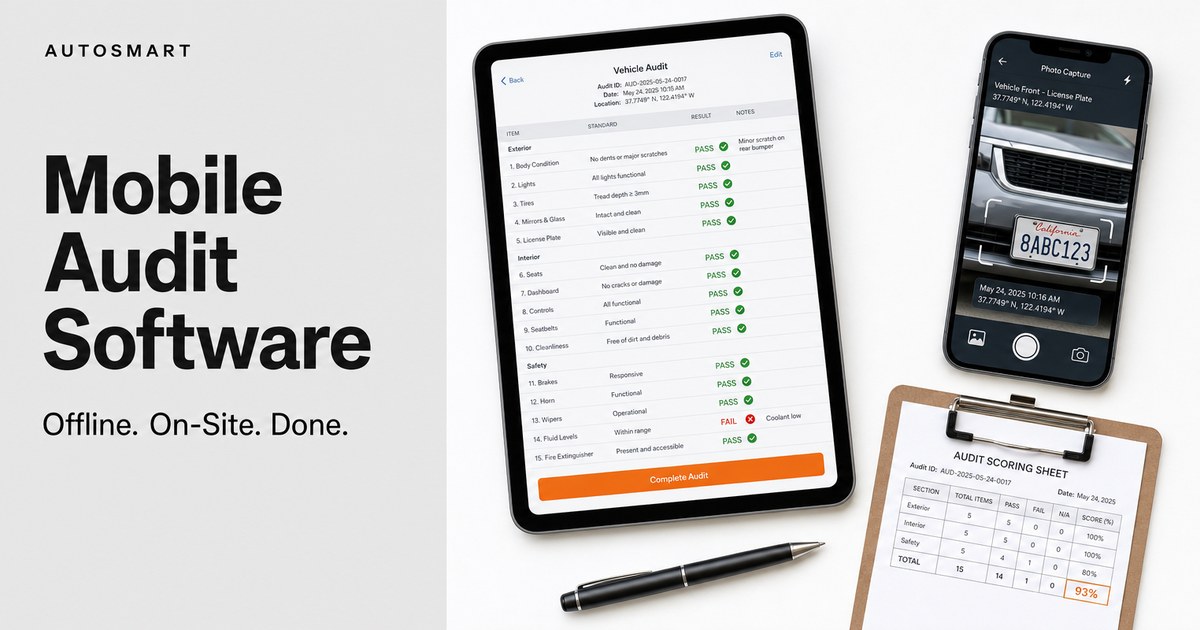
A genuine offline-first mobile audit app handles five functions without connectivity: checklist execution, live photo capture with geotagging, on-device weighted scoring, digital sign-off, and queued sync on reconnect.
Each audit generates 8-20 findings; without a closed-loop corrective-action workflow, over 60% of those findings never trigger action within the same business week (FieldPie, 2026).
At $500 per physical visit, 100 dealer visits costs $50,000 in travel - before consolidation hours are counted.
Why Offline-First Is Not Optional for Dealer Network Audits
Offline-first mobile audit software stores checklists, scoring logic, and evidence capture entirely on the device so auditors complete a full audit with no internet connection. In MENA and APAC dealer networks, field auditors travel 6-12 hours per visit. The GSMA Mobile Economy MENA 2025 report confirmed 67% of users in the region are on 4G - but a substantial usage gap persists in secondary cities and workshop locations, making offline capability a non-optional requirement.
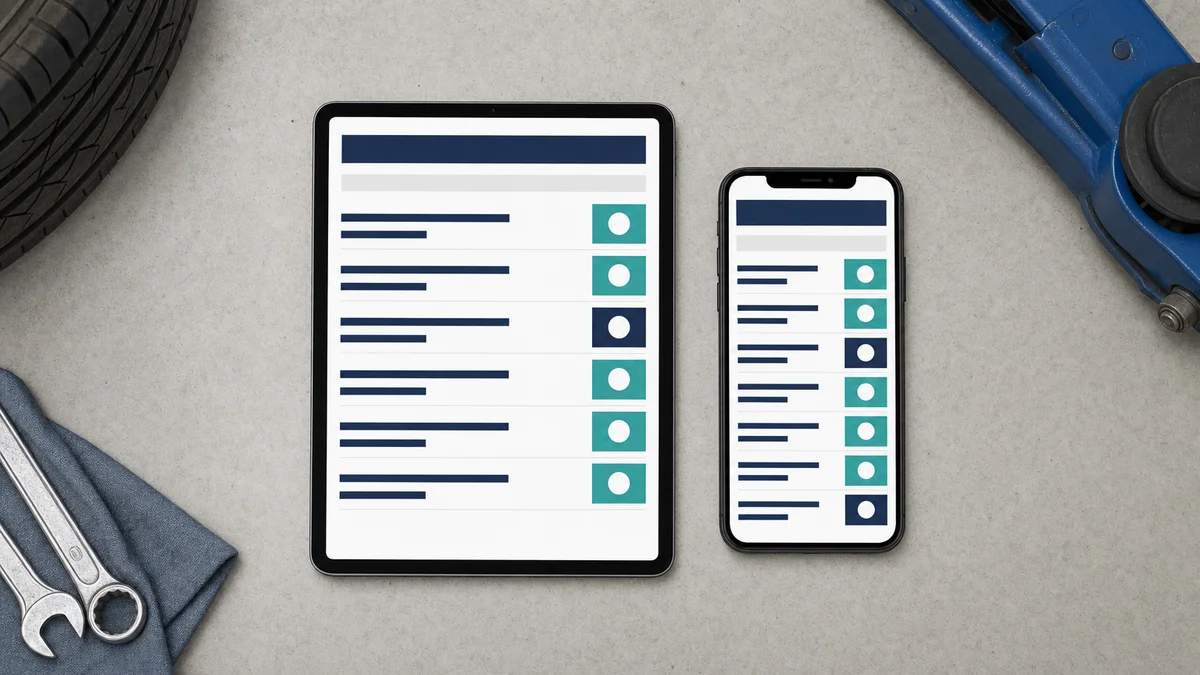
Tablet and smartphone showing dealer audit checklist forms on a workshop surface
The Mobile Inspection Software Market was valued at USD 54.38 billion in 2024 and is projected to reach USD 117.19 billion by 2032, growing at a CAGR of 12.67% (Verified Market Research, 2026). Mobile apps are now in use at 47% of construction and engineering firms, nearly double the 2023 share (Deloitte, cited by Clappia, 2026). Dealer network audit teams are in the same adoption curve, with the same connectivity constraints.
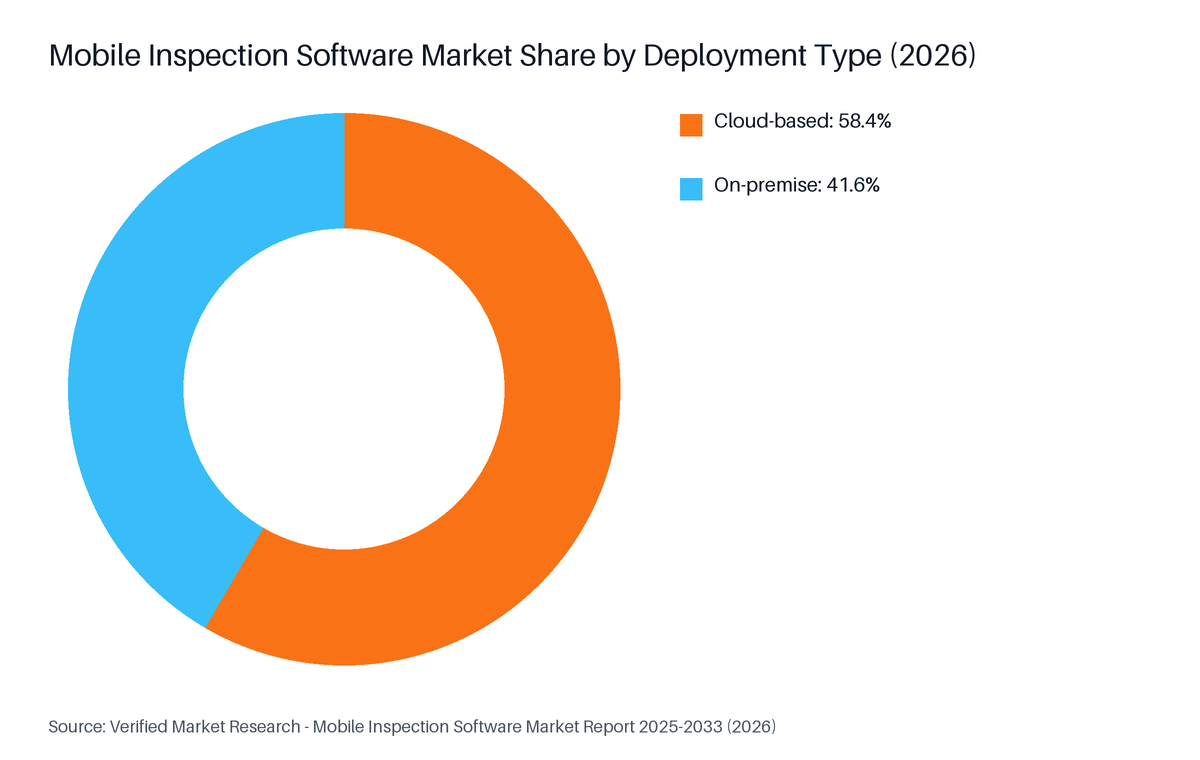
Donut chart: Mobile Inspection Software Market Share by Deployment Type (2026). Highest: Cloud-based at 58.4%.
Cloud-based deployment now accounts for 58.4% of the mobile inspection software market (Verified Market Research, 2026) - but cloud-only architecture is not offline-first. Auditors in workshop basements, enclosed service bays, or rural dealerships in India and secondary Gulf cities need the full workflow on the device, not in the cloud.
The Connectivity Reality in MENA and APAC Dealer Networks
Dealer networks in MENA and APAC are not uniformly connected. Rural dealerships in India and secondary Saudi and Gulf cities regularly operate on Edge or 3G speeds. Workshop basements cut signal further. An auditor running a Dealer Operating Standards (DOS) checklist in these environments needs every function available locally - the alternative is a half-completed audit and four hours of typing at the hotel.
A truly offline-first mobile audit app downloads the complete checklist, scoring weights, dealer profile, and historical context to the device before the auditor leaves connectivity. Everything that happens on-site is stored locally. The upload runs automatically when the device reconnects - no manual export, no email attachment, no waiting.
The Real Cost of the Post-Visit Consolidation Problem
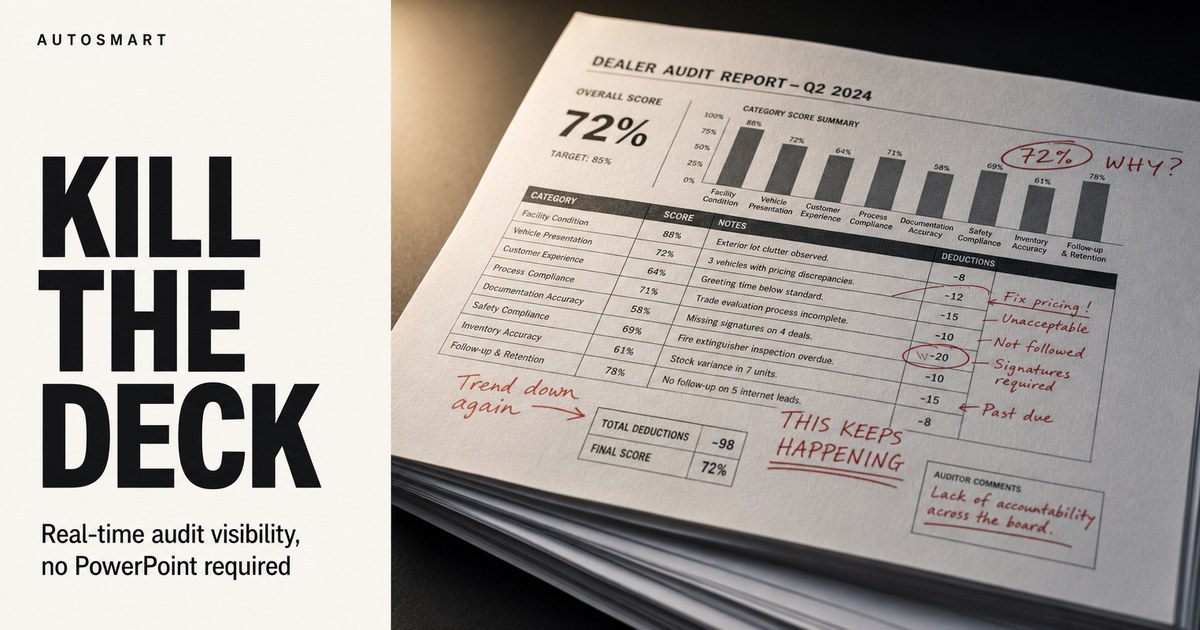
Post-visit consolidation is the hidden tax on every dealer audit: field teams spend 3-4 hours after each site visit converting handwritten notes into Excel calculations, sign-off sheets, and PowerPoint reports, while management spends further hours consolidating outputs across dealers and audit cycles. "Only 55% of paper inspection reports were submitted within 24 hours of the site visit" (Clappia, 2026). The other 45% arrive days later.
Stack of paper audit forms next to a smartphone showing a digital audit score
The arithmetic is direct. At $500 average per physical visit, every 100 dealer visits costs approximately $50,000 in travel. Add 3-4 hours of post-audit consolidation per visit, multiplied across a network running 17-18 audit programmes at daily, weekly, monthly, quarterly, and yearly frequencies, and the administrative overhead rivals the travel budget.
Our data: AutoSmart's field data shows dealer network teams spend 3-4 hours per audit visit on post-visit consolidation - Excel calculations, sign-off sheets, PowerPoint compilation, and photo attachment - across audit programmes running at multiple frequencies simultaneously.
A 90-day time-and-motion study tracking 2,847 inspections across 12 operations found that switching from paper to mobile reduced average inspection time by 67% (from 18.8 minutes to 6.2 minutes), cut errors by 94%, and saved $142,000 annually per 100 daily inspections (Heavy Vehicle Inspection, 2025). The underlying mechanism is the same for dealer audits: the consolidation step disappears because data is structured at the point of capture.
Ajeesh Alex, Regional After Sales Manager at MG MENA, put it plainly after deploying AutoSmart Audit: "Everything is at their fingertips since adopting the audit system."
What Mobile Audit Software Must Handle Offline: A Checklist for Evaluating Tools
Mobile audit software must handle five capabilities without any internet connection: structured checklist execution with weighted scoring on-device, live photo capture enforced at the point of capture, geotagging and timestamp on every image, digital sign-off from the auditor and dealer principal, and automatic sync with conflict resolution on reconnect. "Only 55% of paper inspection reports were submitted within 24 hours of the site visit" (Clappia, 2026) - tools that miss any of these five fail the same way paper does.
Smartphone capturing a geo-tagged photo inside a vehicle showroom with timestamp overlay
Use this table when evaluating any mobile audit app for a dealer network:
Capability
What to look for
Why it matters on-site
Checklist execution
Full checklist stored on-device; branching logic works offline
Auditor cannot pause mid-audit waiting for a question to load
Photo capture
Live capture enforced; no upload from camera roll
Prevents submission of old or staged photos
Geotagging
GPS coordinates embedded automatically in every image
Confirms photo was taken at the audited facility
Timestamp
Date and time embedded at shutter click, not upload time
Evidence chain intact even if sync is delayed by hours
Weighted auto-scoring
Scoring weights and nullify rules stored on-device
Score is calculated and final before the auditor leaves
Digital sign-off
Dealer principal and auditor can sign offline
Creates a time-stamped acknowledgement record on-site
Sync on reconnect
Automatic queue upload; no manual action required
Findings are in the system as soon as the device finds signal
Corrective-action assignment
Person-In-Charge (PIC) and due date set offline
Action plan exists before the visit ends
The Difference Between True Offline-First and Cached Forms
A cached form loads the checklist when the device last had connectivity and lets the auditor fill in answers. It cannot enforce live photo capture, cannot calculate a weighted score without a server call, and cannot handle digital signatures that need server-side validation. When sync fails - because conflict resolution logic sits on the server - the auditor loses data.
A true offline-first mobile audit app holds all logic on-device. The score is calculated locally using the same weighted rules the server would apply. Photos are captured, geotagged, and stored in a local queue. Signatures are recorded on-device. When the device reconnects, the upload is a single complete record, not a partial push that needs the server to fill in gaps. This distinction rarely appears on feature comparison pages - but it becomes obvious the first time an auditor submits a 60-question audit in a workshop basement and drives out to find half the answers are missing.
For the full picture of what automotive-specific audit software must do that generic tools miss, this structural difference in offline architecture is where purpose-built platforms separate from form builders.
Evidence Integrity: Why Photo Capture Rules Matter More Than Storage
Evidence integrity in mobile audit software means the photo was taken at the dealership, at the time of the audit, by the auditor conducting it - not pulled from a camera roll or sent by a dealer who staged the shot. Storing photos offline is straightforward; proving they are genuine requires three controls working together.
When "only 55% of paper inspection reports were submitted within 24 hours of the site visit" (Clappia, 2026), the evidence that does arrive is unverifiable - memories have faded, context has shifted, and the dealer has had time to remediate and re-photograph. That makes chain-of-custody controls non-optional.
Geotagging is the process of embedding GPS coordinates into a captured image, confirming the location where evidence was collected. Timestamping embeds the date and time at shutter click, not at upload. Live-capture enforcement prevents the auditor from selecting an existing image from the device gallery - the app opens the camera directly and only accepts a freshly taken photo.
These three controls matter most in dealer network audits where findings carry commercial consequences. A dealership contesting a brand standards failure needs to dispute a photo with coordinates, a timestamp, and a capture-enforced chain of custody - not a file with a creation date from a different week.
For paperless audit workflows in dealer networks, evidence integrity is the difference between a report management can act on and one a dealer principal can unravel in the first five minutes of a review meeting.
Auto-Scoring Offline: How Weighted Compliance Scores Work Without a Server
Offline auto-scoring in a mobile audit app means scoring logic, section weights, and nullify rules are downloaded to the device before the audit begins, so the compliance score is calculated locally as the auditor answers each question. Smartphones account for approximately 52.4% of the mobile inspection software market by device type (Verified Market Research, 2026) - the processing power to run weighted scoring locally is standard on any mid-range device today.
Audit scoring sheet with section weights, a pen, and a clipboard on a white surface
When the auditor submits, the score is final and identical to what a server-side calculation would produce. This matters in dealer network audits because scoring disputes are one of the fastest-moving buying triggers in the category. A dealer cannot contest a result produced by a formula configured once and applied identically across every auditor and every site.
Section Weights and Nullify Rules
A Dealer Operating Standards audit is not a flat checklist. Different sections carry different weights - aftersales process compliance may outweigh signage standards in a particular Original Equipment Manufacturer (OEM) programme. Some questions are nullified if a facility does not offer a specific service. All of this logic must be on the device before the auditor walks in, or the offline score will differ from the server-calculated result.
The right question to ask any vendor: "If the device has no connectivity from the moment I open the audit to the moment I submit, does the score on screen match what your server would have calculated?" If the answer is anything other than yes, the tool is not fully offline-first on scoring.
Sync on Reconnect: What Happens When the Auditor Drives Out of the Car Park
Sync on reconnect means the completed audit, scored results, photo evidence, and digital signatures upload automatically the moment the device finds a connection - no manual action, no export, no forwarding. Gartner's August 2025 survey of 107 Chief Audit Executives found 80% want to increase the impact of data analytics in their audit function (Gartner, 2025) - a goal only achievable if field data enters the analytics system in real time, not days after the site visit.
As SiteCapture noted in 2026, "Most reporting delays don't happen in the field. They happen because the field and the office aren't connected in real time" (SiteCapture, 2026).
A well-built mobile audit app queues the full data package locally and transmits it as a single complete upload. The management dashboard shows completed findings while the auditor is still driving back to the office. For a network running 17-18 audit programmes simultaneously - daily, weekly, monthly, quarterly, and yearly - that real-time visibility is the difference between management seeing network health today and management seeing it next Thursday.
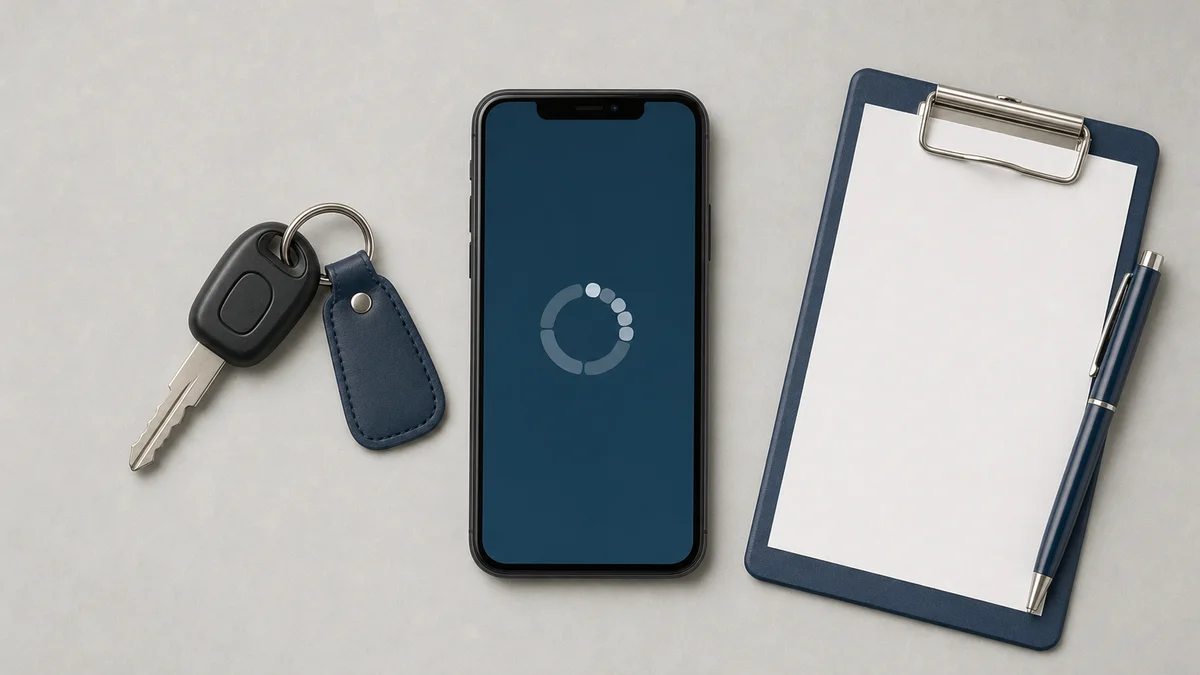
Smartphone showing a sync progress screen beside car keys and a clipboard
Our data: Almajdouie Motors cut its audit cycle from 10 days to 3 days after deploying AutoSmart Audit. The reduction came directly from eliminating post-visit consolidation and manual reporting steps. (AutoSmart Audit case study)
Luai Felemban, Network and Dealer Development Manager, confirmed the impact in a video testimonial: an evaluation that previously took 5 days plus 5 more days to prepare and share reports now takes 3 days in total - including the action plan. That compression only happens when sync on reconnect puts findings into the system without a separate consolidation step.
Corrective Actions in the Field: Assigning a PIC Before You Leave the Site
A mobile audit app that closes the loop assigns each failed item to a Person-In-Charge (PIC) - the named individual responsible for rectifying the non-compliance - with a due date and automated reminders, before the auditor leaves the dealership. "Over 60% of audit findings never trigger a corrective action within the same business week. Paper is the reason" (FieldPie, 2026).
Each dealer audit generates 8-20 findings. Under a manual process, each finding requires 4-5 follow-ups including escalations before closure. The audit team becomes the chasing team, with no system record of who owns what, what the deadline is, or where the finding stands. When the corrective-action assignment is built into the mobile audit app and syncs with the PIC's notification on reconnect, the finding is already owned before the auditor reaches the car park.
A closed-loop Action Plan Tracker connected to a mobile audit app should deliver:
Automatic conversion of every failed item into an action item at submission
PIC assignment with a named owner and a defined due date
Automated reminders beginning before the due date and repeating until closure
Closure evidence required before the action item can be marked complete
Full audit trail visible to management without manual consolidation
For dealer networks managing 5S audits, safety checks, and operational compliance in the same visit, the corrective-action workflow needs to handle findings across multiple audit types simultaneously - keeping them organised by type, location, and PIC without the auditor managing a spreadsheet.
See how AutoSmart Audit's audit management software handles corrective-action tracking across dealer networks of different sizes.
Who This Is Not For
Mobile audit software built for dealer networks is not the right tool for every team. Networks with fewer than approximately 10 sites can still coordinate audits with a spreadsheet - the pain of manual consolidation is real but manageable at that scale, and the infrastructure cost of a platform outweighs the benefit.
Mobile audit software is also not a vehicle inspection tool. AutoSmart Audit inspects sites and standards - whether the process happened, whether it was done correctly, whether the facility meets the brand standard. It is not a mechanical inspection system for evaluating vehicle condition.
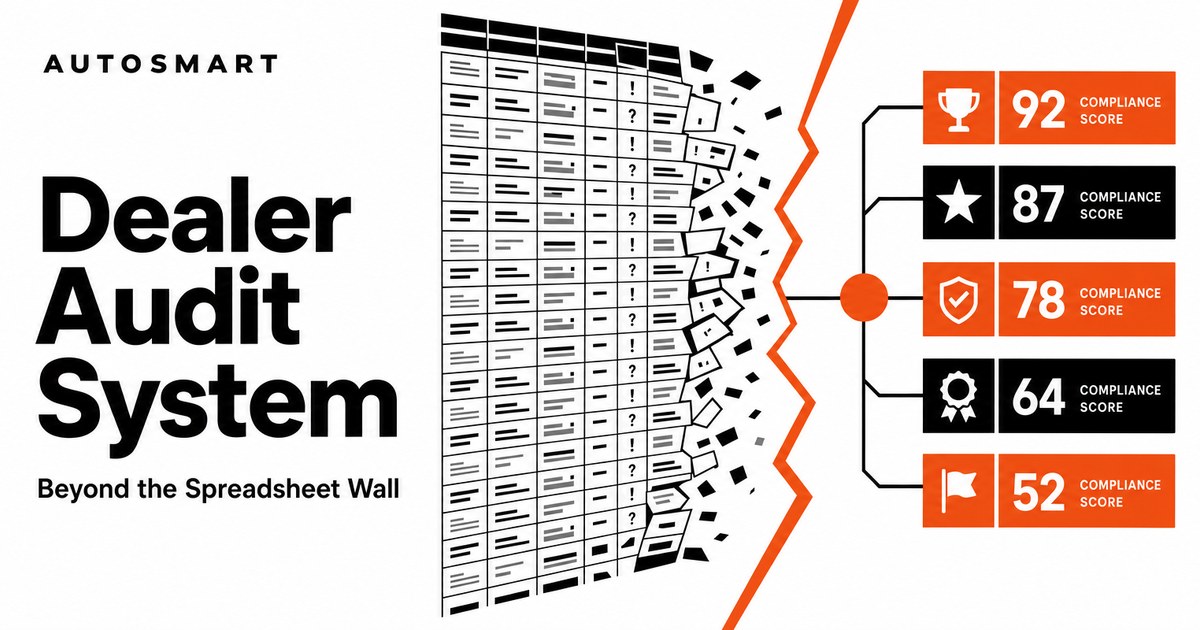
Generic mobile audit tools handle single-site checklist execution well. They do not handle dealer hierarchies, distributor tiers, weighted scoring configured per OEM standard, or multi-country reporting that rolls up to a management dashboard without manual aggregation. If the audit output needs to compare 200 dealers across five markets against one standard and deliver a regional board view, a general-purpose form app will produce data but not insight.
For automotive network audit software where the unit of value is network performance rather than a single site's checklist, the architecture requirements in this article are the baseline, not advanced features.
Frequently Asked Questions
Our auditors submit findings days after the site visit because they type up notes back at the office - how much does a mobile audit app cut that lag?
A mobile audit app eliminates the back-at-office transcription step entirely. A 90-day time-and-motion study tracking 2,847 inspections found that switching from paper to mobile reduced average inspection time by 67% and cut errors by 94% (Heavy Vehicle Inspection, 2025). With an offline-first mobile audit app, the dealer visit report is generated and scored at the moment of on-site submission - findings enter the system before the auditor leaves the car park, not days later.
Our auditors travel six to twelve hours per dealer visit - which mobile audit apps support offline-first evidence capture?
An offline-first mobile retail audit app stores the full checklist, scoring logic, and evidence capture capability on the device, with no active connection required. AutoSmart Audit's mobile app for Android and iOS runs the complete audit workflow offline - including photo capture with geotagging and timestamps, auto-scoring, and digital sign-off - then syncs all data automatically when connectivity is restored. The 6-12 hour travel investment produces a finished, submitted audit rather than a notebook to type up later.
We run audits on mobile devices but sync and evidence capture still fail in low-connectivity dealerships - what should mobile audit tools handle offline?
Mobile audit services must handle five capabilities natively without a connection: structured checklist execution with branching logic, photo capture enforced as live (not from the camera roll), geotagging and timestamp on every image, weighted auto-scoring calculated on-device, and digital sign-off from the dealer principal. Sync on reconnect must be automatic and conflict-aware. If any of these require a live connection, the tool is a cached form rather than a true offline-first platform.
Conclusion
The post-visit consolidation problem costs dealer network field teams 3-4 hours per audit visit. Compounded across an audit programme running at multiple frequencies across dozens or hundreds of sites, that is a recurring drain on field capacity and management time. A better spreadsheet template does not fix it.
Offline-first mobile audit software removes the consolidation step by making the audit complete at the point of submission. Five capabilities must work without a connection: checklist execution, live photo capture with geotagging and timestamps, on-device weighted scoring, digital sign-off, and automatic sync on reconnect. Corrective-action assignment closes the loop before the auditor leaves the site.
Field teams that evaluate mobile audit tools against this list - rather than a generic feature checklist - avoid the common failure mode: a tool that works in the demo room and fails in a workshop basement in Riyadh or rural Maharashtra.
AutoSmart Audit holds a 4.8/5.0 rating from 17 reviews on G2 (March 2025-September 2026) and was recognised as Digital Product of the Year at Automechanika Dubai 2023. For a personalised walkthrough based on your dealer network size and audit programme, Schedule a Free Demo with AutoSmart.
Written by
Naseef Umar
Founder | CEO
Naseef Umar is an automotive industry expert and the Founder & CEO of AutoSmart, with over a decade of experience working across automotive operations, dealer standards, network performance, audits, and digital transformation.
Company
KERALA Full Address - Pulikillam W Rd, Kakkanad West, Chembumukku, Edappally, Kochi, Kerala 682030; DUBAI Full Address - Dubai Silicon Oasis, UAE

 Naseef Umar