
Blog
Field Audit App: What to Test Before You Commit
Test a field audit app on offline-first behaviour, evidence capture and report-before-you-leave-site, with a timed bake-off and weighted scorecard.

Non conformance management software for dealer networks: what the report template should standardise, what generic CAPA tools miss, and how to verify closure.
 Naseef UmarOct 31, 2026
Test a field audit app on offline-first behaviour, evidence capture and report-before-you-leave-site, with a timed bake-off and weighted scorecard.
Define SOPs for automobile dealers, clear up what SOP means in the auto industry, and follow six steps that make SOPs stick, with or without SOP software.
Toyota's digital service evaluation has no public program name. See how TSM, Kodawari and Image USA II differ and how a Toyota dealer audit works.
Request a quote and our experts will contact you within 24 hours with tailored solutions and pricing.
You can also send us a quick email at info@autosmarts.co.
AutoSmart Technology
Last updated: Oct 31, 2026
By Naseef Umar, Founder and CEO, AutoSmart
Non conformance management software is a system that records each audit finding against a standard, assigns it to an owner, tracks it to verified closure, and shows recurrence across sites, replacing email chains and spreadsheets. In a dealer network the volume is the problem. By AutoSmart's own figures, each audit raises 8 to 20 findings, and under a manual process each finding needs 4 to 5 follow-ups, escalations included, before it closes. The audit team quietly becomes the chasing team. This guide covers what the software changes. It also covers what a report template should standardise so dealers stop arguing about wording, and what generic corrective and preventive action (CAPA) tools miss. If you are still on spreadsheets, start with when a dealer audit system breaks down.
Key Takeaways
- Non-conformance management software turns each failed audit item into an owned, dated action with closure evidence, so auditors stop chasing by email.
- A non-conformance report template should fix the standard clause, evidence, severity, required outcome, due date and owner, so findings read the same whoever writes them.
- Generic CAPA tools assume the organisation owns the process; a dealer is an independent business, so owner access, scoring and repeat-finding views must be built for the network.
- A finding should close on verified evidence (photo, desk review or follow-up visit), not on a dealer's signature alone.
- Standards are rising: 43% of Original Equipment Manufacturer (OEM) executives expect to require a new image facility within five years (Kerrigan Advisors, 2026). This is market context, not findings data.
Non conformance management software is a system that turns each audit finding into a tracked record with a standard reference, evidence, severity, an owner, a due date and a closure check. A non-conformance is a failure to meet a specified requirement. In a dealer network, which NADA counted at 16,990 franchised US dealers for 2025 (NADA, 2026), it also rolls findings up by dealer, region and standard clause.
Non-conformance is a failure to meet a specified requirement, whether that is a brand standard, an internal procedure or a regulation. Corrective action is the work that removes the cause of that failure so it does not come back. Corrective and preventive action (CAPA) is the wider discipline of finding root cause, fixing it and checking that the fix worked. A non-conformance report (NCR) is the record that starts the chain.
| Term | What it records | Who typically owns it in a dealer network |
|---|---|---|
| Audit finding | What the auditor saw, against which standard | Auditor |
| Non-conformance report | The finding formally logged as a failed requirement | Auditor, then the dealer |
| Corrective action | The fix and the cause it removes | Dealer, verified by the brand |
| Action plan | All corrective actions for one audit, with dates | Dealer principal or Person-In-Charge |
Some teams treat "finding" and "non-conformance" as the same thing. Others keep observations separate from formal non-conformances. Pick one rule and write it into the template. For a plain-language explainer on the ISO 9001 side, see AutoSmart's earlier non-conformance report FAQs.
Non-conformance management matters more for dealer networks because standards keep rising across a large footprint. As context, not audit-findings data, Kerrigan Advisors' 2026 OEM Survey found 43% of OEM executives expect to require a new image facility from dealers within five years (Kerrigan Advisors, 2026), and 31% expect higher facility requirements, up from 25% in 2025.
Kerrigan Advisors' 2026 OEM Survey, as reported by Dealership Guy, found 61% of OEM executives expect current standards to hold, 8% expect a decrease and 31% expect higher requirements (Dealership Guy, 2026). These figures describe facility standards, not audit findings, so the link to findings is an inference: more standards to measure, and few loosening, means more findings to track.
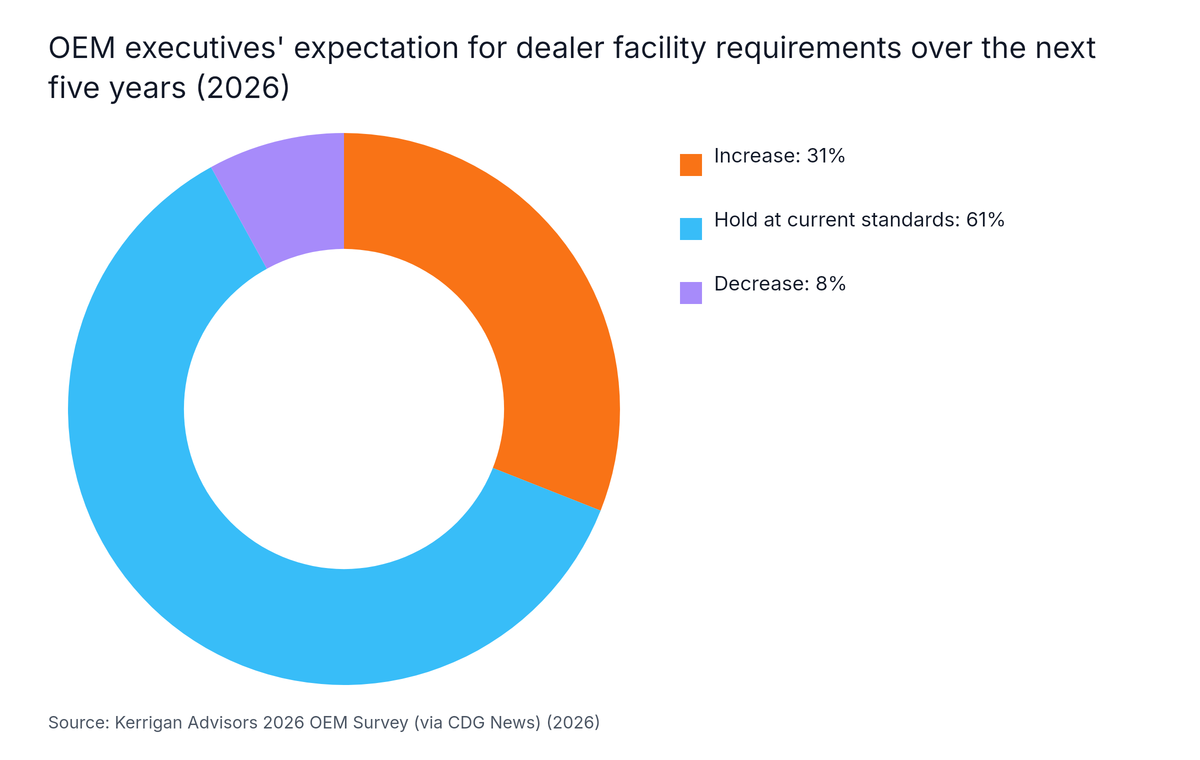
Source: Kerrigan Advisors 2026 OEM Survey (via CDG News), 2026
In the 2025 Kerrigan Dealer Survey, 42% of dealers expect OEM-required property investments, including EV infrastructure, to hurt future profits (Kerrigan Advisors, 2025). Kerrigan's OEM report puts the consequence bluntly: "dealers are choosing to divest dealerships whose facility investments yield a low or negative return" (F&I Magazine, 2026). A dealer who expects a finding to cost money will contest it, so the record behind each finding has to hold up. For how OEMs structure the audits behind those findings, read dealer performance audits and how standards are enforced.
Non-conformance software turns every failed audit item into an action with a Person-In-Charge (PIC), a due date, automated reminders and required closure evidence, so the audit team stops chasing by email. By AutoSmart's own figures, each audit raises 8 to 20 findings, and a manual process needs 4 to 5 follow-ups per finding before closure.
The manual routine is familiar. The team downloads the report, emails action items to the dealer principal, shares an Excel sheet, waits, and raises the finding again in a meeting. Some items are missed entirely. Others cross their deadline unnoticed. When something stays open, no clean record shows who owns it. The pressure is not easing: Cox Automotive's Q3 2026 index shows franchised dealer sentiment fell 4 points to 49, from 53 a year earlier (Cox Automotive, 2026). Dealers under margin pressure are more likely to push back on findings that carry cost.
Action Plan Tracker is a closed-loop corrective-action workflow connected directly to each audit finding. Person-In-Charge (PIC) is the named owner who manages and closes an assigned finding. Here is what changes step by step:
| Step | Manual process | Action Plan Tracker |
|---|---|---|
| Raising the action | Report downloaded, items emailed to the dealer principal | Each failed item becomes an action automatically |
| Assigning an owner | Agreed in an email thread | PIC named on the action, with a due date |
| Reminders | Auditor chases, 4 to 5 follow-ups per finding | Configurable reminders and escalations relative to the due date |
| Closing | Dealer says it is done | Closure evidence required before the action can be marked complete |
| Visibility | Excel and memory | Owner, deadline and status on one record |
Our data: AutoSmart's data shows audit cycles compressing from 10 days to 3 days.
Evidence compilation shrinks too. Under the status quo, auditors and head teams spend several hours per audit compiling photos and preparing PowerPoint decks, and some dealership teams spend 3 to 4 hours after each audit consolidating Excel calculations, sign-off sheets and photos. A dealer visit report generated at the end of the visit, with digital sign-off from auditor and dealer, removes that tail. A drill-down dashboard removes the several hours per reporting cycle that management spends consolidating data across dealers and regions. The same logic applies to replacing the manual PowerPoint reporting cycle.
Self-assessment can also cut visits for suitable checks. AutoSmart estimates this could reduce physical visits by 30 to 40%. That is an estimate, not a measured result.
A non conformance report template for a dealer network should standardise six fields: the standard clause, the observed evidence, the severity class, the required outcome, the due date and the owner. Fixed fields give every finding the same shape, which leaves dealers less to dispute.
Disputes are likely to persist: 42% of dealers in Kerrigan's 2025 survey expect OEM-required property investments to hurt future profits (Kerrigan Advisors, 2025). That is context, not data on audit disputes, but it explains why a finding needs a defensible basis. Most templates standardise record fields but not auditor judgement. The fields below are a working proposal for a dealer network, not a published standard. Adapt them to your own Dealer Operating Standards (DOS), the written requirements dealers are audited against.
| Field | What it holds | Why it prevents a dispute |
|---|---|---|
| Standard reference | Clause or question ID, with the version of the standard | The dealer can check the requirement itself |
| Finding statement | One sentence: what was expected, what was observed | Removes opinion and adjectives |
| Evidence | Live photo with date, time and geotag, plus notes | Proves the condition at the site on the day |
| Severity class | Major or minor, with weighting from the scoring model | Same failure scores the same everywhere |
| Required outcome | What "fixed" looks like and what proof closes it | Dealer knows the target before starting |
| Owner (PIC) and due date | Named person and date | No orphaned findings |
| Response and dispute route | Response window, challenge option, reviewer | Disagreement has a place to go |
A major non-conformance is a significant breakdown that affects the system or safety and needs immediate action. A minor non-conformance is a narrower lapse, such as a single missed step, that still needs closing. Define both in the template, with two or three examples each.
Two auditors can fill the same fields and still write different findings. Four practices close that gap:
For the 5S side of this consistency problem, see running 5S audits consistently across sites.
Dealers are independent businesses, so a finding needs a lifecycle, not just a record. A workable route has a response window, a place for the dealer to upload counter-evidence, a reviewer who did not raise the finding, and a logged outcome. Write it into the template so a contested score exposes a process, not a personality.
Compared with a corrective and preventive action (CAPA) tool built for dealer networks, generic CAPA tools miss five things: dealer owners who are not employees, weighted scoring, repeat-finding views by standard and region, verified closure evidence, and hierarchy across brands and distributors. They follow the plant quality model that ISO 9001 certifies, with approximately 1.47 million valid certificates worldwide at the end of 2024 (QIA, 2025).
The pattern below is typical of generic tools. Check any tool you are evaluating against it rather than assuming.
| Capability | Typical generic CAPA tool | Action Plan Tracker built for a network |
|---|---|---|
| Action owner | Internal employee | Dealer PIC, scoped by dealership, location or geography |
| Template fields | Batch, lot, part, quantity | Standard clause, severity, evidence, required outcome |
| Scoring | Often none | Weighted auto-scoring, identical across auditors and sites |
| Recurrence view | Open actions per site | Repeat findings by dealer, region, standard and cycle |
| Hierarchy | One organisation | Multi-country, multi-brand and multi-distributor by default |
| Field conditions | Assumes a connected office | Offline-first mobile app with live photo capture |
| Root-cause form | Plant-style, owned by the organisation | Dealer-owned plan, verified by the brand |
The brand cannot dictate a dealer's internal root-cause work. It negotiates, verifies and escalates. The model that fits is a corrective action plan owned by the dealer and verified by the OEM, with escalation to a regional manager when dates slip. Generic tools have no concept of that relationship.
Service standards generate most repeatable findings. NADA's 2025 report shows more than 276 million repair orders and service and parts sales exceeding $164 billion across franchised dealers (NADA, 2026). The stakes for the customer relationship show in Cox Automotive's 2025 study: 74% of buyers who returned for service are likely to repurchase from that dealership, against 44% of those who did not (Cox Automotive, 2025).
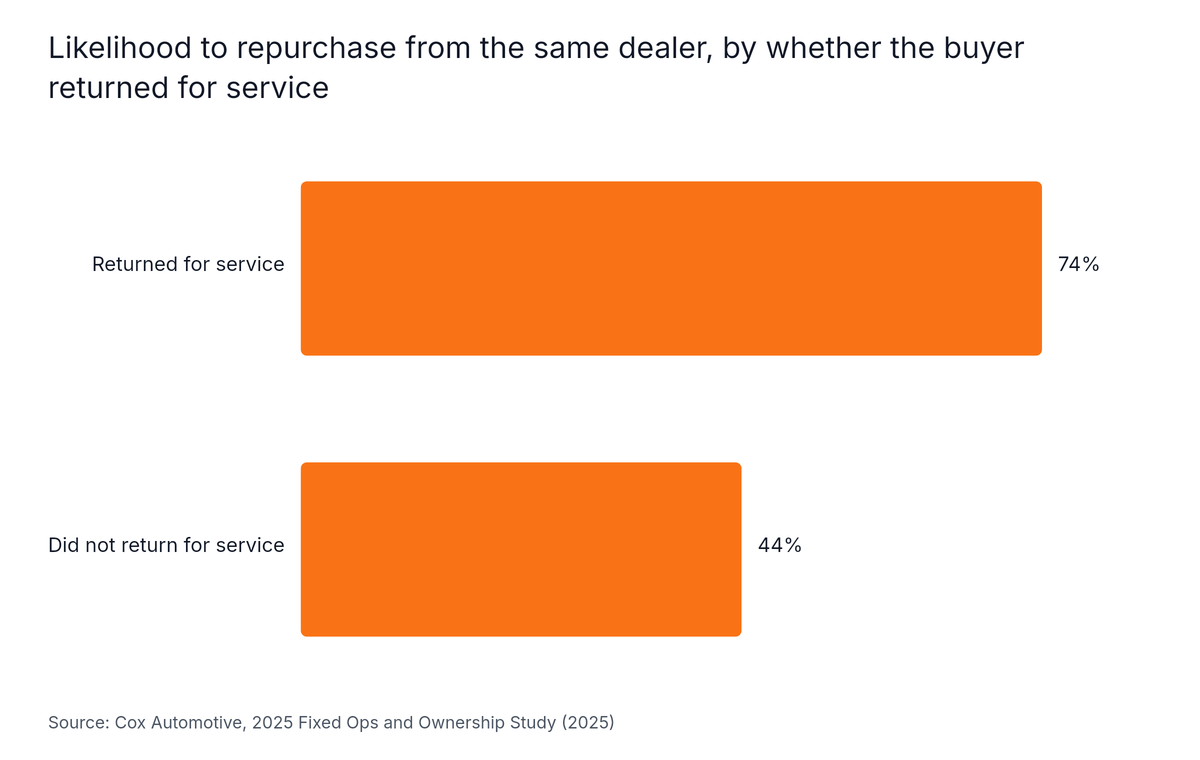
Source: Cox Automotive, 2025 Fixed Ops and Ownership Study, 2025
The same study notes that "Trust is the number-one reason consumers return to a dealership for service" (Cox Automotive, 2025). An unclosed service-standard finding is a trust problem waiting for a customer to find it.
One dealer principal can answer to several OEM audit programmes. A network tool should show that principal's open actions across brands with one consistent response workflow. More on this category is in automotive network audit software built for dealer networks.
A non-conformance tracker should close a finding only on verified evidence. The ECA Academy cautions in its analysis of FDA warning letters that "a plausible explanation is not necessarily a root cause, and a procedural promise is not necessarily an effective CAPA" (ECA Academy, 2026). Photos, a desk review or a follow-up visit qualify; a dealer's promise alone does not.
Regulators show what weak closure costs. A Qbench analysis of all 470 FDA warning letters issued in 2025 found 19 lab-related letters (13%) citing CAPA that was missing, undocumented or inadequate (Qbench, 2026). That is pharma data, not dealer data, but the failure mode is the same: closed on paper, not fixed. ISO 9001 expects corrective action effectiveness to be reviewed without prescribing a method. For dealers, the practical options are:
| Method | Best for | Evidence |
|---|---|---|
| Photo evidence | Physical fixes: signage, bay layout, equipment | Live photo, date, time and geotag |
| Desk review | Process and document fixes | Uploaded records reviewed by a second person |
| Follow-up visit or audit | Safety, repeat or high-severity findings | New audit result in the next cycle |
The Action Plan Tracker requires closure evidence before an action can be marked complete. Live photo capture blocks pre-existing images, and date, time and geotag confirm the photo was taken at the right facility. The mobile side is covered in offline-first evidence capture and sync.
A list of open actions per site misses the bigger signal. When the same finding appears across many dealers, the cause is often the standard, the training or the process, not the dealers. Evaluation cycles group audits so trends show across time. A drill-down dashboard lets management move from network performance to region, dealer, pillar and individual finding. During the current audit, the auditor sees previous failures, previous evidence and whether the failed question was later resolved, on the same screen. See field audit software for dealer networks for the capture workflow.
Evaluate non-conformance management software for a dealer network against eight criteria: network hierarchy, dealer access, standard library, scoring, escalation, evidence capture, security and rollout effort. A tool that passes on single-site checklists but fails on hierarchy or dealer access will push the chasing back onto the audit team.
Scale matters when you test. NADA's mid-year report shows 16,991 franchised dealers and more than 136 million repair orders in the first half of 2026 (NADA, 2026), so ask how a tool behaves at hundreds of sites, not ten.
| Criterion | Question to ask | What good looks like |
|---|---|---|
| Hierarchy | Does it model distributor tiers, countries and brands? | Built in, not an add-on |
| Dealer access | Can a dealer PIC respond, upload and close? | Role-based access scoped to the dealer |
| Standard library | Can your administrator edit checklists without a ticket? | Self-service, versioned |
| Scoring | Is weighting identical for every auditor? | Auto-scoring on submission |
| Escalation | Do reminders and escalations run without the auditor? | Configurable relative to due date |
| Evidence | Is evidence live, time-stamped and geotagged? | Enforced, attached to the finding |
| Security | Which certifications and hosting options exist? | ISO 27001, SOC 2 Type II and GDPR, with SSO |
| Rollout | How long to go live? | Days, not months |
AutoSmart holds ISO 27001, SOC 2 Type II and GDPR compliance, with badges verified by TÜV SÜD, and runs on AWS with SSO available. Go-live is typically 5 to 10 working days once configuration inputs arrive. Whichever vendor you assess, stress-test it with demo scenarios built from your own worst audit.
Ready to see the Action Plan Tracker on your own standard? Schedule a Free Demo.
Non-conformance management software is not for a single-site operation, a network without a written standard, or a team unwilling to let dealers see and respond to findings. Software enforces a process; it cannot repair vague standards. The only third-party closure data in our research, Qbench's review of 2025 FDA warning letters (Qbench, 2026), cites 19 lab-related letters (13%) for inadequate CAPA, and it covers pharma, not dealers.
Non-conformance management software is a system that records each audit finding against a standard, assigns it to an owner, tracks corrective action to a verified closure and shows recurring failures across sites. For dealer networks it also handles independent dealer owners, brand hierarchies and weighted scoring that generic tools do not.
A non-conformance report records that a requirement was not met, while corrective and preventive action (CAPA) is the response that fixes the cause and stops recurrence. The report is the finding, the CAPA is the action plan. A network tool links the two so each finding carries its own owner, deadline and closure evidence.
A disputed audit finding should go through a defined route: a challenge window, evidence upload by the dealer, review by a second person who did not raise the finding, and a logged outcome. Weighted scoring applied identically to every auditor and every site removes many disputes before they start.
A major non-conformance is a significant breakdown that affects the system's ability to work or the safety of a product or site, and needs immediate corrective action. A minor non-conformance is a narrower lapse, such as a single missed step, that still needs correcting before it compounds.
Excel and generic corrective and preventive action tools break down in dealer networks because dealers are independent owners, not employees. They lack dealer hierarchies, weighted scoring and repeat-finding views by standard, so the audit team ends up chasing each finding through four or five follow-ups by hand.
Dealer networks raise 8 to 20 findings per audit, and the cost sits in the chasing, the disputes and the findings nobody can prove were fixed. Five points to keep:
Your next step is to bring one live audit programme to a demo and check it against the criteria above. Continue learning with paperless auditing for multi-site dealer networks.
© 2026 AutoSmart Technology All rights reserved.