oem complianceoem dealer compliance auditsimproving oem standard compliance with dealer audits
OEM Compliance: How Dealer Audits Improve Standards Compliance
OEM compliance explained: what dealers are audited on, how often OEMs audit and how closed-loop follow-up lifts compliance, with sourced figures.
Naseef UmarOct 28, 2026
Last updated: Oct 28, 2026
OEM Compliance: How Dealer Audits Improve Standards Compliance
OEM (Original Equipment Manufacturer) compliance is how closely a dealership meets the facility, brand, sales, service and warranty standards its manufacturer sets, and dealer audits are the mechanism that measures that gap and closes it. More than half of U.S. dealers (53%) say brand compliance requirements are difficult to keep up with (, 2026). That makes the way audits are run matter as much as how often. This guide explains what OEM compliance covers, how often OEMs audit, and why shorter audit cycles, owned corrective actions and re-audits raise compliance. It also flags where the evidence runs thin. For the wider scoring picture, see our guide to .
OEM compliance is the measurable extent to which a dealership meets its manufacturer's facility, brand, sales, service and warranty standards.
No public source gives a single OEM audit frequency. Cadence is set brand by brand and tiered by audit type and risk.
Dealer audits raise OEM compliance when each finding gets an owner, a due date, closure evidence and a re-audit, not when audits are merely frequent.
A digital field audit workflow removes post-visit consolidation work, which AutoSmart's data puts at 3 to 4 hours per audit for some dealerships.
Written by Naseef Umar, Founder and CEO of AutoSmart, who has worked for over a decade across automotive operations, dealer standards, network performance and audits.
What is OEM compliance for a dealership?
OEM compliance for a dealership is the extent to which the dealer meets the standards its manufacturer sets in the franchise agreement and standards manual. Those standards cover facility image, brand identity, sales, service and warranty claims. They also change: image standards are refreshed every seven to 10 years (CBT News, 2026), and each refresh resets what the dealer is audited against.
An audit scores each area against the standard, so compliance becomes a measurable number rather than an opinion. The table below shows the usual split.
Standards area
What an audit typically checks
Evidence usually needed
Facility and image
Signage, showroom layout, workshop and parts areas against the brand's image program
Dated photos, measurements
Brand identity
Logo use, uniforms, customer-facing materials
Photos, document copies
Sales and customer experience
Process steps, customer handling, mystery audit results
Audit cycle is the recurring period in which a dealer is audited against a standard, then corrected and re-audited.
Non-compliance is any audited requirement the dealer fails to meet.
Corrective action is a specific fix, with an owner and a due date, raised from a finding.
Chargeback is money an OEM reclaims from a dealer after an audit finds a warranty or incentive claim unsupported.
Housekeeping standards such as 5S are a common part of the aftersales scope. See 5S audits in a dealer network for how they are scored.
How often do OEMs audit their dealers for compliance?
No public source states how often OEMs audit dealers, because cadence is set brand by brand in franchise agreements and standards manuals. Facility standards refresh every seven to 10 years (CBT News, 2026), but that is a program refresh cycle, not an audit frequency. Warranty and incentive claims face legal look-back windows such as Florida's 12 months after payment as of 2026 (Bass Sox Mercer, 2026).
Treat any single number you read online with caution. The cadence figures that circulate come from vendors and consultants, and they contradict each other. A better approach is to read cadence as a set of drivers.
Audit type
What sets the cadence
Evidence
Facility and image standards
Multi-year program refresh, plus triggers such as construction or ownership transfer
Florida, as of 2026: 12 months after the claim or incentive is paid (Bass Sox Mercer, 2026)
Post-audit chargeback process
Statutory notice and response times
Florida, as of 2026: OEM meets the dealer within 30 days of the audit; dealer has at least 45 days to respond (Bass Sox Mercer, 2026)
Sales, service and customer experience
Brand-specific, often set by prior score
Check your standards manual
The legal limits are state-specific and moving. One law firm describes "reinforcing the growing trend toward increased state oversight of warranty-payment practices" (Nelson Mullins, 2025). Verify your own state's statute.
What manufacturing suggests about layered cadence
IATF 16949 clause 9.2.2.3 requires all manufacturing processes to be audited at least once per three-calendar-year period, according to a secondary summary (GovernanceDocs, 2026). Plants then run daily, weekly and monthly layered audits on top as the adherence check. That is a supplier-quality analogy, not a dealer rule. It does show a common pattern: a slow formal cycle with frequent light checks between. Fuel retail networks follow the same logic, covered in safety audit cadence and escalation.
How do regular dealer audits actually improve compliance with OEM standards?
Regular dealer audits improve compliance with OEM standards by shortening the gap between a failed check and its correction. A tighter audit cycle surfaces non-compliances sooner, gives each an owner and a due date, and uses the next audit to confirm closure. Timelines matter: in Florida, a dealer has at least 45 days to respond to a proposed chargeback (Bass Sox Mercer, 2026).
The mechanism is a loop with six steps:
Fix the standard. Version the checklist so every auditor scores the same requirements and weightings.
Audit with evidence. Capture dated photos and score each item the same way at every site.
Convert each non-compliance into a corrective action. Name a Person-In-Charge (PIC), the individual who owns closing that item, and set a due date.
Track to closure. Send reminders and require closure evidence before an item can be marked done.
Re-audit. Check the same items in the next audit cycle and see whether earlier failures were resolved.
Read the trend. Repeat failures show where support or escalation is needed, and a clean record can justify lighter checks.
Steps three and four are where most manual programs leak. Under a manual process the audit team becomes the follow-up team.
Our data: AutoSmart's data shows each audit generates 8 to 20 findings, and each finding requires 4 to 5 follow-ups, including escalations, before closure under a manual process.
A shorter cycle matters because it moves every later step earlier. A dealer told about a failed item the day of the visit has more time to fix it before the next check. Spreadsheet-based programs struggle to hold this loop together, which is why teams eventually look at a dealer audit system beyond spreadsheets.
Franchise commentary points the same direction from the dealer side: "any audit is a wakeup call to the dealer to know whether their procedures and processes for warranty claims need to be fine-tuned." (Virginia Automobile Dealers Association, 2025)
Why do dealers find OEM compliance hard to keep up with?
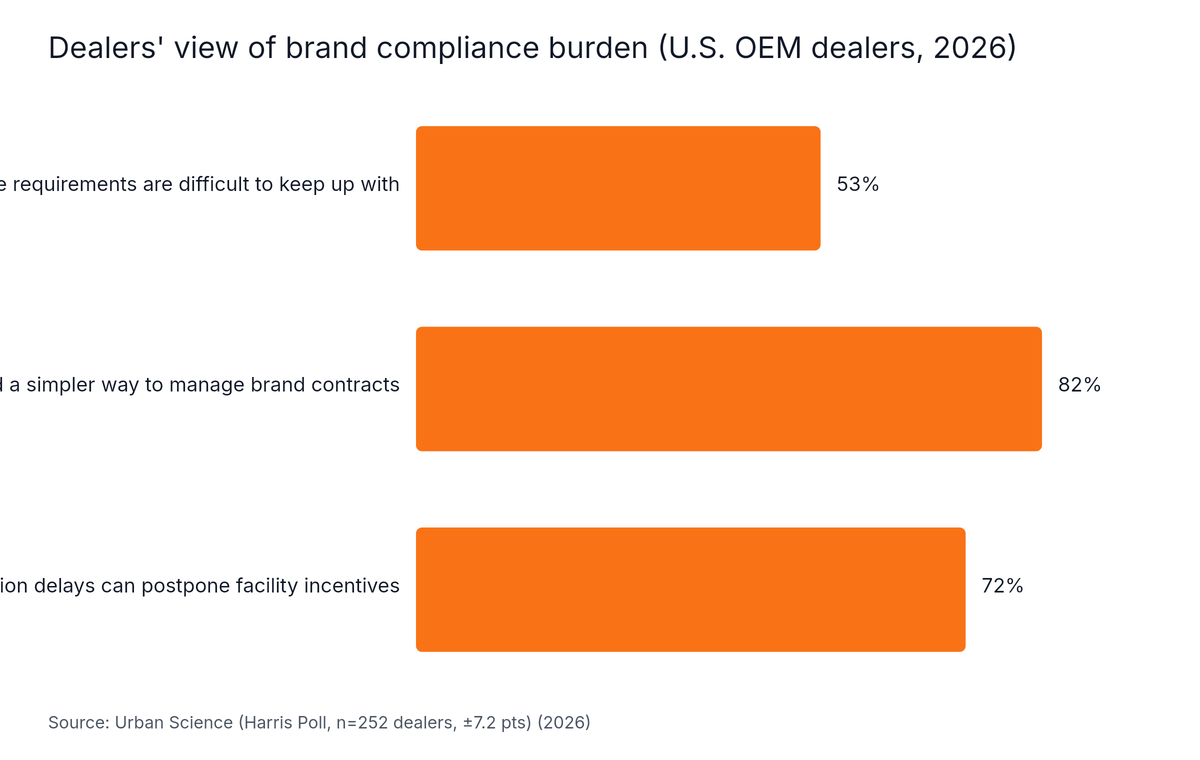
OEM compliance is hard for dealers because requirements are many, change often and carry financial consequences. In the 2026 Urban Science Harris Poll of 252 U.S. OEM dealers, 53% said brand compliance requirements are difficult to keep up with (Urban Science, 2026), and 72% said documentation delays can postpone facility incentives.
Horizontal Bar chart: Dealers' view of brand compliance burden (U.S. OEM dealers, 2026). Highest: Say networks need a simpler way to manage brand contracts at 82%.
The same survey found 82% of dealers say their networks need a simpler way to manage brand contracts (Urban Science, 2026). Urban Science sells network software, so treat this as vendor research with a stated method: an online survey with a sampling precision of ±7.2 points.
The money and the mood
Failing a facility standard is expensive. New-construction estimates run $250 to $600 per square foot, which implies $10 million to $24 million for a 40,000-square-foot dealership (CBT News, 2026). As adviser Dave Cantin put it, "A dealer has to evaluate the cost of what it's going to be to bring all of their dealerships to an image compliant capacity." (CBT News, 2026)
Dealers also have less patience for audit workload. Franchised dealer sentiment fell 4 points to 49 in Cox Automotive's Q3 2026 index, below the 50 mark where more dealers see conditions as positive (Cox Automotive, 2026).
Consistent scoring, visible evidence and a clear closure record separate a standards audit from a clawback exercise. Replacing the manual reporting cycle helps too, as described in operational audit management.
How does audit software shorten the audit cycle?
A digital field audit platform shortens the audit cycle by removing manual work after the visit: compiling photos, calculating scores, building reports and chasing actions. The delay is costly, since 72% of dealers say documentation delays can postpone facility incentives (Urban Science, 2026). AutoSmart's data shows teams at some dealerships spend 3 to 4 hours after each audit consolidating outputs.
The table maps four audit cycle steps to what changes. The capability column is vendor-described, based on AutoSmart Audit's own product documentation.
Audit cycle step
Manual process
Vendor-described capability
Capture evidence
Photos pasted into PowerPoint
Live photo capture with date, time stamp and geotag
Score
Excel calculations per auditor
Weighted auto-scoring applied identically across sites
Report
Hours of consolidation after the visit
Dealer visit report at the end of the visit, with digital sign-off
Assign and close
Emails and spreadsheets, 4 to 5 follow-ups per finding
Action Plan Tracker with PIC, due date, reminders and closure evidence
Our data: AutoSmart reports an audit cycle reduced from 10 days to 3 days, a 70% reduction. This is one client-reported result. The period and measurement definition are not published here, so treat it as indicative, not independent research.
Go-live is typically achievable in 5 to 10 working days once the customer shares the required configurations. Offline-first mobile execution matters for field auditors in workshops with poor connectivity, covered in mobile audit software for dealer networks. The evidence flow is detailed in field audit software for dealer networks.
Self-assessment and travel
Not every check needs a visit. At an average of $500 per physical visit, every 100 visits cost $50,000 in direct travel. AutoSmart estimates that moving suitable checks to self-assessment could reduce physical visits by 30 to 40%, saving approximately $15,000 to $20,000 per 100 visits. Management can then compare self-assessments with independent audits to find gaps.
When do dealer audits fail to improve compliance?
Dealer audits fail to improve OEM compliance when they are low quality, punitive or never closed out. Dealers often suspect the motive: "Many dealers believe that audits are a profit center for a franchisor" (Virginia Automobile Dealers Association, 2026). The pressure is real, since 53% of dealers say brand compliance requirements are difficult to keep up with (Urban Science, 2026).
Be honest about the limits:
Cadence is not proof. A faster cycle enables earlier correction, but gains depend on audit quality and follow-through.
No independent study quantifies the chain. None found for this guide ties audit frequency to compliance gains in dealer networks, and the 10-day to 3-day result above is AutoSmart's own.
Legal data is state-specific. The Florida windows are examples, not a national rule, and the trend is toward tighter state oversight of warranty payments (Nelson Mullins, 2025). Check your own jurisdiction.
Audit scope varies by brand. Your franchise agreement and standards manual decide what is checked and how often.
Tools do not fix trust. If dealers see audits as a profit center, they will keep parallel records however good the software is.
This guide is not for networks looking for a legal opinion on chargebacks. For that, talk to a franchise attorney.
Frequently Asked Questions
How often do OEMs audit their franchise dealers?
OEMs set audit frequency brand by brand, and no public source gives a single figure. Facility standards typically refresh every seven to 10 years, according to CBT News in 2026, but that is a program refresh cycle, not an audit frequency. Warranty and incentive claims are audited within law-limited windows such as Florida's 12 months after payment. Check your franchise agreement and standards manual for your brand's actual cadence.
What happens if a dealer fails an OEM audit?
A failed OEM audit produces findings the dealer must correct, usually through a corrective action plan with an owner and a deadline. For warranty or incentive audits, failure can also lead to a proposed chargeback. As of 2026 under Florida law, the OEM must meet the dealer within 30 days of the audit, and the dealer has at least 45 days to respond (Bass Sox Mercer, 2026).
What is a corrective action plan in a dealer audit?
A corrective action plan is the list of fixes a dealer commits to after an audit, with each non-compliance assigned to a Person-In-Charge (PIC), a due date and a required piece of closure evidence. It turns a finding into a tracked task, and closure is confirmed through submitted evidence or at the next audit.
How can a dealer prepare for an OEM audit?
A dealer prepares for an OEM audit by closing open findings from the previous audit, checking operations against the current version of the manufacturer's standards manual, and keeping dated evidence ready for each requirement. Warranty and incentive claims deserve extra attention because those audits can lead to chargebacks.
Conclusion
Dealer audits improve OEM compliance when they run as a loop, not a report. Here is what to carry forward:
OEM compliance is measurable, and audits are how it gets measured.
Cadence is brand-specific and risk-tiered, so check your own standards manual and state law.
Compliance rises when every finding gets an owner, a due date, closure evidence and a re-audit.
Dealer trust depends on consistent scoring and visible follow-through.
A shorter audit cycle makes that follow-through practical, and less manual work after each visit is how it gets there.
To see how a closed-loop audit cycle would run against your own standard, Schedule a Free Demo. For software context, read about franchise compliance across 50-plus sites.
Written by
Naseef Umar
Founder | CEO
Naseef Umar is an automotive industry expert and the Founder & CEO of AutoSmart, with over a decade of experience working across automotive operations, dealer standards, network performance, audits, and digital transformation.
Company
KERALA Full Address - Pulikillam W Rd, Kakkanad West, Chembumukku, Edappally, Kochi, Kerala 682030; DUBAI Full Address - Dubai Silicon Oasis, UAE

 Naseef Umar