Blog
Dealer Audit System: When Spreadsheets Break Down and What to Evaluate Next
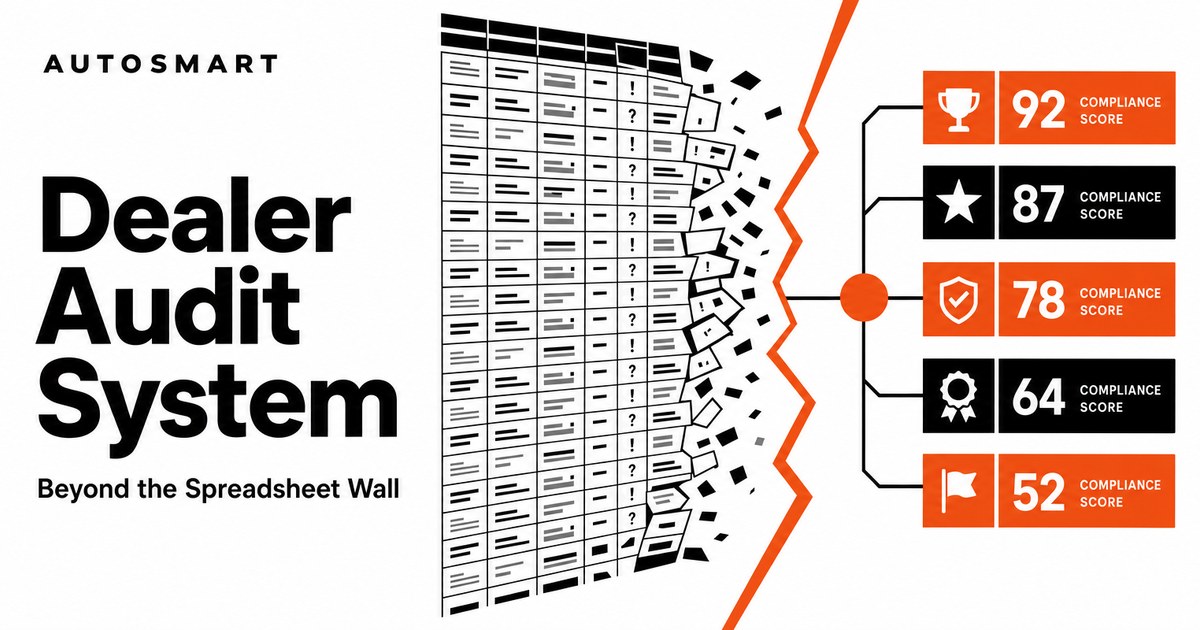
Networks hit the spreadsheet wall at 50-100 sites. Five functional tests separate genuine dealer audit software from a checklist builder dressed up as one.

Operational audit management software replaces hand-built PowerPoint decks and emailed reports - giving network operations heads real-time visibility the moment an audit closes.
 Naseef UmarOct 12, 2026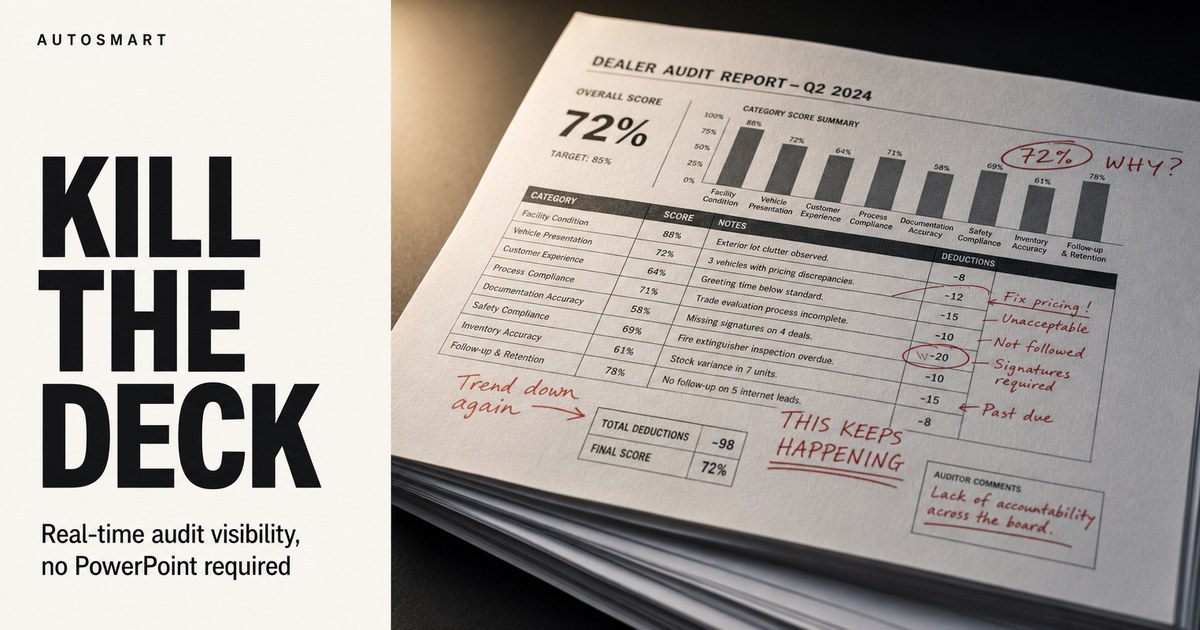
Networks hit the spreadsheet wall at 50-100 sites. Five functional tests separate genuine dealer audit software from a checklist builder dressed up as one.
Generic audit tools handle checklists well and dealer hierarchies badly. Learn what automotive network audit software must handle natively at network scale.
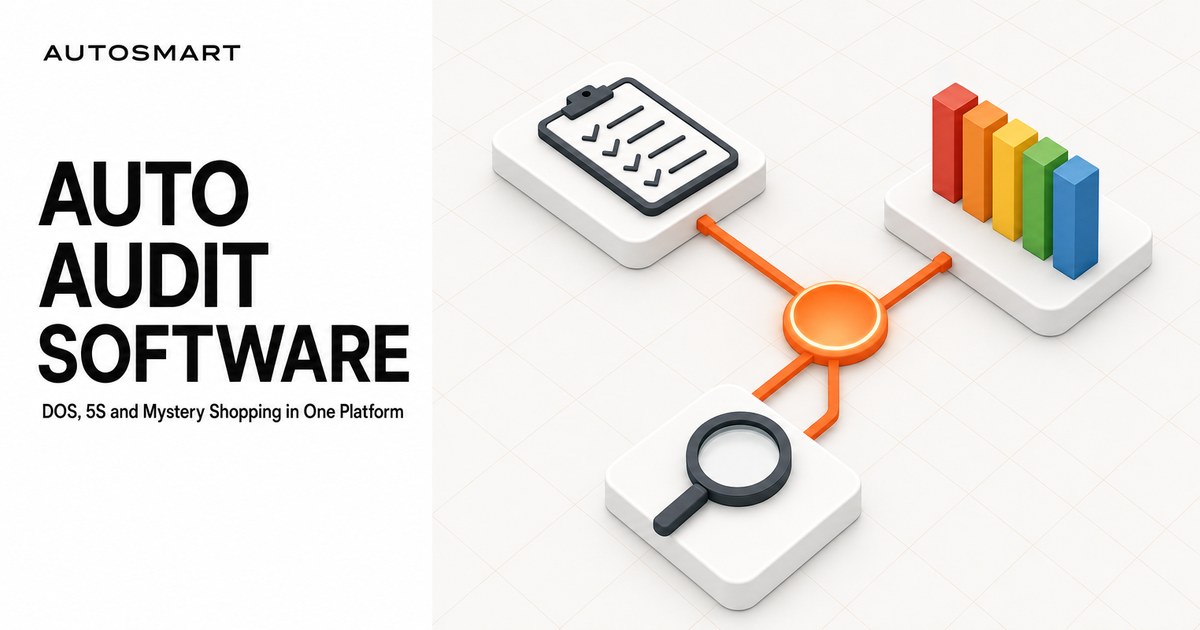
Running 17-18 audit programmes in separate tools creates blind spots. Learn what auto audit software needs to manage DOS, 5S and mystery shopping on one platform.
Request a quote and our experts will contact you within 24 hours with tailored solutions and pricing.
You can also send us a quick email at info@autosmarts.co.
AutoSmart Technology
Last updated: Oct 12, 2026
Written by Naseef Umar, Founder and CEO, AutoSmart
An operational audit management solution is a digital platform that replaces the full manual cycle between field audit execution and headquarters decision-making - eliminating hand-built PowerPoint decks, emailed reports, and spreadsheet-tracked follow-ups so compliance data reaches leadership the moment an audit closes, not at the next scheduled review.
If you run a dealer or branded retail network, you know the rhythm. The field auditor finishes a site visit. The next few hours go to pulling photos, calculating scores in Excel, building a slide deck, and emailing it to the right distribution list. Management sees a consolidated picture at the monthly review. A finding from day 3 of the reporting cycle waits until day 30 to generate a decision. That gap is the problem this article addresses.
What follows deconstructs every step in the manual PowerPoint audit cycle, maps what operational audit management software replaces, and explains what real-time visibility actually means for a network operations head who needs to act between reporting windows.
Key Takeaways
- AutoSmart's operational estimates put post-audit consolidation at 3 to 4 hours per dealership per audit cycle - overhead that compounds across 17 to 18 parallel audit programmes.
- The practical minimum for operational audit management software to justify itself is around 10 sites. The clear sweet spot is 25 to 500 sites under one brand or group.
- Franchisees on a continuous audit cycle show 34% higher brand-standard adherence than those reviewed only annually (FieldPie, 2025).
- Operational audit management software replaces five discrete manual steps: evidence collection, scoring, slide building, report distribution, and corrective-action chasing.
- Organisations that build closed-loop corrective action tracking into every audit cycle cut repeat findings by up to 60% (Linfordco research cited by FieldPie, 2025).
The manual PowerPoint audit cycle is the five-step sequence - evidence collection, Excel scoring, slide building, deck distribution, and emailed follow-up - sitting between a field audit and a management decision. AutoSmart's operational estimates put post-audit consolidation at 3 to 4 hours per dealership per audit cycle. Across a network running 17 to 18 parallel audit programmes at daily, weekly, monthly, quarterly, and yearly frequencies, that overhead compounds every reporting period.

The hidden cost is data quality, not just time. As the Kissflow editorial team notes: "Gathering data for an audit from different tools is a lot of mind-numbing manual work. It also invites errors and might skew the reports." (Kissflow, 2025).
In June 2026, OFS published primary research across 500 UK manufacturing professionals. Operators lost an average of 21 minutes per shift to manual reporting, logging, and data transcription. That is more than 380 hours lost per year across a three-shift operation (Industry 4.0 Today, June 2026). In the same study, only 8% of manufacturers described their reporting as fully automated. A further 68% still spent up to 30 minutes per shift on manual reporting and admin tasks (Industry 4.0 Today, June 2026).
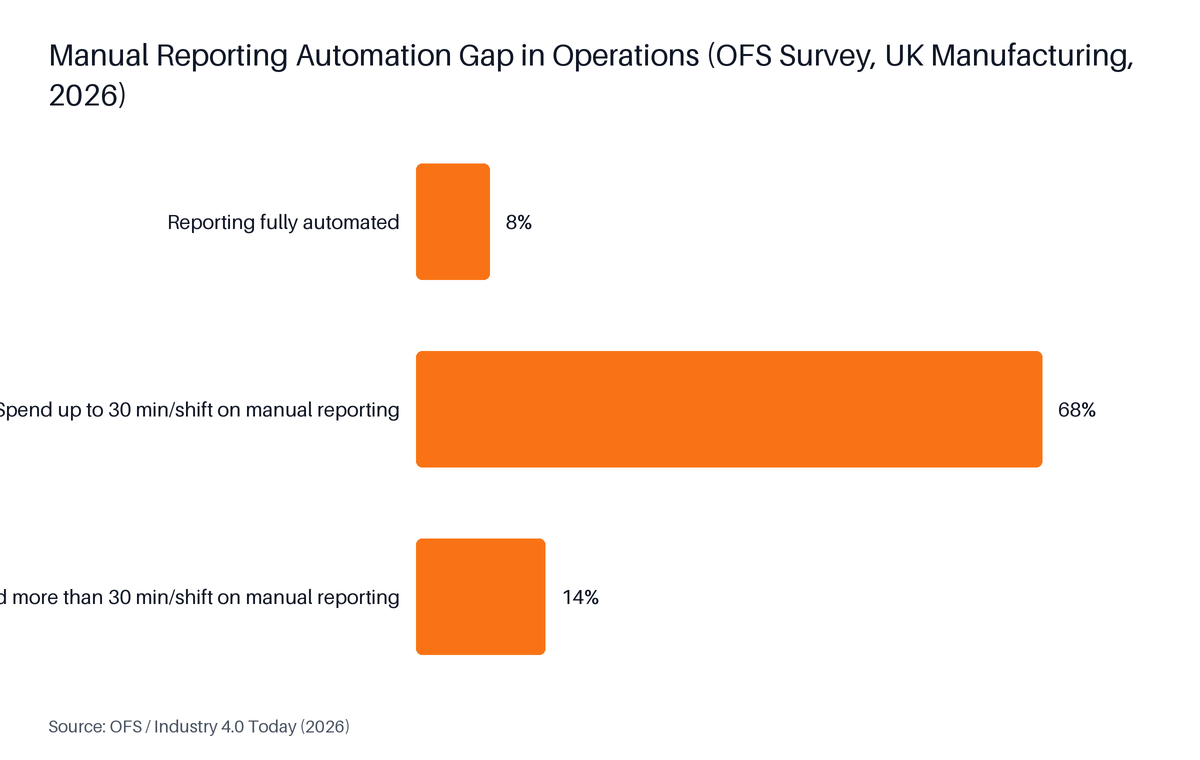
Source: OFS / Industry 4.0 Today, 2026
The Asana 2026 Anatomy of Work global survey found that knowledge workers spend 60% of their working time on "work about work" rather than skilled execution (cited by Stealth Agents, 2026). Assembling PowerPoint decks from field data fits squarely in that category.
Automotive National Sales Companies (NSCs) and Original Equipment Manufacturer (OEM)-affiliated dealer groups typically run 17 to 18 parallel audit programmes simultaneously. Dealer Operating Standards (DOS) checks run monthly. 5S checks run weekly. Customer experience evaluations run quarterly. Mystery audits run twice a year.
Each programme generates its own output. Under the manual cycle, each output is a separate deck. For distributor groups running this range of programme frequencies across multiple regions, maintaining a manual PowerPoint output per frequency, per region, per brand creates a compounding administrative load. That load grows with network size - not with the number of staff assigned to it.
Action latency is the gap between when a field auditor identifies a compliance breach and when headquarters can act on it. In a monthly PowerPoint cycle, a finding made on day 3 may not reach leadership until the next scheduled review - up to 28 days later. Non-compliant locations underperform compliant ones by 12 to 18% in revenue, per FieldPie's 2025 franchise audit guide (FieldPie, 2025). That gap is a measurable commercial cost, not a reporting inconvenience.
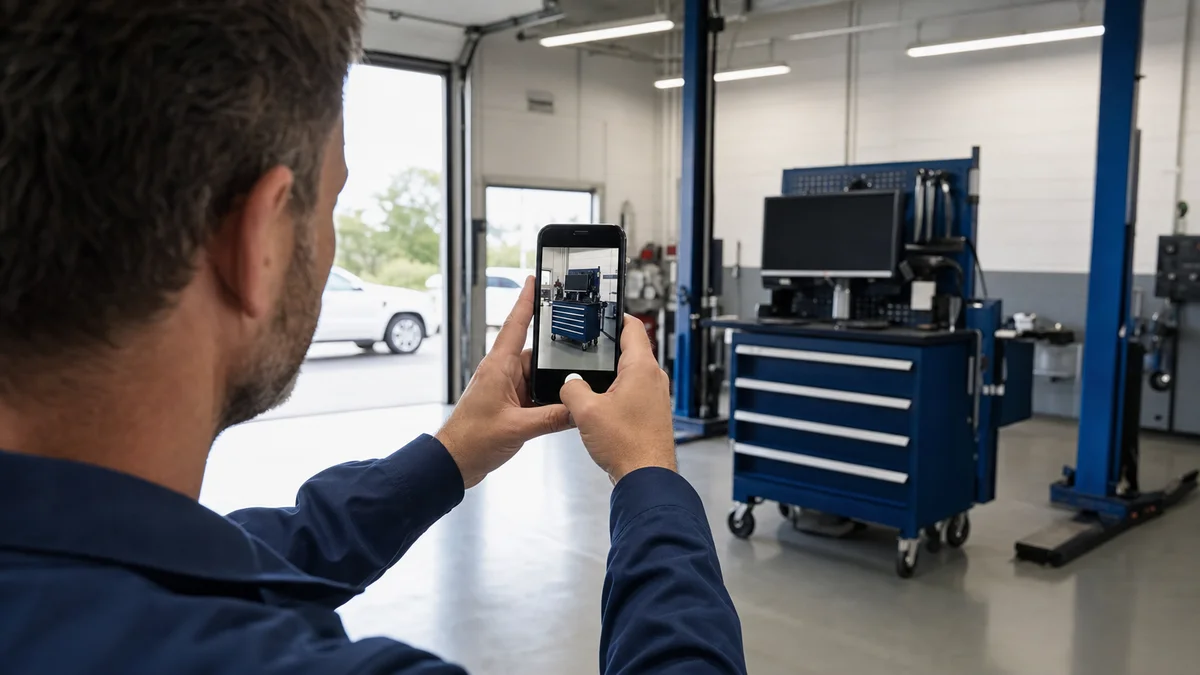
During the action latency window, the finding sits in a field auditor's notes or a local spreadsheet. There is no assigned owner. There is no deadline. There is no escalation if the date passes without action. Some items are missed entirely. Others cross their expected resolution dates before anyone realises they are open.
Under the manual cycle, the audit team becomes the chasing team. AutoSmart's operational estimates put each audit at 8 to 20 findings, each requiring 4 to 5 manual follow-ups before closure. Once an audit closes and the deck is sent, responsibility for follow-up defaults to whoever assembled the report. There is no system record of who owns each finding, what the deadline is, or where it currently stands.
If the next visit reveals the same non-compliance unresolved, the only paper trail sits in someone's email outbox.
An operational audit management solution is a digital platform that replaces every manual step between field audit execution and headquarters decision-making. It removes separate evidence folders, Excel score sheets, hand-built PowerPoint decks, emailed reports, and spreadsheet-tracked follow-ups. Evidence is captured during the audit. Weighted scores are calculated automatically. The dealer visit report is generated at audit close. Each non-compliance becomes a corrective action with a named owner and due date.

The table below maps each manual step to its software replacement:
| Manual Step | What the Auditor Does Today | What Software Replaces It With |
|---|---|---|
| Evidence collection | Photos taken on phone, filed manually, pasted into PowerPoint | Live photo capture in-app; geotagged, timestamped, attached to the specific finding |
| Score calculation | Exported to Excel; weighted manually by auditor or head team | Automatic weighted scoring on audit submission; identical logic across every auditor and site |
| Report assembly | PowerPoint slide deck built by hand; 3-4 hours per site | Dealer visit report generated automatically at audit close |
| Report distribution | Emailed to distribution list; read at next scheduled review | Drill-down dashboard visible to authorised roles the moment the audit closes |
| Corrective-action follow-up | Email, WhatsApp, or verbal chasing; multiple contacts per finding | Action Plan Tracker: each finding becomes an owned action with a Person-In-Charge (PIC), due date, and automated reminders |
Automated reporting tools can save individual employees up to 25% of their time, per Forrester research cited by ClearPoint Strategy (2025). The mechanism is removing the assembly step entirely, not accelerating it.
The field auditor still visits the site. The standard is still assessed against defined criteria. The finding is still a human judgement made on-site. Software removes the administration surrounding that judgement. It does not replace domain expertise or audit rigour.
Our data: AutoSmart's platform data shows audit cycle compression from 10 days to 3 days at Al Majdouie - achieved by removing post-audit manual consolidation, not by shortening the audit itself (AutoSmart case study).
Luai Felemban, a Network and Dealer Development Manager, describes the before and after in a video testimonial: evaluation previously took 5 days, plus 5 more to prepare and share reports. Now the whole process, including the action plan, takes 3 days.
Ajeesh Alex, Regional After Sales Manager at MG MENA, puts it plainly: "Everything is at their fingertips since adopting the audit system."
For a detailed look at how field audit software structures evidence capture and dealer visit reports in this workflow, the linked post covers the mobile execution layer in full.
Real-time visibility in an operational audit management solution means a drill-down dashboard is available to network operations heads the moment an audit closes - no manual consolidation required. Management navigates from overall network compliance to individual dealer findings in one session. Franchisees on a continuous audit cycle show 34% higher brand-standard adherence than those reviewed only annually, per FieldPie's 2025 franchise audit guide (FieldPie, 2025). The mechanism is visibility frequency, not dashboard speed.

This matters for a reason the generic "real-time dashboards" framing misses. The contrast is not between a slow dashboard and a fast one. It is between a dashboard that exists between reporting windows and one that does not.
Operandio's editorial team describes the practical outcome: "Instead of waiting for manual reports, head office can see completed checks, failed items, open actions, overdue follow-up, and recurring location patterns from one place." (Operandio, 2026).
The shift from manual reporting to live operational visibility is accelerating across the region. As of January 2026, fuel retailers across MEA - including Go Station Saudi Arabia (which expanded from 65 to 160 locations), Soor Kuwait (42 sites), and Darb Stations (25 sites) - had accelerated their move from on-premise systems to cloud-based, real-time operational analytics (Mobility Plaza, January 2026). That shift raises the expectation for audit visibility across all branded networks operating in the same markets.
In November 2025, GSMA Intelligence's Global Digital Transformation Survey (covering 5,320 enterprises across 32 countries) confirmed that MENA enterprises now outpace global peers in digital adoption. They committed an average of 9.8% of revenues to digital transformation between 2025 and 2030. Automotive ranked among the sectors expecting the largest impact (GSMA Intelligence, November 2025). In the same survey, 39% of MENA enterprises already made advanced use of generative AI (GSMA Intelligence, November 2025).
AutoSmart Audit aggregates scores from local auditors across multiple countries into a single network view for regional headquarters. A drill-down dashboard is a management reporting interface that lets a Head of Network Development navigate from overall network compliance to regional, dealer, pillar, and individual finding level - without requesting a separate report or waiting for a deck.
The platform supports checklists in Arabic, English, French, German, Italian, and Spanish. That removes the translation and formatting overhead that currently falls to regional managers before results can be consolidated upward.
A network operations head using operational audit management software can answer four questions without requesting a separate consolidation exercise:
Under the manual PowerPoint cycle, answering each of those questions requires a separate manual data pull.
Closed-loop corrective action tracking means every failed audit item automatically becomes an action assigned to a named Person-In-Charge (PIC) with a due date and escalation path - no manual email chain required. Automated reminders continue until the action is closed, and closure requires uploaded evidence. Organisations that build this into every audit cycle cut repeat findings by up to 60%, according to Linfordco research cited by FieldPie (2025).

The table below shows the difference between the two approaches at each stage of a corrective action lifecycle:
| Stage | Spreadsheet / Email Process | Closed-Loop Audit Software |
|---|---|---|
| Finding identified | Auditor notes in Excel; emails dealer principal | System creates action item automatically on audit submission |
| Owner assigned | Manually decided and communicated via email | PIC assigned from user list; notification sent immediately |
| Due date | Set informally, often verbal | Configured in system; countdown visible to all parties |
| Reminder | Auditor chases manually; multiple contacts per finding | Automated reminders on configurable schedule until closed |
| Closure | Verbal or email confirmation | Closure evidence uploaded; status changes to Approved |
| Audit trail | Email chain; often incomplete | Full record of owner, timeline, evidence, and resolution date |
Without a live system, some action items are missed entirely. Others cross their expected deadlines before resolution. The audit team carries the follow-up burden personally. Their capacity for the next audit cycle is reduced before the current one closes.
The dealer audit system evaluation post covers the specific point at which spreadsheet-based tracking breaks down for growing networks and what to look for when evaluating alternatives.
Operational audit management software is not the right fit for every network. At fewer than roughly 10 sites, spreadsheet coordination remains workable and setup overhead outweighs the gain. The category measures qualitative standards - whether a process happened correctly, whether a site meets its defined standard - not transactional inventory or financial data. It is not a vehicle inspection tool, a warranty claims system, a dealer management system (DMS), or a general-purpose form builder.
For organisations with an existing internal audit tool, the question is not whether to replace the current process on day one. The more useful starting point is identifying where the internal tool has specific limits: flexibility to configure new standards without vendor tickets, central management across multiple brands and markets, analytics depth across historical evaluation cycles, and closed-loop corrective-action tracking with evidence requirements. A no-cost pilot on one existing audit programme is the lowest-friction way to test whether those gaps are real.
Teams in organisations where global IT is building an in-house platform face a related version of this question. In-house builds carry timeline and resourcing risk. AutoSmart Audit can typically go live within 5 to 10 working days once configuration inputs are received. That gives regional teams working visibility while a global build continues. A pilot also generates the operational data that informs whether an in-house build is correctly scoped.
For networks managed by an external audit consultancy, the first question is whether headquarters has direct access to findings, scores, trends, and open action items - or whether visibility is entirely mediated through the consultancy's reporting cycle. An operational audit management solution addresses the latter without necessarily replacing the consultancy's audit team.
The automotive network audit software post covers the specific gaps that generic checklist tools leave open for dealer networks - a related but distinct consideration.
Operational audit management software replaces five manual steps: evidence collection into separate photo folders, score calculation in Excel, slide assembly in PowerPoint, emailing the deck to HQ, and chasing corrective actions by email. The platform captures evidence during the audit, calculates weighted scores automatically, generates the dealer visit report the moment the audit closes, and converts every failed item into a tracked action with an assigned owner and due date - no deck required.
In a monthly PowerPoint cycle, a compliance breach found on day 3 of the reporting period may not reach HQ until the next scheduled review - up to 28 days later. During that window the finding sits in a field auditor's notes or a local spreadsheet with no assigned owner and no deadline. Operational audit management software makes the finding visible at HQ the moment the audit closes.
Operational audit management software generates the dealer visit report automatically at the moment the audit closes - it does not sit alongside a manually built report. The auditor does not write a separate document after the visit. Both the auditor and the dealer can digitally sign the generated report on-site, creating a timestamped record of what was assessed and acknowledged before anyone leaves the location.
Operators in the Gulf use a drill-down dashboard that gives global HQ direct access to network compliance scores, regional breakdowns, and open corrective actions in real time - without requesting a deck or waiting for a reporting cycle. As of November 2025, MENA enterprises committed 9.8% of revenues to digital transformation through 2030, outpacing global peers (GSMA Intelligence, 2025). Audit software produces the verifiable, structured data global HQ requires.
A spreadsheet-tracked corrective action has no automatic owner assignment, no due-date reminder, no escalation path, and no evidence requirement for closure. Audit software connects each finding to a named Person-In-Charge (PIC) with a due date, sends automated reminders until closure, requires uploaded evidence before the item is marked complete, and keeps a full audit trail - cutting repeat findings by up to 60%, per Linfordco research cited by FieldPie (2025).
Yes. An offline-first mobile application lets field auditors conduct full audits, capture geotagged photos, and record scores without an active internet connection. Data syncs automatically when connectivity is restored. This matters for dealer service bays, basement workshops, and rural fuel-retail sites across MENA and APAC where mobile signal is inconsistent.
The practical floor is around 10 sites. Below that, a spreadsheet remains manageable. The clear sweet spot is 25 to 500 sites under one brand or group, where manual consolidation across multiple dealers, regions, and audit frequencies consumes hours per reporting cycle - and that overhead grows directly with network size.
The manual PowerPoint audit cycle carries four measurable costs: hours of post-audit consolidation per site, weeks of action latency between finding and HQ response, multiple manual follow-ups per finding before closure, and a management view assembled from email and memory rather than live data. None of those costs are inherent to auditing. They are costs of the reporting format.
An operational audit management solution removes the format. The dealer visit report is generated at audit close. The drill-down dashboard is available immediately. Every non-compliance becomes an owned, tracked corrective action before the auditor leaves the site. For a network development head who needs to act between reporting windows, that is the practical definition of real-time visibility.
Networks should also consider how 5S audits run consistently across dealer sites fit into the same platform - the compliance infrastructure is shared. A look at paperless audit workflows covers what changes day to day once the deck is gone.
If your network is past the point where the monthly deck is sustainable, the next step is a structured walkthrough against your existing audit programme.
Schedule a Free Demo to see AutoSmart Audit against your specific network size, audit frequency, and reporting requirements.
© 2026 AutoSmart Technology All rights reserved.