What Does Moving from Paper-Based to Paperless Auditing Actually Involve for a Multi-Site Dealer Network?
A step-by-step guide to moving from paper-based to paperless auditing across a multi-site dealer network - timelines, change management, and what to migrate.
What Does Moving from Paper-Based to Paperless Auditing Actually Involve for a Multi-Site Dealer Network?
By Naseef Umar, Founder and CEO, AutoSmart
Paperless auditing for a multi-site dealer network means replacing paper checklists, Excel score sheets, WhatsApp photo threads, and manually assembled PowerPoint reports with a single digital workflow covering audit execution, evidence capture, auto-scoring, corrective-action tracking, and management reporting.
The transition has six distinct stages. Each one has specific failure modes. This guide covers every stage - from pre-migration preparation through phased network rollout - so the people responsible know what they are committing to before they start.
Key Takeaways
Paperless auditing for dealer networks involves six stages: process mapping, platform configuration, controlled pilot, change management, corrective-action setup, and phased rollout.
Approximately 25% of industrial companies still rely on paper for quality processes, which LNS Research describes as incompatible with analytics (Wooqer, citing LNS Research, 2025).
Switching to digital raises same-day report submission rates from 55% to 81% and saves inspectors an average of 1.78 hours per day (Clappia, citing WSDOT, 2026).
AutoSmart's operational data shows each manual audit generates 8 to 20 findings, each requiring 4 to 5 follow-ups before closure. Configure the corrective-action workflow before go-live.
Platform go-live typically takes 5 to 10 working days once configuration inputs are received.
What Paperless Auditing Actually Means for a Dealer Network
Approximately 25% of industrial companies still rely on paper for quality processes, which LNS Research describes as incompatible with analytics (Wooqer, citing LNS Research, 2025). For a multi-site dealer network, paperless auditing means replacing that paper - checklists, Excel score sheets, WhatsApp photo threads, and manually assembled PowerPoint reports - with a single digital workflow covering audit execution, evidence capture, auto-scoring, corrective-action tracking, and management reporting. The shift is structural, not cosmetic.
Field auditor holding a thick stack of paper audit sheets at a car dealership showroom
As Ejaz Ahammed wrote in December 2025, "Dealer audits, once entirely manual and paper-based, are now transforming through advanced software solutions designed to streamline processes, enhance compliance, and improve visibility" (AutoSmart Audit blog, 2025). That transformation is not a format swap. It reshapes how findings are scored, escalated, and closed.
The paper-based failure pattern is consistent. "Reports may take days or even weeks to compile, making it difficult for OEMs and dealers to respond quickly to compliance gaps or performance issues" (AutoSmart Audit editorial team, 2025). The auditor finishes a site visit, then spends three to four hours converting notes into a score, a slide deck, and an email. The dealer receives the report days later. By then, the findings are history.
Digital audit workflows close that gap. The score appears the moment the audit is submitted. The dealer visit report is ready before the auditor leaves the site. Corrective actions are assigned the same day. The inspection management software market was valued at USD 9.20 billion in 2024 and is projected to reach USD 18.86 billion by 2030 at a CAGR of 13.2% (Grand View Research, 2025). What changes day to day is covered in detail in our guide to paperless audit software for dealer networks.
What You Need Before You Start
Before beginning a paperless auditing transition, a multi-site dealer network needs three things confirmed: a digital copy of every active audit checklist and its scoring weights, a clear role map showing who audits, who reviews findings, and who owns corrective actions, and agreement on which audit programme to run as the pilot. Organisations report spending an average of 18 or more hours preparing for a single compliance audit under manual processes (oxmaint.com, 2025).
Network quality manager configuring a digital audit checklist on a laptop in a dealership office
Work through this readiness checklist before touching any platform configuration:
Readiness Item
Why It Matters
Who Owns It
Digital copy of all active checklists with section weights
Platform configuration cannot begin without this
Network Quality Manager
Role map: auditor, reviewer, Person-In-Charge (PIC), management viewer
Role-based access must be set before the first audit runs
Head of Network Development
Site list with connectivity status per location
Confirms offline-first requirement for low-connectivity sites
Field Audit Manager
Decision on pilot programme (one programme only)
Limits early risk; creates proof point for wider rollout
Head of Network Development
Historical paper records archiving plan
Determines what to migrate versus archive before go-live
Compliance or Quality team
IT and data residency requirements
Required for hosting configuration, especially in MENA markets
IT or CTO
Difficulty: Moderate. The configuration work is straightforward once inputs are ready. The bottleneck is nearly always collecting clean, agreed checklist content from the standards team.
Time estimate: Three to five working days for the mapping and preparation phase. Five to ten working days for platform configuration and go-live once inputs are submitted.
Step 1: Map the Current-State Audit Process Before You Digitise Anything
Mapping the current-state audit process means documenting every manual step - checklist format, scoring method, evidence collection, report preparation, and corrective-action follow-up - before configuring any digital platform. Skipping this is the most common reason implementations stall. For a network running 17 to 18 audit programmes across daily, weekly, and monthly cycles, the mapping exercise typically takes three to five working days. Organisations spend an average of 18 or more hours preparing for a single manual audit (oxmaint.com, 2025).
What to document in the mapping exercise
Work through each of the following with the field audit team and the standards owner:
List every active audit programme by name, frequency, and the number of sites it covers.
Document the checklist structure for each: section names, question count, and how scoring is weighted.
Record the evidence requirements: which questions need photos, what format is accepted, and where photos are stored today.
Map the post-audit workflow: who prepares the report, in what format, to whom it goes, and how corrective actions are tracked.
Identify who owns each step: auditor, regional manager, dealer principal, head office.
Flag the failure points: where does data go missing, where do deadlines slip, where does management lose visibility?
The output is a one-page process map per audit programme. It becomes the specification for platform configuration in Step 2.
Why the corrective-action map matters most
AutoSmart's operational data shows each audit typically generates 8 to 20 findings. Each finding requires 4 to 5 follow-ups including escalations before closure under manual processes. Some items are missed entirely; others cross their deadlines before anyone notices. Documenting exactly how that currently works determines the configuration decisions for the Action Plan Tracker.
Step 2: Select and Configure the Platform Against Your OEM Standards
Configuring a digital audit platform for an Original Equipment Manufacturer (OEM) dealer network means building every checklist, section weight, and scoring rule into the platform so the output matches what headquarters expects. Over 70% of large dealership groups with 10 or more outlets prefer fully integrated platform suites rather than standalone modules (Congruence Market Insights, 2024). The platform must support the OEM-to-National Sales Company (NSC)-to-distributor-to-dealer hierarchy by default, not as a custom build.
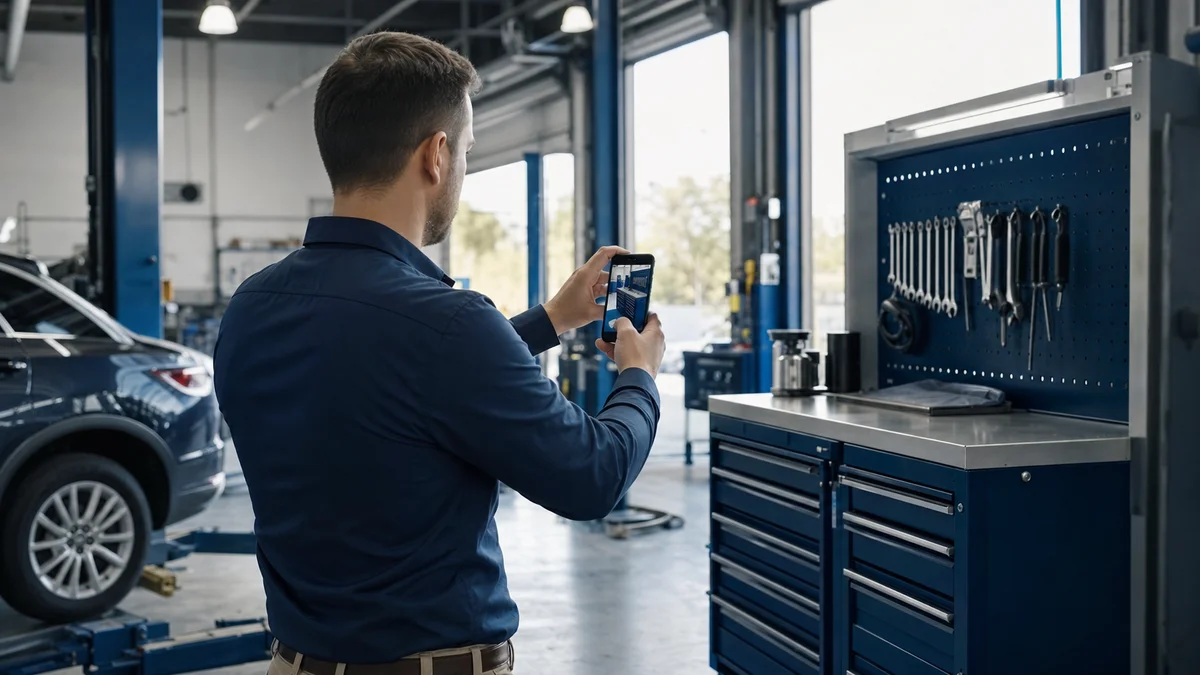
Field auditor photographing a service bay tool cabinet with a smartphone during a live dealer audit
The OEM governance hierarchy in a digital audit system
The OEM governance model changes when auditing goes paperless. In a paper-based network, data flows upward manually: the auditor submits a report, the regional manager compiles a summary, head office receives a consolidated deck. In a digital network, the hierarchy is enforced by access controls configured once at setup:
Role
Access Level
Data Visible
OEM or Head Office
Management viewer (read-only)
Full network: all brands, all regions, all dealers
NSC or Distributor
Regional viewer
Own region's dealers only
Regional Field Manager or Auditor
Auditor access
Assigned dealers only
Dealer Principal
Dealer viewer and PIC
Own site: findings, action items, history
Person-In-Charge (PIC)
PIC access
Assigned corrective action items only
Getting this access map right before go-live matters more than the checklist configuration. A misconfigured access structure creates blind spots or data exposure.
Who builds the audit templates?
The standards team builds and owns the templates. A well-configured platform lets the network quality manager or brand standards manager create, update, and version checklists without raising a ticket with the vendor. This is critical for multi-brand distributor groups running two to four OEM standards simultaneously across a single dealer. Each brand gets its own checklist, its own scoring weights, and its own corrective-action assignment rules - all within one system.
Dealer Operating Standards (DOS) are the documented requirements an OEM or distributor sets for how a franchised dealership must operate, covering facility presentation, customer experience, aftersales processes, and staff behaviour. For DOS, brand standards, customer experience, 5S, and aftersales function audits, the checklist structure typically mirrors the existing paper standard exactly on first build. Revisions are updated in-platform by the administrator. See our guide on auto audit software for dealer operating standards, 5S, and mystery shopping for running multiple programme types in one platform.
Step 3: Run a Controlled Pilot on One Audit Programme
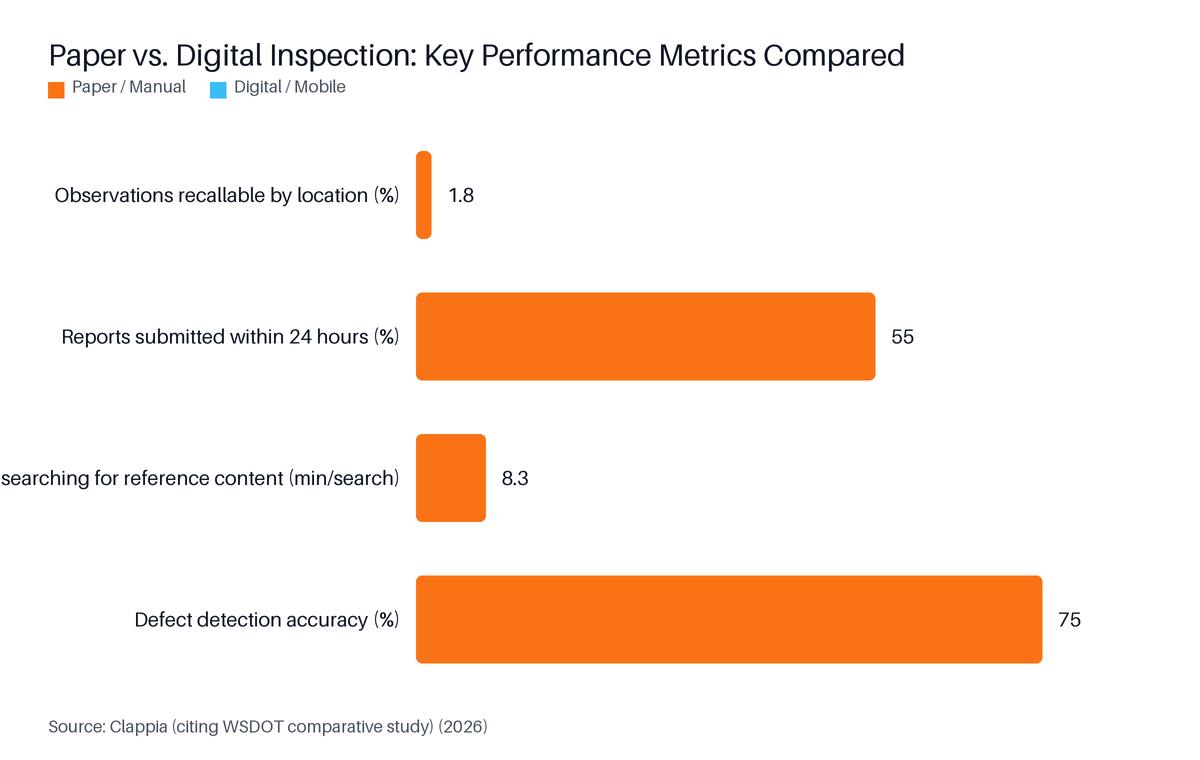
A controlled pilot for paperless auditing means running one existing audit programme on the digital platform across three to five representative dealer sites before any broader rollout. The pilot tests connectivity handling, scoring consistency, and report delivery speed. Switching from paper to digital checklists raises same-day report submission rates from 55% to 81% (Clappia, citing WSDOT, 2026) - the clearest proof point for sceptical dealer principals.
Horizontal Bar chart: Paper vs. Digital Inspection: Key Performance Metrics Compared. Highest: Defect detection accuracy (%) at 75.
Pick one audit programme that meets all three of these criteria:
Moderate complexity: not the simplest checklist, which proves nothing, and not the most complex, which creates too many variables.
A willing auditor: early-adopter field managers make better pilots than resisters. Their data will be used to persuade others.
A mix of connectivity conditions: include at least one site where internet access is unreliable to test offline-first capability before the rollout depends on it.
What to measure in the pilot
Track these metrics across every audit in the pilot period:
Time from audit submission to report available (target: same day)
Time from audit submission to corrective actions assigned to PICs (target: same day)
Number of findings per audit, compared to paper baseline
Photo-capture compliance rate (target: 100% live capture, no archive uploads)
Auditor time saved per visit
Inspectors using mobile audit tools collected 2.75 times more observations per day than the paper baseline, with GPS-tagged timestamps on every entry versus only 1.8% recallable by location on paper (Clappia, citing WSDOT, 2026). The pilot should produce comparable evidence for your network.
Step 4: Manage the Change - Auditors and Dealers Both Need a Different Conversation
Change management for paperless dealer auditing requires two separate conversations. Field auditors need to see the tool ends their evening spent writing up findings - inspectors using mobile tools saved an average of 1.78 hours per day compared to paper (Clappia, citing WSDOT, 2026). Dealer principals need to see that digital sign-off and instant report delivery protects them. Head-office mandates alone are not enough; adoption happens site by site.
The train-the-trainer model
As the Audiment editorial team noted in 2026, "The franchisor owns the brand, but the daily operation sits with franchisees and local managers" (Audiment, 2026). That structural fact means a head-office directive alone cannot deliver adoption. Field auditors who complete the pilot become the trainers for the wider rollout. This works for three reasons:
They can answer practical, site-specific questions that a vendor trainer cannot.
Their credibility with peers is higher than management's.
They have real pilot data: actual times, actual scores, actual reports.
Run two structured sessions with each new auditor cohort before their first live audit. One session to walk through the platform. One session to complete a practice audit at a real site. Auditors who only see a demo revert to paper notes at the first site with poor connectivity.
Dealer principal adoption
Offline-first is a mobile application design approach that allows auditors to complete the full audit checklist, capture photos, and record scores without any internet connection, with data syncing automatically once connectivity is restored. Dealer principals resist when the new system adds steps rather than removing them. The case is straightforward: the dealer visit report is available immediately at the end of the visit, with digital sign-off built in. Under the paper process, that clarity took days. Sometimes it never arrived.
Step 5: Set Up the Corrective-Action Workflow Before Go-Live
Configuring the Action Plan Tracker before the first live audit means every failed item automatically generates an owned task: a named Person-In-Charge (PIC), a due date, and an automated reminder schedule. AutoSmart's operational data shows each audit generates 8 to 20 findings, each requiring 4 to 5 follow-ups before closure under manual processes. Digital inspection software typically breaks even in 60 to 90 days (HVI App, 2026).
Our data: AutoSmart's customer data shows that under manual corrective-action tracking, each finding requires 4 to 5 follow-ups including escalations before closure. Some items are missed entirely. Others cross their deadlines before anyone notices. The audit team becomes the chasing team, with no system record of who owns what, what the deadline is, or where it stands.
Corrective-action configuration checklist
Before go-live, confirm these four elements are configured:
PIC assignment rules: which finding categories map to which roles at the dealer level.
Due-date logic: standard timeframes by finding severity - critical findings versus minor observations.
Reminder schedule: automated notifications starting before the due date, repeating until the action item is closed.
Closure evidence requirements: what the PIC must submit - photo, document, or written confirmation - before an action item can be marked complete.
The Action Plan Tracker is AutoSmart Audit's closed-loop corrective-action workflow. It automatically converts every non-compliance finding into an owned task with a named PIC, due date, automated reminders, and verifiable closure evidence. Our guide on 5S audits for dealer networks covers corrective-action design for workshop-specific programmes in detail.
Step 6: Phased Rollout Across the Full Dealer Network
A phased rollout means bringing sites onto the digital audit platform in structured cohorts grouped by region or audit frequency, rather than switching the entire network at once. Platform go-live takes 5 to 10 working days once configuration inputs are received. Digital inspection software typically breaks even within 60 to 90 days (HVI App, 2026), giving the business case a concrete payback window to present to senior leadership.
Regional operations manager reviewing a live dealer compliance dashboard on a large monitor
Rollout phasing model for a 50 to 200 site network
AutoSmart's operational estimates put the average travel cost at roughly $500 per physical visit, so every 100 visits represents approximately $50,000 in direct travel costs. Moving suitable checks to controlled self-assessment could reduce physical visits by 30 to 40%, saving approximately $15,000 to $20,000 per 100 visits. Self-assessment programmes - where dealers complete structured evaluations against defined standards - run within the same platform and compare directly against independent audit scores to identify gaps.
A December 2025 commentary in Automotive News argued that dealers should prioritise going paperless over AI investments, citing compliance, security, and efficiency gains as the core strategic rationale for 2026 (Automotive News, 2025). The phased rollout is what makes that priority actionable. Networks spanning MENA markets should also note that the UAE government issued its National Cloud Security Policy in October 2025, setting requirements for cloud consumers and providers covering data sovereignty, governance, and resilience. Confirm your platform's hosting configuration against those requirements before go-live.
What Results to Expect After Going Paperless
A multi-site dealer network completing the move to paperless auditing should expect measurable compression of the audit cycle, faster corrective-action closure, and real-time management visibility replacing scheduled report runs. Switching from paper to digital inspection reduces labour-hours per inspection by up to 60% and saves inspectors an average of 1.78 hours per day (Clappia, citing WSDOT, 2026). Digital inspection software typically breaks even within 60 to 90 days (HVI App, 2026).
Dealer principal and auditor reviewing a digital visit report together on a tablet at a meeting table
Our data: AutoSmart's case study data shows Al Majdouie Motors cut its audit cycle from 10 days to 3 days after switching to digital audit workflows (AutoSmart Audit, Al Majdouie case study).
The management view changes most visibly. Under paper processes, AutoSmart's operational data shows management teams spend several hours per reporting cycle manually consolidating data across dealers, regions, and audit frequencies - before they can answer a basic question: which sites need attention this week? A drill-down dashboard - the real-time, filterable network view that lets management navigate from overall network performance down to regional, dealer, pillar, and individual finding level - answers that question on demand.
For field auditors, the visit ends when the visit ends. The dealer visit report is the formal, time-stamped record of the on-site audit, generated digitally and available for immediate digital sign-off the moment the submission is made. No evening spent formatting a PowerPoint. AutoSmart's operational data shows that for some dealership networks, teams previously spent 3 to 4 hours after each audit preparing and consolidating Excel calculations, sign-off sheets, and photo evidence. That time is recovered on day one of go-live.
Who This Approach Is Not Suited For
Paperless auditing at the platform level is not suited for networks with fewer than roughly 10 sites under one brand, where spreadsheets remain workable and a networked platform costs more than the pain it solves. Over 70% of large dealership groups with 10 or more outlets prefer fully integrated platform suites (Congruence Market Insights, 2024), a threshold implying networks below that scale sit outside the core adoption cohort for this category of platform.
This approach is also not suited for transactional audit use cases. Vehicle inspection is a different job: a field audit platform inspects sites and qualitative standards, not cars. Warranty claims validation, inventory counts, and asset condition checks that pull data from a system rather than from a human judgement made on-site are outside this platform's scope entirely.
Networks where auditing is owned entirely by a third-party audit consultancy - with no internal visibility required by the client - are a weaker fit at the outset. The platform's value compounds when the internal team can see programme data directly, rather than receiving a consultant's summary. See automotive network audit software: what generic tools miss for a broader comparison of platform types and where they fit.
Frequently Asked Questions
How long does it take to implement a paperless audit system across 50 or more dealer sites?
Platform configuration and go-live typically takes 5 to 10 working days once the required checklist configurations and user details are shared. The wider rollout - covering auditor training, pilot completion, and phased site onboarding - usually spans four to eight weeks depending on network size, connectivity conditions, and how many audit programmes are running in parallel.
What happens to historical paper audit records when we go digital?
Historical paper records do not need to be digitised before going live. Most networks archive prior paper records for compliance purposes and begin collecting clean digital data from go-live. If comparable historical scores are needed for trend analysis, key data points can be entered manually as a one-time import before launch. Full digitisation of old paper records is rarely necessary or cost-effective.
Can auditors complete digital audits offline when there is no internet connectivity at the dealer site?
Yes. A platform built for automotive field audits should operate offline-first, allowing auditors to complete the full checklist, capture photos, and record scores without any internet connection. Data syncs automatically once connectivity is restored. This capability is non-negotiable for networks with workshops in low-connectivity locations across MENA and APAC.
How do we handle dealers who refuse to adopt the new digital audit platform?
Resistance from dealer principals is most common when the audit tool adds steps rather than removing them. The fix is a train-the-trainer programme: train regional field managers first, let them run two or three live audits with dealers present, and let report delivery speed make the case. A dealer visit report available immediately at the end of the visit is more persuasive than any training session.
What audit types does AutoSmart Audit support?
AutoSmart Audit supports Dealer Operating Standards (DOS), Customer Experience, Corporate and Brand Identity, 5S, Infrastructure and Process, Mystery Shopping, Internal, Health and Safety, Environmental, Government Compliance, Bodyshop, Technical, Standard Operating Procedure (SOP), and Risk Management audits - all in one platform, with separate checklists and scoring weights per programme.
Conclusion
Moving from paper-based to paperless auditing in a multi-site dealer network is a six-stage process: map the current state, configure the platform against your OEM standards, run a controlled pilot, manage the change with auditors and dealers separately, set up the corrective-action workflow before go-live, and roll out in cohorts. The technology is the straightforward part. The preparation, the access map, and the corrective-action configuration are where implementations succeed or stall.
The numbers are clear. Up to 60% reduction in labour-hours per inspection. Same-day report submission. Audit cycles compressed from weeks to days. Al Majdouie Motors cut its audit cycle from 10 days to 3 days. Paper cannot sustain the audit cadence modern dealer networks require - and the cost of trying grows with every site added to the network.
For a broader look at mobile execution, evidence capture, and field audit scoring, see our guide on field audit software for dealer networks. If your network is ready to see how this works against your existing audit programme, Schedule a Free Demo to walk through the configuration with the AutoSmart team.
Written by
Naseef Umar
Founder | CEO
Naseef Umar is an automotive industry expert and the Founder & CEO of AutoSmart, with over a decade of experience working across automotive operations, dealer standards, network performance, audits, and digital transformation.
Company
KERALA Full Address - Pulikillam W Rd, Kakkanad West, Chembumukku, Edappally, Kochi, Kerala 682030; DUBAI Full Address - Dubai Silicon Oasis, UAE

 Naseef Umar