
Blog
Field Audit App: What to Test Before You Commit
Test a field audit app on offline-first behaviour, evidence capture and report-before-you-leave-site, with a timed bake-off and weighted scorecard.
Build a retail audit process every auditor follows: steps, calibration, 5S scoring, version control and GM dealer audit prep for results that compare.
 Naseef UmarNov 8, 2026

Test a field audit app on offline-first behaviour, evidence capture and report-before-you-leave-site, with a timed bake-off and weighted scorecard.
Define SOPs for automobile dealers, clear up what SOP means in the auto industry, and follow six steps that make SOPs stick, with or without SOP software.

A field audit is an on-site inspection against a standard. Learn the meaning, how it differs from a desk audit, and how often field audits are performed.
Request a quote and our experts will contact you within 24 hours with tailored solutions and pricing.
Last updated: Nov 8, 2026
A retail audit process is a fixed sequence of steps, one written standard and one scoring rubric that every auditor follows on every store visit, so results can be compared across sites, regions and years.
Most networks don't have one. Each auditor brings a personal checklist, a personal sense of "good enough" and a personal way of writing up the visit. In Zipline's 2026 survey, 67% of HQ retail leaders admit their communications are at least sometimes ignored, duplicated or deprioritised by store teams (Zipline, 2026). Instructions alone don't hold a standard in place. This guide sets out the steps, the calibration, the version control, and what is public about the GM dealer audit. If your team still runs on spreadsheets, this look at when spreadsheets break down is a useful companion.
Key Takeaways
- A repeatable retail audit process uses one frozen checklist, one anchored rubric and one visit agenda for every auditor.
- Auditor calibration, meaning independent scoring of the same store, is what makes scores from different people comparable.
- A 5S audit compares across sites only when each score level has an observable anchor, such as a reference photo.
- Audit results compare across years only when checklist versions, N/A rules and weightings are logged and frozen per cycle.
- The GM dealer audit procedure is not published step by step, so GM franchise holders should prepare against their agreement and program rules.
A repeatable retail audit process runs the same seven steps on every visit: plan against a frozen checklist, brief the store, score with anchored criteria, capture dated evidence, issue the report on site, assign corrective actions, and review trends by cycle. Each step has one owner and one output, so two auditors visiting the same store should reach the same result.
Retail audit is a scored, evidence-backed assessment of a store against a written standard. A store visit without a predefined standard, structured scoring and documented evidence is a conversation, not an audit. The table below shows the sequence.
| Step | What happens | Output | Owner |
|---|---|---|---|
| 1. Plan | Select the site, cycle and checklist version | Visit scheduled against a frozen version | Audit manager |
| 2. Brief | Tell the store what will be assessed and when | Store contact confirmed | Auditor |
| 3. Score | Mark each item against the rubric anchors | Item scores with reasons | Auditor |
| 4. Capture evidence | Take dated photos tied to each finding | Evidence attached to items | Auditor |
| 5. Report on site | Generate and review the visit report with the store | Signed visit report | Auditor and store lead |
| 6. Assign actions | Give each non-compliance an owner and due date | Corrective-action list | Person-In-Charge (PIC) |
| 7. Review cycle | Compare to the last cycle, region and peers | Trend view for management | Network lead |
The sequence matches how international guidance frames auditing. ISO 19011:2026 is the fourth edition of the ISO guidelines for auditing management systems, published in May 2026. It covers audit programme management and auditor competence. The ISO technical committee says: "Effective audits are more than verifying conformity; they help organizations strengthen their management systems, improve performance, and build confidence." (ISO/TC 176, 2026) That standard targets management systems, not dealer networks. Use it as a design reference, not a requirement.
Our data: AutoSmart's customer data shows audit cycle and reporting turnaround compressed from 10 days to 3 days once audits moved onto a single digital workflow.
A retail store audit process is standardised by writing one checklist with observable criteria, one scoring rubric and one visit agenda, then requiring every auditor to use them unchanged. Only 36% of retail leaders say more than three-quarters of their store initiatives execute correctly and on time (Zipline, 2026), so standards must be checkable at store level.
A criterion such as "showroom looks professional" invites a personal answer. Replace it with something two people can verify: "no visible dust on display surfaces, floor free of marks, all price tags current." Each question needs a response type (pass or fail, or a defined scale) and a place for evidence. Keep the list to what you will act on. Long checklists get skimmed.
A rubric is the written scoring guide that says what each score level looks like for each checklist item. The checklist asks the question. The rubric settles the argument. Where your standard is the OEM's Dealer Operating Standards (DOS), copy the weightings exactly, because dealers will judge your process on whether it reproduces their standard. A field audit workflow that scores automatically removes one source of drift, since the weighting is configured once and applied identically.
An unstructured visit mixes judging and helping, and the score suffers. Use one agenda for every visit:
Zipline's 2026 survey of 227 US and Canadian retail leaders (a vendor-run study) names the main causes of failed store initiatives. Insufficient staffing leads at 51%, and insufficient training or guidance follows at 31% (Zipline, 2026). The second figure applies to auditors too. Train them on one written rubric, not on tribal knowledge.
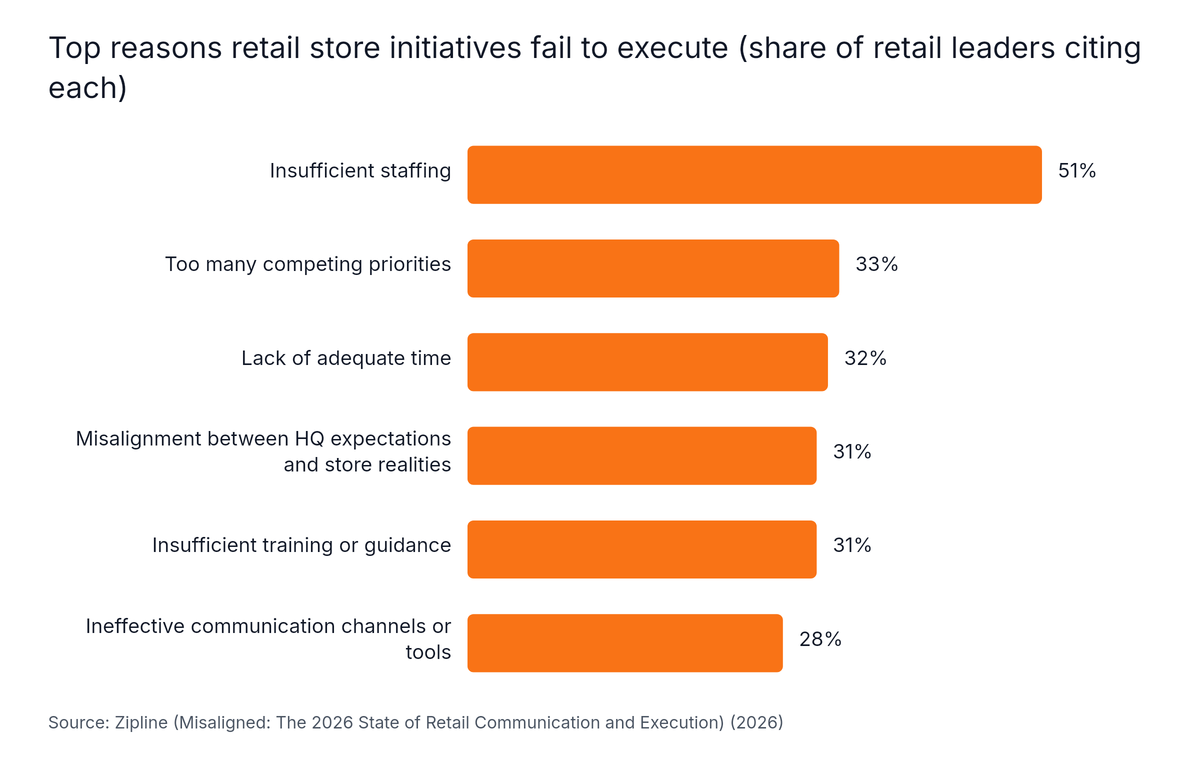
Source: Zipline (Misaligned: The 2026 State of Retail Communication and Execution), 2026
Standardising the audit won't fix staffing. It does show where the gap sits and whether it is closing from one cycle to the next.
Auditor calibration is the practice of having every auditor score the same store independently, comparing results and rewriting any criterion that produced different scores. It needs a reference store, photo anchors for each score level and a written agreement threshold. Insufficient training or guidance is cited by 31% of retail leaders as a reason initiatives fail (Zipline, 2026).
Inter-rater agreement is the share of items on which two auditors give the same score for the same store. Perception gaps show why it matters. Yoobic's 2026 vendor guide says leaders assume promotional compliance of 80% to 85%, while photo-validated audits show 55% and 65% (Yoobic, 2026). The method behind those figures isn't stated, so read them as directional. Retail-specific reliability data is scarce, so measure your own agreement.
Most guides name calibration without showing how. This protocol is a practical sequence, not a published standard:
Set the threshold yourself, and record it in the rubric. No published benchmark exists for retail audits, so the number is your team's decision. Run the protocol again when a new auditor joins, when the rubric changes version, when a region is added, or when one auditor's average drifts from peers.
Once scoring starts, compare each auditor's average scores on the same areas and regions. If one person scores consistently higher, the cause is more likely the auditor than the stores. Familiarity matters too. Auditors who know a store manager well tend to soften scores, so rotate auditors across sites where you can.
5S is a workplace-organisation method scored on how orderly, clean and consistently maintained an area is. Most 5S material describes factory floors. In a dealership, define observable anchors for the showroom, service lane and parts store. This example shows the shape for a service lane, scored 0 to 4:
| 5S element | What the auditor observes | Score 0 anchor | Score 4 anchor |
|---|---|---|---|
| Sort | Items in the lane that don't belong | Unused equipment and scrap in walkways | Only items for current jobs present |
| Set in order | Tool and fluid locations | No marked locations | Every item at a marked, labelled place |
| Shine | Floor and bay condition | Visible spills and debris | Clean surfaces, no spills |
| Standardise | Visual rules and signage | No signage or inconsistent use | Same layout and signs in every bay |
| Sustain | Evidence of regular checks | No records of previous checks | Dated checks with closed actions |
Add a reference photo to each anchor. For site-by-site guidance, see 5S audits in a dealer network.
Audit results stay comparable between regions and years when the checklist, rubric and weighting are versioned and frozen for each evaluation cycle, every change is logged, N/A items follow one written rule, and sites are compared only with like sites. Without those controls, a score change can mean the standard moved, not the store.
Comparability is a design requirement, not a by-product. Few retail guides treat it that way. Use these rules:
| Rule | What to do | Why it matters |
|---|---|---|
| Freeze versions | Lock checklist, rubric and weights for each audit cycle | Scores within a cycle share one yardstick |
| Log changes | Record every added, removed or reworded criterion | Year-on-year gaps can be explained |
| One N/A rule | Remove the item and its weight from the denominator, or score it consistently another way | Stops sites gaming scores with N/A |
| Compare like with like | Group by format, size or market before ranking | A percentage alone hides different scope |
| Keep evidence | Attach dated photos to each finding | Disputed scores can be re-checked |
Benchmarks show why consistent scoring matters. T-ROC's 2026 report draws on vendor programme data from 500+ brands. It puts average planogram compliance across all retailers between 50% and 70% (T-ROC, 2026). T-ROC also estimates that 15% to 20% of potential sell-through goes unrealised at shelf because of the compliance gap (T-ROC, 2026). That is shelf data, not dealership data, and the second figure is an estimate. Read both as directional.
Evidence also settles disputes. Paperless capture with dated, geotagged photos gives you something to re-check. The same logic runs through moving from paper to paperless auditing.
The GM dealer audit process is not published step by step. GM's public material covers programs and facility requirements, while the review procedure itself is not public. Prepare against your Dealer Sales and Service Agreement, current program rules and your own records, and treat the routine below as preparation, not GM's official procedure.
The legal footing is clear. Law firm Bass Sox Mercer, which advises motor vehicle dealers, says: "Every OEM has the contractual ability to audit its dealers" (Bass Sox Mercer, 2026). A franchise relations commentator adds that "any audit is a wakeup call to the dealer" (Virginia Automobile Dealers Association, 2025).
| Area | What is public | What to confirm with GM |
|---|---|---|
| Used-vehicle certification | Over 750 GM dealers are enrolled in CarBravo, and from June 2, 2026 it is the sole used-vehicle certification platform for Chevrolet, Buick and GMC (Wards Auto, 2026) | Current certification checks on used inventory |
| Sales performance | GM reports CarBravo dealers sold 2.3 times the certified volume of dealers using traditional CPO (General Motors, 2026), a self-reported figure | Which metrics your reviewer uses |
| Facility image | Voluntary program offering roughly $50,000 to $1.5 million depending on store size (The Truth About Cars, 2025) | Current requirements in the dealer portal |
| Audit rights | OEMs hold contractual audit rights over dealers | Notice terms, record retention and challenge route in your agreement |
Cadillac keeps its own separate certified pre-owned program, so check which brand rules apply.
For how OEMs structure these reviews more broadly, see dealer performance audits and OEM standards. Confirm anything contractual with GM or your counsel.
A fixed retail audit process is not for single-site operators who audit themselves, networks whose standards are still being written, or teams hoping a scoring tool will fix an unclear standard. The evidence is also limited: the Zipline 2026 survey covers 227 US and Canadian retail leaders, not dealerships (Zipline, 2026).
Know the limits before you adopt it:
A 5S audit process produces comparable results when every score level has an observable anchor, ideally a reference photo, and auditors calibrate on the same area before scoring. Then compare each auditor's average scores on the same areas. If one auditor scores consistently higher or lower, retrain on the rubric instead of treating the gap as a real store difference.
Calibrating store auditors means having them score the same store independently, then comparing item by item. Reconcile every disagreement, rewrite any criterion that caused it, and repeat until agreement meets a threshold you set beforehand. Use a reference store, photo examples for each score level and a written record of every ruling.
Auditor recalibration should happen on triggers as well as on a calendar. Recalibrate when a new auditor joins, when the rubric changes version, when one auditor's average scores drift from peers, and when the programme enters a new region. A practical rule of thumb is to pair a fixed calendar slot with those triggers.
Not-applicable items should be handled by one written rule for the whole network. The usual choice is to remove the item and its weight from the denominator so the score reflects only what applied. Whichever rule you pick, record it in the rubric and apply it identically, or scores will not compare.
A retail audit is a scored assessment against a written standard with documented evidence, while a store visit is a broader call that may include coaching, selling support or relationship work. Keeping the two separate on the agenda lets the audit stay comparable and the coaching conversation stay open.
A repeatable retail audit process comes down to a few decisions made once and applied everywhere. Use these takeaways:
The next step is to pick one audit programme and run a calibration on a single reference store this month. If you would rather see the process running end to end, with auto-scoring, dated evidence and an offline-first mobile workflow, Schedule a Free Demo.
By Naseef Umar, Founder and CEO of AutoSmart. Naseef has over a decade of experience across automotive operations, dealer standards, network performance and audits.
© 2026 autosmarts.co All rights reserved.

