Blog
Field Audit App: What to Test Before You Commit
Test a field audit app on offline-first behaviour, evidence capture and report-before-you-leave-site, with a timed bake-off and weighted scorecard.
Choose retail audit software for a branded outlet network with one standard, offline mobile audits and a clear cost comparison with audit firms.
 Naseef UmarNov 6, 2026
Test a field audit app on offline-first behaviour, evidence capture and report-before-you-leave-site, with a timed bake-off and weighted scorecard.
Define SOPs for automobile dealers, clear up what SOP means in the auto industry, and follow six steps that make SOPs stick, with or without SOP software.

A field audit is an on-site inspection against a standard. Learn the meaning, how it differs from a desk audit, and how often field audits are performed.
Request a quote and our experts will contact you within 24 hours with tailored solutions and pricing.
autosmarts.co
Last updated: Nov 6, 2026
By Naseef Umar, Founder and CEO of AutoSmart, with over a decade of experience in automotive operations, dealer standards, network performance and audits.
Retail audit software is a field platform that lets a branded outlet network check every site against one written standard, score it consistently, capture evidence on site and track every failure to closure.
If you run standards audits across 80 outlets and every region does them differently, the tool you pick decides whether you get one network score or 80 opinions. Most buyers start from a dealer audit system built on spreadsheets and hit the same walls: drifting methods, slow tablets, patchy signal and findings nobody closes. This guide covers what the software should standardise, what makes auditors use it, whether it must work offline, what India adds, and how it compares with hiring an audit firm.
Key Takeaways
- Retail audit software should fix the checklist, weighted scoring, evidence rules and corrective-action workflow centrally, so regional scores are comparable across outlets.
- A mobile retail audit app is used only if it is faster on site than the spreadsheet it replaces, and only 28.5% of surveyed CPG and retail executives say field teams have the tools they need (POI, via YOOBIC, 2026).
- Retail audit software for Indian networks should be offline-first, because the Department of Telecommunications reports 5G population coverage of 85% even with 99.9% of districts covered (2025).
- Audit firms charge per visit, while retail audit software is a subscription, so cost follows visit count for one and network size for the other.
- Retail audit software suits brands that enforce a written standard across owned, franchised or licensed outlets, not one-off single-site audits.
In this guide: what retail audit software is, why it matters now, what to standardise, what drives adoption, offline requirements, India factors, cost versus audit firms, limitations, and FAQs.
Retail audit software is a system that lets field auditors check branded outlets against a written standard, score each outlet automatically, capture dated photo evidence and track every failed item to closure. It replaces spreadsheets and WhatsApp photos with one record, which matters because only 25% of retailers report full visibility across store functions (OneDoor, citing Coresight Research, 2025).
The category label covers very different products, so define the job first. This guide is about audits of a brand's own or franchised outlets against brand standards: signage, layout, service, safety, cleanliness, customer experience. It is not about CPG shelf and merchandising audits, which check a supplier's products inside someone else's store.
The same idea goes by several names: retail store audit software, a retail audit platform, a retail audit solution. They share a core loop:
Evidence capture is the practice of recording proof of each answer, such as a photo, with a date, time and location, at the moment of the audit. It is what separates an audit record from an opinion.
The World Economic Forum describes the status quo for frontline work bluntly: "Many operations still depend on paper-based shift planning, manual clocking and ad hoc phone calls or WhatsApp messages" (World Economic Forum, 2025). Outlet audits often run the same way. For a closer look at the paper-to-digital shift, see what moving to paperless auditing involves.
Retail audit software matters now because branded networks are adding outlets faster than manual inspection can follow. Only 36% of retail leaders say most store initiatives are executed correctly and on time (Zipline, 2026), and a second finding from the same survey shows headquarters and stores seeing the network very differently.
The survey covered 227 retail leaders in the US and Canada. Zipline is a frontline-communications vendor, so read the result as an indicator rather than an audit of your network. Its sharpest result is the perception gap: headquarters rates its own understanding of store operations 9.13 out of 10, while stores rate headquarters' understanding 5.67 out of 10 (Zipline, 2026).
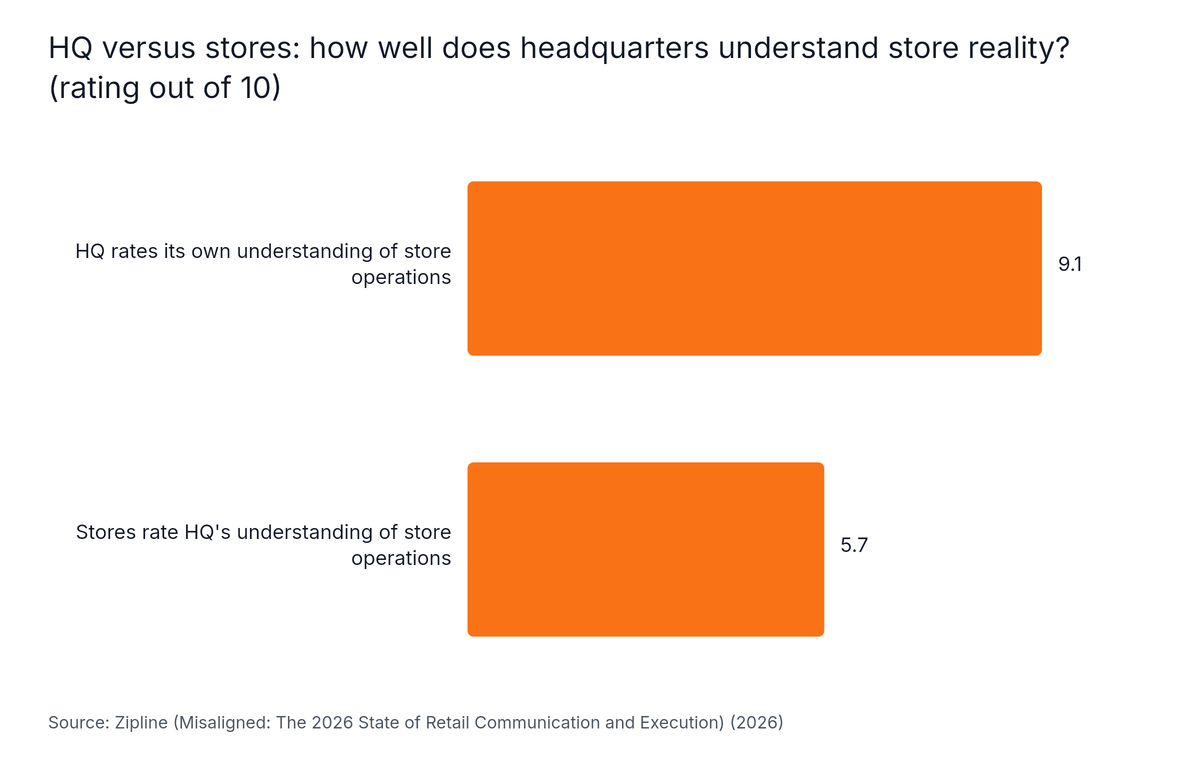
Source: Zipline (Misaligned: The 2026 State of Retail Communication and Execution), 2026
A gap of more than three points is what a shared audit record is meant to close. When head office, regional managers and outlet owners all look at the same scored evidence, the argument moves from "what is happening" to "what do we fix first".
Networks rarely buy because of a general sense that audits could be better. A specific event forces the issue:
If one of these describes your quarter, the rest of this guide is the checklist to use. Teams enforcing standards across many sites often meet the same issues in franchise compliance software evaluations.
Retail store audit software should standardise four things across every outlet: the checklist wording, the weighted scoring logic, the evidence rules and the corrective-action workflow. Configured once and applied identically by every auditor, they make regional scores comparable, which matters because at least 88% of retailers report challenges across critical operational areas (OneDoor, 2025).
Drift happens quietly. One region adds questions, another skips the ones it thinks are irrelevant, a third scores in its own spreadsheet. The table below shows what to lock centrally and what drift looks like when you do not.
| Element | Set once, centrally | What drift looks like |
|---|---|---|
| Checklist | One master version with change control | Regions reword, add or skip questions |
| Scoring | Weighted points and critical items | Scores cannot be compared between regions |
| Evidence | Live photo with date, time and geotag | Old or unrelated photos accepted as proof |
| Follow-up | Owner, due date and closure evidence per failure | Findings chased by email and meetings |
| Cycle | Fixed cadence per audit programme | Each region visits at its own interval |
Weighted scoring is a method in which each question carries a set number of points reflecting its importance. A critical item is a question that can fail an outlet regardless of its total score, such as a safety or legal requirement. Configured once and applied to every auditor, both remove most scoring disputes.
Consolidation is a change-management job as much as a software one. A practical sequence:
Skipping step 4 is a common failure. Without a single owner, the master checklist tends to fork. The platform should let your own administrator edit and version checklists without a vendor ticket. It should also support different standards by brand, country and distributor in one system. Different programmes, from Dealer Operating Standards (DOS), 5S and mystery audits, should run in the same platform without separate tools.
A corrective action is a tracked task, with an owner, a due date and closure evidence, that fixes a failed audit item. The owner is the Person-In-Charge (PIC). A platform that stops at the report leaves your audit team doing the chasing.
Our data: AutoSmart reports that under manual processes each audit generates 8 to 20 findings, and each finding needs 4 to 5 follow-ups, including escalations, before closure.
Look for failed items converting automatically into actions, reminders that repeat until closure, and closure evidence required before an item can be marked done. Dealer performance audits show how Original Equipment Manufacturers (OEMs) structure this enforcement.
A mobile retail audit app gets used when it is faster on site than the spreadsheet it replaces and the auditor never keeps a parallel record. Only 28.5% of CPG and retail executives agree field teams have the tools they need (POI research, as reported by YOOBIC, 2026). Audit duration, completion rate and overdue corrective actions show real use.
That figure is a secondary citation from a vendor write-up, and the upstream POI report was not retrieved, so verify it before you quote it internally.
Adoption is decided in the first two site visits. Field managers judge fast and ask each other in informal group chats. The verdict reaches the standards owner within days. Design the pilot around that.
Define use before rollout. Track the audit duration per outlet against a target, the share of audits completed in the app, the share with live photo evidence, and the number of overdue corrective actions. If any of these drift, a shadow process has probably appeared.
Our data: AutoSmart reports audit cycle time falling from 10 days to 3 days.
Rollout speed matters for adoption too. AutoSmart states that go-live is achievable within 5 to 10 working days once the customer shares its configuration inputs. For a look at what changes day to day, read about paperless audit software for dealer networks.
Yes, a retail audit app used across a branded outlet network should work fully offline, because signal at outlets is uneven even after India's 4G and 5G rollout. The Department of Telecommunications reports 5G in 99.9% of districts but only 85% population coverage (PIB, 2025), so some outlets will always sit in weak-signal zones.
Offline-first means the whole audit completes without a connection and syncs when signal returns, rather than treating offline as a degraded mode. The Department of Telecommunications year-end review says: "5G services have been rolled out in all States/ UTs across the country and it is available in 99.9% of the districts" (Department of Telecommunications, via PIB, 2025). The same review notes that 6,279 villages with only 2G or 3G were still slated for a 4G upgrade. District averages hide stockrooms, basements and small-town outlets.
Field teams feel this. The POI research reported by YOOBIC says 60.2% of field execution teams struggle with offline capability (YOOBIC, 2026), with the same verify-upstream caveat as above.
Many vendors list offline as a checkbox. Test each item below in your demo with the device in airplane mode.
| Capability | Must work with no signal | Why it matters |
|---|---|---|
| Checklist load | Full programme and prior-cycle data cached before the visit | Auditor can still see last quarter's failures |
| Photo and geotag capture | Live photo with date, time and location stored on device | Evidence stays valid when uploaded later |
| Scoring | Score calculated on the device | Result is available in the room |
| Signatures and visit report | Digital sign-off by auditor and outlet | Visit closes on site |
| Queued upload | Automatic sync when signal returns, with no data loss | Nothing is retyped at the hotel |
Also ask what happens when two people edit the same audit and both sync later. The answer reveals how mature the sync design is. For more on the technical side, see offline-first evidence capture and sync.
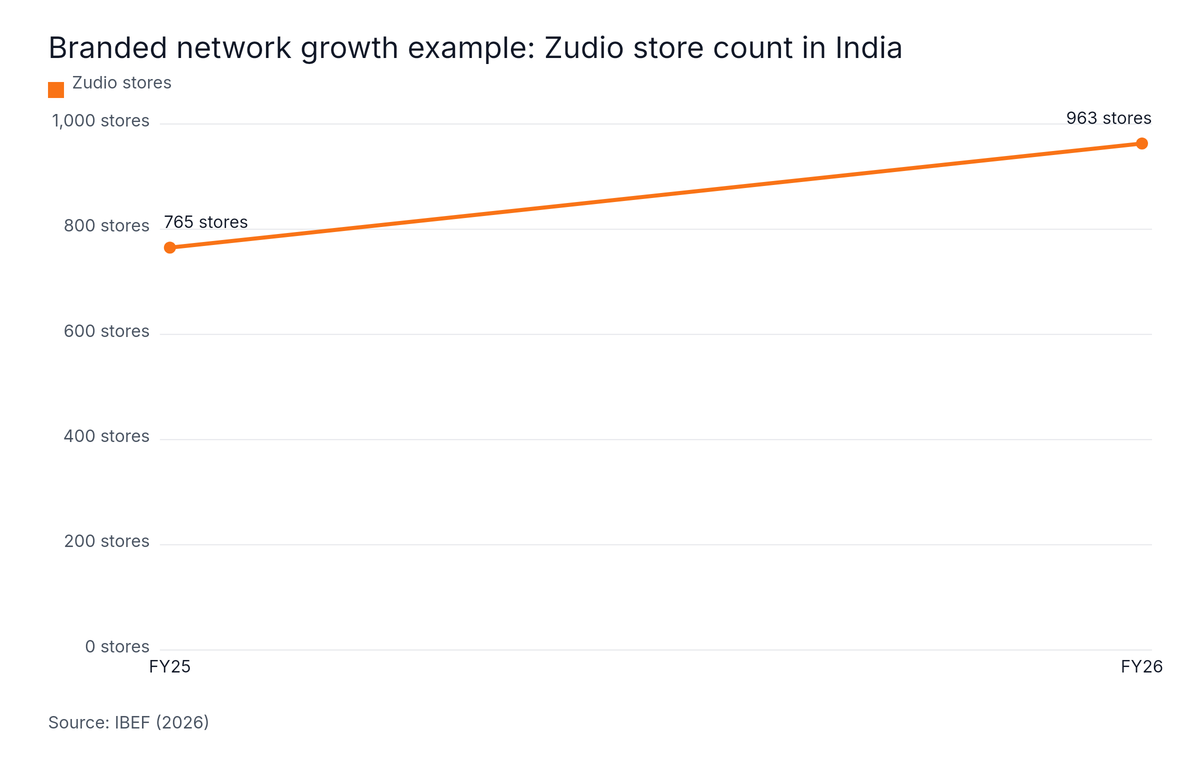
Retail audit software in India needs to handle fast network growth, uneven village-level coverage and new data-protection rules. Zudio went from 765 outlets in FY25 to 963 in FY26 (IBEF, 2026), and the DPDP Rules give organisations an 18-month phased compliance window from November 2025.
Zudio added 212 stores and 76 cities in a single year, taking it to 963 stores across 313 cities in FY26. IBEF, citing a Deloitte and Retailers Association of India report, projects organised retail at US$230 billion by 2030 and more than 35% of the total market (IBEF, 2026). More outlets in more cities means more regions inventing their own audit methods.
Source: IBEF, 2026
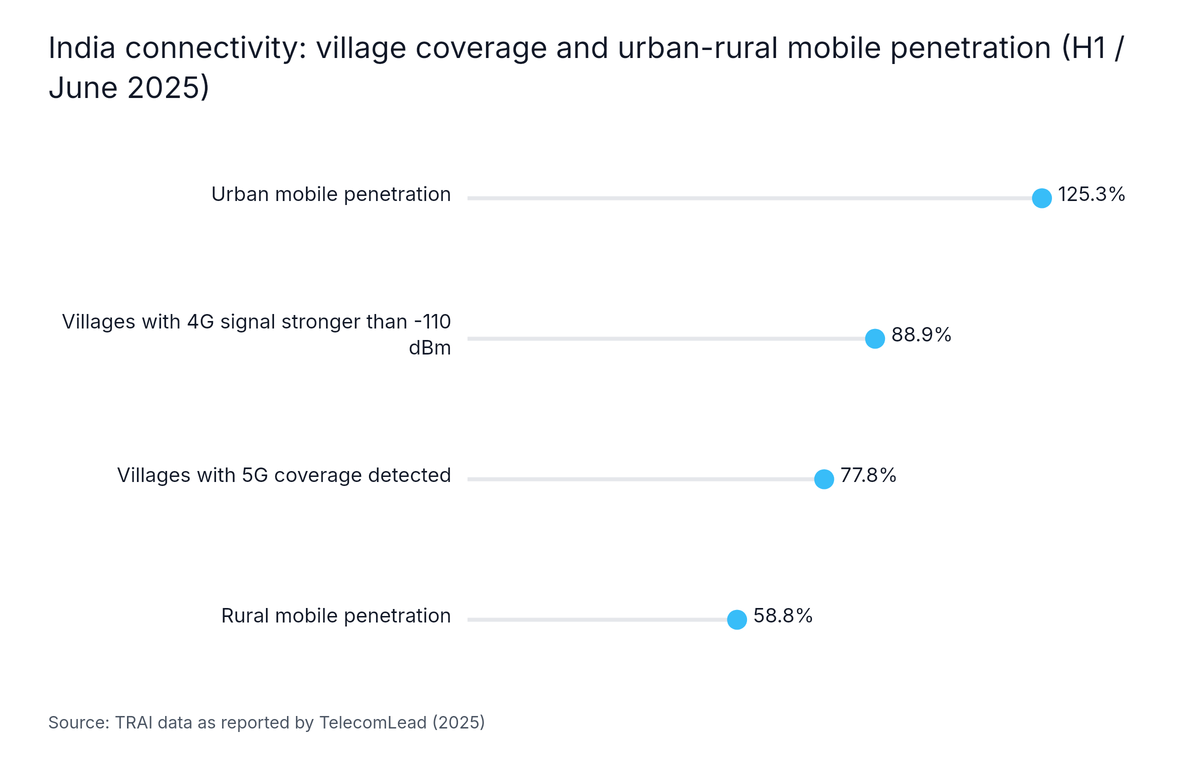
In H1 2025, 4G signal stronger than -110 dBm was detected in 88.9% of sampled villages, and 5G coverage in 77.8%, according to TRAI data (TelecomLead, 2025). Mobile penetration in June 2025 was 58.8% in rural India against 125.3% in urban areas (TelecomLead, 2025). A figure above 100% reflects multi-SIM use.
Source: TRAI data as reported by TelecomLead, 2025
For a network with outlets in smaller towns, weak signal is a routine audit condition, not an edge case.
Outlet audits capture photos of staff, customers and premises. The Digital Personal Data Protection (DPDP) Rules are India's data-protection rules, notified on 14 November 2025. The government states: "The DPDP Rules provide an 18-month phased compliance timeline, allowing organisations time for smooth transition." (Ministry of Electronics & IT, via PIB, 2025). Confirm exact obligation dates against the official Gazette.
Outsourced retail audit services are priced per visit: one provider publishes $50-200 per visit and $200K-$1M+ a year for a managed programme (T-ROC, 2026), while another quotes $20-50 per store visit with data 3-4 weeks old (Vision Group Retail, 2026). Retail audit software is a subscription, so cost follows network size rather than visit count.
Treat both price ranges as indicative. They are vendor-published, US-centric, and cover different scopes, so they disagree. Neither gives a break-even point, and we will not invent one. Build your own: annual visits per outlet times outlets times the per-visit rate, against a subscription quote for the same outlet count. AutoSmart's subscription, for example, is charged by the number of outlets in the network.
| Factor | Audit firm | Own auditors on software | Hybrid |
|---|---|---|---|
| Pricing basis | Per visit or managed programme | Subscription | Subscription plus selective visits |
| Data speed | Can be weeks old on delivery | Score available at submission | Mixed |
| Fixes during the visit | Limited | Findings become actions in the app | Depends on scope |
| Coverage of remote sites | Provider travels | Your auditors travel, or outlets self-assess | Firm covers gaps |
| Best fit | One-off or peak coverage | Repeat audits against a written standard | Large or scattered networks |
Typical scope includes brand standards, planogram and shelf compliance, pricing, regulatory and safety checks, and mystery shopping. Ask any provider whether scoring, photo evidence, corrective-action follow-up and trend reporting come in the price, or only a report per visit.
Physical visits carry their own bill. AutoSmart estimates an average of $500 per physical visit, which puts every 100 visits at about $50,000 in direct travel costs. It also estimates that moving suitable checks to self-assessment could cut physical visits by 30 to 40%, saving approximately $15,000 to $20,000 per 100 visits. These are planning estimates, not audited results. A related read on removing the manual reporting cycle is operational audit management software.
Retail audit software for branded outlet networks is not for every audit job. It fits brands, OEMs and distributors that enforce a written standard across outlets they own, franchise or license, once informal inspection stops working. It fits poorly for a one-off audit of a single site, for shelf and merchandising checks run by CPG field reps, or for financial and internal-control audit.
Be honest about these limits before a demo:
To pressure-test any vendor, use these demo scenarios for dealer compliance audit software.
A retail audit app should handle offline audits on tablets, live photo capture with date, time and geotag, automatic weighted scoring, role-based access by outlet or region, and corrective-action tracking with owners and due dates. A shared spreadsheet cannot control who edits what, prove a photo was taken at the outlet, or turn a failed item into a tracked action.
The right choice depends on visit volume and how repeatable your standard is, so work out your own numbers first. Own auditors on a platform tend to suit repeat audits against a written standard, bought-in audits suit one-off coverage, remote regions and peaks, and a hybrid is workable. Multiply annual visits by the per-visit rate and compare the result with a subscription quote.
Audit firm pricing is per visit: T-ROC publishes $50-200 per visit and $200K-$1M+ a year for a managed programme (2026), while Vision Group Retail quotes $20-50 per store visit (2026). Retail audit software is a subscription, so cost follows network size rather than visit frequency. Compare a vendor quote with your annual visit count multiplied by the per-visit rate.
Retail audit services typically cover on-site checks of brand standards, planograms and shelf compliance, pricing, regulatory and safety items, and mystery shopping, delivered as a report per visit. Scope varies by provider, so confirm whether scoring, photo evidence, corrective-action follow-up and trend reporting are included, because some deliver a report and stop there.
A proper retail audit solution replaces the spreadsheet checklist, manual score calculations, WhatsApp photos, emailed PDFs, PowerPoint report decks and chasing emails for follow-up. It puts audit execution, scoring, evidence, corrective actions and management reporting in one system, so the hours spent compiling outputs after each audit drop away.
A retail audit platform consolidating three regional processes should support one versioned master checklist, weighted and critical-item scoring applied identically, role-based access scoped by region, market-specific question variants, and a named owner for changes. Without these, the network ends up reporting in two formats, which is worse than the spreadsheets it replaced.
Choosing retail audit software comes down to whether one standard survives contact with 80 outlets, tablets with no signal and field teams with no patience. Keep these points in front of you when you shortlist vendors:
The cheapest mistake is the one you catch in a pilot, so run your own checklist before you sign anything. Next step: see the platform run your own standard. Schedule a Free Demo with AutoSmart.
© 2026 autosmarts.co All rights reserved.