Blog
Dealer Audit Software: A Buyer's Checklist for OEMs and Dealer Groups
Dealer audit software explained: what it replaces, how it differs from generic inspection apps, and eight tests to run in a demo before you buy.

When an HSE incident spikes audit frequency across a fuel retail network, manual follow-up chains break first. Here's what safety audit management software must handle.
 Naseef UmarOct 8, 2026
Dealer audit software explained: what it replaces, how it differs from generic inspection apps, and eight tests to run in a demo before you buy.
Score a 3-bay workshop and a flagship showroom fairly on one retail audit checklist: format profiles, N/A arithmetic, weighting and guardrails.
A brand standards audit scores a dealer against OEM facility, process and customer experience rules. See who sets standards, what they cost and how audits run.
Request a quote and our experts will contact you within 24 hours with tailored solutions and pricing.
You can also send us a quick email at info@autosmarts.co.
AutoSmart Technology
Last updated: Oct 13, 2026
Safety audit management software is a structured digital platform that converts site inspection findings into owned, deadline-tracked corrective actions - and when an HSE incident at a fuel retail site forces an immediate jump from monthly to weekly or daily audits, it is the only reliable way to stop the follow-up chain from collapsing entirely.
When cadence spikes, so does corrective-action volume. A network of 50 fuel retail sites running monthly audits might generate 400 to 1,000 findings per cycle. Shift to weekly and that figure multiplies by four before the first month is out. The audit team can write up findings. What breaks is the follow-up: who owns each item, when it is due, whether evidence was submitted, and who gets told when the deadline passes. This post covers what safety audit management software must handle natively when frequency spikes and volume multiplies across a branded site network: escalation routing, corrective-action closure, and the cadence frameworks that keep a fuel retail network defensible to regulators.
Key Takeaways
- An HSE incident at a fuel retail site triggers an immediate jump in audit cadence, and the first thing that breaks is the manual corrective-action follow-up chain.
- Nearly 35% of corrective actions from incident investigations remain open after 90 days - a rate regulators treat as evidence of a broken safety management system (iFactory, 2026).
- Safety audit management software must escalate overdue actions automatically to the right Person-In-Charge (PIC) and up the management chain - no manual chasing.
- Fuel retail HSE audits run on layered daily, weekly, and monthly frequencies; the platform must support all three in one programme without rebuilding the checklist each time.
- A 10-day audit cycle can be compressed to 3 days with the right platform - as demonstrated by AutoSmart Audit's work with Almajdouie Motors.
Manual corrective-action follow-up breaks under high audit cadence because volume multiplies faster than a human chase chain can absorb. A single monthly audit across a fuel retail network of 50 sites generates 400 to 1,000 findings per cycle; shift that to weekly and the figure becomes 1,600 to 4,000 per month. Nearly 35% of corrective actions from incident investigations remain open after 90 days - a rate regulators treat as a broken safety management system (iFactory, 2026).

The UK Health and Safety Executive (HSE) carried out over 13,200 workplace inspections in 2024/25, a 47% increase year-on-year (Arinite, citing UK HSE official data, 2025). Regulators are not slowing down. An organisation that cannot demonstrate timestamped corrective-action closure faces materially higher citation risk than one that can.
"Paper-based HSE compliance has one critical structural failure: it cannot prove anything happened on time." (Kissflow, 2025)
The same structural failure applies to email and Excel. The audit team knows what was found. Nobody knows what happened next.
| Stage | Manual approach | What breaks when cadence spikes |
|---|---|---|
| Finding recorded | Excel row or paper form | Version control collapses across sites |
| Owner assigned | Email to site manager | No confirmation, no system record |
| Deadline set | Calendar note or verbal | Not enforced by anything |
| Follow-up | 4-5 manual chase emails per finding | Team time consumed; items still missed |
| Evidence of closure | Photo in email attachment | Not linked to the original finding |
| Escalation | Manager remembers to ask | Does not happen consistently |
Each audit typically generates 8 to 20 findings. At 4 to 5 manual follow-ups per finding before closure, a network running 50 weekly audits produces thousands of individual follow-up actions that no email chain can track reliably. This is the failure mode that safety audit management software exists to eliminate.
Safety audit management software built for branded fuel retail networks must handle five things natively when audit cadence spikes: configurable evaluation cycles that switch from monthly to daily without rebuilding the programme; automatic corrective-action creation from every failed item; Person-In-Charge (PIC) assignment with deadlines enforced by the system; escalation rules that notify the next management tier when an action ages past its Service Level Agreement (SLA); and offline-first mobile execution for remote forecourt sites with unreliable connectivity.

This is not a checklist-and-report problem. Organisations using structured digital inspection programmes report 30 to 50% reductions in workplace injury rates compared to paper-based alternatives (Certainty Software, citing NSC Injury Facts, 2024). The reduction comes from closure, not from inspection volume. You can run daily audits and still accumulate open findings if the corrective-action workflow does not enforce completion.
With 67% of EHS budgets held flat in 2025 (Vector Solutions, citing EHS Today survey, 2025), doing more audits without adding headcount requires automation at every stage: creation, assignment, notification, escalation, and evidence capture.
AutoSmart's customer data shows: Almajdouie Motors cut a 10-day audit cycle to 3 days after moving to AutoSmart Audit - without adding headcount. The full audit report, including the action plan, was completed in that window. (AutoSmart case study)
A safety audit management platform must be evaluated against the following before deployment in a post-incident fuel retail context:
For a broader view of field audit software capabilities for dealer networks, including evidence capture, scoring and dealer visit reports, see the linked overview.
Escalation in safety audit management software works as a timed notification chain tied to each corrective action's due date. The first alert goes to the assigned Person-In-Charge at the due date. If no closure evidence is submitted within the configured window - typically 7 to 14 days past due - the system notifies the Area Service Manager (ASM). A second threshold, often 30 days, escalates to the HSE Director or regional head. OSHA penalties for willful or repeat violations can reach $165,514 per violation as of January 2025, making documented, timestamped escalation chains a direct cost-avoidance asset (Vector Solutions, citing OSHA official schedule, 2025).

"Naturally, there was no traceable visibility of incident investigations and corrective actions, which was a big challenge." (Mikki Teodoro, SGS Global Operations Integrity, via EHSLeaders.org, 2024)
That lack of traceability is precisely what a configurable escalation chain solves - and what regulators require evidence of when reviewing a post-incident corrective programme.
| Days overdue | Notification recipient | Action required |
|---|---|---|
| 0 (due date) | Person-In-Charge (PIC) | Submit closure evidence |
| 7 days | Area Service Manager (ASM) | Confirm action plan or reset deadline with reason |
| 14 days | Zonal Service Manager (ZSM) | Escalate to site visit or direct intervention |
| 30 days | HSE Director / Regional Head | Formal review; regulatory documentation prepared |
| 60+ days | Compliance record flagged | Regulator audit trail entry; corrective programme under review |
AutoSmart Audit's Action Plan Tracker supports configurable reminders starting, for example, from 10 days before the due date and repeating every 2 days - giving the PIC visibility before the deadline, not after it has passed. Kanban stages (Pending, In Progress, Completed, Approved) make status visible across the management hierarchy without requiring anyone to chase by email.
Audit reporting is the structured record of what was observed during a site visit: scores, findings, photo evidence, and a dealer visit report in PDF. Corrective-action tracking is what the software does after the report closes: each failed item becomes an owned task assigned to a specific Person-In-Charge (PIC), with a due date, a status, required photo or document evidence at closure, and automatic escalation if the deadline passes.

Most generic checklist tools do the first part well and the second part poorly. They export a PDF. The PDF lands in an inbox. Nothing in the system enforces what happens next. After a Health, Safety and Environment (HSE) incident, when audit cadence has jumped and a regulator may review the corrective programme, the gap between a report and a closed-loop workflow is the difference between a defensible record and an open liability.
| Capability | Report-only tool | Closed-loop safety audit management software |
|---|---|---|
| Findings documented | Yes | Yes |
| Corrective action auto-created | No - manual export | Yes - automatic at audit close |
| PIC assigned in system | No | Yes - per finding |
| Due date enforced | No | Yes - system-generated, configurable |
| Escalation if overdue | No | Yes - timed multi-tier notification |
| Closure evidence required | No | Yes - photo/document, geo-tagged |
| Prior-cycle failures surfaced | No | Yes - historical cycle comparison in-audit |
| Regulator-ready audit trail | No | Yes - timestamped end-to-end record |
The Action Plan Tracker within AutoSmart Audit is built on this closed-loop model. Every failed item is an action. Every action has an owner, a deadline, a status, and a verified closure state. The audit team stops being the chasing team.
Fuel retail Health, Safety and Environment (HSE) audits run on multiple overlapping frequencies, and safety audit management software must support all three layers in a single platform - with separate scoring, separate PIC assignment, and automatic cycle rollover for each layer. The International Association of Oil and Gas Producers (IOGP) recorded 32 fatalities across 21 separate incidents in the oil and gas sector in 2024, up from 27 in 2023 (Journal of Petroleum Technology, citing IOGP 2024 Safety Performance Indicators, 2025). The frequency of a post-incident audit programme should match the severity of the finding.
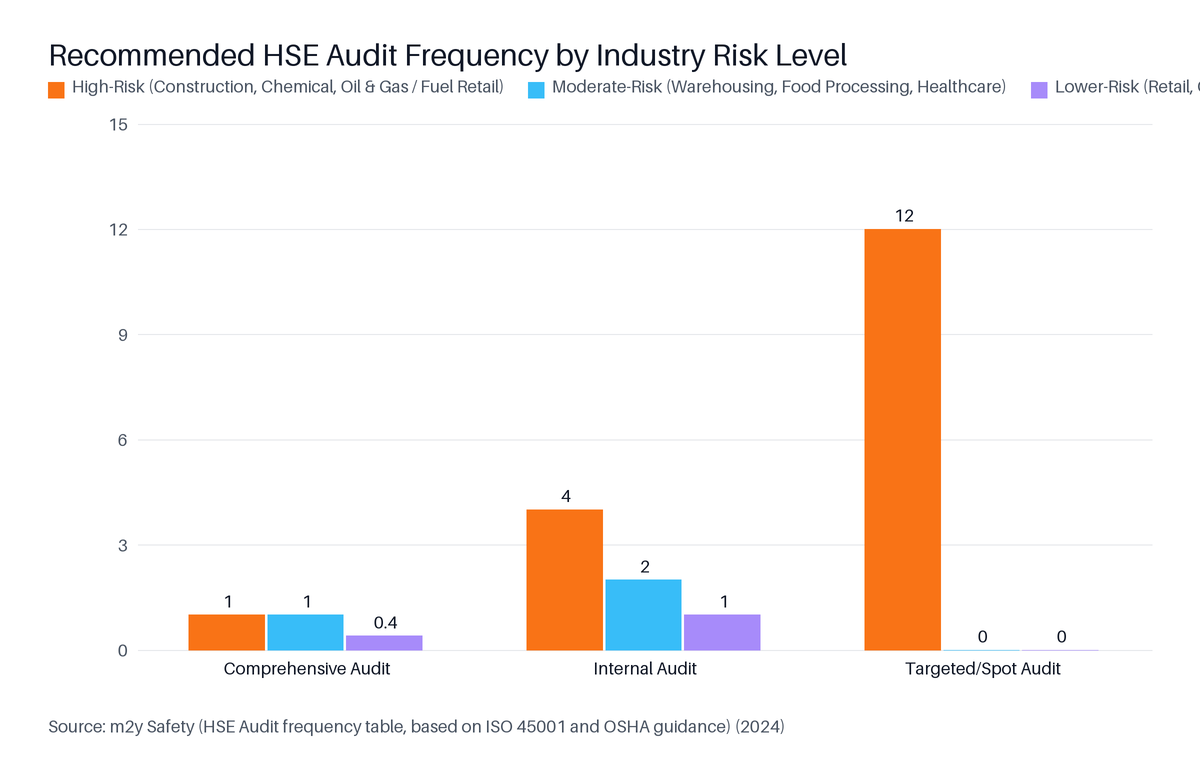
Source: m2y Safety (HSE Audit frequency table, based on ISO 45001 and OSHA guidance), 2024
The chart above reflects recommended minimum audit frequencies by risk level, drawing on ISO 45001 and OSHA guidance (m2y Safety, 2024). For high-hazard fuel retail operations, targeted spot audits - the highest-frequency tier - map to daily or weekly forecourt checks.
| Frequency | Scope | Typical checklist areas |
|---|---|---|
| Daily | Forecourt operations | Spill containment, fire extinguisher access, PPE compliance, housekeeping, signage |
| Weekly | Storage and equipment | Underground storage tank (UST) signage, emergency equipment condition, contractor documentation |
| Monthly | Full site | Structural compliance, chemical handling, waste management, staff training records |
| Quarterly | Network-level | Cross-site trend analysis, repeat failures, site scoring against oil major or OEM standard |
| Post-incident | Targeted | Immediate re-inspection of the specific area; escalated corrective-action programme |
Software must handle the layering: a daily checklist and a monthly comprehensive audit run simultaneously on the same site, with different PICs, different due dates, and different scoring weights. A single-programme tool cannot manage this without configuration debt that the HSE team ends up owning forever.
Replacing paper audits with a digital programme produced 50% faster audit cycles and 30% improvement in safety compliance in a documented APAC case (Hakunamatata Tech, EHS Scorecard case study, 2024). Incident resolution ran 40% faster. The gains came from the combination of structured digital capture and closed corrective-action workflows - not from the inspection itself.
When a fuel retail site is owned by a franchisee but audited against an oil major's or Original Equipment Manufacturer's (OEM's) standard, safety audit management software must separate programme ownership from site-level accountability. The franchisor controls the checklist and scoring criteria; the franchisee's site manager is assigned corrective actions and receives escalation notifications. Multi-level approval workflows ensure that closure evidence is reviewed by both the site operator and the field auditor before a finding is closed - preserving accountability across the ownership boundary.
This configuration also applies to automotive dealer networks where a Dealer Development Head (DDH) or Dealer Operating Standards (DOS) manager at OEM level sets the audit standard, Area Service Managers (ASMs) conduct field audits, and individual dealers are responsible for corrective actions at their own sites. AutoSmart Audit supports this hierarchy natively: role-based access control separates what auditors can see and do from what dealers can see and do, and external agency auditors can be granted limited, scoped access without seeing network-wide data.
Ajeesh Alex, Regional After Sales Manager at MG MENA, on adopting a structured audit platform: "Since we started using the audit system, everything is at our fingertips." (AutoSmart case study)

For networks using Area Service Manager (ASM) self-assessments alongside independent field audits, the platform lets management compare self-assessment scores against auditor scores to identify the gap. Self-assessments that consistently outperform independent audits flag sites that need closer attention - without requiring an additional site visit.
The paperless audit software transition for dealer networks covers how this shift affects daily field operations in more detail.
Safety audit management software of this type is designed for branded retail networks of roughly 10 or more sites operating under one standard. Below that threshold, a site owner who walks the floor personally can manage findings without a platform. The sweet spot is 25 to 500 sites under one brand or group; enterprise deployments cover 500-plus sites across multiple countries and brands.
The platform is also not suited to quantitative or transactional inspections - vehicle condition assessment, inventory audit, or financial audit - where the output is a number pulled from a system rather than a judgement made on site.
If the existing workflow is a single shared spreadsheet across 8 sites and the HSE incident was isolated and non-recurring, a full platform deployment is probably not the right first step. If the network spans 30-plus sites, audit cadence has jumped post-incident, and the follow-up chain is already failing, the cost of not deploying is significantly higher than the cost of a 5 to 10 working day implementation.
Safety audit management software built for high-frequency post-incident use must support configurable evaluation cycles - daily, weekly, bi-weekly - that can be activated per site or per region without rebuilding the programme. The software should auto-generate corrective actions from every failed item, assign them to the right Person-In-Charge (PIC) at that site, and escalate overdue actions up the management chain automatically. Offline-first mobile execution is non-negotiable for remote forecourt locations. AutoSmart Audit supports all of these cycle frequencies with automatic rollover and escalation rules.
Audit reporting produces a record of what was found during a site visit - scores, findings, photos, and a PDF output. Corrective-action tracking is what happens next: each failed item becomes an owned task with a named Person-In-Charge (PIC), a due date, a status, and required closure evidence. Most generic tools stop at the report. Safety audit management software that closes the loop treats the report as the starting point and tracks every action to verified completion.
There is no universal rule, but industry practice and configurable EHS software typically sets the first escalation trigger between 7 and 14 days after a due date is missed, with a second escalation to senior management at 30 days. Nearly 35% of corrective actions from incident investigations remain open after 90 days, which regulators treat as a broken safety management system (iFactory, 2026). The escalation window should be set in the software and enforced automatically, not managed by email.
Yes, provided the software is built offline-first. AutoSmart Audit runs as a native iOS and Android mobile app with an offline-first architecture: auditors complete full evaluations, capture geo-tagged photo evidence, and record corrective actions without a network connection. All data auto-syncs to the central platform when connectivity is restored. This is critical for remote forecourt locations, underground storage tank inspections, and rural LPG sites where mobile signal is unreliable.
Safety audit management software designed for branded networks separates the audit programme owner from the site operator. The franchisor or oil major sets the checklist and scoring standard; the franchisee's site manager is assigned as Person-In-Charge (PIC) for corrective actions and receives escalation notifications. Multi-level approval workflows ensure that closure evidence is reviewed by both the site operator and the field auditor before an action is marked complete - maintaining accountability across the ownership boundary.
The problem is not that fuel retail networks fail to conduct audits after an HSE incident. The problem is that the corrective-action volume a post-incident cadence generates is incompatible with manual follow-up, and the consequences of open actions - regulatory citation, repeat incidents, documented non-closure - are significant. Safety audit management software must handle escalation, PIC assignment, evidence-linked closure, and multi-frequency layered programmes as built-in capabilities, not configurations bolted on after purchase.
Five points to carry forward:
Schedule a Free Demo to see how AutoSmart Audit handles cadence spikes, escalation routing, and corrective-action closure across a fuel retail or dealer network.
Written by Naseef Umar, Founder and CEO, AutoSmart Solutions. Naseef has over a decade of experience in automotive operations, dealer standards, network performance and digital transformation.
© 2026 AutoSmart Technology All rights reserved.