Safety audit software should capture HSE findings on the same visit as the standards audit. See what to test offline, what to check and how to staff it.
Safety audit software is a digital system that lets one auditor record safety findings, evidence and corrective actions on the same visit as the standards audit, not on a separate trip. One incident at one site changes the question. You stop asking whether that site is compliant and start asking about every other site. Great Britain lost an estimated 40.1 million working days to work-related ill health and injury in 2024/25 (Health and Safety Executive, 2025). A separate safety trip per site cannot keep pace with that. This guide covers what the software must handle, how to test offline capture, how to staff collision centre audits and how to estimate your own time savings. Its statistics come from Great Britain's regulator, so map every checklist item to your own regime. It builds on our guide to mobile audit software for dealer networks.
Key Takeaways
Safety audit software for dealer networks should run the safety module inside the standards audit checklist, so one visit produces one report and one action log.
Offline-first capture is a test, not a feature claim: run the checklist, photos, signatures and actions in airplane mode before you buy.
Collision centre safety audits usually work best as a hybrid: a specialist auditor on your template, with internal owners closing actions.
After an incident, rank sites by shared hazard, audit them on one checklist and track every failure to closure.
No independent figure exists for time saved by one auditor across many sites, so measure travel, reporting and chasing hours yourself.
What should safety audit software handle on the same visit as the standards audit?
Safety audit software should let an auditor complete the health, safety and environment (HSE) module inside the same checklist as the dealer standards audit. It must capture photo evidence offline, score gating items separately from weighted ones, and turn every non-compliance into an owned corrective action. The aim is one trip, one report and one action log per site.
A corrective action is a tracked task, with an owner and a deadline, that fixes a failed audit item. A non-compliance is a checklist item that fails the standard. Seven capabilities decide whether the tool can fold safety into the standards visit:
One template with a safety module. Dealer Operating Standards (DOS) and HSE questions sit in one program, with their own sections and owners.
Gating versus scored items. A failed lift check should not be averaged away by a strong showroom score.
Live evidence capture. Photos are taken in the moment, with date, time and location stamps.
Offline-first capture. The visit does not stop in a basement workshop.
Separate routing. Safety findings go to the HSE lead or Person-In-Charge (PIC), while standards findings go to the dealer principal.
Closure evidence. An action cannot be marked done without proof.
Network view. A drill-down dashboard shows every site, region and finding.
What belongs on the safety module of a dealer site checklist?
An HSE audit checklist is the list of health, safety and environment checks an auditor verifies at a site. For a dealer or workshop it should reflect how workshops injure people. The regimes named below are Great Britain's, so map each item to your own jurisdiction.
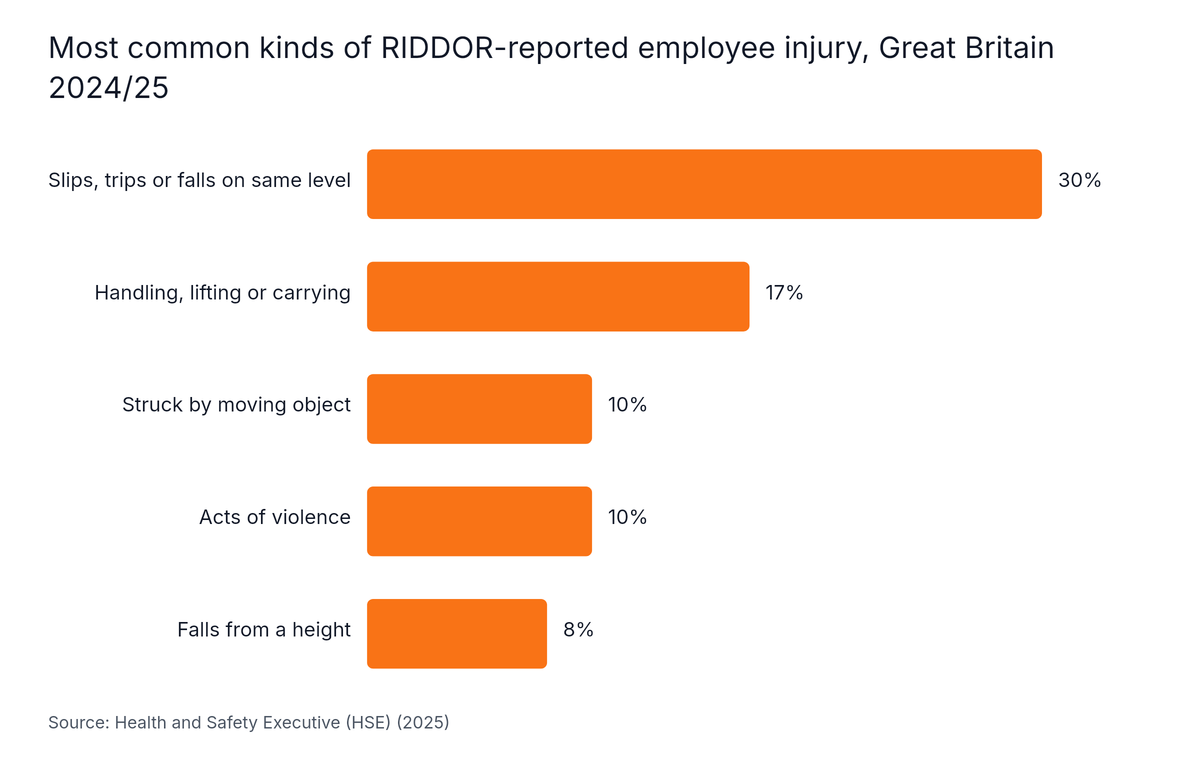
The scale matters for the business case. Slips, trips or falls on the same level made up 30% of RIDDOR-reported employee injuries in 2024/25, followed by handling, lifting or carrying at 17%. Both are everyday workshop floor hazards.
Horizontal Bar chart: Most common kinds of RIDDOR-reported employee injury, Great Britain 2024/25. Highest: Slips, trips or falls on same level at 30%.
The chart shows the same split: 30% slips, trips and falls on the same level, 17% handling, lifting or carrying, 10% struck by a moving object, 10% acts of violence and 8% falls from a height.
On vehicle movement, the release names no underlying dataset, so treat the reversing figure as guidance, not a measured rate. The inspector's comment in that case is a fair brief for any checklist: "Employers must ensure their workplaces are properly organised to keep workers safe." (Laura Royales, Health and Safety Executive, 2026)
On support equipment, the plant hire company in that case paid £10,000 plus £3,475.90 costs after a mechanic was injured under the poorly propped body.
Fold this module into the dealer visit rather than adding a second one. Our guide to field audit software for dealer networks shows how scoring, evidence and the dealer visit report sit in one workflow.
Which safety audit platforms capture findings on a phone at sites with no signal?
Safety audit platforms that handle sites with no signal are offline-first: the checklist, live photos, signatures and corrective actions all work with no connection, then sync on reconnect. The phone is the working copy during the visit. Test this in airplane mode during a pilot, on the phones your auditors actually carry, before you commit to any platform.
Offline-first capture is a design where the device holds the full audit and syncs later, so a dead zone never forces a paper backup. Vendors describe this as a feature, but few explain how to test it. Basement workshops and metal-clad bodyshops are the usual dead zones, and they are also where floor hazards live: slips, trips or falls on the same level were 30% of RIDDOR-reported employee injuries in 2024/25 (Health and Safety Executive, 2025). A parallel paper or WhatsApp record is the real risk, because once an auditor keeps one, the platform's data stops being the record.
An offline test script for your pilot
Run this on the phones your auditors actually carry:
Download the template, then switch on airplane mode.
Start a new audit and an ad-hoc hazard report with no signal.
Take photos and check that each shows a date, time and location stamp.
Collect the dealer's signature and the auditor's signature.
Raise a corrective action with an owner and a due date.
Look for a visible count of pending uploads.
Reconnect and check for duplicates, lost photos or overwritten answers.
Repeat with two auditors editing the same site.
Run the script on your first pilot site visits, so any failure shows up before the rollout and not after it.
AutoSmart Audit, the field audit platform from AutoSmart, offers a mobile application on Android and iOS, a mobile-responsive web interface, offline-first audits, and live photo capture with date, time and geotag stamps. For a wider list of stress tests, see these demo scenarios for dealer compliance audit software.
What are the options for collision centre safety audits when you cannot staff them internally?
Collision centre safety audits can be run in-house, by an outsourced specialist, by a hybrid of both, or by the OEM. Most dealer groups end up hybrid: a specialist auditor works from the group's own template on a phone while an internal owner closes the actions. Trade press reported about 1,000 targeted inspections of repair businesses on isocyanate paints (CollisionWeek, 2025).
CollisionWeek reported that Great Britain's Health and Safety Executive would focus those inspections on isocyanate paints and COSHH compliance. A trade-research summary from the Institute of Occupational Medicine says inspectors check spray booth ventilation, air-fed respirators, clearance times and health surveillance (IOM World, 2025). The regulator's own bulletin describes the aim "to check protection measures against isocyanate exposure, the leading cause of occupational asthma in the UK" (Health and Safety Executive, 2025).
How the four staffing models compare
Model
Who audits
Main cost drivers
Independence
Best fit
In-house
Your own HSE lead or standards auditor
Salary, travel time, training
Lower
Small networks, close to the sites
Outsourced specialist
External firm
Day rate, travel, report writing
High
Paint shop and ventilation depth
Hybrid
Specialist on your template, internal owner closes actions
Specialist days plus internal follow-up
High and consistent
Dealer groups with many collision centres
OEM-run
Brand's own field team
Brand resources, not yours
High, but on the brand's agenda
Brand standards, less often HSE depth
What makes hybrid work is one shared template. If the platform can restrict an outside auditor's permissions to assigned sites, a third party can use your checklist and raise actions into your log. Write the scope of work around the template, not the vendor's own format.
What a collision centre module adds
Add these items for paint shops: spray booth ventilation and clearance times, air-fed respirators and face-fit, isocyanate health surveillance, local exhaust ventilation (LEV) testing, flammables storage and welding fume control. Examination records for lifts and LEV need a competent person's sign-off, which the software should store rather than replace. For the broader workshop picture, read about 5S audits in a dealer network.
What should you do when one safety incident means auditing every site?
After a safety incident at one site, audit every site against one common checklist, in risk order, with the same evidence standard and a tracked corrective action for each failure. Start with sites that share the incident's hazard, such as workshop transport or paint shops, then work outward. Software makes that cadence sustainable because findings, owners and deadlines sit in one record.
Manual tracking is where a network-wide round tends to stall. AutoSmart's data indicates each audit generates 8 to 20 findings, and under a manual process each finding needs 4 to 5 follow-ups, including escalations, before closure. Multiply that by every site in the network and the chasing alone can outgrow a spreadsheet.
One incident also tends to widen. A 2 October 2026 prosecution found that an investigation into a crush injury also uncovered a failure to control welding fume exposure. The inspector said: "Had the company identified the risk and ensured its employees were adequately instructed and trained, this incident would not have happened." (Matthew Dundas, Health and Safety Executive, 2026)
A five-step network playbook
Rank sites by risk. Use the incident's hazard first: forklifts, lifts, paint shops or reversing vehicles.
Issue one checklist. Same questions, same weighting, same gating items at every site.
Set the evidence standard. Live, time-stamped photos and a signature from the assessed party.
Route each failure. Every non-compliance becomes an action with a Person-In-Charge, a due date and closure evidence.
Report upward. Show closure by site and by finding to management, the OEM or an insurer.
The Action Plan Tracker in AutoSmart Audit follows this pattern: a closed-loop corrective-action workflow in which non-compliances become action items with an owner and due date, and closure evidence is required before an action is marked complete.
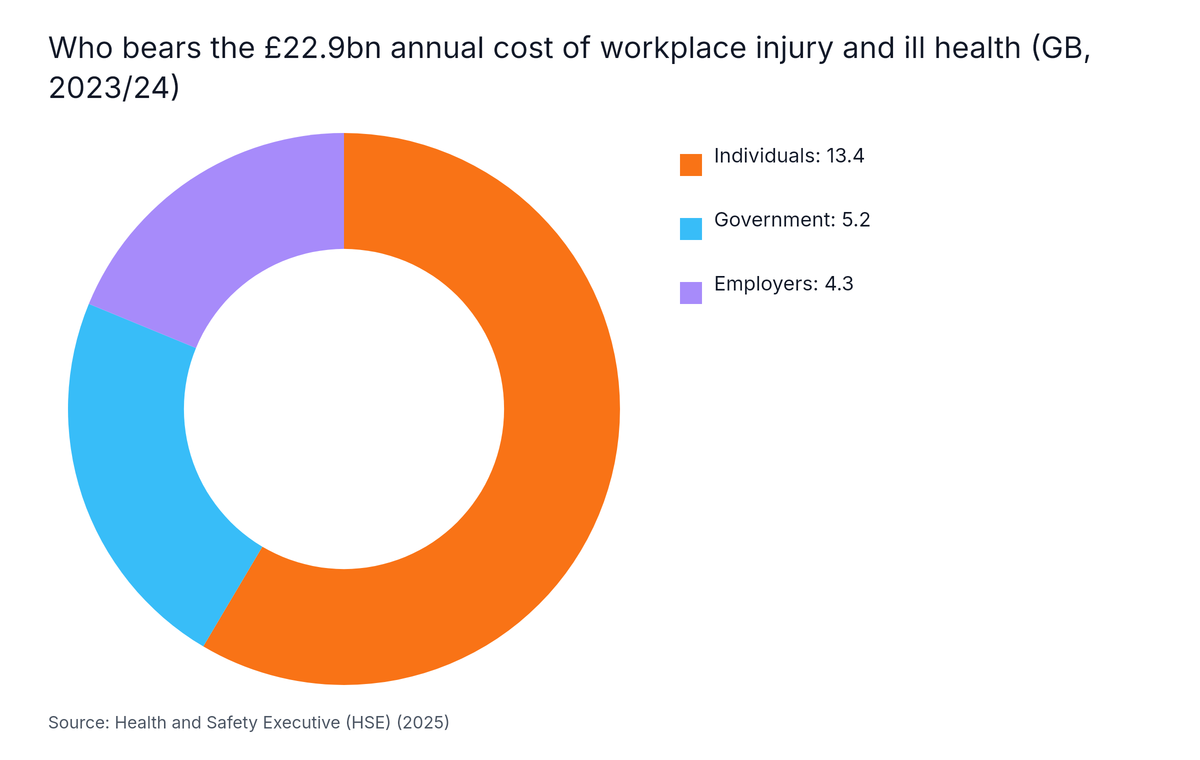
The cost of getting this wrong is not abstract. A vehicle maintenance company was fined £30,000 plus £4,325 costs after a worker was crushed (Health and Safety Executive, 2026). Workplace injury and new ill health cost Great Britain an estimated £22.9 billion in 2023/24, and employers bore £4.3 billion of it (Health and Safety Executive, 2025).
Donut chart: Who bears the £22.9bn annual cost of workplace injury and ill health (GB, 2023/24). Highest: Individuals at 13.4.
How much time can safety audit software save one auditor covering 40 sites?
One auditor can estimate the time safety audit software saves by measuring travel, report writing, chasing corrective actions and consolidating results for each site. AutoSmart estimates an average travel cost of $500 per physical visit, and says some dealership teams spend 3 to 4 hours after each audit preparing and consolidating outputs. Measure your own baseline first.
No independent source quantifies time saved for a single auditor covering many sites, and vendor percentages are rarely sourced. Time spent on admin is time not spent on the hazards behind the 40.1 million working days lost in 2024/25 (Health and Safety Executive, 2025). So use a method rather than a headline number.
Time sink
How to measure it
What the software changes
Travel
Hours and cost per physical visit, per site
Suitable checks move to self-assessment
Report writing
Hours after the visit compiling photos, Excel and slides
Dealer visit report is generated at the end of the visit
Chasing actions
Follow-ups per finding until closure
Owners and due dates assigned to each action
Consolidation
Hours per reporting cycle merging sites and regions
Drill-down dashboard shows live aggregate data
Our data: AutoSmart estimates that at $500 average per physical visit, every 100 visits is $50,000 in direct travel cost, and moving suitable checks to self-assessment could reduce physical visits by 30 to 40%, saving approximately $15,000 to $20,000 per 100 visits. AutoSmart's data also shows audit cycles compressed from 10 days to 3 days.
Self-assessment needs care: management needs confidence that dealer self-scores are honest and comparable to independent audits, so compare them against your own visits. Go-live is achievable within 5 to 10 working days once configuration inputs are received. For the reporting side, see replacing the manual PowerPoint reporting cycle.
Who is safety audit software not for?
Safety audit software is not for every situation. It will not replace a competent person's statutory examination of lifts or ventilation, it cannot fix a weak safety culture, and it adds little for a single site. The evidence in this guide is also Great Britain only, so map each checklist item to your own regime.
Statutory examinations stay with competent people. The software stores the record and chases the action. It does not examine the equipment.
Jurisdiction is yours to map. The statistics here are from Great Britain. For US sites, one law-firm summary says OSHA raised the maximum penalty for a serious violation to $16,550 from January 2025 (Bricker Graydon via JD Supra, 2025), so verify current figures with OSHA.
Single-site operators gain less. The value comes from network scale, comparison and closure tracking.
Adoption is the real risk. If the app is slow or unreliable on site, auditors keep paper copies and the data loses value.
Frequently Asked Questions
What should HSE audit software handle after a safety incident at one site?
HSE audit software should let you roll one common checklist out to every site quickly, capture dated photo evidence, and convert each failure into an owned corrective action with a deadline. It should also show all sites in one view so you can rank them by risk and report closure to management, the OEM or a regulator.
Can one tool cover both the safety checks and the standards audit?
Yes, one tool can cover both if it lets you build the safety checks as a module inside the same program as the dealer standards audit. The auditor then completes one checklist on one visit, gets one report, and every failure from either part lands in the same corrective action log.
What belongs on an HSE audit checklist for a dealer site?
An HSE audit checklist for a dealer site should cover slips and trips on workshop floors, manual handling, vehicle movement and reversing, lifts and vehicle support equipment, and falls from height. Collision centres add spray booth ventilation, respiratory protection, health surveillance and flammables storage. Mark the critical items as gating so one failure cannot be averaged away.
What would safety auditing software save one auditor covering 40 sites single-handed?
Safety auditing software saves a single-handed auditor mainly the time spent on post-visit reporting, chasing corrective actions and consolidating results, and it can cut physical visits where checks suit self-assessment. AutoSmart estimates 30 to 40% fewer physical visits for suitable checks. Measure your own travel, reporting and follow-up hours first, because no independent figure exists for one auditor across many sites.
Which HSE audit tools work for a dealer or workshop network rather than construction?
The HSE audit tools that suit a dealer or workshop network have a site hierarchy for dealer groups, templates deep enough for workshop hazards, and scoring that fits the OEM standard. Many tools are construction-first, and risk varies by industry (Health and Safety Executive, 2025), so test with a workshop checklist, a multi-site rollout and a corrective action workflow.
Conclusion
Safety checks belong on the standards visit, not in a second trip. The software that makes this work has five traits:
One template, with the safety module inside the dealer standards audit.
Offline-first capture that survives your worst dead zone.
Gating items scored separately from weighted ones.
Corrective actions with owners, deadlines and closure evidence.
A network view you can use after an incident.
For collision centres, use a hybrid model on a shared template, and for time savings, measure your own baseline. To see how one visit can produce the safety findings, the standards score and the action log together, read how dealer audit systems move beyond spreadsheets, then Schedule a Free Demo.
Written by
Naseef Umar
Founder | CEO
Naseef Umar is an automotive industry expert and the Founder & CEO of AutoSmart, with over a decade of experience working across automotive operations, dealer standards, network performance, audits, and digital transformation.
Company
KERALA Full Address - Pulikillam W Rd, Kakkanad West, Chembumukku, Edappally, Kochi, Kerala 682030; DUBAI Full Address - Dubai Silicon Oasis, UAE

 Naseef UmarNov 2, 2026