what is a field auditfield audit meaninghow often are field audits performed
What Is a Field Audit? Meaning, Desk Audit and Frequency
A field audit is an on-site inspection against a standard. Learn the meaning, how it differs from a desk audit, and how often field audits are performed.
What Is a Field Audit? Meaning, Desk Audit and Frequency
By Naseef Umar, Founder and CEO of AutoSmart, an automotive industry expert focused on dealer standards, network performance and audits. Updated October 16, 2026.
A field audit is an on-site inspection in which an auditor visits the premises being assessed, observes operations first-hand, collects evidence and checks actual practice against a defined standard or rule. Ask a tax agent, a dealer standards manager and a safety officer what a field audit is, and you'll get three different answers. The follow-on questions stall most teams: how a field audit differs from a desk audit, and how often to run one. This guide defines the term, separates it from a desk audit, gives the frequency evidence and shows how a field audit runs in a dealer network.
Key Takeaways
A field audit is an on-site inspection that checks real practice against a standard, using direct observation and evidence.
A desk audit reviews documents remotely and suits record-based checks; a field audit suits standards that must be seen.
Field audit frequency depends on risk, regulation and context. One vendor guide puts OEM and dealer facility cycles at typically every one to three years (2026).
A sound field audit ends in owned, dated corrective actions, not just a report.
What Is a Field Audit?
A field audit is an inspection carried out at the location being assessed, such as a dealership, workshop, forecourt or taxpayer's premises, rather than from documents alone. The auditor observes work as it happens, collects evidence and checks practice against a standard. In the Internal Revenue Service (IRS) Data Book for FY2025, published in June 2026, 19.0% of exams were conducted in the field (IRS, 2026).
That is a tax example, but the logic carries over to any network: the visit is where the evidence is made.
The three things every field audit has
Physical presence. The auditor is at the site, not reviewing a file sent from it.
Evidence. Photos, measurements, observations and records gathered during the visit.
A standard. A written rule, checklist or regulation that each item is scored against.
Where a field audit sits in the audit cycle
An audit cycle is the recurring sequence of audits a site goes through, grouped so results can be compared over time rather than read as isolated snapshots. A field audit is one event inside that cycle. Desk reviews, self-assessments and follow-up checks fill the space around it. For networks, the difficulty is rarely the visit itself. It is everything before and after: the planning, the write-up and the chasing.
What Does Field Audit Mean in Tax, Dealer, Safety and Other Contexts?
Field audit meaning shifts with context, but the core idea stays fixed: a field audit sends someone to the site to check reality against a rule. In tax, it means an Internal Revenue Service examination at the taxpayer's location. In dealer networks, it means an Original Equipment Manufacturer (OEM) or distributor visiting a dealership. In safety work, it means an inspection of the workshop or forecourt.
Most search results pick one meaning and ignore the rest. Here is the short disambiguation.
Context
Who audits
Where it happens
What gets checked
Tax (IRS)
Revenue agent or examiner
Taxpayer's premises or business
Books, records and returns against tax rules
Dealer or OEM network
OEM, distributor or third-party auditor
Dealership, showroom, workshop, bodyshop
Dealer Operating Standards, facility, process and evidence
Safety and environmental
HSE manager or auditor
Workshop, forecourt, plant
Safety, 5S and environmental controls
Customer experience
Anonymous assessor
Retail outlet
The visit as an ordinary customer experiences it
HR (the contrast case)
HR analyst
Desk, not site
Documentation review plus interviews, a desk audit
A mystery audit is an assessment in which an anonymous auditor experiences a site as an ordinary customer would. It is a field audit by location, but the auditor hides the purpose of the visit.
If you run audits for a dealer network, the dealer row is yours, and the rest of this guide leans on it. For one common standard type, see how 5S audits work across a dealer network.
How Does a Field Audit Differ from a Desk Audit?
A field audit happens on-site and relies on direct observation, while a desk audit reviews documents and data remotely. Harvard Business School researchers found that remote audits report fewer violations, with the gap largest where auditors assess compliance by direct observation (HBS, 2025). A field audit therefore suits standards that must be seen, and a desk audit suits those that records can prove.
A desk audit is a review of documents, records and submitted data carried out remotely, without visiting the site. It is faster and cheaper per site. It is also easier to game, because the auditee chooses what to send.
Factor
Field audit
Desk audit
Location
On-site at the auditee
Remote, from documents or data
Evidence
Direct observation, live photos, measurements
Submitted records, forms and data
Best for
Observation-based and higher-risk standards
Record-based checks and screening
Main weakness
Travel time and cost
Misses what documents don't show
Typical role
Verification and follow-up
First pass before escalation
The study's authors put it this way: "remote audits report fewer violations, and quality problems are especially pronounced for (a) standards clauses in which auditors assess compliance via direct observation" (Palmarozzo, Toffel and Ouellet, HBS, 2025). In a dealership, think of bay layout, tool control, signage and safety practice. A folder of certificates tells you little about those.
How Often Are Field Audits Performed?
Field audit frequency depends on risk, regulation and context, so no single figure applies. For OEM and dealer facility audits, one vendor guide puts scheduled cycles at typically every one to three years, with more frequent visits for dealers with open findings (Auto Lift Services, 2026). In tax, about 30% fewer individual audits were started in FY2025 (The Fiscal Times, 2026).
The Auto Lift Services range is a vendor blog with no stated methodology. Read it as one practitioner's range, not a benchmark. Your OEM agreement, your standard and your risk profile set the real interval.
What the public tax data shows
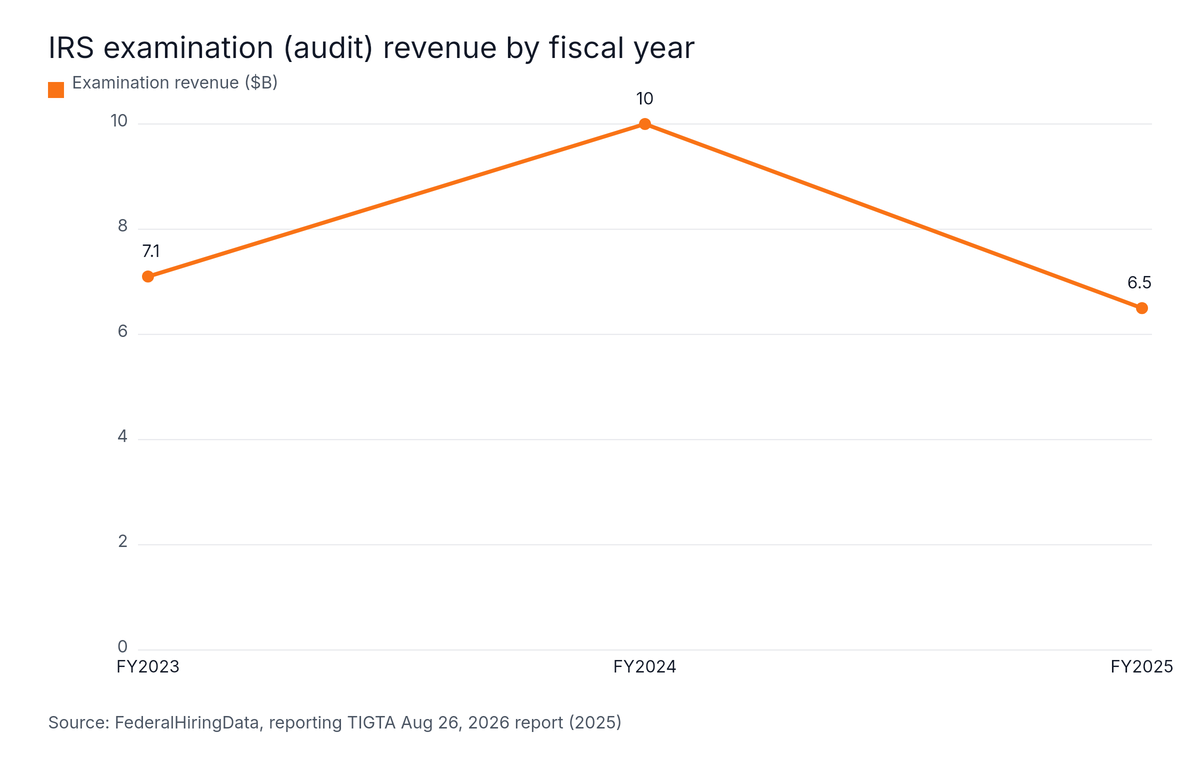
The IRS runs the largest public field audit programme, and its recent numbers show that frequency moves with capacity. As of the Treasury Inspector General for Tax Administration (TIGTA) report released in late August 2026, IRS audit revenue fell from $10 billion in FY2024 to $6.5 billion in FY2025, a 35% decline (The Fiscal Times, 2026).
Line chart: IRS examination (audit) revenue by fiscal year. Highest: FY2024 at 10.
TIGTA warns: "While the workforce reductions influenced metrics in FY 2025, the downstream effects of these reductions are likely to become more apparent over time." (The Fiscal Times, quoting TIGTA, 2026) The lesson for any audit team: the number of field audits you perform is partly a capacity decision. When travel and write-up eat the schedule, coverage falls.
What sets the interval in a dealer network
Prior scores. Low scorers get visited sooner.
Open findings. Unclosed non-compliances pull the next visit forward.
Regulation or contract. Some standards fix a minimum cadence.
Trigger events. A complaint, an incident or a revised standard can prompt an unscheduled visit.
Auditor capacity. Travel hours and write-up time cap how many sites one person can cover.
A simple risk-based cadence model
Site tier
Typical profile
Field audit pattern
In between
High risk
Low scores, open findings, recent incidents
Most frequent field visits
Desk checks on open items
Standard
Stable scores, few open findings
Regular scheduled field visit
Self-assessment
Low risk
Consistently high scores, no open findings
Least frequent field visit
Desk review and self-assessment
Set the actual intervals from your own standard and OEM agreement. This table only shows the shape. For how paperwork affects cadence, see moving from paper to paperless auditing.
When Is a Desk Audit Enough, and When Must You Go On-Site?
A desk audit is enough when records can prove the standard, such as certificates, training logs or submitted self-assessments. A field audit is needed when compliance depends on what an auditor can see, measure or test on-site. Harvard Business School researchers found remote audits report fewer violations, especially on observation-based clauses (HBS, 2025), so those items belong on the field list.
A decision rule you can apply this week
Ask three questions for each checklist item:
Can a record prove it? If yes, it is a desk candidate.
Could the site hide the gap in what it sends? If yes, verify on-site at least some of the time.
Does it depend on observation? Layout, safety practice, housekeeping and customer handling do. Keep these on the field list.
Desk first, then escalate
The efficient pattern is a sequence, not a choice. Run the desk review or self-assessment first. Escalate to a field visit when it shows discrepancies, when findings stay open, or when a score drops. Management then compares self-assessment results with independent audits to see where sites rate themselves too kindly.
What Does a Field Audit Look Like in a Dealer Network?
In a dealer network, a field audit is a scheduled visit in which an auditor checks a dealership against Dealer Operating Standards (DOS), captures dated photo evidence, scores each item and logs every failed item as a corrective action. One vendor guide puts scheduled OEM and dealer facility audits at typically every one to three years (Auto Lift Services, 2026).
Dealer Operating Standards (DOS) are the OEM's written requirements for how a dealership must operate. A non-compliance is any item that fails its standard. A corrective action is the fix assigned for it, owned by a Person-In-Charge (PIC), the named person responsible for closing it.
The steps of a field audit
Plan. Pick the site, the checklist version and the date from the audit cycle.
Visit. Walk the site and answer each checklist item from direct observation.
Capture evidence. Take live, time-stamped photos tied to the right question.
Score. Apply the weighted scoring identically for every auditor and every site.
Report. Issue the dealer visit report, ideally before leaving, with sign-off from both sides.
Close the loop. Assign each non-compliance a PIC and due date, then track it to verified closure.
The visit is rarely the costly part. Under manual processes, auditors compile photos and build PowerPoint decks for hours, then chase actions by email.
Our data: AutoSmart's customer data shows each audit generates 8 to 20 findings, and under manual follow-up each finding can need 4 to 5 follow-ups, including escalations, before closure. For some dealerships, teams spend 3 to 4 hours after each audit consolidating Excel calculations, sign-off sheets, PowerPoint reports and photo evidence. AutoSmart reports audit cycle compression from 10 days to 3 days as its outcome.
Our estimate: AutoSmart estimates that at an average of $500 per physical visit, every 100 visits is about $50,000 in direct travel costs. Moving suitable checks to self-assessment could cut physical visits by 30 to 40%, saving roughly $15,000 to $20,000 per 100 visits.
If your audit team recognises that workload, you can also read how a field audit software workflow handles evidence capture, scoring and dealer visit reports.
Limitations: Who This Guide Is Not For
A field audit is not a substitute for legal or tax advice, and the figures in this guide are not a binding inspection schedule. The dealer cadence range, typically every one to three years, comes from one vendor guide (Auto Lift Services, 2026), and the tax figures come from news reports on IRS data, not from a regulator for dealer networks. Treat them as ranges.
Know the limits before you quote any number from this page:
The dealer cadence range is vendor guidance. It has no stated methodology, so it is a practitioner view, not a benchmark.
The Harvard Business School finding is general. It compares remote and in-person audits across settings, not dealership audits specifically.
IRS data describes tax exams. It shows how capacity shapes frequency, not what your interval should be.
Self-assessment needs checks. Management needs confidence that self-assessments are honest, which means comparing them with independent audits.
Single-site teams may not need a platform. A business with one site and few standards can often run field audits without dedicated software.
Frequently Asked Questions
What does field audit mean?
Field audit means an inspection carried out on-site at the place being assessed, rather than from documents alone. An auditor visits a dealership, workshop, forecourt or taxpayer's premises, observes how work is actually done, collects evidence and compares it with a defined standard or rule. The exact meaning varies by field, such as tax, dealer standards or safety.
What is the difference between a desk audit and a field audit?
A desk audit reviews documents and submitted data remotely, while a field audit happens on-site and relies on direct observation. Desk audits suit checks that records can prove, such as certificates and training logs. Field audits suit standards that must be seen, such as bay layout, tool control and safety practice.
How often are field audits performed?
Field audits are performed on intervals set by risk, regulation and context, so no single frequency applies. One vendor guide puts scheduled OEM and dealer facility audits at typically every one to three years, with more frequent visits for dealers with open findings (Auto Lift Services, 2026). Treat that as an attributed range, not a benchmark.
Can a desk audit replace a field audit?
A desk audit can replace a field audit only for standards that records can prove, such as certificates, training logs or submitted self-assessments. It cannot replace on-site checks where compliance depends on direct observation. A common pattern is desk review first, then escalation to a field visit when discrepancies or open findings appear.
What triggers a field audit?
A field audit is triggered by a scheduled audit cycle or by risk signals such as open findings, low previous scores, discrepancies found in a desk review, complaints or a revised standard. Sites with unresolved non-compliances are typically visited more often than sites with clean records.
Conclusion
A field audit puts an auditor on-site to check real practice against a standard, and that presence is what a desk review can't replace. The takeaways:
A field audit is an on-site inspection with evidence and a written standard behind it.
Keep observation-based items on the field list and record-based items on the desk list.
Frequency depends on risk, regulation and context; one vendor guide cites every one to three years for OEM and dealer audits.
Use desk review and self-assessment first, then escalate on discrepancies.
A visit only counts when each non-compliance becomes an owned, dated corrective action.
Next step: sort your checklist items into record-based and observation-based, then see how the visit, evidence and follow-up can run in one workflow. Schedule a Free Demo to see it on your own audit programme.
Founder | CEO
Naseef Umar is an automotive industry expert and the Founder & CEO of AutoSmart, with over a decade of experience working across automotive operations, dealer standards, network performance, audits, and digital transformation.
Company
KERALA Full Address - Pulikillam W Rd, Kakkanad West, Chembumukku, Edappally, Kochi, Kerala 682030; DUBAI Full Address - Dubai Silicon Oasis, UAE

 Naseef UmarNov 3, 2026