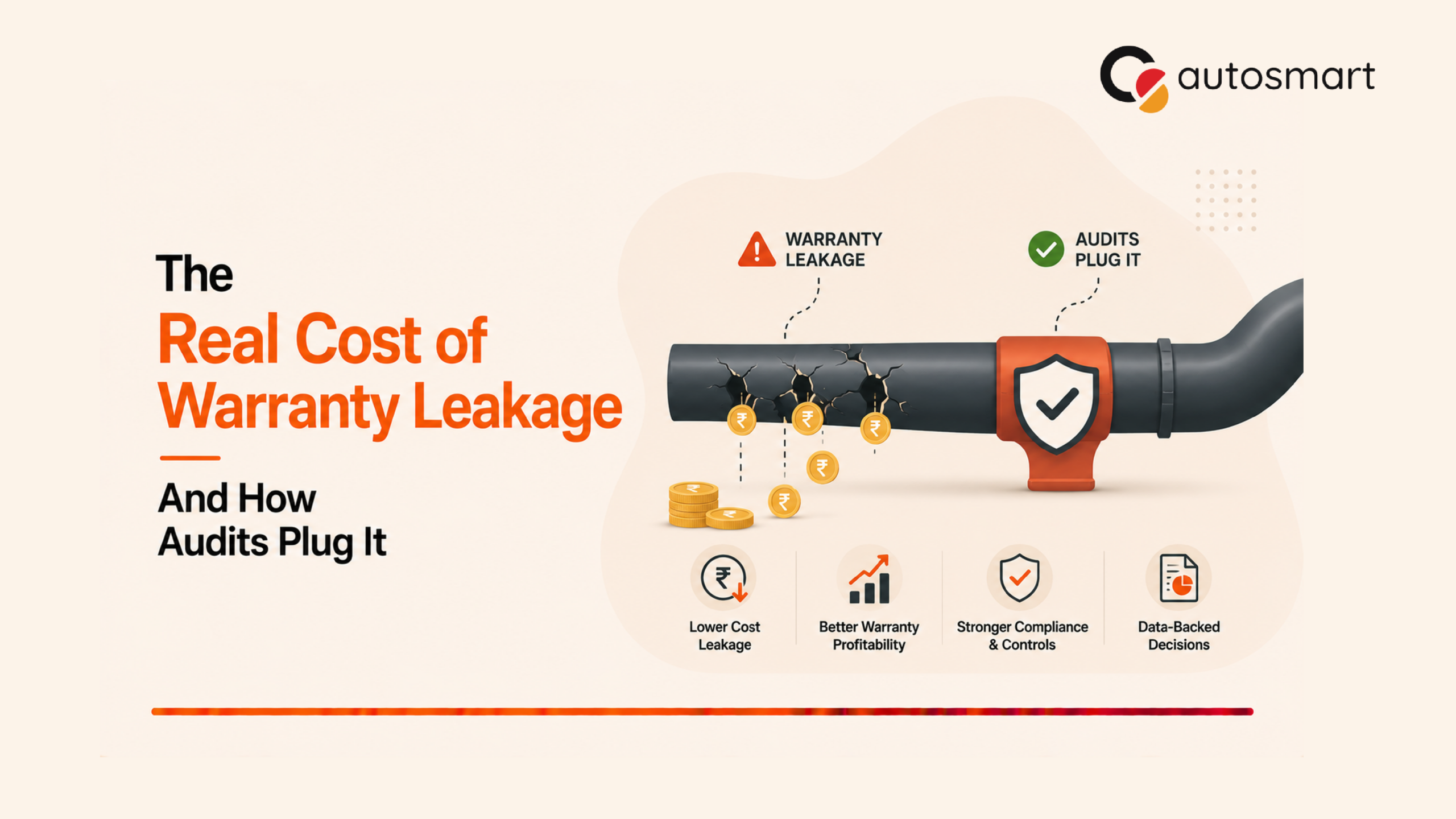
Warranty leakage doesn’t show up as a line item anywhere. It’s not a number a finance team can point to directly, which is exactly why it’s easy to underestimate. It’s the gap between what an OEM should be paying in warranty claims and what it actually pays — inflated labor time, parts that didn’t need replacing, repeat repairs billed as new issues, claims approved slightly outside policy because nobody caught the deviation. None of it looks dramatic individually. All of it adds up.
Why Leakage Is Hard to See
Most warranty budgets are built and tracked against total claims paid, not against claims that should have been paid. That distinction matters more than it sounds like it should. A warranty team can hit every reporting deadline, close every claim on time, and still be managing a budget that’s quietly larger than it needs to be because the process measures throughput, not accuracy.
Leakage compounds this by being distributed. It’s rarely one dealership responsible for the bulk of it. It’s small, consistent overages spread across a network a few extra minutes of labor here, a slightly generous parts allowance there that individually look like normal variance and collectively look like nothing at all, until someone adds them up across a year.
Where Leakage Actually Comes From
Labor time inflation. Repairs billed slightly above standard operation time, consistently enough that it’s not noise but isn’t obvious enough to flag on any single job card.
Unnecessary parts replacement. Parts swapped and billed when a repair, diagnostic step, or adjustment would have resolved the issue — sometimes convenience on the dealership’s part, sometimes genuine misdiagnosis.
Repeat repairs billed as new. A vehicle returning for the same fault, logged under a different complaint each time to avoid the scrutiny a comeback would draw.
Claims approved outside policy, at volume. Individual exceptions that make sense in isolation but, reviewed in aggregate, represent a policy the OEM never actually intended to run.
Claims that should have been rejected but weren’t caught in time. Not fraud, just review capacity falling short of claim volume, letting things through that a slower, fuller review would have stopped.
Why This Is a Structural Problem, Not a People Problem
It’s tempting to frame leakage as a dealer behavior issue, and sometimes it is. But most of it isn’t intentional it’s what happens when review capacity doesn’t scale with claim volume. A warranty team sampling 10-15% of claims isn’t failing at their job; they’re operating within the limits of a manual process applied to a volume it was never built to fully cover. Leakage, in that context, is less a behavior problem and more a coverage gap with a cost attached.
How Audits Actually Plug the Gap
Warranty audits close leakage not by catching every individual instance after the fact, but by changing what gets reviewed before a claim is paid:
- Job card cross-referencing before claim approval : catching labor time and parts discrepancies at the point of submission, not months later.
- Recurrence tracking : surfacing repeat repairs and drift patterns that a single-claim review would never see.
- Full-coverage first-pass evaluation : moving past sampling so leakage isn’t only caught in whatever slice happened to get reviewed.
- Severity-based escalation : directing manual attention toward the claims most likely to represent real leakage, rather than spreading review effort evenly.
- Network-wide pattern visibility : checking whether a leakage pattern at one dealership shows up elsewhere, instead of treating each finding as isolated.
What Closing the Gap Actually Looks Like
The value of a strong audit process isn’t a single large recovery it’s a lower baseline going forward. Once labor time, parts usage, and repeat repairs are being checked consistently, the small overages that used to slip through stop accumulating. The savings show up less as a dramatic clawback and more as a warranty budget that simply grows more slowly than it would have otherwise, year over year.