Quality management systems generate a lot of documentation, but few documents matter as much as the non conformance report. It’s the record that turns a spotted problem into a tracked, resolved one, rather than an observation mentioned once and forgotten. For dealer networks and OEM quality teams, understanding non-conformance reporting is fundamental to keeping a QMS functioning as intended.
This piece answers the questions that come up most often around a non conformance report, ISO 9001 requirements, and how AutoSmart supports quality teams tracking these across a dealer network.
What a Non-Conformance Actually Is
A non-conformance is a failure to meet a specified requirement, whether from a customer specification, an internal procedure, a regulatory standard, or the ISO 9001 system itself. Understanding what is a non conformance at this level matters because ISO 9000 defines it precisely as the non-fulfilment of a requirement, and this is exactly what a non conformance report exists to document.
Non-conformances fall into two categories. A major one represents a significant breakdown affecting the QMS’s ability to function or a product’s safety, demanding immediate corrective action. A minor one is narrower, a single missed step or documentation gap, but still needs addressing before it compounds.
ISO 9001 Non-Conformance Examples in Practice
Seeing ISO 9001 non conformance examples side by side makes the major/minor distinction easier to apply. A missing quality control step that allows an unsafe product to ship is a clear major finding. A technician skipping one documented step on a single job, with no measurable impact, is typically minor.
Other common examples include work completed against an outdated drawing, a service delivered late without justification, and a failure to maintain accurate process records. These are the kind of findings that show up regularly in internal audits and certification reviews, and each one is a candidate for a formal non conformance report.
When a Non-Conformance Report Gets Raised
A non conformance report is typically raised the moment a deviation is identified, during an internal audit, a customer complaint, a management review, or a staff member noticing something isn’t right. The report documents what happened, where, when, and under what conditions, creating the evidence trail for the next step: figuring out why it happened and stopping it recurring.
This is a distinct document from a general audit finding. A finding can note an observation without triggering formal corrective action. A non conformance report is specifically tied to a documented QMS requirement and initiates a structured investigation.
What a Quality Assurance Sample Process Looks Like
A typical quality assurance sample process follows a consistent sequence. It starts with monitoring, routine inspections, checklist-based audits, or statistical sampling of output, catching deviations early rather than after a customer complaint. When found, a deviation gets documented, evaluated for severity, and assigned for investigation.
From there, the process moves into root cause analysis. Techniques like the Five Whys or a fishbone diagram identify what actually caused the issue, rather than just the symptom. Only once the root cause is understood does a genuine corrective action for non-conformance get designed, implemented, and verified before the case is closed.
Corrective Action for Non-Conformance: Getting It Right
A correction and a corrective action for non-conformance aren’t the same thing. A correction is the immediate fix, replacing a defective part, redoing a job. Corrective action goes further: it addresses the root cause so the non-conformance doesn’t recur.
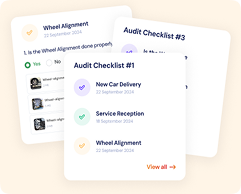
AutoSmart’s regulatory compliance software is built around this distinction. When non-compliance is logged during an audit, the responsible person is notified automatically and can respond with a corrective action, notes, and photo evidence, all tracked in one system.
Tracking Non-Conformances With Quality Audit Software
Manual tracking through spreadsheets works for a handful of findings, but breaks down quickly across a network generating non-conformances from multiple sites. Quality audit software centralises every finding, corrective action, and closure date in one place, with visibility across locations rather than buried in individual reports.
AutoSmart’s quality audit software tracks non-conformances from the moment they’re logged through to verified closure, with Month-on-Month and Quarter-over-Quarter comparisons surfacing recurring issues a single audit cycle wouldn’t reveal.
Who Closes Out a Non-Conformance Report
Responsibility for closing a non conformance report typically sits with the person or department where the finding originated, though final sign-off often requires a quality manager to verify the corrective action was actually effective, not just completed on paper. AutoSmart’s platform handles this through Persons In Charge (PICs) mapped at the question level, notified automatically and responding directly within the system.
This prevents a common failure mode: a corrective action marked “complete” without anyone confirming it solved the problem. Verification of effectiveness, not just task completion, is what closes a report properly.
Keeping the QMS Honest
A quality management system is only as reliable as the non-conformances it catches and genuinely resolves. A report that’s raised, investigated, and closed with a verified corrective action strengthens the system. One that’s logged and forgotten does the opposite, allowing the same issue to resurface across different sites and different audit cycles.
AutoSmart’s audit platform brings non-conformance tracking, corrective action management, and trend reporting into a single system built for dealer networks and OEM quality teams. Book a demo to see how AutoSmart keeps non-conformances visible from the moment they’re raised to the moment they’re closed.

Siddharth works in the Founders’ Office at AutoSmart, where he covers strategy, research, and revenue operations. He writes about warranty audits, compliance frameworks, and what the data across audit programmes actually shows.