

Dealer audit applications are often evaluated as a compliance cost rather than a business investment. For automotive dealership groups, this mindset usually changes after the first avoided penalty, failed OEM audit, or operational issue that would have gone unnoticed without structured oversight.
Modern dealerships operate under constant scrutiny. Regulatory bodies, manufacturers, insurers, and internal governance teams all expect documented proof that standards are followed. Manual audits and disconnected spreadsheets struggle to keep up with these expectations, especially across multi-branch operations.
A dealer audit application such as AutoSmart Audit provides measurable financial returns by reducing compliance exposure, improving operational control, and supporting consistent performance across locations.
Reducing Financial Exposure from Compliance Failures
Compliance failures remain one of the most expensive risks for automotive retailers. Regulatory fines, licence suspensions, OEM penalties, and legal disputes can quickly outweigh the cost of an audit platform.
Environmental violations, safety gaps, data protection issues, or failure to meet manufacturer standards often stem from process breakdowns. Missed inspections, incomplete documentation, or unresolved non-conformities create gaps that attract penalties.
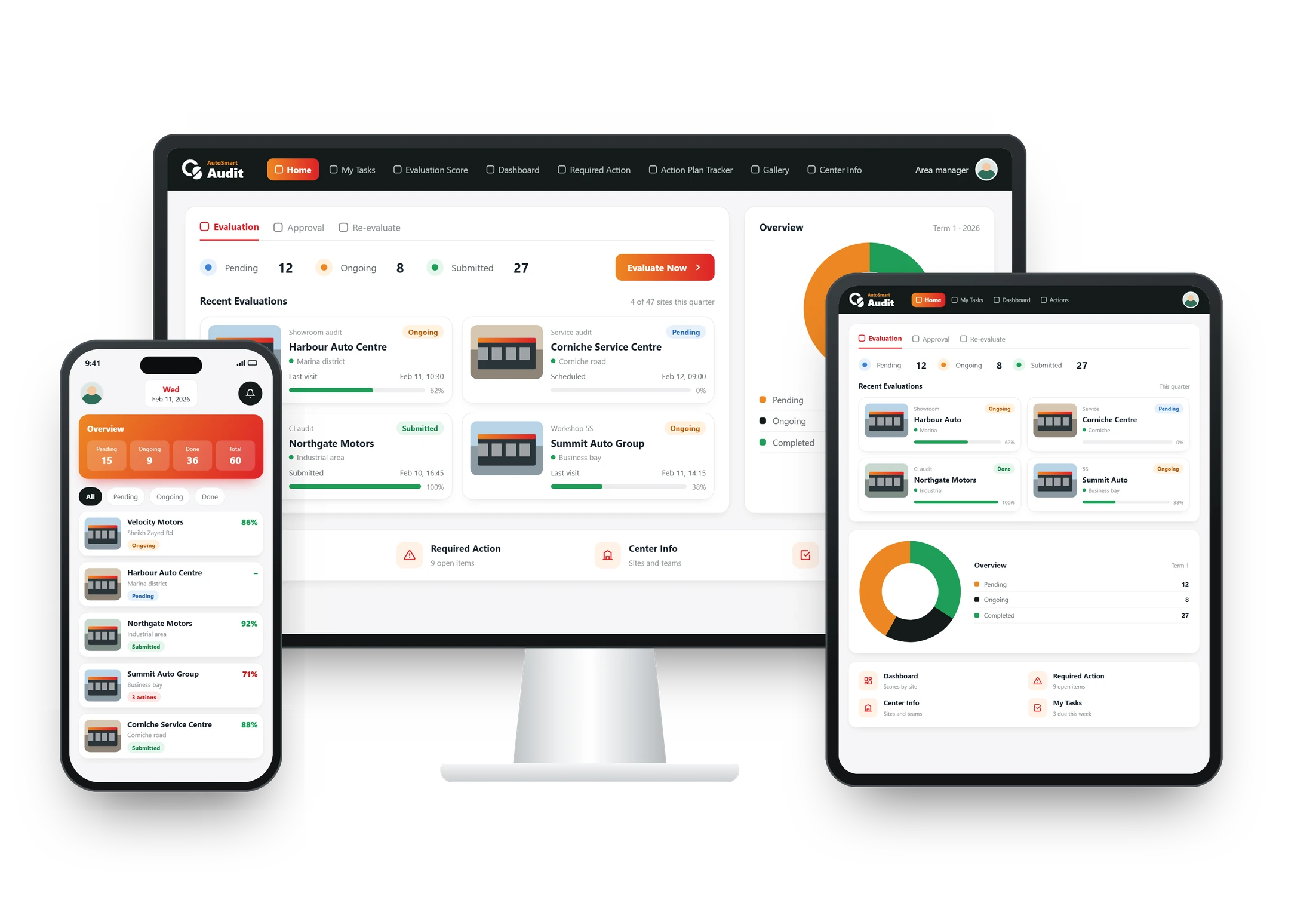
A dealer audit application reduces this exposure by introducing consistency and traceability. AutoSmart Audit allows dealerships to conduct scheduled audits using approved checklists, capture evidence on-site, and assign corrective actions with clear deadlines. Each action is logged, tracked, and visible to management.
This structure helps dealerships demonstrate due diligence. When regulators or OEMs review operations, documented audits and closed actions show that controls are active rather than theoretical. Avoiding even one serious compliance incident can justify the investment in audit software.
Time Savings That Convert into Cost Savings
Traditional audit processes demand a large time commitment. Auditors travel between sites, complete paper forms, manually compile reports, and follow up through emails or calls. This approach consumes hours that could be spent on oversight or operational support.
Digital audit platforms reduce the manual effort involved in audits. Checklists are standardized, reporting is automatic, and findings are available immediately after submission. Managers no longer wait days for summaries or chase updates across multiple channels.
Dealership groups using audit applications often report major reductions in audit cycle duration. Shorter audits lower labour costs and reduce disruption at site level. Remote review capabilities also limit travel requirements, especially for internal audits across large regions.
The time saved translates directly into financial value. Audit teams can cover more locations, review higher-risk areas more frequently, and focus on problem-solving rather than paperwork.
Improving Operational Consistency Across Locations
Inconsistent processes are a hidden cost for dealership groups. Two branches under the same brand may follow different procedures, leading to variable customer experience, uneven compliance results, and inconsistent performance.
Audit applications help enforce visible and measurable standard operating procedures. When every site is assessed against the same criteria, deviations become clear.
AutoSmart Audit supports this consistency through centralized checklist management and group-level reporting. Head office teams can compare performance across branches, identify recurring issues, and address root causes rather than isolated symptoms.
Consistency reduces rework, complaints, and escalation. Over time, this stability improves customer satisfaction and operational reliability, both of which influence revenue and retention.
Data That Supports Better Decisions
Audit data has value only when it is accessible and comparable. Manual systems limit insight because information is fragmented or outdated.
A dealer audit application turns audit results into structured data. Trends emerge across time periods, locations, and departments. Management teams can see which sites repeatedly miss standards, which issues are most common, and where improvements have been sustained.
This insight supports informed decisions. Resources can be allocated where risk is highest. Training efforts can focus on recurring gaps. Investments can be justified using evidence rather than assumptions.
AutoSmart Audit provides dashboards and reports that support this level of oversight without requiring separate data tools. Decision-makers gain clarity on operational health without relying on feedback.
Supporting OEM and Principal Requirements
Manufacturers place growing emphasis on audit compliance across their dealer networks. Brand standards, facility requirements, customer handling processes, and safety protocols are routinely reviewed.
Failure to meet these standards can affect incentive eligibility, franchise standing, or future expansion approvals. Preparing for manufacturer audits using manual methods increases stress and error risk.
Dealer audit applications support ongoing readiness rather than last-minute preparation. Internal audits mirror external requirements, allowing issues to be corrected ahead of formal assessments.
AutoSmart Audit helps dealership groups maintain documented evidence of compliance across all locations. When manufacturer audits take place, required records are already available, reducing disruption and reputational risk.
Revenue Impact Through Process Control
While audit applications are often associated with compliance, their influence extends into revenue performance. Sales and service processes that follow defined standards tend to deliver better outcomes.
Audits help verify that customer handling steps are followed, documentation is complete, and service processes meet expected timelines. These factors influence satisfaction scores, repeat business, and referrals.
Consistent execution also supports pricing integrity and reduces disputes. When processes are followed correctly, fewer issues arise that lead to discounts, rework, or lost trust.
AutoSmart Audit does not replace operational management, but it supports it by highlighting gaps that affect performance. Over time, this contributes to stronger financial results.
Lower Long-Term Administrative Overhead
As dealership networks grow, administrative complexity increases. Managing audits across regions using email and spreadsheets becomes unsustainable.
Dealer audit applications reduce this burden by centralizing audit activity within a single system. User access, audit schedules, findings, and actions are managed in one place.
This reduces reliance on manual coordination and lowers the risk of missed audits or incomplete follow-up. Administrative efficiency improves without adding headcount.
Measuring ROI Over Time
Return on investment from an audit application builds through accumulated benefits rather than a single outcome. Avoided penalties, reduced audit labour, improved compliance scores, and better operational consistency all contribute to financial return.
AutoSmart Audit supports these gains by providing a structured, repeatable audit process that scales with the business. The platform does not rely on complex setup or specialized skills, which helps control adoption costs.
As audit maturity improves, dealerships spend less time reacting to issues and more time maintaining stable operations. This shift is where long-term ROI becomes clear.
Conclusion
A dealer audit application should not be viewed as a compliance expense. It is a control system that protects revenue, reduces risk, and supports consistent performance across dealership operations.
AutoSmart Audit delivers value by helping automotive retailers conduct structured audits, track corrective actions, and maintain visibility across all locations. These capabilities reduce exposure to penalties, lower operational costs, and support stronger relationships with manufacturers and regulators.
For dealership leaders focused on sustainable growth and governance, the return on investment from a dealer audit application is measured not only in savings, but in stability, accountability, and confidence in daily operations.