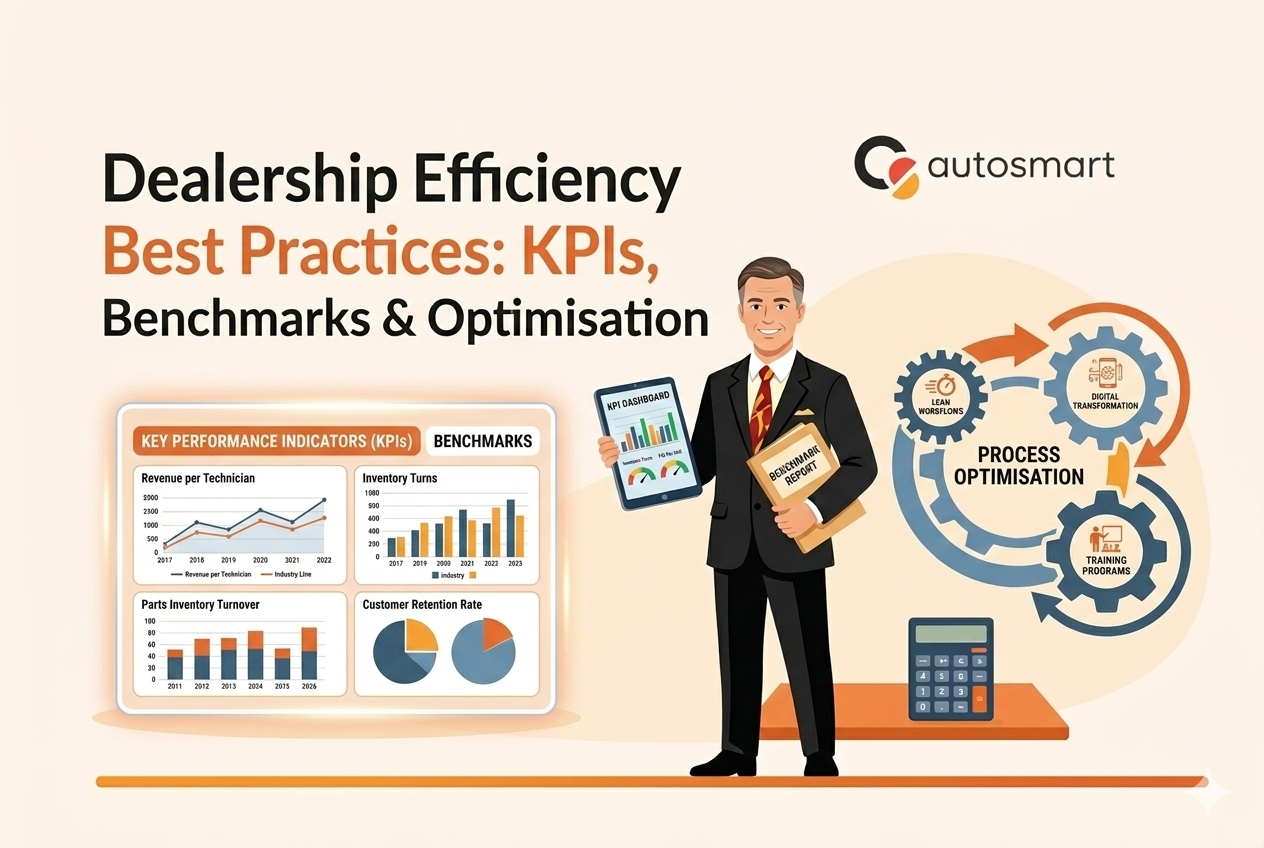
Efficiency in a dealership isn’t a single metric. Dealership efficiency best practices cover the total effectiveness of sales, service, parts, and F&I in their roles, and how smoothly work flows between these areas.
Most improvement efforts fix one department while the others continue bleeding. Dealership efficiency best practices often focus on improving key operational indicators such as service absorption above 65–75%, higher workshop utilisation, and faster parts processing for urgent vehicle-off-road (VOR) jobs.
This guide shows important KPIs and department benchmarks. It also shares practical steps. These steps help high-performing dealerships stand out from average ones.
Service Department: The 65% Absorption Threshold
Service absorption shows how much of a dealership’s fixed costs are covered by service and parts profits. It’s the key efficiency measure in fixed operations.
Dealerships consistently above around 80% absorption are generally more resilient during sales downturns because a larger portion of fixed costs is covered by service and parts operations.
Those below roughly 55–60% are structurally dependent on new car margins to stay profitable.
Dealerships that move from around 55–60% to 65% service absorption often see a meaningful improvement in fixed operations profitability.
The gap between high and low absorption dealers rarely comes down to customer volume. It comes down to Multi-Point Inspection (MPI) consistency and upsell conversion.
When every vehicle gets a completed MPI, the findings are documented and shown to the customer in a standard format. This greatly improves repair authorisation rates. If the MPI is done inconsistently or spoken instead of written, the same vehicles leave with unpaid work that should have earned revenue.
Bay utilisation compounds this. Workshops typically aim for 75–85% utilisation, so operations running near 65–70% often have unused capacity, usually caused by scheduling gaps, parts delays, or technician downtime between jobs. Tracking utilisation by hour, not just daily, reveals where idle time actually occurs and makes it addressable.
Sales Department: Response Time and Process Discipline
The biggest efficiency loss in many sales departments isn’t on the showroom floor. It’s the gap between a digital lead arriving and a qualified response being sent out. Leads that receive a fast response, often within minutes or the first hour, convert significantly better than leads contacted later. By 24 hours, the customer has typically moved on.
The fix is a process, not headcount. A defined lead response SOP, with a named owner, a time target, and CRM entry requirement, closes this gap without adding staff. The same logic applies to test drive-to-sale conversion rates and average days to close. Tracking these metrics weekly in department huddles helps managers spot process breakdowns. This is better than waiting for a monthly sales report.
Key sales efficiency benchmarks:
- Lead response time: under 1 hour recommended for digital enquiries
- Lead-to-visit conversion: track directional trend weekly
- Test drive-to-sale ratio: declining ratio signals process or follow-up issue
- Average days to close: any increase signals process or pricing problem
Parts Department: Reducing VOR parts processing delays
Vehicle Off Road parts (VOR) are the most urgent items in any parts operation, causing the most workshop delays. When a VOR part arrives at the loading bay and sits unreceipted for one to two hours or longer the vehicle occupies a bay, a technician is idle, and the customer waits. That delay costs revenue in three places simultaneously.
In a busy workshop, consistently processing urgent parts as quickly as possible after arrival can materially increase available productive hours per day, removing one of the most common sources of unplanned technician idle time.
Fast receipting of urgent parts is operationally achievable with the right process. Parts should be logged as soon as they arrive and matched with the repair order quickly. When this handoff is done digitally instead of by phone or paper, it removes delays from miscommunication and manual data entry.
Additional parts efficiency benchmarks:
- Stock order receipting: within 24 hours of arrival
- Inventory turnover: Typically between 6 and 8 times per year
- Unsold VOR review: weekly, tracked at 30/60/90-day aging buckets
- Fill rate: percentage of technician part requests fulfilled from stock on first request
For a complete monthly parts department audit checklist, see the Parts Department Audit Checklist.
Cross-Department Efficiency Killers Most Dealerships Overlook
The biggest efficiency losses happen at handoff points between departments. These losses are rarely recorded by reports from just one department.
- Sales to F&I handoff: Delays between signing and entering finance take longer, raise withdrawal risk, and lower F&I product sales. A defined handoff SOP with maximum wait time eliminates this bottleneck.
- Service advisor to workshop: Verbal or unclear job card instructions lead to rework, confusion, or delays. This cuts down productive hours but doesn’t change the clocked hours. Standardised job card documentation with mandatory fields closes this gap.
- Parts to Workshop Notification: Parts arrive, but technicians aren’t notified quickly. This means vehicles stay idle, even when work could start.
A digital notification trigger eliminates this delay.
These failures show up only when we measure efficiency from start to finish, covering the entire repair or sale cycle. They don’t appear within just one department’s KPIs.
Multi-Location Efficiency: The Standardisation Imperative
For dealer groups managing multiple sites, the challenge is consistency as much as performance. A flagship location at 85% bay utilisation provides no protection against a branch at 62% if measured as a network.
The fix needs standardised benchmarks used at all locations. It also requires clear visibility so that underperformance is easy to spot. When all sites’ KPIs appear on one dashboard, regional managers can quickly spot declines. They can compare results to targets and each other. This way, they act early instead of waiting for issues to worsen over a quarter.
Standardised digital checklists from one platform keep the MPI process, lead response SOP, and VOR receipting procedure the same across the network. When one location’s scores drop, the system flags it for targeted review immediately.
For structured SOP implementation in automobile dealerships, see the Standard Operating Procedure (SOP) Checklist for Automobile Dealers and Car Dealership Operations Management guide.
30-Day Efficiency Roadmap
Week 1
Deploy digital MPI checklist in service. Track completion rate and upsell authorisation daily.
Week 2
Run bay utilisation audit. Map idle time by hour and identify the top three causes.
Week 3
Implement VOR receipting target. Track 30-minute compliance on every delivery for two weeks.
Week 4
Activate cross-department KPI dashboard. All department heads review their scores in a shared weekly meeting.
From week five, the system spots gaps and triggers fixes. It provides management with real data to improve, not just assumptions from last month’s report.
FAQ
What are dealership efficiency best practices?
Best practices for dealership efficiency include:
- service absorption of 65–75% as a baseline target, with 80%+ for top performers
- improving workshop utilisation and technician productivity
- faster processing of urgent parts requests
- Lead response within the first hour whenever possible
These metrics should be tracked regularly and reviewed weekly across departments.
What service absorption rate should a dealership target?
A dealership should target a service absorption rate of 65–75% as a solid operational baseline, with top-performing dealerships reaching 80% and above. Dealerships below 55% often face gaps in MPI consistency or upsell conversion, not a volume problem.
What is the biggest efficiency killer in a dealership?
Cross-department handoff failures, like those between sales and F&I, service advisors and technicians, and parts and workshop, are the main cause of efficiency loss. Single-department KPIs often miss this issue.
How do dealer groups maintain efficiency across multiple locations?
Standardised digital checklists are launched from one platform. They work with KPI dashboards that compare each location against the same targets in real time.
How quickly can a dealership improve efficiency with digital audits?
Dealerships implementing consistent MPI processes and better parts coordination often begin seeing operational improvements within the first few weeks
AutoSmart’s audit platform helps dealerships and dealer groups. It lets them use digital checklists, track KPIs at different locations, and manage corrective actions in real time. Book a free demo to see how it works across your network.

Naseef Umar is the Founder & CEO of AutoSmart Technology, a SaaS platform digitizing audits for OEMs, distributors, and dealer networks. With prior experience at Toyota (Abdul Latif Jameel) and a background in IT and Industrial Management, he writes about audits, operational discipline, and building SaaS products for enterprise customers across markets.