
















The challenge
How an inspection goes wrong
Rules change, evidence is kept in different places, and the inspector picks the date. On paper, it goes like this.
Months before
A rule changes
The paper checklist isn’t updated, so dealerships keep checking against the old version.
Weeks before
Evidence goes missing
Licences, certificates and photos sit in different folders and inboxes.
Inspection day
The gap is found
The inspector finds what no one checked: an expired licence, a blocked exit, a missing sign.
After
The cost
A fine, a warning or a repeat visit, and the same scramble before the next inspection.
Compliance fails between inspections, not on the day. The fix is to check every dealership regularly against the current rules.
How it works
From rule to proof
Regulations become checklists, every gap becomes a tracked action, and you see which dealerships are ready before an inspection.
The rule
Every regulation as a checklist item
Each regulation and policy becomes a checklist item, together with the evidence it needs. When a rule changes, you update the checklist once and every new audit uses the new version.
The check
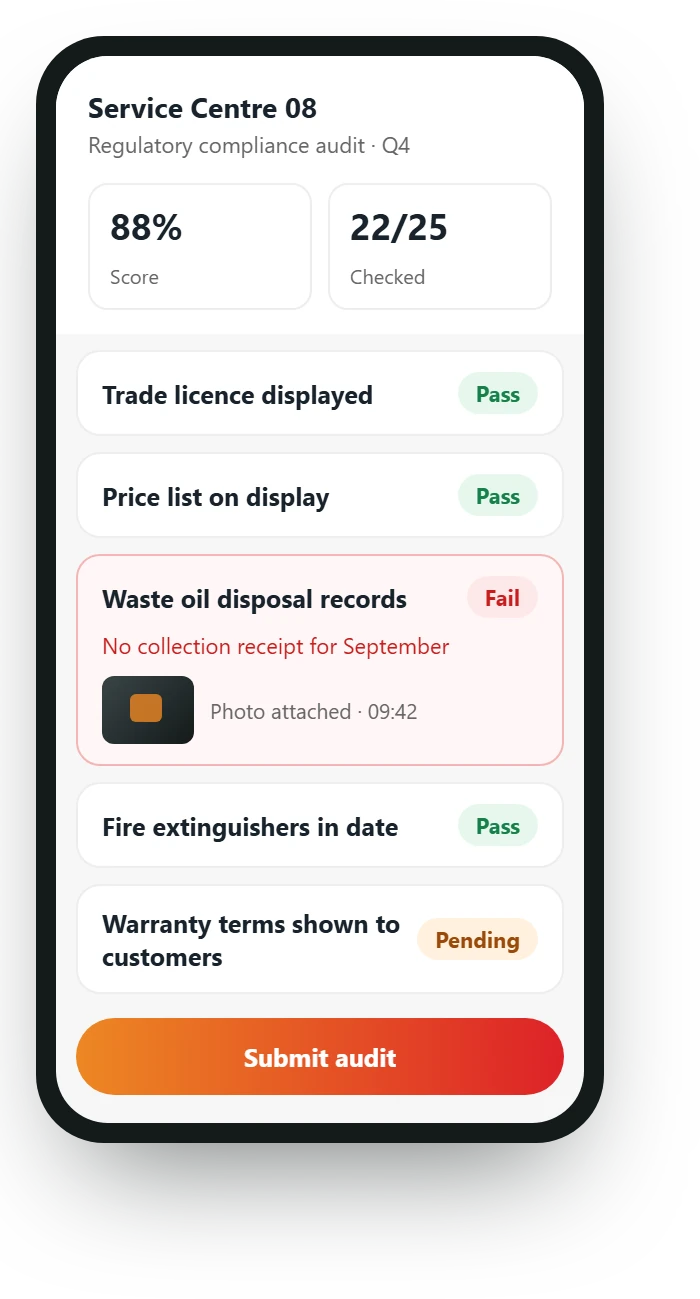
Evidence attached on the spot
Auditors go through each requirement on a phone and attach photos of certificates, labels and records as they go. It works offline.
The proof
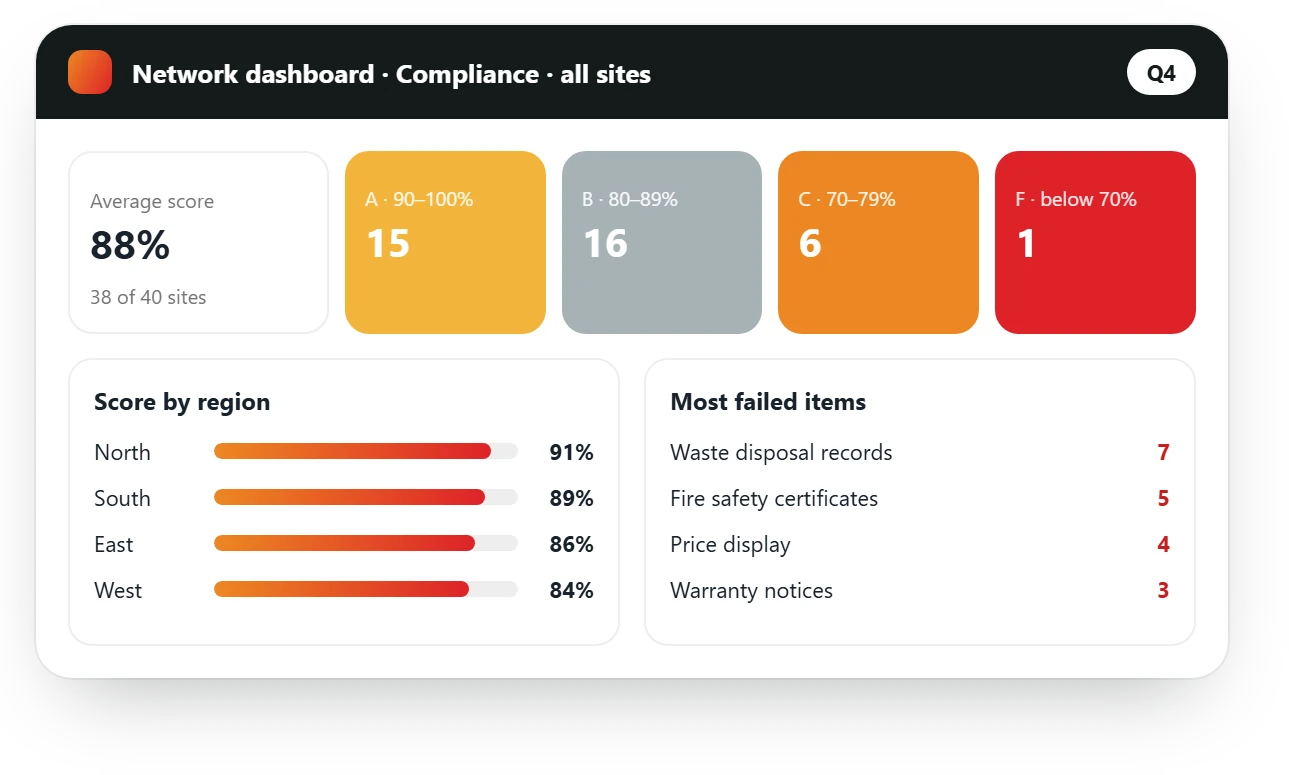
Gaps closed before the inspector comes
Every gap becomes an action with a person in charge and a due date, and is closed with photo proof. The dashboard shows which dealerships are ready for an inspection.
Results
Results from AutoSmart customers
4 stages
Every action at Behbehani Brothers moves from Pending to Approved
Before and after
Requirement by requirement
| Requirement | Before | With AutoSmart |
|---|---|---|
| Licences and permits | Expiry dates kept in a spreadsheet nobody opens | Each licence checked, with a photo, on every audit |
| Fire and civil defence | Checked just before the inspection | Exits, extinguishers and signs checked on every visit |
| Consumer protection | Price and warranty notices assumed to be in place | Each notice photographed at every dealership |
| Environmental | Waste records kept in a binder | Records and storage checked, gaps tracked to closure |
| Your own policies | A separate form from head office | In the same checklist as the regulations, so one visit covers both |
What gets audited
What dealership compliance software covers
Teams combine local regulations with their own policies in one audit.
Licences and permits
- Trade and operating licences
- Certificates on display
- Renewal dates
Consumer protection
- Price display
- Warranty terms
- Customer notices
Fire and civil defence
- Extinguishers and alarms
- Exits and signage
- Inspection certificates
Environmental
- Waste oil disposal
- Hazardous waste records
- Emissions controls
Workplace safety
- PPE and training
- Equipment inspections
- First aid
Your own policies
- Company rules
- OEM or brand requirements
- Your own scoring
Who it’s for
Built for the teams that keep dealerships compliant
Quality and compliance
Keep every regulation in one set of checklists and see which dealerships are at risk before an inspection.
Network development
Know that every dealership in the network meets the rules, without waiting for reports.
Field operations
Check dealerships against the rules on each visit and leave with the actions agreed.
FAQ
Automotive compliance software: common questions
Are there ready-made checklists for SASO, ESMA and other regulations?
Yes. The free library has 23 regulatory checklists, including SASO Auto Spare Parts Regulation, ESMA Workshop Equipment Compliance, PDPL Data Privacy Compliance, NHTSA Recall Compliance and the Saudi Compliance Checklist for Automotive Companies. Each can be edited, and our team can build templates from any other regulation or OEM requirement you work to, so local rules and your own policies sit in one audit.
Can we audit used vehicle compliance at our dealerships?
Yes. Used car requirements become checklist items with the evidence each one needs, either in the same audit as your other rules or as a separate programme. The free library includes an FTC Used Car Rule Checklist and a State Dealer Licensing Compliance Checklist to start from. Every gap becomes an action with a person in charge and a due date, closed with photo proof.
What audit trail does dealership compliance software keep for an inspector?
Every answer keeps its photos, notes, location and time, and every gap keeps its action history from Pending to Approved, with the photo that closed it. Because the full issue history is stored, you can show when a requirement failed, who fixed it and whether it came back. Audit reports and action plans export to PDF or Excel for an inspector or head office.
Can one system handle different rules in different countries?
Yes. Brands, countries and distributor groups can sit under one parent account with segregated data, so each country runs its own regulatory checklists while head office sees the whole network. Access can be limited by brand, location or audit programme, and data residency options let you choose where data is hosted to meet regional requirements.
How do we make sure compliance gaps are fixed before the deadline?
Escalation rules chase them for you. When an action passes its due date, AutoSmart notifies the person in charge and escalates it by the rules you set for deadlines, severity or issue type. At Behbehani Brothers, automated deadline alerts and weekly summaries keep managers informed of outstanding tasks, so the Quality Team no longer chases actions by hand.
Can we require photo proof even when a requirement is met?
Yes. Photos can be made mandatory on any item, including answers marked compliant, so a fire extinguisher tag or a displayed licence is shown rather than ticked. This matters most for self-audits, where dealerships check themselves between visits and head office needs to see the proof. Inspectors and head office then see the same evidence the person on the ground saw.
Can licences, certificates and inspection reports be kept as evidence?
Yes. PDFs and other files can be attached as evidence, alongside photos and notes, so a trade licence, a calibration certificate or an inspection report is stored against the requirement it proves. Each audit then checks the document is valid and on display, and any gap becomes an action with a person in charge and a due date, closed with proof of the fix.