In automotive dealerships, audits fail because accountability is unclear. The dealership audits often highlight the same recurring issues: incomplete documentation, workshop safety gaps, pricing discrepancies, or outdated compliance records. The problem isn’t awareness. It’s ownership.
A familiar management principle says it best: when everyone is responsible, no one is. This is especially true in complex dealership environments where sales, service, parts, and administration intersect. Without assigning a clear Person in Charge (PIC) for each audit finding, even the most detailed audit report risks becoming another ignored document.
For dealerships, fleet operators, and automotive groups operating under the regulatory and manufacturer standards, accountability is no longer optional. It is the difference between continuous improvement and audit fatigue.
Why Accountability Is Critical in Dealership Compliance
Audits are designed to protect your business, operationally, legally, and reputationally. In the automotive sector, compliance expectations are shaped by:
- Manufacturer standards
- Local authority requirements
- Health, safety, and environmental regulations
- Internal group governance frameworks
Yet many dealerships struggle to convert audit findings into measurable action. The reason is simple: tasks are identified, but responsibility is not.
When an audit flags 30, 50, or even 100 non-conformances, leadership teams often receive them as a single, overwhelming list. Without structured task ownership, these findings linger until the next audit, where the same issues resurface.
Why General Audit Feedback Fails to Deliver Results
The Problem with “One-Owner” Audit Reports
Sending a lengthy audit report to a Dealer General Manager may feel like escalation, but in practice it creates a bottleneck. Senior leadership rarely has the time, or operational proximity to resolve:
- Workshop housekeeping issues
- Equipment calibration gaps
- Missing price labels or POS errors
- Incomplete technician records
When accountability isn’t distributed, corrective actions stall. This leads to:
- Repeated audit findings
- Lower audit scores
- Frustrated staff
- Loss of confidence in the audit process
This cycle is commonly referred to as audit fatigue, and it is one of the biggest threats to sustainable compliance in dealerships.
The Role of the ‘Person in Charge’ (PIC) in Audit Accountability
What Does “Person in Charge” Really Mean?
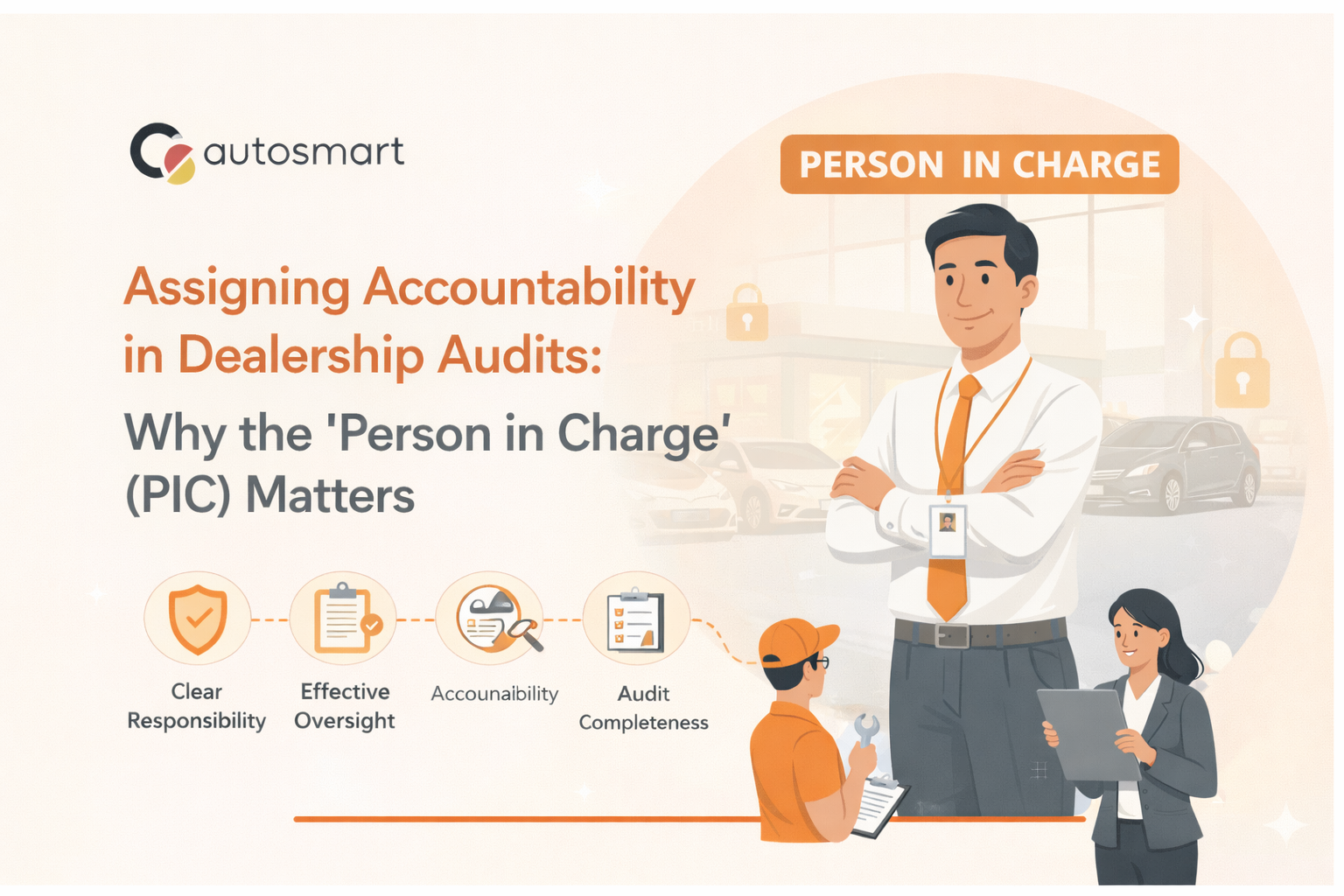
The Person in Charge (PIC) is the individual explicitly responsible for resolving a specific audit finding. Not a department. Not “management.” A named person with the authority to act.
In effective dealership audit systems, every failed item is assigned a PIC at the point of audit, ensuring nothing is left ambiguous.
Examples of Effective PIC Assignment
- Showroom non-compliance? Assign to the Sales Manager
- Workshop safety or lift issue? Assign to the Workshop Controller
- Parts inventory discrepancy? Assign to Parts Manager
- Documentation or HR gap? Assign to Administration or HR
This level of clarity removes excuses and accelerates resolution.
How Assigning Audit Tasks to PICs Drives Real Change
From “Company Problem” to Personal Responsibility
When audit findings are assigned to individuals, behaviour changes. Staff no longer see non-conformances as abstract compliance issues, they see them as their task, their outcome, and their responsibility.
This shift delivers measurable benefits:
- Faster corrective action closure
- Higher staff engagement
- Clear accountability trails
- Improved audit scores over time
In dealerships where teams are often diverse and operationally stretched, this clarity is essential for consistency.
Building a Culture of Ownership in the Workshop and Showroom
Accountability as a Performance Enabler
Contrary to common fears, assigning responsibility does not demotivate staff, it empowers them. When technicians, managers, and supervisors understand what they own, they can take pride in maintaining standards within their domain.
In high-performing dealerships, accountability becomes part of daily operations, not an annual audit event.
A structured PIC approach:
- Encourages proactive issue resolution
- Reduces last-minute audit preparation
- Strengthens internal controls
- Supports manufacturer and regulatory alignment
How Autosmart Audit Automates Person-in-Charge Accountability
Eliminating Manual Follow-Ups and Email Chains
Autosmart Audit’s Person in Charge (PIC) functionality is designed specifically for dealership and fleet audit environments.
Once an audit is completed:
- Each failed item is assigned to a named PIC
- The assigned individual receives an automatic notification
- The PIC can view the issue, auditor comments, and photo evidence
- Corrective actions can be uploaded directly as proof of closure
There is no need for manual emails, spreadsheets, or follow-up calls. Accountability is built into the audit workflow.
Transparent Corrective Action Ownership and Tracking
Evidence-Based Closure, Not Assumptions
One of the biggest weaknesses in traditional audits is the lack of verification. Autosmart Audit addresses this by requiring:
- Photo or document evidence for corrective actions
- Clear visibility for managers and auditors
- Time-stamped records of resolution
This creates a defensible compliance trail, critical for multi-site dealership groups, fleet operators, and organisations subject to manufacturer or authority review.
Why PIC Accountability Matters for Dealerships and Fleets
Consistent audit performance impacts:
- Manufacturer relationships
- Brand reputation
- Operational safety
- Customer trust
By assigning a Person in Charge to every audit finding, dealerships move from reactive compliance to controlled, repeatable improvement.
Accountability is no longer dependent on memory, motivation, or follow-ups, it is embedded in the system.
Conclusion
Turning Audits into Action with Autosmart Audit
Audits should not be paperwork exercises. They should drive improvement, reduce risk, and strengthen operations.
Autosmart Audit helps dealerships and fleet operators to achieve this by transforming audit findings into owned, trackable actions through clear PIC assignment.