I’ve been in enough multi-million dollar car showrooms to know that a polished marble floor can hide a proper technical disaster. On the surface, everything feels like an untouchable example of branding gone right, until a consumer requests access to their order history or to initiate a remote diagnostic with a technician. The premium experience now has a lag.
While aesthetic standards are tightly governed, operational infrastructure often receives less structured oversight, and yet it has allowed it to affect the digital, physical backbone of our dealership networks. Global rollouts get held up because someone took the wrong router to the field, or one EV charging station wasn’t built quite to the expectation, unseen bugs that drain millions of dollars from an organisation in silent opportunity cost. You refer to it as infrastructure, but for the overall quality of your dealership network, maintaining network quality standards through infrastructure audit is the difference between a smooth ride and a blown engine.
How do you fix this? How does your dealership infra audit rectify these blind spots that are now eating up just as much as you spend on marketing altogether?
The Digital Backbone: Why Infrastructure Audits are Your Dealership’s Life Support?
Before going deeper, it’s helpful to know what kind of audit we are looking at regarding dealership facility audits. Infrastructure is the silent partner in every sale. When it works, nobody notices. When it fails, it’s the only thing the customer remembers. In the automotive world, an infrastructure audit is preventive maintenance for your entire business.
While a BRI audit is an examination of the soul of the brand and its aesthetics, an infrastructure audit, essential for infrastructure compliance, is a deep dive into the skeleton: the physical standards, facilities in the dealership building, server racks supporting dealership management systems, and even physical security systems. For dealerships handling millions of transactions annually, service efficiency, stock inventory verification, vehicle arrangement, software quality, data privacy and high-speed connectivity are essential to keep the data flow and sales smooth.
This audit is mostly conducted by external auditors or OEM-appointed ones. If you’re still doing this extensive audit with manual spreadsheets or clipboard notes, you aren’t being old school; you’re putting a major liability in your dealership. It’s like trying to fix a modern electric car using only a hammer.
The Chaos of Flying Blind Without Proper Tools
When you don’t have a digital, automated system to track your network quality, the cracks start to show almost immediately.
1. The Report Graveyard Phenomenon
An auditor finds a faulty router or a non-compliant service bay during infra audits and infrastructure audits, notes it down on a spreadsheet, and then that file is emailed to a manager who never opens it. Without a live software loop, data doesn’t lead to action; it leads to a folder named Audit_Final_v2 that nobody ever looks at again.
2. Zero Real-Time Visibility
If a critical piece of hardware fails in a dealership five hundred miles away, you shouldn’t have to wait for a monthly report to find out. Manual systems leave you in a reactive state, always putting out fires that could have been prevented weeks ago.
3. Subjectivity Over Standards
Without a guided digital checklist, the OEM auditor might think a slightly frayed cable is fine, while another sees it as a fire hazard. This inconsistency makes it impossible to benchmark your network quality across different regions.
4. The Follow-up Failure
This is often the most overlooked risk. Even if a flaw is identified, manual audits rarely have a fix-it tracking system. You end up with a list of problems but no proof that they were ever resolved, leaving your infrastructure in a permanent state of almost broken.
That process is elevated from chaotic drudgery to high-precision operation by a specialised tool. It’s the difference between guessing your engine temperature and having a digital diagnostic readout in the palm of your hand. But spotting the need for an audit is only half the battle. To provide real protection to your investment, you need perfect insight into exactly which high-stakes components are in your blind spot.
Identifying Your Dealership’s Blind Spots
In a modern dealership, the infrastructure isn’t just the bricks and mortar; it’s a complex ecosystem of physical facilities, IT networks, and specialised operational technology. When these systems fall out of sync with OEM standards or regulatory requirements, they don’t just look bad; they become a massive liability.
- Eliminating Shadow IT: Bandaged hardware solutions and rogue routers that create massive security vulnerabilities and violate data privacy regulations.
- Optimising Operational Tech: Ensure workshop Wi-Fi and diagnostic tools are in peak performance to prevent service revenue from tanking due to failed software flashes, which is critical for network quality standards.
- Strict Regulatory Adherence: Treat physical security and energy mandates as contractual obligations rather than nice-to-haves to avoid heavy fines or franchise loss.
- Data-Driven Growth: Transform infrastructure audits from simple to-do lists into a strategic, data-driven weapon for maintaining global network quality.
Identifying these gaps is the first step toward a high-performing network. However, simply knowing the problems exist doesn’t solve them. The real magic happens when you stop treating these issues as to-do items and start treating them as data-backed assets.
So, how do we move from merely surviving these infrastructure gaps to mastering them across a global network? It starts with turning your audit into a weapon for growth.
How Does Autosmart Audits Turn Blind Spots into Clear Advantages?
We’ve seen the clipboard era of auditing, and that is where good results rot without any action. To fix the bottlenecks in your infrastructure, the broken Wi-Fi, and noncompliant signage, you need a system that doesn’t just document failure but drives success. Spreadsheets are great for accounting, but they’re terrible if you’re trying to inspect the spinal cord of a high-performance retail network.
This is why you need Autosmart Audits. It acts as the central nervous system that connects the OEM’s global standards directly to the dealership floor. It eliminates the human error and communication lag that usually keeps such infrastructure blind spots hidden for months.
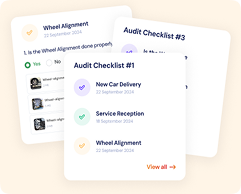
1. Customizable Digital Checklists
We take the massive, intimidating OEM infrastructure manual and distil it into a sleek, mobile-friendly checklist for infra audits and infrastructure audits. Whether it’s testing the load capacity of a service lift or verifying the security protocols of an on-site server, the auditor has a clear, no-guesswork path to follow. Our checklists are vast and accommodate several purposes.
2. The Receipt of Reality (Photo & Video Evidence)
You can’t argue with a high-resolution, timestamped photo. If a tool is outdated or a safety barrier is missing, the OEM auditor captures the proof instantly. This evidence is uploaded to the cloud in real-time, eliminating the he-said, she-said friction between the dealer and the manufacturer.
3. Automated Scoring & Live Dashboards
Instead of waiting weeks for a PDF report to be typed up, the data is live the moment the audit is submitted, tracking network quality standards. OEMs can see a map of their entire network’s quality. If one dealership or part of a dealership is consistently failing on IT security compliance, the system flags it immediately.
4. The Closed-Loop Action Plan
This is the most critical feature. Once a flaw is identified, Autosmart Audits automatically generates a task with a deadline. The dealership manager receives the notification, fixes the issue, and uploads proof of fix directly into the platform. The bottleneck is cleared, the task is closed, and the network quality is restored without a single follow-up email being sent.
By digitizing this entire audit lifecycle with our Audit Management Software, you stop treating your infrastructure like a static building and start treating it like a high-performance machine. Your dealership move from “I hope the chargers work” to “I know 90% of my network is ready for the next customer.”
Master Your Network Quality: Book Your Autosmart Audits Demo Today
There is no infrastructure as a back-office operation, but the operational skeleton for how dealerships perform. AutoSmart Audits for OEMs Guided infrastructure audits with real-time visibility, measurable compliance tracking and closed-loop issue resolution across all of your network members or dealers.
Request a demo to standardize how you monitor infrastructure, minimize operational risk, and maintain peak performance of network.
الأسئلة الشائعة
What distinguishes a BRI audit from an infrastructure audit?
Whereas a BRI audit is about the soul and look of the brand, an infrastructure audit looks at the physical, IT and operational infrastructure that keeps the dealership on its feet.
How can digital audit software combat report graveyards?
It turns stale results into live, trackable assignments complete with automated deadlines, so every identified flaw in the infrastructure actually gets repaired instead of lost in a spreadsheet.
How can an infrastructure audit aid in OEM electric vehicle (EV) compliance?
Yes, they deliver instantaneous validation of charging station integrity and uptime, so that dealers comply with rigorous manufacturer requirements for the onset of electrification.

Ishaq leads go-to-market at AutoSmart. He spends most of his week in conversations with OEM and distributor teams about how their audit programmes actually run. He writes about network standards, rollout across markets, and building the business case for digital audits.