
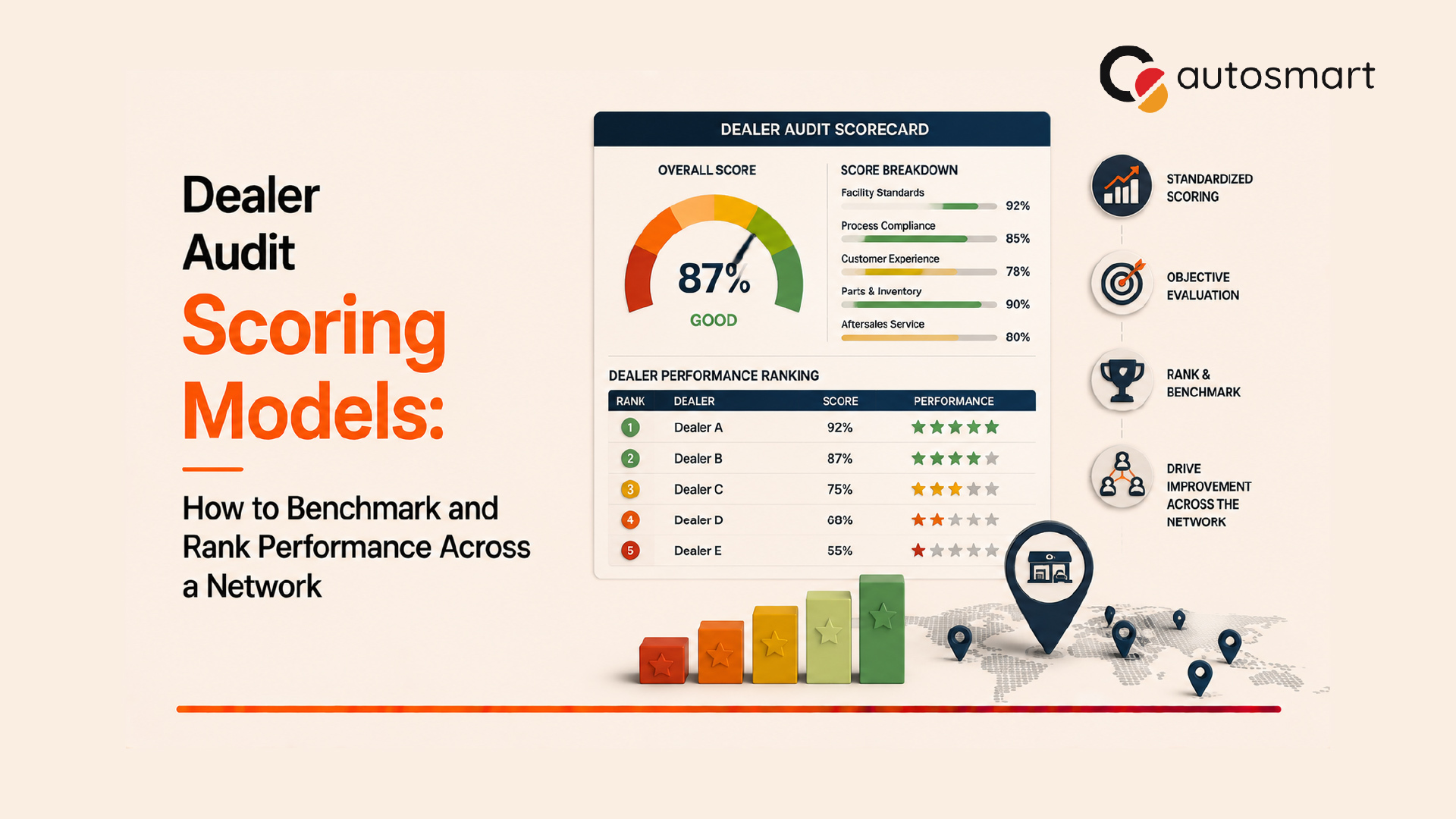
Audit failures vary in consequence, but most scoring models treat them as equal. A dealership that fails a safety item can end up scoring the same as one that missed a dozen signage points.
That is the problem a dealer audit scoring model exists to solve. In this guide, AutoSmart Audit explains how findings should be weighted, what makes a benchmark fair, and how OEM field teams can rank dealerships in a way the network accepts.
What a Dealer Audit Scoring Model Does
A scoring model converts audit findings into a number that can be compared. Without one, a distributor has a stack of reports and no clear way to identify which dealership needs attention first.
The model has to do two things. It must reflect the relative consequence of each finding, so that a critical failure is not offset by a run of easy passes. It must also apply identically at every location, since inconsistent criteria make the comparison unreliable.
Why Weighted Audit Scoring Beats a Simple Pass Rate
A simple pass rate treats every item as equal. Weighted audit scoring automotive networks use assigns each item a value reflecting its consequence.
Under a flat model, a dealership failing one safety item and passing forty minor items scores 97 per cent. Under a weighted model, that safety failure pulls the score down sharply, or caps it entirely until the item is closed.
Weighting usually works on three levels:
- Critical items: safety, legal compliance, genuine parts. A failure here should cap the overall score regardless of other performance
- Major items: process failures affecting customers or warranty validity
- Minor items: presentation, documentation tidiness, items with limited consequence
The weights themselves matter less than applying them consistently. A network that changes weighting mid-cycle cannot compare anything.
What Makes a Dealer Performance Benchmark Fair
The hardest part of any dealer ranking methodology OEM teams adopt is not the scoring. It is deciding what to compare against.
A network-wide average is the simplest benchmark and the least useful. A metropolitan flagship and a rural single-bay site face different conditions, and a ranking that punishes a dealership for its circumstances is one the network will dismiss.
To benchmark dealer performance network wide, compare within categories instead:
- Size
- Market type
- Facility class
Rank within those groups, not across the whole network. Movement matters too. A dealership improving from 61 to 74 is doing something a dealership sitting flat at 79 is not.
Looking for a fairer way to benchmark dealer performance across your network? See how AutoSmart Audit helps OEM field teams score and rank dealerships at scale.
Should Dealer Audit Scoring Differ by Dealership Size?
The scoring criteria should stay identical across the network. The benchmark is what should differ. Applying different standards to different dealerships breaks the comparison entirely. A safety item is a safety item regardless of how many bays the site has.
What can reasonably differ is what a dealership is compared against. A small rural site and a metropolitan flagship should be scored on the same criteria, but ranked within their own peer groups, and held to targets that reflect what is achievable at that location.
That distinction, same scoring and different benchmarking, is what keeps a ranking credible with the dealerships being ranked.
Turning Audit Scores Into Field Team Actions
A single score identifies position but not cause. Field teams need both. An audit KPI dashboard dealership teams can act on shows more than the number:
- Movement across cycles, so decline is visible before it becomes a problem
- Breakdown by category, showing whether a low score is a facility issue or a process issue
- Peer group position rather than network position alone
The ability to compare dealer performance across network locations is where the value sits. A single dealership scoring poorly indicates a problem at that location. Six dealerships failing the same item indicates something broader: a training gap, a supply issue, or a standard that was not communicated clearly.
When Dealer Benchmarks Need Recalibrating
Benchmarks lose their value over time. As a network improves, a score that once marked a strong performer becomes average, and a benchmark that never moves stops distinguishing anything.
Most networks review benchmarks annually, and after any material change:
- A standards update from the OEM
- A facility programme rollout
- A shift in network composition
Recalibrating mid-cycle should be avoided, since it makes the current cycle incomparable to the last.
Building a Scoring Model the Dealer Network Trusts
A scoring model only works if dealerships accept the result. If they think the score is unfair, they will argue with it instead of fixing what it found.
That acceptance comes from the design. Weight items by consequence, apply the same criteria everywhere, and compare each dealership against sites like it. A dealer audit scoring model built this way gives dealerships nothing to dispute, which is what makes the score worth acting on.
AutoSmart Audit helps OEM field teams build and run scoring like this across a network.
Book a demo of AutoSmart Audit to see how OEM teams benchmark dealer performance across their networks.

ناصيف عمر هو المؤسس والرئيس التنفيذي لشركة أوتوسمارت تكنولوجي، وهي منصة برمجية كخدمة (SaaS) تقوم برقمنة عمليات التدقيق لشركات تصنيع السيارات والموزعين وشبكات الوكلاء. ومن خلال خبرته السابقة في شركة تويوتا (عبد اللطيف جميل) وخلفيته في تقنية المعلومات والإدارة الصناعية، يكتب عن عمليات التدقيق، والانضباط التشغيلي، وبناء المنتجات البرمجية لعملاء المؤسسات عبر مختلف الأسواق.