A dealership runs on dozens of repeated processes: vehicle intake, service handovers, warranty claims, customer follow-ups. Where a written standard exists for each of these, staff perform them the same way regardless of who is on shift. Where no standard exists, quality drifts from one team member to the next, and audits routinely surface the gap.
This is where SOP operations become central to running a consistent dealership network. A documented procedure removes the guesswork from repeated tasks, giving every branch and every shift the same standard to work from.
What Is an SOP?
A Standard Operating Procedure (SOP) is a documented, step-by-step set of instructions for carrying out a specific task. In a dealership, SOPs typically cover service bay procedures, parts handling, customer intake, warranty documentation, and audit preparation.
An SOP differs from policy in one key respect: policy states what should happen, an SOP states how it should happen, down to the exact sequence of checks, sign-offs, and documentation required.
Why SOP Operations Matter for Dealerships
Dealer networks are audited regularly, whether by the manufacturer, an internal compliance team, or a third-party auditor. SOPs give auditors a fixed reference point: the documented procedure against which actual practice is measured.
Where SOP operations are managed well, dealerships typically see:
- Fewer inconsistencies between branches or shifts, since staff work from the same documented standard.
- Faster onboarding, as new staff are trained against a written procedure rather than informal handover.
- Stronger audit outcomes, since gaps between documented and actual practice are among the most common findings during OEM audit preparation.
- Reduced liability exposure, particularly around warranty claims and safety-critical service steps.
How to Write an Effective SOP for Service Centres
Writing an SOP is not a one-time exercise. It requires input from the people who actually perform the task, and it needs to be revisited as processes change.
A workable approach to writing an SOP for service centres follows this sequence:
- Define the scope. State precisely which task the SOP covers and where it begins and ends. A vague scope produces a vague procedure.
- Document the current process. Observe or interview the staff performing the task today, rather than writing from assumption.
- Break the task into sequential steps. Each step should describe one action, in the order it happens, with enough detail that a new employee could follow it unassisted.
- Assign responsibility. Note who is accountable for each step and who signs off where approval is required.
- Add reference points. Include any relevant safety checks, compliance requirements, or manufacturer standards the step must satisfy.
- Test the draft. Have a staff member follow the written SOP exactly as documented and flag anywhere the instructions are unclear or incomplete.
- Review on a fixed schedule. An SOP that is not updated becomes a liability rather than a safeguard, particularly where manufacturer standards or safety regulations change.
SOP Examples for Automotive Service
A few examples illustrate what a service-centre SOP typically covers:
- Vehicle check-in SOP – covering odometer recording, existing damage documentation, and customer sign-off before work begins.
- Warranty claim SOP – detailing the exact documentation, photographic evidence, and approval sequence required before a claim is filed.
- Pre-delivery inspection SOP – listing every mechanical and cosmetic check required before a vehicle is released to a customer.
- 5S workshop SOP – covering tool storage, bay cleanliness, and workspace organisation, an area where a documented 5S workshop checklist is often used alongside the SOP itself.
- Parts handling SOP – covering receipt, storage, and traceability of parts used in service, particularly relevant where warranty audits require part-level documentation.
SOP vs Checklist: What’s the Difference?
An SOP and a checklist are related but not interchangeable. An SOP explains the full procedure, the reasoning behind each step, who is responsible, and what standard applies. A checklist is a condensed tool derived from the SOP, used to confirm each step has been completed in the moment.
In practice, an SOP is the reference document, and a checklist is the working tool built from it. Dealerships that rely on checklists alone, without the underlying SOP, often find staff cannot explain why a step exists once the checklist itself is unavailable or a new scenario arises outside its scope.
Digitizing Standard Operating Procedures
Paper-based SOPs are difficult to track, easy to lose, and slow to update across multiple locations. Digitizing standard operating procedures addresses each of these problems directly.
A digitized SOP typically allows a dealership network to:
- Push updates to every branch simultaneously, rather than redistributing printed documents.
- Track which staff have read and acknowledged the current version.
- Link SOPs directly to audit checklists, so compliance checks reference the exact procedure in force, a step that fits naturally into a structured dealership audit process.
- Maintain a version history, which matters where a warranty dispute or audit finding requires proof of the procedure that applied at a given time.
SOP Compliance Tracking
Writing an SOP solves only part of the problem. The larger challenge for most dealer networks is confirming the SOP is actually being followed, consistently, across every branch.
SOP compliance tracking typically involves scheduled audits against the documented procedure, digital sign-off at each completed step, and reporting that flags where a branch or individual repeatedly deviates from standard. Dealer audit management software is generally built around this exact requirement, replacing manual cross-checking with real-time compliance data.
How AutoSmart Helps Dealer Networks Manage SOPs
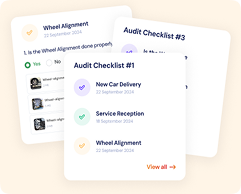
AutoSmart’s dealer audit management software is built to close the gap between a written SOP and what happens on the floor. Rather than storing SOPs in a static document, AutoSmart links each procedure to its corresponding audit checklist, tracks compliance across branches in real time, and flags deviations before they surface as a formal audit finding.
For dealer networks managing SOPs across multiple locations, SOP management software of this kind removes the manual work of chasing sign-offs, cross-checking paper records, and reconciling inconsistent versions across branches.
From Written SOP to Verified Practice
A written SOP sets the standard, but it doesn’t confirm the standard is being met. That gap, between what’s documented and what actually happens on the floor, is where most audit findings originate, and paper-based tracking makes it nearly impossible to close across multiple branches.
AutoSmart’s dealer audit management software brings SOP documentation, checklists, and compliance tracking into one system, giving dealer networks a clear, branch-by-branch view of where practice matches the procedure and where it doesn’t.

Siddharth works in the Founders’ Office at AutoSmart, where he covers strategy, research, and revenue operations. He writes about warranty audits, compliance frameworks, and what the data across audit programmes actually shows.