
Your service lane lives or dies by parts discipline. When ETAs are guessed, back-orders sit without updates, or VOR parts wait hours to be receipted, the impact shows up fast, missed promises, stalled repairs, frustrated customers, and falling CSI.
Clear, enforced parts standards for dealerships remove ambiguity. They define what “good” looks like, who owns each step, and how performance is checked. This playbook lays out a practical way to build parts department standards that actually work on the floor, not just on paper.
Why Parts Standards Matter More Than Ever
Service advisors sell time. Technicians need parts on hand to produce hours. Customers expect accurate updates, not excuses. Without dealership parts SOPs, each role fills the gaps differently:
- Advisors promise best-case ETAs
- Parts teams juggle priorities without clarity
Standards replace assumptions with rules. They protect service throughput, reduce rework, and keep customer communication honest. The result is fewer stalled ROs and a parts department that supports service instead of slowing it down.
What does a High-Performing Parts Department Look Like
Strong parts department standards focus on six operational areas. Each one removes a common failure point that hurts service speed and customer trust.
1. Stock and ETA Visibility
Service advisors should never rely on guesswork.
- Distributor and PDC stock must be visible on demand
- ETAs are reviewed and updated daily
- Any irregularity, missing ETA or extended lead time, is flagged the same day
- Customers are notified immediately when an ETA changes
A defined parts ETA process sets expectations early and prevents awkward conversations days later.
2. Back-Order Management That Keeps Service Moving
Back-orders are unavoidable. Silence is not.
- Parts shares a daily Back-Order Sheet with advisors, production, and the service manager
- Each back-order has a clear status and next step
- Customers receive proactive updates on a set day
This backorder management approach keeps advisors aligned and shows customers their repair is not forgotten.
3. Clear Rules for VOR vs. Stock Orders
VOR parts exist for one reason: to reduce downtime. Standards protect that.
- VOR arrivals are receipted within 30 minutes of truck arrival
- Stock orders are receipted within 24 hours
- Random spot checks (five to seven parts) confirm receiving accuracy
If VORs wait for a specific person to arrive, the standard is broken. Cross-training is not optional.
4. Inventory Location Discipline
A part without a reliable location is already lost.
- Every inventory location is reconciled monthly
- The location sequence report is reviewed each month
- Missing or incorrect locations are corrected immediately
This discipline supports pick accuracy and prevents wasted technician time searching for parts that should be ready to issue.
5. Control of Unsold VORs and Slow Movers
Unsold VORs quietly drain cash and space.
- A weekly review confirms system location and status
- Each part has a clear decision: return, reassign, or hold with a documented reason
- Aging brackets (30/60/90 days) drive action, not discussion
This keeps urgent orders from becoming long-term inventory problems.
6. Storage Layout and Ergonomics
Layout standards save time and reduce strain.
- Similar parts are grouped logically
- Long or thin parts are stored vertically
- Heavy parts are placed at waist level or lower
Good storage design speeds picks and protects your team from avoidable injuries.
How to Build Your Parts Standards Step by Step
Strong standards are built deliberately. Follow this sequence to create dealership parts SOPs your team can follow.
Step 1: Document the Entire Parts Flow
Map the process from start to finish:
Order → Receipt → Put-away → Pick → Issue → Return or Claim
This exposes handoffs, delays, and unclear ownership. If a step exists in real life, it belongs in the process.
Step 2: Define Clear SLAs
Standards need measurable targets.
- VOR receipt: within 30 minutes
- Stock receipt: within 24 hours
- ETA updates: daily
- Back-order customer updates: three times per week
These SLAs turn expectations into rules.
Step 3: Assign Ownership with a PIC
Every SLA needs a Person-in-Charge.
- Who updates ETAs?
- Who sends customer messages?
- Who signs off on reconciliations?
Clear roles protect consistency.
Step 4: Make the Work Visible
Use a simple visual system:
- Pending
- In Progress
- Done
A Kanban board or dashboard keeps tasks from hiding in inboxes or conversations. Visibility drives accountability.
Step 5: Audit Against the Standards Monthly
Standards only work when inspected.
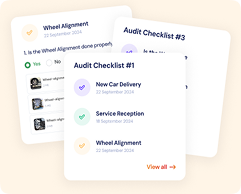
- Use the rules as your audit checklist
- Score compliance
- Document gaps
- Assign actions with due dates to the PIC
This is where AutoSmart Audit supports consistency by turning standards into repeatable checks.
Step 6: Close the Loop Weekly
Review misses as a team.
- Was the standard unclear?
- Was training missing?
- Was the workload unrealistic?
Adjust the process or coaching as needed.
KPIs That Prove Your Standards Are Working
Track a short list of indicators tied directly to your rules:
- VOR receipt SLA hit rate (≤30 minutes)
- Stock receipt SLA hit rate (≤24 hours)
- Monthly location reconciliation completion (target: 100%)
- Back-order customer update compliance
- Pick accuracy or cycle count variance
- Unsold VOR aging over 30/60/90 days
Common Pitfalls to Avoid
Even well-written standards fail when these traps appear:
- “We’ll update ETAs later.” Later rarely comes, and CSI suffers.
- Train backups to receipt VOR’s.
- No single PIC. Ownership must be obvious.
- Storage chaos. Poor layout costs minutes on every pick.
Each issue is preventable with clear rules and routine inspection.
Conclusion: Standards Protect Service Speed and CSI
Parts standards for dealerships are not complicated. Write the rule. Assign a PIC. Check it weekly. That discipline alone removes delays, protects customer trust, and keeps the service lane moving.
When standards are documented and audited consistently, the parts department becomes a reliable partner to service rather than a bottleneck. AutoSmart Audit helps dealerships turn these standards into measurable habits, so accountability stays in place long after the rules are written.

Naseef Umar is the Founder & CEO of AutoSmart Technology, a SaaS platform digitizing audits for OEMs, distributors, and dealer networks. With prior experience at Toyota (Abdul Latif Jameel) and a background in IT and Industrial Management, he writes about audits, operational discipline, and building SaaS products for enterprise customers across markets.