Customer expectations in the automotive industry have evolved significantly. Today, buyers and service customers expect not just quality vehicles, but seamless, transparent, and professional dealership experiences. This is where the Customer Satisfaction Index (CSI) plays a critical role. For dealerships aiming to improve CSI automotive performance, the challenge lies in execution.
A high CSI score is not achieved through occasional efforts or customer follow-ups alone. It is because of consistent, disciplined operations across every touchpoint. This is exactly where a structured automotive audit system becomes essential.
CSI in Automotive Depends on Daily Execution
The customer satisfaction index automotive metric reflects how customers perceive their experience during service interactions. Unlike loyalty-focused metrics, CSI evaluates real, measurable service quality, right from vehicle reception to final delivery.
However, CSI is not influenced by a single department. It depends on how well multiple teams perform every day, including:
- Service advisors
- Workshop technicians
- Quality control teams
- Customer support staff
Without a system to monitor and standardize these operations, maintaining consistent performance becomes difficult. This is why dealerships often struggle with fluctuating CSI scores despite having capable teams.
Why Dealership CSI Scores Fluctuate
Even within the same automotive brand, CSI scores can vary significantly across dealerships. This inconsistency is rarely due to branding or marketing, it is almost always operational.
Common factors affecting dealership CSI include:
- Inconsistent adherence to service processes
- Poor communication during vehicle delivery
- Lack of cleanliness and facility standards
- Ineffective complaint handling
- Missing final quality checks
- Incomplete or inaccurate documentation
These issues highlight a key truth: CSI is an operational outcome. And operational gaps require structured monitoring and accountability, not assumptions.
The Role of a Structured Automotive Audit System
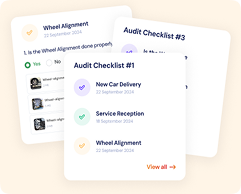
A well-designed dealership audit software introduces consistency into dealership operations. It enables organizations to define clear service standards and ensure that every branch follows them uniformly.
With a structured system in place, dealerships can:
Standardize Service Processes
Audit systems help define and enforce step-by-step workflows for:
- Customer reception
- Job card creation
- Workshop repair procedures
- Quality inspection protocols
- Vehicle delivery processes
Evaluate Every Customer Touchpoint
Each interaction that influences CSI can be measured, including:
- Advisor communication quality
- Waiting area experience
- Repair accuracy and completion
- Final vehicle handover clarity
When these touchpoints are audited consistently, customer satisfaction becomes measurable and controllable.
Real-Time Visibility Drives Faster Improvements
Traditional audit methods often rely on delayed reports and manual tracking. This slows down decision-making and allows issues to persist unnoticed.
A digital automotive audit system changes this completely by providing:
- Instant audit scores across branches
- Department-level performance insights
- Evidence-backed observations
- Trend tracking over specific time periods
This real-time visibility allows leadership teams to identify problems as they occur, rather than reacting after CSI scores decline.
Corrective Action Tracking Reduces CSI Issues
One of the biggest reasons dealerships fail to improve CSI is the repetition of the same mistakes. Identifying issues is not enough, resolving them consistently is what matters.
A structured audit system ensures that:
- Every audit finding is converted into a clear action plan
- Responsibilities are assigned to specific team members
- Deadlines are defined and monitored
- Overdue actions are tracked and escalated
Over time, this significantly reduces recurring customer dissatisfaction.
Identifying and Fixing Recurring Weaknesses
Certain CSI issues tend to persist across dealerships if not addressed strategically. These include:
- Delays in promised delivery timelines
- Weak communication from service advisors
- Lack of proactive customer follow-ups
A dealership CSI improvement strategy powered by audit data helps identify these recurring patterns.
Once identified, dealerships can take targeted actions such as:
- Refining internal processes
- Conducting focused employee training
- Increasing leadership oversight
- Strengthening accountability frameworks
Addressing patterns, not just isolated incidents, is key to sustainable CSI improvement.
Transparency Improves Dealership Performance
Performance visibility plays a crucial role in driving operational discipline. When dealership teams have access to clear performance metrics, they are more likely to stay aligned with defined standards.
A structured audit system provides:
- Branch-wise performance comparisons
- Department-level score breakdowns
- Historical performance tracking
- Action closure rate monitoring
This transparency fosters healthy competition between branches and encourages continuous improvement. As discipline improves, CSI naturally follows.
Preventing CSI Escalations and OEM Risks
Low CSI scores can have serious consequences beyond customer dissatisfaction. They can lead to:
- OEM penalties
- Brand-level escalations
- Financial losses
- Strained dealer relationships
A proactive audit system minimizes these risks by ensuring consistent compliance with service standards.
It helps dealerships:
- Detect underperforming branches early
- Prevent repeated service failures
- Maintain alignment with OEM expectations
- Enforce corrective actions effectively
By stabilizing operations, dealerships can protect both their reputation and their business relationships.
Building Long-Term CSI Stability
Short-term improvements in CSI can sometimes be achieved through campaigns or temporary initiatives. However, these gains are rarely sustainable without strong operational control.
A structured automotive audit system enables long-term stability by creating:
- Predictable and standardized service delivery
- Reduced variation between dealership branches
- Continuous monitoring and improvement cycles
- Data-driven decision-making processes
Consistency is the foundation of customer satisfaction. When every process is monitored and optimized, CSI becomes stable, not accidental.
Why Structured Audits Are Essential for CSI Growth
A robust dealership CSI improvement strategy powered by audit software delivers:
- Standardization across all service processes
- Real-time operational visibility
- Strong corrective action discipline
- Clear accountability across teams
This structured approach transforms CSI from a fluctuating metric into a controllable business outcome.
Conclusion
Improving customer satisfaction in automotive dealerships is not about requesting better feedback scores, it is about delivering consistently excellent experiences at every step.
A structured automotive audit system empowers dealerships to achieve this by bringing discipline, visibility, and accountability into daily operations. It ensures that service standards are not just defined, but followed, measured, and continuously improved.
It becomes a reflection of operational excellence, stable, scalable, and aligned across the entire dealership network.
With this structured approach, AutoSmart Audit helps dealerships move from inconsistent performance to sustained customer satisfaction success.

Naseef Umar is the Founder & CEO of AutoSmart Technology, a SaaS platform digitizing audits for OEMs, distributors, and dealer networks. With prior experience at Toyota (Abdul Latif Jameel) and a background in IT and Industrial Management, he writes about audits, operational discipline, and building SaaS products for enterprise customers across markets.