M
A structured dealership audit process helps every showroom, workshop, and parts department meet operational standards, OEM requirements, and compliance rules. For automotive groups with multiple locations, this method uncovers gaps, like inconsistent sales processes or safety issues and turns them into actionable fixes with measurable results.
Unlike scattered Excel checklists, a professional dealership audit process scales across your network. It provides clear findings, accountability, and continuous improvement that boosts CSI scores, bay utilization, and profitability.
Using AutoSmarts’ dealer audit tool, these audits can be automated end-to-end, providing instant scoring, centralized dashboards, and action tracking across all locations.
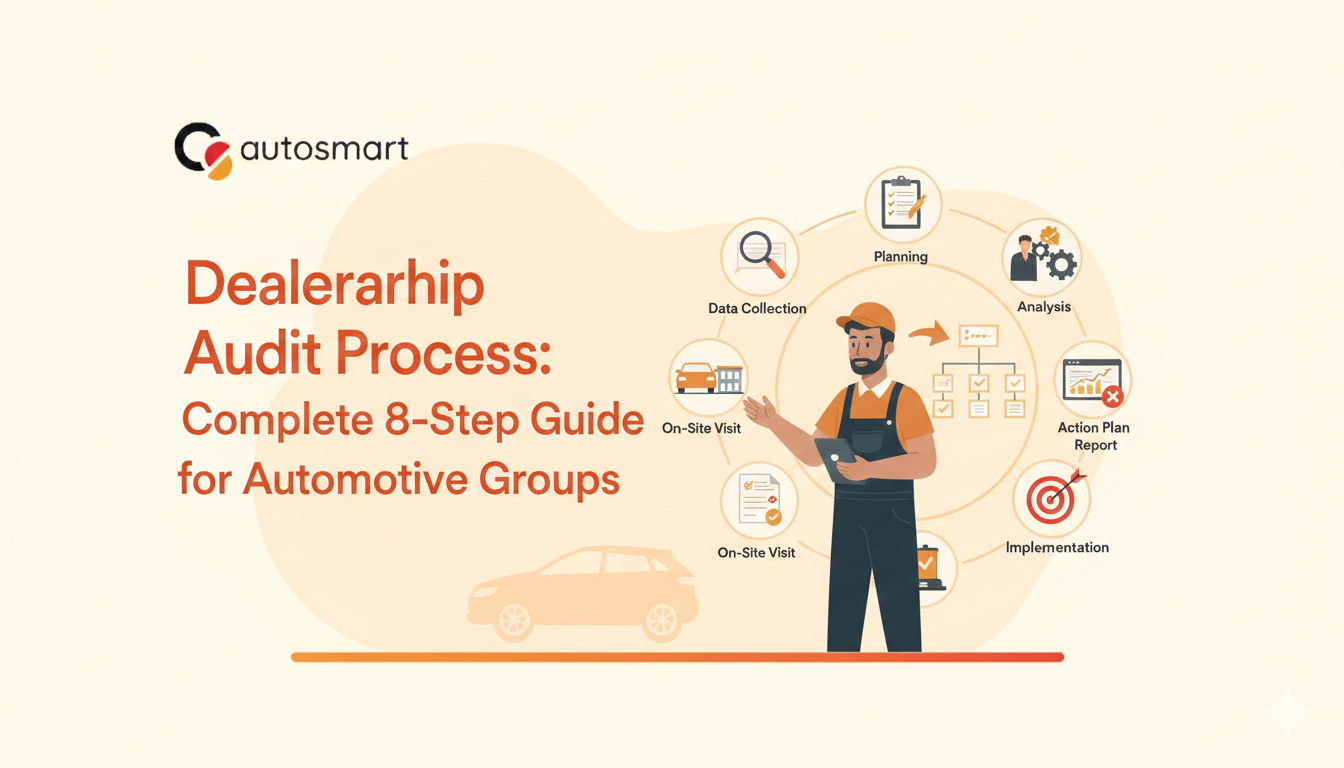
This guide outlines the 8-step dealership audit process, from planning to follow-up, with practical examples for automotive groups. Pair it with a dealer audit tool to automate each step, and check related resources like OEM audit standards and common challenges.
What Makes the Dealership Audit Process Unique?
A dealership audit is more than just a financial compliance audit, and its purpose is to ensure that day-to-day operations are consistent with brand standards and customer expectations. A traditional audit might focus on just the accounting function, but a dealership audit looks at the entire workflow and customer experience.
Key focus areas include:
- Sales floor and lead management: Check greeting protocols, CRM use, test drive procedures, and follow-up consistency.
- Workshop efficiency and safety compliance: Look at bay utilization, technician productivity, tool calibration, and PPE use.
- Parts inventory accuracy: Verify stock counts, turnover rates, and the management of obsolete parts, as well as ensuring compliance with suppliers.
- Customer experience touchpoints: Checking waiting areas, service advisor communications, delivery, and customer satisfaction index.
- Facilities and housekeeping: Checking facilities such as restrooms, parking lots, and general housekeeping standards.
- Administration and documentation: Checking employee documentation, training, licenses, and regulatory compliance.
Audit frequency matters: For example, workshops can be audited monthly, especially in high-risk areas where safety violations are common. Customer experience and sales can be audited quarterly. Administration and compliance can be audited twice a year, unless changes in legislation require auditing to be done more frequently.
This process does not end at producing a report; it produces a list of actions that are assigned to managers, which are then implemented and verified. There is also a Data Visualization
Dashboard that tracks trends across all the facilities, giving the organization an overview of how they are performing.
AutoSmarts dashboards allow leadership to track completion rates, trends, and recurring issues across all dealerships in real time.”
When to Run Each Audit Type
Different audits are designed to accomplish different objectives and are thus run at different times.
Operational audits: This audit type focuses on KPIs in the workshop, the sales process, and general efficiency. This audit can be done monthly, as it deals with high-risk areas. Metrics can be bay efficiency, repair order efficiency, productivity, and conversion.
- OEM audits ensure showroom layout, signage, and staff uniforms align with OEM requirements. Conduct these quarterly to maintain brand consistency. They verify everything from corporate identity guidelines to customer-facing materials and staff appearance.
- Compliance audits involve checking licenses, advertising, and data protection. Bi-annual audits ensure that no fines or legal issues arise, which involve checking dealer licenses, emissions, and consumer protection laws for different locations.
- Facility audits involve checking safety, maintenance, and housekeeping conditions. Annual reviews ensure that all locations are in good condition, which includes checking fire safety, emergency exits, HVAC, electrical, and accessibility conditions.
- Event-driven audits are conducted after receiving complaints, accidents, or legal warnings. These audits are conducted to investigate specific events that have taken place.
Pro tip: Stagger different audits for different locations to avoid burdening your employees. Having an annual calendar for audits helps you space them evenly throughout the year.
The 8-Step Dealership Audit Process
Step 1: Plan Scope and Team
As the first step, define the audit type, target locations, and measurable goals.
For example : “Raise workshop bay utilization from 65% to 80% across five service centres” or “Improve sales CSI scores from 85% to 92% at three underperforming showrooms.”
Then, determine your audit team, which is typically the lead auditor and 1-2 specialists. The lead auditor needs to have operating expertise, while the specialists need to have department expertise (e.g., a master technician for the workshop). Establish a one-week preparation period and discuss the usual challenges to prevent scope creep.
Step 2: Prepare Checklists and Brief Managers
Develop checklists by combining OEM templates with internal KPIs. Objectives can be measured (e.g., “Bay 3 temperature: 22°C”) or subjective (e.g., “Service advisor greeting: Professional/Adequate/Poor”) and can include photo requirements.
Notify managers 48 hours in advance with a clear agenda: “4-hour visit, full access to bays, records, and staff interviews.” This allows managers to prepare documents without artificially improving conditions. Load prior audit data to spot recurring issues.
Using AutoSmarts, checklists are digital and auto-filled with historical data to highlight recurring issues without manual effort. And free checklist templates are also available
Step 3: On-Site Audit
A standard 4-6 hour audit consists of the following steps:
- Walkthrough (45 minutes): inspect Facilities, safety, customer areas and record first impressions.
- Process observation (90 minutes): monitor Sales greetings, service intake, parts picking, technician work.
- Staff interviews (60 minutes): ask Five key questions per department head.
- Records review (60 minutes): examine CSI logs, license renewals, training records, maintenance records, warranty claims etc.
Observe the processes, interview the staff, and review the records to score them green, yellow, or red.
A good audit trail is a safeguard against any future disputes for the auditor as well as the manager. A simple method of scoring is to use a standardized scale of Green (90-100%), Yellow (70-89%), and Red (below 70%).
Modern digital audit tools allow instant scoring and photo uploads on-site, creating an audit trail that protects both auditors and managers.
Step 4: Analyze and Prioritize Findings
Tally the scores per category (Sales 92/100, Service 78/100). Identify trends, such as low CSI follow-ups. Compare the overall score to the previous cycle to see if the score is improving.
Risk Ranking:
As an auditor you can rank the risk like this,
- Critical: Safety violations, expired license, customer risks. Address within 24 hours. Escalate to senior management.
- High: Revenue impacting issues like poor lead follow-ups, etc. Address it within 7 days.
- Medium: Process gaps or cosmetic issues – fix within 30 days.
Digital audit platforms can automate this prioritization, ensuring managers immediately see which issues require action.
Step 5: Generate Actionable Report
Generate the report and present the results within 24 hours. Include an executive summary, detailed breakdowns, photos, trend comparisons, root causes, and recommendations. Use a central dashboard to distribute the report.
Automated audit software can generate and distribute reports via central dashboards for immediate leadership access.
Step 6: Assign and Communicate Actions
Action items must be specific, measurable, achievable, relevant, and time-bound.
For example, “Ahmed (Service Manager) – Train team on CSI script – Complete by Friday – Evidence: training sign-off sheet.”
Use your dealer audit workflow to assign and track these actions. Have a kickoff meeting with the managers to create accountability.
Automated platforms handle notifications and progress tracking, ensuring accountability across teams..
Step 7: Track Execution
Check-in weekly and escalate any delays to regional managers. Evidence of completion is required. For example, take a photo of the completed action. High performers achieve 85-95% completion of action items. If completion is less than 70%, there might be an issue with the expectations.
Remember, 80% of the audit value comes from the follow-through. If you don’t track the actions, you only have documentation.
Cloud-based audit tools provide real-time visibility into completion status, enabling instant follow-up.
Step 8: Closeout and Continuous Improvement
Re-inspect completed actions after 30 days. Update dashboards and review with your audit committee. Refine checklists based on lessons learned and document wins to build buy-in for future cycles.
Common Dealership Audit Pitfalls
Even experienced groups face challenges:
- No accountability: 70% of actions are incomplete without owners.
- Inconsistent scoring: Different auditors can result in different results, solve this with standardized checklists.
- Reports nobody reads: Use visual dashboards instead of static PDFs.
- No follow-through: Require evidence and re-inspection.
- Audit fatigue: Communicate results and celebrate improvements.
Real-World Example:
Almajdouie Motors, one of the largest automotive groups in the Middle East. They have significantly improved their audit process:
Before: 10-day cycle (5 days in the field, 5 days reporting)
After: 3 days including action planning
Result: 70% reduction in time, and improved completion rate from 45% to 89%
For them, the main advantage was the digital dashboard, which gave them real-time visibility into recurring issues across all their locations.
Read the full case study here: Almajdouie Case Study
Automate Your Dealership Audit Process with AutoSmarts
Manual audits are time-consuming and provide inconsistent outcomes. AutoSmarts revolutionizes the 8-step audit process with:
- digital checklists with OEM standards and historical data
- Real-time scoring with the ability to upload photos during the on-site audit visit
- Automated ranking to identify critical issues
- Dashboards to view everything related to the audit across all locations
- Action tracking with automated notifications
Achieve 85-95% Faster Audits, automotive groups using AutoSmarts have reported significant benefits from the automated audit process compared to their previous manual auditing process