

 AutoSmart Industry Insights
Built on AutoSmart’s work with dealer standards and mystery shopping programmes across car, two-wheeler and commercial vehicle networks, and on publicly available industry research. No individual brand, network or person is identified.
The one-page version
Every car brand with a dealer network needs answers to two questions. Is the standard in place at every dealership? And does the customer actually get it? These are different questions, and no single method answers both.
A structured audit answers the first. An evaluator walks the dealership against a defined standard, checks the facility, the equipment, the processes and the evidence, and leaves behind a scored record and a list of things to fix. It is thorough, repeatable and fair, and it sees the things that hold still long enough to be checked.
A mystery shop answers the second. A trained shopper arrives, phones or enquires online as an ordinary customer and records what happens. It sees the things that only exist in the moment: whether anyone greeted them, whether a test drive was offered, whether the online enquiry got a reply that answered the question.
Public research on car retail shows how wide the gap between the two can be:
19%
Of dealer website enquiries that never got a personal reply within 24 hours, in a study of 4,023 dealerships (Pied Piper, 2025)
36%
Of prospective buyers offered a test drive, in an analysis of more than 40,000 lost sales (JudgeService)
53%
Of buyers who wanted a follow-up on vehicle features weeks after delivery and never got one (J.D. Power, 2025)
None of these dealerships would necessarily fail an audit. Each of them had a process, a trained team and a facility built to standard. What broke was the delivery, on an ordinary day, to an ordinary customer. That is the part an audit is not built to see, and it is exactly what a mystery shop is for.
This paper makes four arguments:
- The two methods answer different questions. Audits check that the standard is in place. Mystery shops check that it reaches the customer. Asking either one to do the other’s job produces bad data and unhappy dealers.
- Each has blind spots the other covers. Audits see infrastructure, process and evidence but only see behaviour on the day of the visit. Mystery shops see real behaviour but only one interaction at a time, and they cannot see what sits behind the counter.
- When the two disagree, the disagreement is the finding. A dealership that passes the audit and fails the shop has a delivery problem. One that fails the audit and passes the shop has a talented team working around missing basics. Each needs a different fix.
- The best-run networks connect them. One standard, two lenses, one action loop. Every finding from either method gets an owner, a due date and evidence of closure, and the dealer sees one picture, not two competing scorecards.
Every section ends with something to take back to your own network, and the paper ends with a 90-day plan.
Two questions every brand needs answered
Ask a network development team how its dealers are doing and you will usually get a score. Ask the customer and you will get a story. Both are true, and they are rarely the same.
Every car brand sets standards for its dealerships. How the showroom looks. How the workshop is equipped. How a customer is greeted, how a test drive is offered, how a service vehicle is received, inspected and handed back. These standards exist because the brand has learned, often the hard way, what the customer expects and what loses them.
Once the standards are written, the brand needs to know two things about every dealership in the network:
- Is the standard in place? Is the facility built to specification, is the equipment there and working, are the people trained, are the processes defined and being recorded?
- Does the customer actually get it? On a busy Saturday, with a new sales consultant, when the customer walks in unannounced or sends an enquiry at 9pm, does the experience match what the standard describes?
The first is a question about the system. The second is a question about the moment. A dealership can have every element of the system in place and still let the moment slip. It can also, less often, deliver a great moment on top of a weak system, usually because a few talented people are working around the gaps.
Why one score is not enough
Our earlier paper on two-wheeler networks, The 2W Dealer Experience Gap, found a pattern that holds well beyond two-wheelers. Networks scored highly on the visible, hospitality side of their standards, often in the high eighties and nineties, while the operational side sat much lower. One senior leader summed it up in a sentence we still hear in four-wheeler networks: complaints and scores were going up at the same time.
That is not a failure of auditing. It is what happens when one method is asked to answer both questions. An audit is designed to check the standard. When the brand also reads the audit score as a measure of what customers experience, it is reading the answer to one question as the answer to another.
Mystery shopping exists to answer the second question directly. It is one of the oldest tools in retail quality, and it remains a large industry: one recent market estimate puts global mystery shopping services at around USD 2.35 billion in 2025, with automotive listed among its main end-use sectors. Car brands have used it for decades to test showroom and service experience. The question this paper asks is not which method is better. It is what each one sees, what each one misses, and how to make them work together.
The audit tool helps us continuously monitor our network and sustain the required standards.
Network development manager, automotive distributor (from a published G2 review)
Take this back to your network
Write your two questions on one slide. Under “Is the standard in place?” list the programmes that answer it today. Under “Does the customer get it?” do the same. Most networks find one column full and the other close to empty, or find the same programme listed under both. Either way, you now know where the gap is.
What a structured audit sees
A structured audit is the backbone of any dealer standards programme. It is the only method that checks every part of the standard, in the same way, at every dealership.
A good audit is built on a checklist that mirrors the brand’s standard, typically sixty to a hundred checkpoints per site once sub-questions are counted. An evaluator, usually a field manager or a dedicated auditor, works through each one, scores it, and attaches evidence: a photo, a document, a sample record. The result is a scored, evidenced picture of the dealership against the standard, and a list of findings that need to be fixed.
What it sees well
- Infrastructure and facility. Signage, corporate identity, showroom layout, workshop bays, customer lounge, washrooms, parking. These hold still and can be checked properly.
- Equipment and tools. Diagnostic equipment, special tools, calibration records, safety equipment. A mystery shopper cannot see any of this from the customer side of the counter.
- Process and records. Whether the dealership has a defined process for enquiry handling, test drives, job cards, quality checks and delivery, and whether there is a record that it was followed.
- People and training. Whether the right roles are filled, whether staff have completed the brand’s training, whether manpower matches the business plan.
- Health, safety and compliance. Fire safety, waste handling, environmental and regulatory requirements. These matter enormously and are invisible to a customer.
- Consistency across the network. Because every dealership is checked against the same checklist, the audit is the one method that lets a brand compare like with like across a hundred or a thousand sites.
No paperwork, quicker audits, less subjective outcomes.
Quality manager, automotive dealer group (from a published G2 review)
What it does not see
The audit’s strength is also its limit. It is designed to check what can be checked: the things that are there or not there, done or not done, recorded or not recorded. It sees behaviour only on the day of the visit, and only behaviour that happens in front of the evaluator.
Research outside automotive shows why that matters. A 2014 study in BMJ Quality & Safety, from University Health Network in Toronto, compared how often hospital staff used hand hygiene dispensers when an auditor was visible against the same period when no auditor was in sight. With the auditor present, the rate was roughly three times higher. The staff were not cheating. People simply behave differently when they know they are being observed.
The same is true in every dealership. When the evaluator is in the showroom, every customer is greeted. That is not a flaw in the audit. It is why well-designed audits focus on things that do not change because someone is watching: the facility, the equipment, the records, the trained headcount. It is also why every brand needs a second lens for the things that do change.
The capacity problem
There is one more limit, and it is practical. Our first paper, The Most Overloaded Job in Automotive Retail, showed that a single field manager typically covers ten to fifteen dealerships. When every check depends on a physical visit, 40 to 60% of a network can go without a manager-led evaluation in a cycle. A brand that wants a more frequent read on customer experience cannot get it simply by adding audit visits. The people who do them do not have the days.
Take this back to your network
Go through your main audit checklist and mark each checkpoint “holds still” or “changes when watched”. Facilities, equipment, records and training hold still. Greetings, offers, explanations and follow-up change when watched. Keep the first group in the audit. The second group is your shortlist for a mystery shop.
What a mystery shop sees
A mystery shop is a single, real interaction seen through the customer’s eyes. Its value is that nobody on the dealership side knows it is happening.
In a mystery shop, a trained shopper plays the part of a real customer. They walk into the showroom asking about a specific model, book a service, call the workshop with a question, or send an enquiry through the dealer’s website. They follow a scenario written in advance, then complete a scorecard describing what happened. The academic literature describes it as a form of participant observation: the researcher acts as a customer to see how the service is actually delivered.
What it sees well
- Behaviour, as it really happens. Whether the customer was greeted, how long they waited, whether anyone asked what they needed or simply started selling.
- Process steps that customers can see. Whether a test drive was offered without being asked, whether a written quotation was given, whether the service advisor walked round the car with the customer at reception.
- Product knowledge. Whether the sales consultant could explain the features that matter, answer a question about financing or warranty, or explain the difference between two variants.
- Follow-up. Whether anyone called back after the visit, and whether that call added anything.
- The digital and phone channels. Whether the enquiry got a reply, how fast, through which channel, and whether it answered the question. Section 04 looks at this in detail.
Public studies built on mystery shopping keep finding the same kind of gap. An analysis of more than 40,000 lost sales by the UK insight provider JudgeService found that only 36% of prospective buyers were offered a test drive. Around half of those who had to ask for one became detractors, and dealers who offered test drives without being asked saw a 63% uplift in net promoter score. A 2017 Ipsos RDA mystery shop of 141 dealerships selling electric cars in the ten largest US electric vehicle markets found that test drives were typically not offered; most of the time the shopper had to ask.
In every one of those dealerships, the test drive process existed on paper. A demo car was almost certainly on site. An audit would have found both. What the audit could not see was that, on an ordinary day, the consultant simply did not offer it.
What it does not see
A mystery shop is a single interaction. That is its strength and its weakness.
- It cannot see behind the counter. The shopper does not see the workshop equipment, the training records, the parts stock or the safety arrangements. A dealership can deliver a great showroom moment while the workshop behind it is under-equipped.
- One shop is one moment. A single visit tells you what happened to one shopper, with one consultant, at one time of day. A great consultant on a quiet Tuesday and a new hire on a busy Saturday can produce opposite results at the same dealership.
- Memory is not a camera. Research published in the Journal of the Market Research Society in 1997 (Morrison, Colman and Preston) set out how the way shoppers encode, store and recall a visit can affect the accuracy of what they report. Good programmes reduce this with tight scenarios, objective questions and prompt reporting, but it never disappears.
- It does not explain why. A shop can tell you the test drive was not offered. It cannot tell you whether that was because the demo car was out, the consultant was untrained, or the process was never defined.
This is why mature programmes are careful about how they use a single shop. It is a strong signal. It is not, on its own, a verdict on a dealership.
Take this back to your network
Before your next mystery shop wave, check every scorecard question against one rule: could two different shoppers, watching the same interaction, give the same answer? “Was a test drive offered without being asked?” passes. “Did the consultant seem enthusiastic?” does not. Keep the questions that pass and move the rest to a separate, clearly labelled impressions section.
The digital front door
For most car buyers today, the first contact with a dealership is not the showroom. It is a website form, a phone call or a message. This is the part of the journey an audit is structurally least able to see.
Cox Automotive’s 2025 Car Buyer Journey study found that the total time to buy a vehicle in the US has fallen to just under 14 hours, and that 44% of new-vehicle buyers now follow a hybrid path, mixing online and in-person steps. In the networks we work with across India and the Gulf, a growing share of the enquiry and follow-up conversation now happens on the phone and on messaging apps, often before the customer has set foot in the dealership.
That changes what “the standard” means. The greeting, the needs assessment and the first impression increasingly happen in a reply to a form or a WhatsApp message. An evaluator walking the showroom cannot see whether that reply arrived, how fast, or whether it answered the question.
What the public studies show
The US has the longest-running public evidence on this, because several firms mystery shop dealer websites and phone lines at scale every year.
- Web enquiries. Pied Piper’s 2025 Internet Lead Effectiveness study submitted mystery shopper enquiries through the websites of 4,023 dealerships, each asking a specific question about a vehicle in stock. Responses were tracked over 24 hours. 85% of dealers responded through at least one channel, but on average dealerships failed to personally respond 19% of the time. Only 69% of email or text replies answered the customer’s actual question.
- Phone calls. A Marchex analysis of more than 8 million calls to US dealerships found that more than 19% of calls went unanswered or were abandoned. Nearly 70% of all inbound calls were about parts and service, not sales.
- What happens when the phone is answered. An earlier Marchex study of 1,000 calls found that on 63% of answered calls, nobody tried to set an appointment, and on 66% nobody asked for the caller’s contact details.
19%
Of web enquiries with no personal reply in 24 hours, on average (Pied Piper, 2025)
19%+
Of calls to dealerships unanswered or abandoned (Marchex)
~70%
Of inbound dealership calls that are about parts and service (Marchex)
Two things stand out. First, these failures are invisible to an on-site visit. A dealership can have a fully staffed enquiry desk, a written lead process and a clean CRM report, and still miss one enquiry in five. Second, the biggest share of phone traffic is service. The digital front door is not only a sales question. It is where most aftersales relationships start, and where many quietly end.
Why this is a natural home for mystery shopping
Digital and phone mystery shops are cheap, fast and easy to run at volume. A shopper does not need to travel. A web enquiry or a call can be placed in minutes, at any time of day, and the response is a timestamped record rather than a memory. That removes most of the reliability concerns from Section 03. It also means a brand can shop every dealership, every month, for a fraction of the cost of a physical visit.
This is the clearest case in the paper where mystery shopping does something an audit cannot. The audit can still check that the process exists: that leads are logged, assigned and followed up in the system. The shop checks whether the process works when a real customer presses send.
Take this back to your network
This week, send one web enquiry and make one service phone call to five of your own dealerships, using a real question about a real vehicle. Note how long each reply took, through which channel, and whether it answered the question. It takes an hour, and most network leaders who try it never look at their lead response reports the same way again.
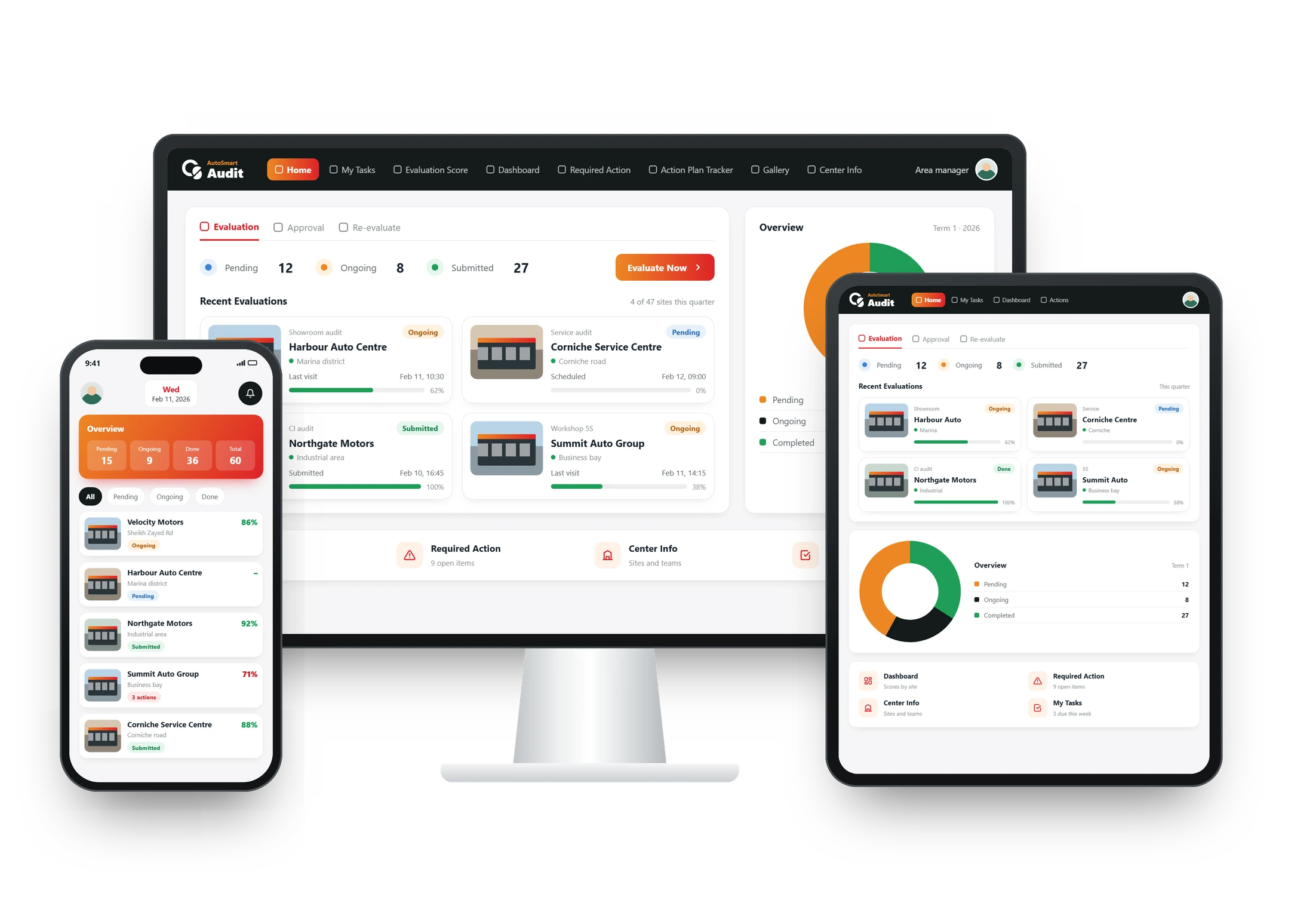
See how networks put this into practice. AutoSmart runs dealer self-assessment with evidence, online verification, owned findings and live coverage on one platform.
Side by side
Put the two methods next to each other and the pattern is clear. They are not competing answers to the same question. They are answers to two different questions, and each is strongest exactly where the other is weakest.
The table below compares the two across seven dimensions. It describes how each method works when it is designed well. Both can be done badly; the comparison assumes neither is.
| Structured audit | Mystery shop | |
|---|---|---|
| The question it answers | Is the standard in place? | Does the customer actually get it? |
| What it measures best | Facility, equipment, process, records, training, safety and compliance | Behaviour, customer-visible process steps, product knowledge, response and follow-up |
| What it misses | Behaviour when no evaluator is present; the digital and phone experience | Everything behind the counter; the reasons behind what it sees |
| Frequency and sample | Every checkpoint at every site, typically once per cycle | One interaction per shop; needs several shops per site to be reliable |
| What drives the cost | Evaluator days on site, travel and reporting | Shopper fees, scenario design and, for physical shops, travel |
| How dealers react | Known and planned for; dealers can prepare, which is often the point | Unannounced; dealers can be wary of a single bad shop affecting their score |
| What happens after the finding | Findings with evidence that can be assigned, fixed and verified | Often a report and a score; turning it into action needs a deliberate step |
Table 1. Structured audits and mystery shops compared. Based on public research and AutoSmart’s experience across dealer networks.
The row that matters most
Most comparisons of the two methods stop at what they measure. The row that decides whether either one improves anything is the last one: what happens after the finding.
A well-run audit programme already turns every failed checkpoint into an action, with a named owner, a due date and evidence of closure. Mystery shopping programmes, especially those run by an outside agency, often end with a report. The dealer receives a score and a commentary, the regional team discusses it, and the next wave arrives three months later with similar findings. The shop has seen the problem perfectly. Nothing in the process makes anyone fix it.
One of the main challenges we face is the follow-up after completing an audit.
Managing director, automotive business (from a published G2 review)
If that is true of audits, which are designed around findings, it is doubly true of mystery shops. This is the single most useful change most networks can make, and it is where Section 07 picks up.
Take this back to your network
Take your last mystery shop wave and count how many findings became a named action with a due date. Then count how many were closed with evidence. If the second number is close to zero, the programme is measuring well and changing nothing.
When the two disagree
The most useful thing about running both methods is not that you get two scores. It is that you can see where they disagree. The disagreement is the finding.
Place every dealership on two simple axes: how it performs on the audit, and how it performs on mystery shops over the same period. Four groups appear, and each one needs a different response.
| Passes the mystery shop | Fails the mystery shop | |
|---|---|---|
| Passes the audit | Delivering. The standard is in place and the customer gets it. Protect it: share what this dealership does with others, and watch for staff turnover. | A delivery gap. The system is in place but the moment slips. The fix is behaviour: coaching, floor management, incentives and follow-up discipline, not more investment in facilities. |
| Fails the audit | Working around the gaps. Good people are delivering despite missing basics. It will not last. Fix the facility, equipment and process gaps before the people who are carrying them leave. | Fundamentals first. Neither the system nor the moment is there. Start with the basics the audit has found. Shopping this dealership harder will not help until those are fixed. |
Table 2. Reading audit and mystery shop results together. Illustrative framework.
The delivery gap is the group that matters
In our experience, the group that most surprises network leaders is the top right: dealerships that pass the audit and fail the shop. They are often well-invested, well-staffed sites in strong markets. Their audit scores are good, their facilities are excellent, and on paper every process is in place. Yet the shopper walks out without a test drive, the web enquiry goes unanswered, and the service customer is never called back.
These dealerships do not need more audit findings. They need someone to look at what happens on the floor. Without a mystery shop, the brand has no way to tell them apart from the genuinely delivering sites.
Do not ignore the bottom left
The opposite group is just as important and is easier to miss, because their customers are happy. These are dealerships where a strong sales manager or an exceptional service advisor is delivering a good experience on top of missing equipment, an outdated facility or an undefined process. The shop says everything is fine. The audit says the foundation is weak.
This is a fragile position. When that one person leaves, the experience goes with them, and there is no process left to fall back on. This is also why the framing rule we use in every paper matters: the first step is always the basics. Brands that audit properly can see this group. Brands that only shop, or only look at customer satisfaction scores, cannot.
Read disagreement over time, not from one shop
One warning. A single shop is one moment, and placing a dealership in a quadrant on the strength of one visit is unfair to the dealer and unreliable for the brand. The framework works when it uses several shops over a period, ideally across different days, times and channels, read against the most recent audit. A dealership that sits in the delivery gap on one shop deserves a second look. One that sits there on five deserves a plan.
Take this back to your network
Plot your dealerships on these two axes using the last two quarters of data. Do not act on the chart yet. Just look at which dealerships sit in the top right and the bottom left, and ask your regional teams whether the names surprise them. The ones that surprise them are where the conversation should start.
Combining the lenses
Running both methods is not the same as combining them. Most networks that do both run two separate programmes, with two scorecards, two calendars and two teams. The dealer sees two verdicts that rarely agree. Here is how the best-run networks connect them instead.
1. One standard, two lenses
Start from the brand’s standard, not from the methods. For every element of the standard, decide which lens checks it. Facility, equipment, records and training go to the audit. Customer-visible behaviour, response and follow-up go to the shop. Some elements need both: the audit checks that a test drive process and demo car exist, the shop checks whether the test drive is actually offered.
The result is a single map of the standard, where every checkpoint has a home and nothing is checked twice by accident. It also gives the dealer one story: this is the standard, and this is how we will check each part of it.
2. Sequence them deliberately
There is little value in shopping a dealership for behaviour before the basics are in place. If the demo car is missing, the shop will find that no test drive was offered and tell you nothing you did not already know. The natural order is audit first, to establish and fix the foundation, then shop, to test whether that foundation reaches the customer.
The sequence also works in reverse. A run of poor shops is a good reason to bring forward an audit visit. As our first paper argued, field managers do not have the days to visit every dealership as often as they would like. Using shop results to decide which dealerships get a visit first means the visits go where they are most needed.
Automating Area Manager dealer visits increases transparency.
Automotive network user (from a published G2 review)
3. One action loop
This is the change that matters most. Every finding, whether it comes from an audit or a shop, should become an action with a named owner inside the dealership, a due date and a requirement for evidence when it is closed. A missed test drive offer becomes an action for the sales manager: brief the team, and show evidence at the next shop. An unanswered web enquiry becomes an action for the digital lead: fix the routing, and prove it with a test enquiry.
When shop findings flow into the same action plan as audit findings, three things happen. Dealers stop seeing the shop as a score and start seeing it as a to-do list. Regional teams can track closure the same way for both. And the next shop wave can check whether last wave’s actions actually changed anything.
4. One view of the dealer
Finally, bring the results together. A network development manager looking at a dealership should see its audit results, its shop results and its open actions on one screen, with the two lenses side by side. That is what makes Section 06 possible in practice, and it is what lets the regional conversation move from “your score went down” to “here is the one thing we both need to fix this quarter”.
Rules that keep the combined model fair
- Never rank or pay on a single shop. Use several shops over a period, across different days, times and channels.
- Keep shop questions objective. Did it happen or not. Impressions are useful context but should not drive a score.
- Rotate scenarios. If every shopper asks about the same model on the same day of the month, dealers will learn to spot them.
- Tell dealers the rules, not the dates. Dealers should know that shops happen, what is checked and how results are used. They should not know when.
- Close the loop visibly. When a dealer fixes a shop finding, the next shop should check it, and the improvement should be recognised.
Take this back to your network
Pick one element of your standard that both methods touch, such as the test drive or the service reception walk-round. For the next quarter, check it through the audit and the shop, put every finding from either into the same action plan, and compare closure and repeat rates against the previous quarter. It is the smallest possible version of the combined model, and it shows quickly whether it works in your network.
The 90-day plan
None of this needs a new team or a new budget to start. It needs a clear map of the standard, a small pilot and one shared action loop.
Days 1 to 30: map and baseline
- Map the standard to the two lenses. Go through every element of your dealer standard and assign it to the audit, the shop or both. Use the “holds still” and “changes when watched” test from Section 02.
- Audit your current shop scorecard. Remove or separate any question two shoppers could answer differently. Add the digital and phone checks from Section 04 if they are missing.
- Run a digital baseline. Send one web enquiry and make one service call to every dealership in a pilot region. It costs almost nothing and gives you a starting point you can measure against.
- Choose a pilot region of ten to twenty dealerships with a field manager who is willing to try something new.
Days 31 to 60: run both lenses on one loop
- Audit and shop the pilot dealerships in the same window, with the shops spread across different days, times and channels.
- Put every finding into one action plan, with a named owner at the dealership, a due date and an evidence requirement. Treat shop findings exactly like audit findings.
- Plot the pilot dealerships on the two axes from Section 06. Share the chart with the field manager and agree a short list of priorities for each quadrant.
- Brief the pilot dealers on how the combined model works: what is checked, how results are used, and how they close actions.
Days 61 to 90: check, compare and decide
- Run a second shop wave focused on the actions raised in the first. Did the test drive offer improve? Did the enquiry response time come down?
- Compare the pilot against the rest of the network on four measures: share of findings with a named owner, share closed with evidence, repeat findings, and digital response.
- Decide what to scale. Most networks find that the action loop alone makes the biggest difference, and that it can be extended to the rest of the network without adding shops or visits.
- Share what the delivering dealerships do. The top left quadrant is your best training material.
The one thing to do on Monday
Take the last mystery shop report your network received and find three findings. For each one, write down who at the dealership owns it, when it is due and what evidence would prove it is fixed. If you cannot answer those three questions, you have found the gap this paper is about.
Methodology, sources and about AutoSmart
How this paper was written
This paper draws on AutoSmart’s work with dealer standards, customer experience and mystery shopping programmes across car, two-wheeler and commercial vehicle networks, and on published industry research. No brand, network, dealer or person is identified. Where we describe our own experience, figures are illustrative ranges across many networks, never one company’s results. Figures taken from our earlier papers are cited as such. Practitioner quotes are taken from published G2 reviews and attributed by role only. The frameworks in Tables 1 and 2 are illustrative.
Sources
- AutoSmart Industry Insights No. 01, The Most Overloaded Job in Automotive Retail, September 2026.
- AutoSmart Industry Insights No. 02, The 2W Dealer Experience Gap, September 2026.
- Cox Automotive, 2025 Car Buyer Journey Study, as reported by Digital Dealer, January 2026.
- J.D. Power, 2025 U.S. Sales Satisfaction Index (SSI) Study, November 2025.
- JudgeService, analysis of more than 40,000 lost sales on test drive offers, as reported by AM Online.
- Ipsos RDA, mystery shopping study of 141 electric vehicle dealerships, as reported by WardsAuto, December 2017.
- Marchex Institute, call handling benchmark across 16 car brands, October 2017; and Mobile Consumers Are Calling, September 2014.
- Morrison, L. J., Colman, A. M. and Preston, C. C., Mystery customer research: cognitive processes affecting accuracy, Journal of the Market Research Society, 39, 1997.
- Pied Piper Prospect Satisfaction Index, 2025 Internet Lead Effectiveness (ILE) Auto Industry Study, as reported by Auto Remarketing, March 2025.
- Srigley, J. A., Furness, C. D., Baker, G. R. and Gardam, M., hand hygiene and the Hawthorne effect, BMJ Quality & Safety, 2014.
- Straits Research, Mystery Shopping Services Market report, global market size estimate for 2025.
- Wilson, A., The role of mystery shopping in the measurement of service performance, Managing Service Quality, 8(6), 1998.
About AutoSmart
AutoSmart builds the audit and dealer performance platform used by car brands, distributors and dealer groups. Structured audits and mystery shopping run on the same platform, against the same standard, with every failed item from either one turned into an action with a named owner, a due date and evidence of closure. Results from both lenses sit side by side for every dealership, so network teams can see where the standard is in place, where the customer gets it, and where the two disagree.
AutoSmart is used across car, two-wheeler and commercial vehicle networks by teams working across more than 4,000 outlets in over 35 countries. If you would like to see your own network on the two axes in Section 06, we would be glad to show you.
© 2026 AutoSmart. This document may be shared freely with attribution. It may not be reproduced commercially without permission.