If you have ever run an audit across a dealer network and found the same issues appearing again the following quarter, you are not alone. Repeat audit failures are one of the most common and costly problems OEMs face today.
Action plans are raised, owners are assigned, and deadlines are set. On paper, everything looks in order. But when follow-up is manual and inconsistent, actions slip and root causes go unresolved.
This is exactly where CAPA automation changes things. CAPA stands for Corrective Action and Preventive Action. It helps teams fix what went wrong and prevent it from happening again.
In this guide, you will learn what CAPA automation means for OEMs, why repeat audit failures keep happening, and how the right system can help you reduce repeat audit failures across your dealer network.
What Are Repeat Audit Failures and Why Do They Keep Happening?
A repeat audit failure is when the same problem shows up in two or more audits. It could be at the same centre or across different ones. It means the issue was found but never properly fixed.
This happens more often than most audit teams expect. The reasons are usually the same.
Actions Are Recorded but Never Tracked
Most audit teams send action plans to the relevant centre. But once that email is sent, there is no way to know whether anyone acted on it. Without a follow-up system, actions get missed and nothing changes.
Root Causes Are Ignored
Centres often fix what is visible rather than what caused the issue. The immediate problem
gets resolved but the root cause stays. The next audit finds the same thing.
Audit Data Lives in Separate Places
Findings stored across spreadsheets, emails, and separate reports make patterns hard to spot. The same issue may be appearing at multiple centres but if the data is not in one place, it goes unnoticed.
What Is CAPA Automation and How Does It Work?
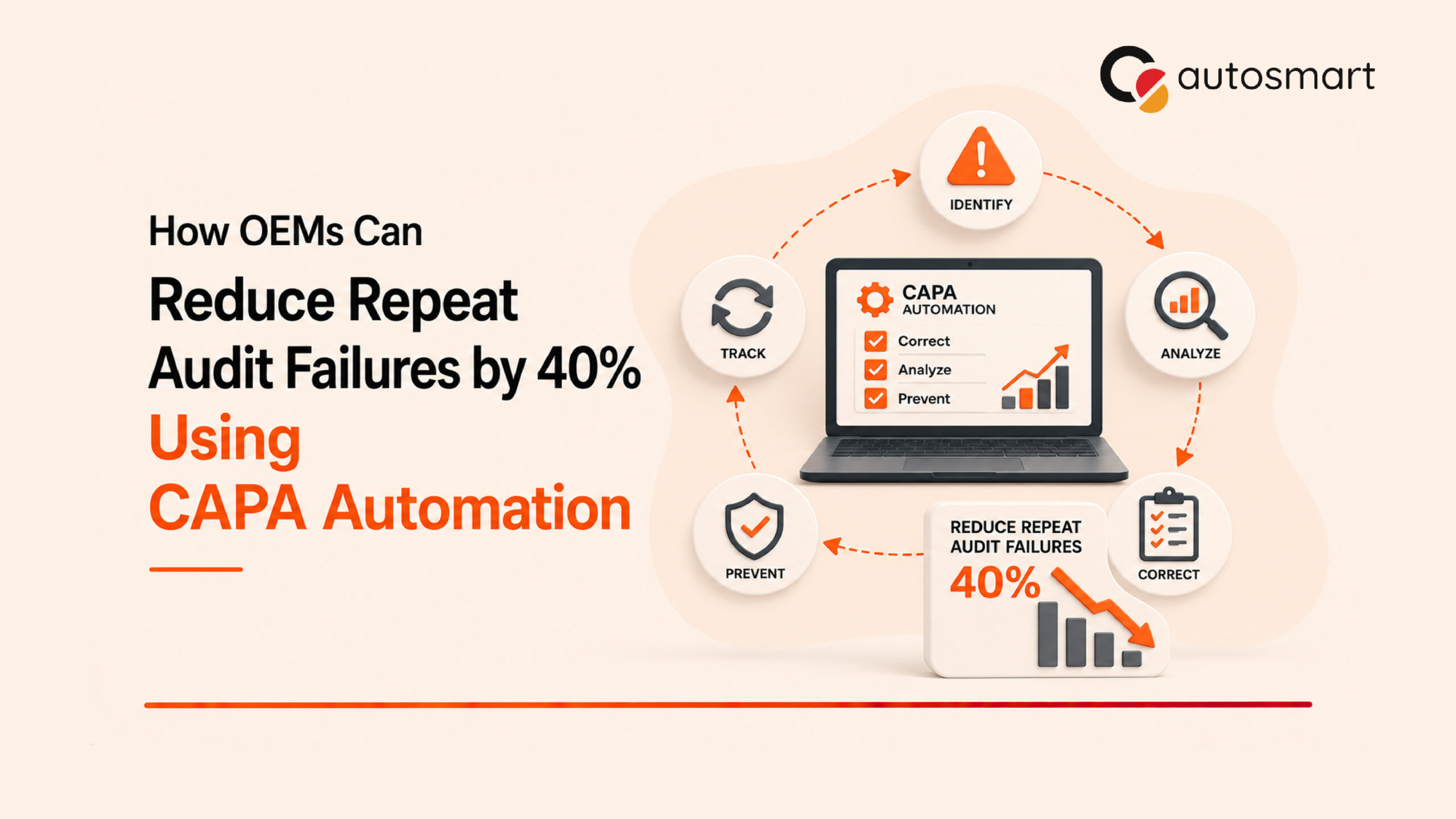
CAPA stands for Corrective Action and Preventive Action. It is a structured process that helps automotive businesses fix problems properly and reduce repeat audit failures for good.
CAPA works in two parts.
Corrective Action : Fixes the specific problem identified in the audit.
Preventive Action : Identifies why it happened and puts measures in place so it does not happen again.
CAPA automation builds this into a digital platform. Instead of manually chasing action plans, the system manages it for you.
How CAPA Automation Works Step by Step
Step 1 — Audit finding is recorded
The auditor logs the issue in the platform with supporting evidence such as photos, notes, or documents.
Step 2 — Corrective action is assigned automatically
The platform assigns the action to the right person at the right centre with a clear deadline.
Step 3 — Root cause analysis is captured
The centre manager must identify the root cause before the action can be closed. This stops quick fixes from being logged as resolved.
Step 4 — Evidence of completion is submitted
The responsible person uploads proof. The audit team can review, approve, or reject it.
Step 5 — Patterns are tracked across the network
The platform flags recurring issues across centres, giving OEMs a clear view of where preventive action is needed.
Where Corrective Action in Dealerships Goes Wrong
In most dealerships, the effort to reduce repeat audit failures is undermined by corrective action in automotive dealerships that still runs on emails, spreadsheets, and manual follow-up. What happens after the report is sent depends on individual follow-up, not any structured process.
The result is predictable. Actions get missed, standards slip, and the next audit finds the same issues.
CAPA automation fixes each of these gaps.
- Built-in accountability
Every action has a named owner, a deadline, and a completion requirement. - A complete audit trail
Every finding, action, and resolution is stored in one place and accessible at any time. - Real-time visibility
OEMs can track every corrective action across every centre without waiting for the next audit. - Consistent standards
When all centres work from the same platform, non-conformances are far less likely to go unaddressed.
What AutoSmart Audit Does Differently for OEMs
AutoSmart Audit is built for corrective action in automotive dealerships and OEM networks running audits across multiple centres.
According to client data, OEMs using AutoSmart Audit have seen up to a 40% reduction in repeat audit failures. Not because audits got stricter, but because the corrective action process became structured and visible. For any OEM looking to reduce repeat audit failures across a large network, this is what it looks like in practice.
- Finding recorded: The platform assigns a corrective action with a clear deadline.
- Root cause required : the centre manager must submit evidence before the action can be closed.
- Full oversight retained : the OEM audit team can review and approve at every stage.
- Recurring issues flagged:: the platform highlights patterns for network-level action.
The Right Process Makes All the Difference
Repeat audit failures are not a sign that your dealers cannot meet standards. In most cases, they signal that the corrective action process is not working as it should.
CAPA automation gives OEMs a structured way to manage corrective action in automotive dealerships and reduce repeat audit failures from the moment a finding is recorded to the point where the root cause is resolved.
With the right system in place, reducing repeat audit failures by 40% is not an ambitious target. It is a realistic outcome of doing corrective action properly.
If you would like to see how AutoSmart Audit supports this process, we are happy to walk you through it.

ناصيف عمر هو المؤسس والرئيس التنفيذي لشركة أوتوسمارت تكنولوجي، وهي منصة برمجية كخدمة (SaaS) تقوم برقمنة عمليات التدقيق لشركات تصنيع السيارات والموزعين وشبكات الوكلاء. ومن خلال خبرته السابقة في شركة تويوتا (عبد اللطيف جميل) وخلفيته في تقنية المعلومات والإدارة الصناعية، يكتب عن عمليات التدقيق، والانضباط التشغيلي، وبناء المنتجات البرمجية لعملاء المؤسسات عبر مختلف الأسواق.