Ask an OEM warranty team to explain how a claim gets from “repair happened” to “payment approved,” and most can describe the process in broad strokes. Ask them to point to exactly where a specific discrepancy entered that chain, and the answer gets a lot vaguer. That gap knowing the process in general but not being able to trace a specific claim through it precisely is the actual weakness in most warranty audit trails. Not that the trail doesn’t exist, but that it isn’t mapped clearly enough to be useful when something goes wrong.
Why the Audit Trail Matters More Than Any Single Checkpoint
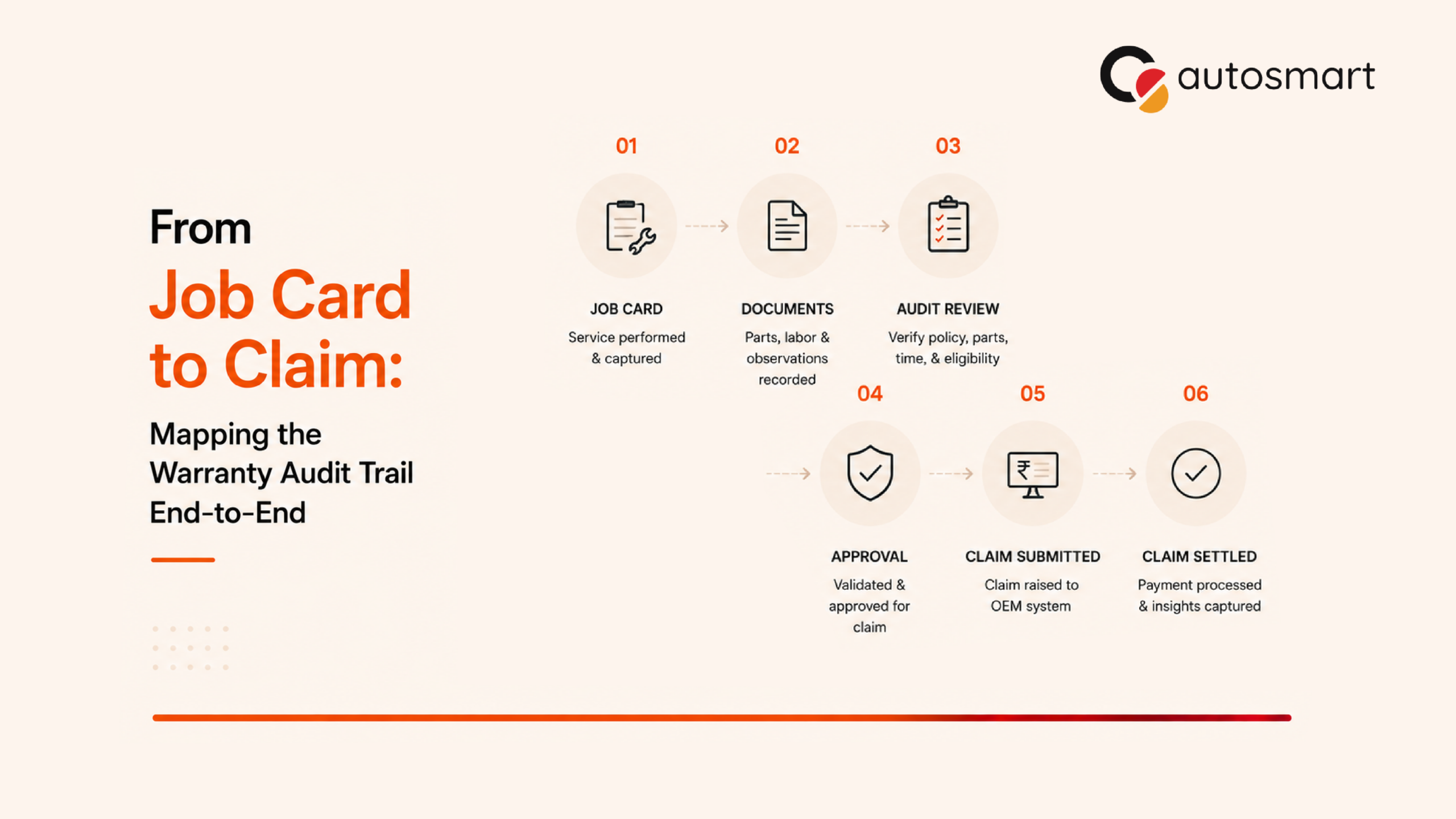
A warranty claim isn’t one event it’s the end product of a sequence: complaint, diagnosis, repair, parts consumption, labor logging, job card sign-off, claim submission, claim review, approval or rejection. A problem introduced at any point in that sequence carries forward to every step after it. Auditing only the claim itself, without visibility into the steps before it, means checking the final output while treating everything that produced it as a black box.
Mapping the Full Trail, Step by Step
1. Customer complaint intake. The starting point what the customer reported, in their own words, before any diagnosis happened. This matters because a diagnosis that doesn’t logically follow from the original complaint is one of the earliest signs something’s off.
2. Technical diagnosis. The technician’s assessment of the actual fault. This is where a mismatch with the complaint, or a diagnosis that’s unusually convenient for a specific repair, first becomes visible.
3. Repair execution. What was actually done to the vehicle the labor operations performed, matched against the diagnosis.
4. Parts consumption. What was used, in what quantity, cross-referenced against both the diagnosis and the repair performed.
5. Labor time logging. How long the repair took, measured against the manufacturer’s standard operation time for that job.
6. PIC sign-off. A named technician and supervisor attached to the completed job card the accountability layer that everything before it depends on.
7. Job card finalization. The completed internal record, ideally digital, that should mirror everything above accurately.
8. Claim submission. What the dealership sends to the OEM, in theory a faithful summary of the job card.
9. Claim review. The OEM’s check of the submitted claim historically the only step most warranty programs actually audit.
10. Approval, rejection, or escalation. The final outcome, based on whatever was reviewed at step 9.
Where Most Warranty Programs Stop Looking
Most audit effort concentrates on steps 8 through 10 the claim itself. That’s understandable; it’s the step closest to the money, and it’s the most centralized, easiest-to-access data point. But a discrepancy introduced at step 1 or 2 a diagnosis that doesn’t match the complaint — is invisible by the time you’re only reviewing step 9. The claim can look internally consistent while still being wrong, because the review never reaches back far enough to catch where the inconsistency actually started.
Why End-to-End Visibility Changes What Gets Caught
When the trail is mapped and auditable end-to-end, a discrepancy can be traced to its actual origin instead of just its symptom. A claim flagged for unusual labor time isn’t just rejected or approved — it can be traced back to the specific job card, the specific technician, and the specific repair step where the time was logged, making the finding actionable rather than just a data point. This is also what makes recurrence tracking possible: a pattern only becomes visible if each instance can be traced back to a comparable point in the same trail.
What This Requires Structurally
Mapping the trail end-to-end isn’t just a documentation exercise it requires the underlying data to actually connect:
- Digital job cards linked directly to claims, not just summarized into them, so the claim isn’t the only record an auditor can see.
- Consistent identifiers across steps the same job card ID traceable from intake through claim approval.
- Timestamped entries at each stage, so the sequence itself can be checked for logical consistency, not just the content.
- PIC attribution carried through the whole trail, not just attached at the job card stage.
- A single system of record, or at minimum, integrated systems a fragmented trail across disconnected tools defeats the purpose of mapping it in the first place.
Why This Matters More as Claim Volume Grows
For a small number of claims, an experienced warranty reviewer might informally reconstruct this trail by asking the dealership directly when something looks off. That doesn’t scale. At real claim volume, tracing a discrepancy back through nine prior steps has to be something the system supports directly otherwise the audit trail exists in theory but isn’t usable in practice when it’s actually needed.

ناصيف عمر هو المؤسس والرئيس التنفيذي لشركة أوتوسمارت تكنولوجي، وهي منصة برمجية كخدمة (SaaS) تقوم برقمنة عمليات التدقيق لشركات تصنيع السيارات والموزعين وشبكات الوكلاء. ومن خلال خبرته السابقة في شركة تويوتا (عبد اللطيف جميل) وخلفيته في تقنية المعلومات والإدارة الصناعية، يكتب عن عمليات التدقيق، والانضباط التشغيلي، وبناء المنتجات البرمجية لعملاء المؤسسات عبر مختلف الأسواق.