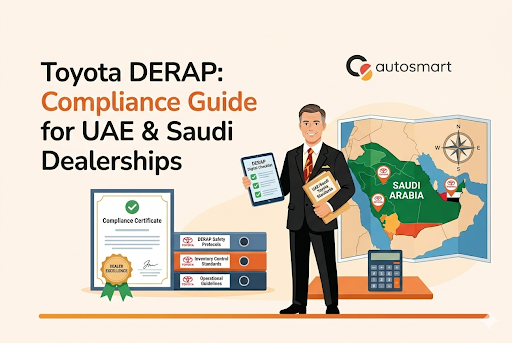
Toyota DERAP (Dealer Environmental Risk Audit Program) mandates strict environmental standards for waste management, water systems, and chemical handling at Toyota dealerships across the Middle East.
UAE and Saudi dealers must secure minimum ECO1 status, while ECO3 unlocks OEM recognition, priority vehicle allocation, and green incentives.
DERAP Program Overview
DERAP (Dealer Environmental Risk Audit Program) is Toyota’s global plan. It sets basic environmental standards for all service workshops.
ECO1 status is the minimum passing grade for dealerships to stay compliant. Achieving ECO3 status shows leadership in sustainability. In the GCC, achieving ECO3 can bring benefits at the distributor level. This includes priority in manufacturer recognition programs and access to green incentives.
Internal progress audits usually happen twice a year in UAE dealerships and four times a year in Saudi Arabia. This ensures that facilities meet the five core fundamentals. Regional distributors evaluate these. Al-Futtaim Motors and Abdul Latif Jameel are examples. They prepare for official annual certification.
UAE and Saudi Requirements
UAE Federal Law No. 24/1999 controls hazardous waste tracking. Dubai Municipality and Sharjah SEWA need permits for wastewater discharge. Also, oil separators must meet EN 858 standards.
Saudi Arabia uses SASO/GSO 1952 for chemical handling and GSO 2021 for separators. Local distributors carry out regular audits to enforce these standards. Non-compliance threatens regulatory fines, Toyota bonuses, and vehicle allocations in GCC markets.
| Requirement | UAE | Saudi Arabia |
| Waste Tracking | EAD/Municipality Permit | NCM Manifest / WML Decree |
| Oil Separators | EN 858 Standard | GSO 2021 Standard |
| Chemical Safety | Federal Law No. 24/1999 | SASO GSO 1952 |
| Audit Frequency | Bi-annual (Internal) | Quarterly (Internal) |
| ECO3 Focus | Solar & Water Recycling | EV Infrastructure & Saudi Vision 2030 |
The 5 DERAP Fundamentals
Fundamental 1:
Environmental Officer: Assign a full-time officer who has valid training certification. This officer will oversee contractors, conduct monthly inspections, report to management, and liaise with Toyota in the area.
Fundamental 2:
Waste Declaration Display: Put up a clear workshop sign (usually 2m x 1m) that lists approved oil, battery, tyre, and chemical contractors. The sign must display valid license numbers and expiry dates; these should be updated and filed monthly for audit review.
Fundamental 3:
Waste Segregation: Keep labelled areas with drip trays for oil and acid-neutralising kits for batteries. Use stacked racks for tyres, with a maximum of four tyres high. Log pickups to avoid cross-contamination.
Fundamental 4:
Drainage Systems: Equip all workshop drains with oil-water separators. Make sure the floor slopes direct water to sumps. Also, keep pH testing kits handy to check that wastewater discharge stays in the municipal target range, usually pH 7–9. Daily logs must be kept for pump functionality and oil-sheen inspections.
Fundamental 5:
Refrigerant Recovery: Provide certified recovery machines, vacuum pumps, leak kits, and color-coded R134a/R1234yf cylinders; log evacuate-vacuum-leak-charge weights per AC job.
Audit Preparation Steps
Follow this 30-day plan for success.
Week 1: Appoint ECO officer and post declarations.
Week 2: Verify drainage and segregation infrastructure.
Week 3: Train all workshop staff on fundamentals.
Week 4: Run mock audit, fix gaps, prepare photos/logs.
Ensure officer presence, clean stations, and current docs on audit day.
Common Audit Failures
Dealerships often struggle because of:
- Unposted certificates (filed but not displayed)
- Part-time officers who can’t answer questions
- Mixed waste storage
- Incomplete pH/refrigerant logbooks
- Missing cylinder weights
Physical operations may comply, but documentation gaps trigger deductions every time.
Achieving ECO3 Status
To get ECO3 status, dealerships must first fully adopt the five fundamentals. Then, they should carry out advanced environmental initiatives. These often include renewable energy integration, such as solar panels. They also feature dedicated EV charging bays, wastewater recycling systems, and participation in community-based environmental programs.
10-Week Implementation Timeline
Weeks 1-2: Officer appointment and displays.
Weeks 3-4: Install/upgrade drainage and segregation.
Weeks 5-6: Comprehensive staff training.
Weeks 7-8: Test procedures and logs.
Week 9: Mock audit and corrections.
Week 10: Toyota DERAP audit.
Expect lower waste costs and zero penalties post-implementation.
Business Benefits
DERAP follows UAE and Saudi rules to avoid fines. It protects OEM incentives and allocations. It also streamlines disposal to save costs. This boosts reputation among fleets, government contracts, and eco-buyers in the GCC.
الأسئلة الشائعة
What is Toyota DERAP?
Dealer Environmental Risk Audit Program Focus on waste, water, and refrigerant management at Toyota workshops.
What are the 5 DERAP fundamentals?
Officer, waste displays, segregation, drainage systems, refrigerant recovery.
How often are DERAP audits?
Bi-annual in UAE; quarterly in Saudi Arabia.
ECO1 vs ECO3 status?
ECO1 meets basics (minimum); ECO3 adds advanced green features for OEM perks.
Does DERAP impact Toyota incentives?
Yes, failures risk bonuses and allocation priority.
How to manage multi-location DERAP?
Many dealerships use third-party platforms like AutoSmart. They keep mobile checklists, upload photos, track pH logs in real-time, and create exportable reports for Toyota’s auditors.