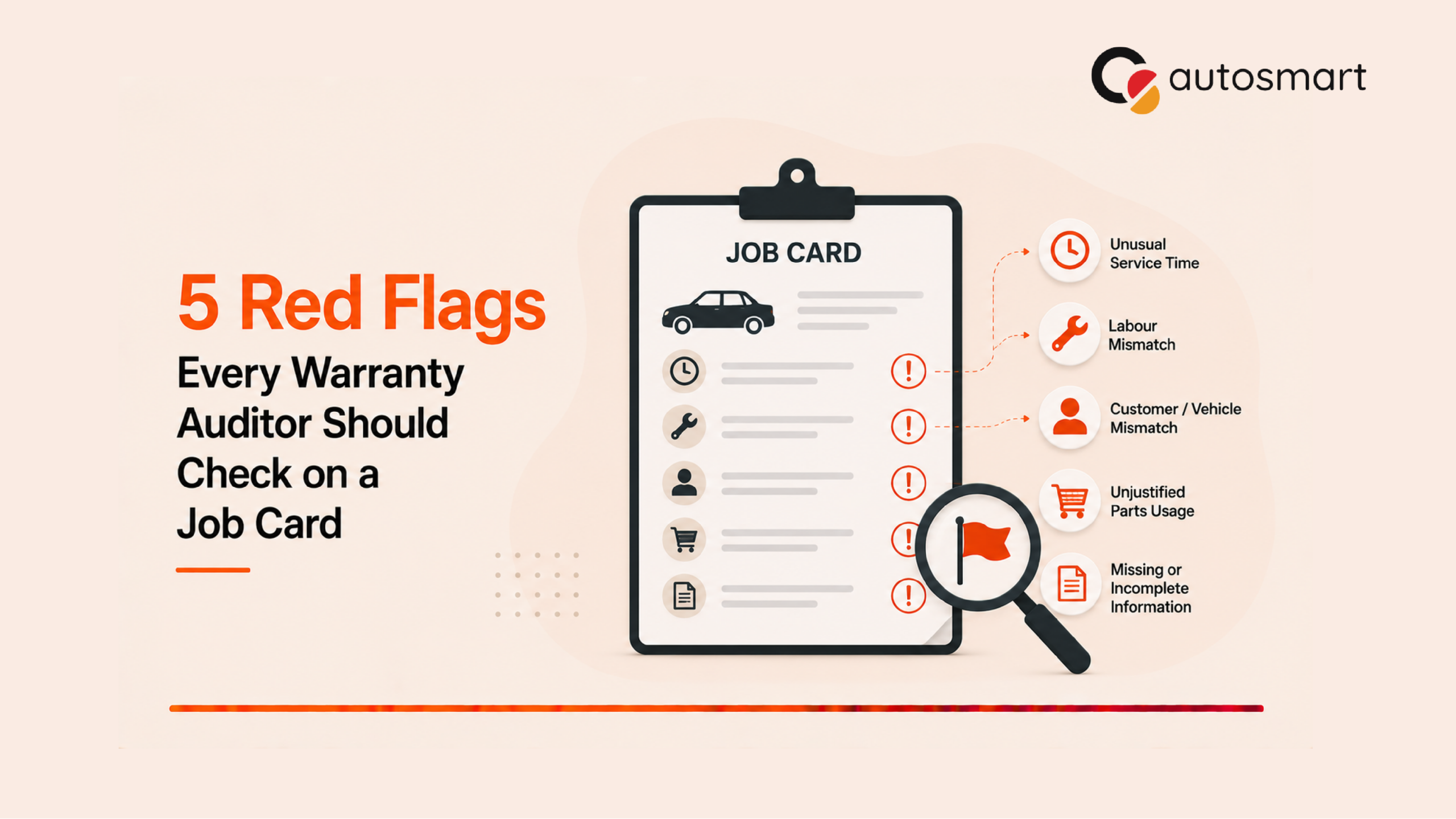
Warranty auditors don’t need a longer checklist. Most already have one, and most job cards pass it without much friction, that’s part of the problem. A job card can satisfy every box on a standard checklist and still be hiding something, because the checklist is checking for completeness, not for the specific warranty job card red flags that tend to precede a bad claim.
The five warranty job card red flags below aren’t about whether a job card was filled out correctly. They’re about what shows up when a job card is compared against context: the repair type, the technician’s history, the dealership’s pattern, rather than read in isolation.
1. Labor Time That Doesn’t Match the Repair Complexity
Every repair type has a reasonable labor time range, usually anchored to the manufacturer’s standard operation time. A job card billing labor meaningfully above that range isn’t automatically wrong, some repairs genuinely take longer. But labor time that consistently sits at the high end, especially for one technician or one dealership, across many job cards, is a pattern worth flagging before it’s worth accusing.
What makes this a red flag isn’t a single job card running long. It’s the same repair type running long, repeatedly, in a way that starts looking less like variation and more like a habit.
2. Parts Billed That Don’t Match the Diagnosis
A job card should show a clear line from complaint to diagnosis to the parts used to fix it. When the parts listed don’t obviously follow from the diagnosis, a part billed that’s rarely needed for that specific fault, or a quantity that doesn’t match the repair, that’s worth a second look. This is one of the easier red flags to miss on a quick read, because most reviewers are checking whether parts were used, not whether the specific parts used make sense for the specific diagnosis logged.
3. Repeat Repairs Logged as New Complaints
A vehicle returning for the same underlying issue, logged each time under a slightly different complaint description, is one of the more deliberate red flags on this list. It’s designed to avoid looking like a comeback, because comebacks draw scrutiny that a “new” complaint doesn’t. Catching this requires comparing a job card against the vehicle’s own repair history, not something visible from the job card alone, which is exactly why it’s easy to miss without that history attached.
4. Missing or Inconsistent PIC Attribution
A job card without a clearly named technician and supervisor isn’t just a documentation gap, it’s a structural weakness that makes every other red flag harder to act on. If a pattern does emerge across job cards, there’s no way to trace it back to a specific person or shift without PIC attribution in place. Auditors should treat missing or inconsistent ownership as a flag on its own, separate from whatever else the job card shows, because it removes accountability from everything downstream.
5. Timing Clustered Around Warranty Expiry
A spike in claims for vehicles approaching the end of their warranty period is a pattern worth watching at the dealership level, not just the individual job card level. One claim near expiry isn’t notable. A dealership where claims noticeably cluster in that window, more than the base rate would suggest, is a pattern that only becomes visible when job cards are viewed in aggregate over time, which is a different exercise than reviewing any single card.
Why These Five Require Context, Not Just a Checklist
None of these red flags are visible from a job card read in isolation. Labor time only looks unusual against a baseline. Parts usage only looks off against the diagnosis. Repeat repairs only look repeated against history. PIC gaps only matter once something needs tracing back. Timing clusters only appear in aggregate. That’s the actual shift auditors need to make: from reading job cards individually to comparing them against the data that gives them meaning.

Siddharth works in the Founders’ Office at AutoSmart, where he covers strategy, research, and revenue operations. He writes about warranty audits, compliance frameworks, and what the data across audit programmes actually shows.