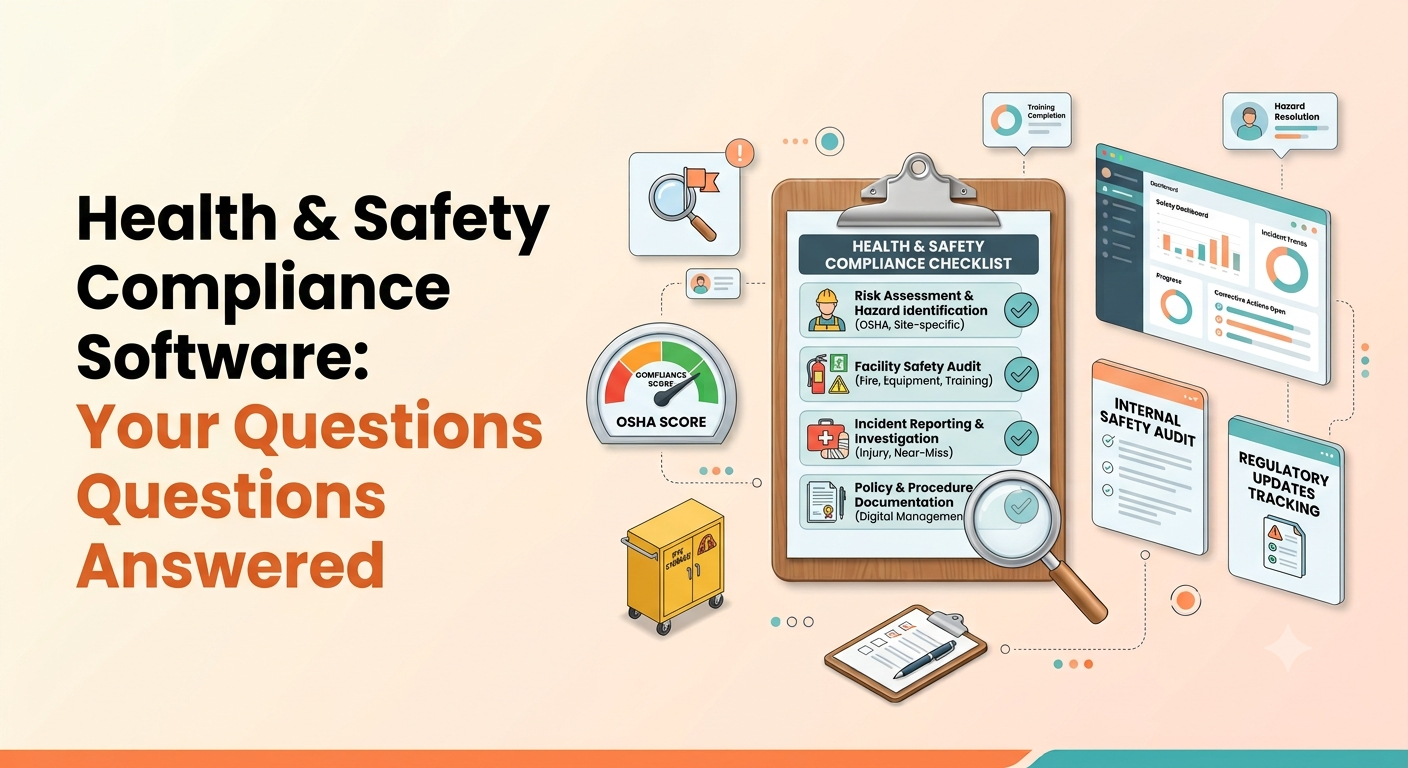
Dealer networks carry two compliance obligations that often get treated as one problem: meeting OEM brand standards, and keeping workshops, showrooms and staff safe day to day. Health and safety reporting software exists to make the second obligation trackable and auditable across every site, rather than dependent on whoever remembers to log an inspection that week. For a distributor or OEM running a multi-site network, this is what separates safety as a stated policy from safety as something that’s actually being measured.
This piece answers the questions that come up most often when dealer groups start comparing health and safety management software, EHS software for automotive, and brand compliance software for retail, along with how AutoSmart’s audit platform approaches all three together.
What Health and Safety Reporting Software Actually Tracks
Health and safety reporting software covers routine checks that keep a workshop or showroom safe, including fire exits and extinguishers, hazardous material storage, PPE compliance, equipment safety, and incident or near-miss logging. These checks need to be scheduled and documented rather than addressed only when something goes wrong.
The main difference is documentation. Good safety practices only become useful evidence when they are recorded, dated, and attributable. Health and safety reporting software provides those records, making routine checks easier to audit and improve. For a practical example, see AutoSmart’s health and safety checklist for automotive dealerships.
Where Spreadsheets Stop Working Across a Dealer Network
Spreadsheets can handle individual inspections, but they become difficult to manage across multiple sites. They cannot easily show whether every inspection happened on schedule, was signed off by the right person, or resulted in a closed corrective action rather than an overlooked entry.
The challenge is similar to what AutoSmart addresses through business process optimisation for dealer networks, where inconsistent site-level tracking becomes harder to manage as a network grows. Once a dealer group expands beyond a few outlets, maintaining a clear view of risks and proving compliance to regulators, insurers, or OEM auditors becomes increasingly difficult. This is often when distributors begin comparing health and safety reporting software instead of continuing to rely on spreadsheets.
Brand Compliance Software vs EHS Software
Brand compliance software checks whether a dealership looks and runs the way the OEM’s manual specifies: signage, showroom layout, service bay standards, customer experience scripts. EHS software for automotive, short for environment, health and safety, checks whether the workplace itself is safe to work in: fire exits clear, hazardous materials stored correctly, PPE worn, incidents logged and investigated.
The two overlap more than most people expect going in. A blocked fire exit is both a safety failure and, in most brand manuals, a compliance failure. Where a dealer group runs these as two separate systems, brand compliance software and EHS software end up flagging the same issue twice, through two different auditors using two different forms, which is duplicated effort without any real gain in coverage. AutoSmart’s piece on regulatory compliance software for the automotive industry breaks this overlap down further.
Features That Set Useful Health and Safety Reporting Software Apart
Not every feature in health and safety reporting software carries equal weight. Mobile-first audit capture matters most in practice, since findings logged on the workshop floor are more accurate than anything reconstructed from memory at a desk later. Checklists that can be configured by site type matter almost as much, because a bodyshop’s hazards aren’t a showroom’s hazards, and a single generic checklist tends to miss both.
Beyond capture, the features that decide whether an issue actually gets fixed are corrective action tracking with clear ownership and deadlines, photo evidence attached to each finding, and a dashboard that rolls results up across locations so a regional manager can see patterns rather than one site’s isolated report. An audit trail that timestamps and attributes every submission ties all of this together. Awards & compliance software for retail networks is often judged on how many boxes it ticks in a demo, but the better test for health and safety software solutions generally is whether a service advisor with five spare minutes between customers can actually complete an audit on it without training or on an awards & compliance software for retail shortlist.
How AutoSmart Combines Brand and Safety Compliance in One Platform
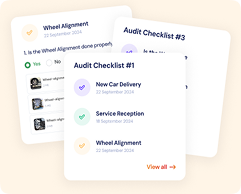
AutoSmart Audit runs brand compliance and workplace safety as two separate modules within the same platform, Compliance Management Software and Safety Audits Software, rather than as one merged checklist. In practice this means a distributor’s audit teams work from a single centralised dashboard instead of licensing two unrelated tools that don’t talk to each other, similar in principle to how a layered process audit applies one structured method across different levels of a process rather than a different tool for each layer.
The safety module covers customisable checklists by location, real-time updates during audits, offline mobile capture, and photo evidence attached to findings, functioning as dedicated EHS software for automotive dealer networks rather than a generic add-on. The compliance module covers real-time monitoring, role-based access control, and audit trails built for traceability. Both sit on the same real-time reporting backbone, so a distributor comparing dealer brand adherence against site safety records isn’t pulling from two disconnected systems to do it. AutoSmart’s dealer audit management software page covers how this works at the audit-programme level.
Automated Reporting in Health and Safety Software
Most established platforms in this category are built to compile submitted audit data into a structured report without someone manually pulling numbers from a spreadsheet afterwards. Once an inspection is logged, health and safety reporting software can generate a formatted output covering scores by category, open corrective actions, and trend lines over time, rather than leaving that work to whoever happens to own reporting that month.
What “automatic” means still varies by vendor, and it’s worth asking specifically whether a platform generates reports on a schedule, on demand, or only after a manual export. For a distributor overseeing dozens of sites, that distinction is usually what decides whether reporting is a five-minute task or a weekly chore, and it’s a more useful question to ask when comparing health and safety management software than any single line on a feature list.
Making Safety Visible Across the Network
A dealer network’s safety record is only as strong as its ability to prove what’s actually being checked, not just what’s supposed to be checked. Health and safety reporting software closes that gap, turning routine inspections into a record that holds up when a regulator, insurer, or OEM asks for evidence rather than assurances.
For distributors already running brand audits across their network, the more practical question isn’t whether to add safety tracking, but whether it needs to live in a second system at all. AutoSmart’s audit platform is built to bring brand compliance software and health and safety reporting software into one place. Book a demo to see how it works for your network.

Siddharth works in the Founders’ Office at AutoSmart, where he covers strategy, research, and revenue operations. He writes about warranty audits, compliance frameworks, and what the data across audit programmes actually shows.