Most warranty cost conversations start at the claim level — approval rates, clawbacks, dealer scorecards. Job cards rarely come up until something’s already gone wrong. That’s backwards. The claim is just the output. The job card is where the actual repair, the actual labor, and the actual parts usage get written down first — and it’s the layer that decides whether everything downstream is even accurate.
If the job card is wrong, sloppy, or incomplete, the claim built on top of it inherits that problem. No amount of claim-level review fixes an issue that started three steps earlier, on the floor, at the point of write-up.
What a Job Card Actually Represents
A job card is the dealership’s own internal record of a repair: the customer complaint, the diagnosis, the labor operations performed, the parts consumed, and — in a properly run shop — the technician and supervisor attached to the work. It’s created before a warranty claim is ever submitted.
That makes it the earliest point where accuracy either gets locked in or lost. Everything the OEM later sees on a claim form is, in theory, a summary of what’s on the job card. In practice, the two don’t always match.
Why Job Card Audits Get Skipped
Warranty teams tend to audit claims, not job cards, for a simple reason: claims are centralized and job cards aren’t. A claim shows up in the OEM’s system automatically. A job card sits at the dealership, often on paper or in a disconnected DMS, and pulling it for review means a separate request, a separate wait, a separate manual comparison.
That friction is exactly why job card audits are the layer most warranty programs underinvest in — not because they matter less, but because they’re harder to get to.
What a Job Card Audit Actually Checks
A proper job card audit isn’t a glance at whether the form was filled out. It’s a structured check across several things:
- Complaint-to-diagnosis consistency: Does the diagnosis logically follow from what the customer reported?
- Diagnosis-to-repair consistency: Was the repair performed actually appropriate for the diagnosis?
- Labor time vs. standard operation time: Is the billed labor within a reasonable range of the manufacturer’s standard repair time?
- Parts consumption vs. repair type: Do the parts listed match what the repair would realistically require?
- PIC and technician attribution: Is there a named individual accountable for the job, not just a shop stamp?
- Supporting evidence: Photos, diagnostic trouble codes, or signed customer authorization, where required.
Any one of these breaking down is a signal worth flagging — not necessarily fraud, but a gap that, left unchecked, becomes a pattern.
The Real Risk: Patterns, Not One-Offs
A single job card with a minor documentation gap isn’t a crisis. The risk is when the same gap shows up across multiple job cards, at the same dealership, month after month — inflated labor times on a specific repair type, parts billed that don’t match diagnosis frequency, the same technician’s jobs consistently running over standard time.
Without job card-level audits, that pattern is invisible. The OEM only sees claims, and claims — reviewed one at a time — don’t carry the history needed to spot recurrence. That’s the actual cost: not one bad job card, but months of a pattern nobody was positioned to catch.
What Needs to Be in Place to Audit Job Cards at Scale
For an OEM running audits across dozens or hundreds of dealerships, a few things have to exist before job card audits are workable:
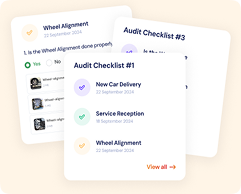
- Digital job card capture at the dealership — paper job cards can’t be audited systematically or cross-referenced at scale.
- A standard checklist tied to repair type — a clutch replacement and an electrical fault shouldn’t be reviewed against the same generic criteria.
- Historical job card storage per dealership — so an auditor (or a system) can compare this month’s job cards against the last several cycles.
- Named ownership on every job card — a PIC structure that ties each job to a specific technician and supervisor.
- Severity and recurrence tagging — flagging not just what’s wrong, but whether it’s the first time or the fifth.
Why This Compounds at Network Scale
For a handful of dealerships, a warranty team can still spot-check job cards manually and catch the obvious problems. That breaks down fast past 50-100 locations, where the volume of job cards generated every month makes manual cross-referencing impractical. At that point, either job card audits happen systematically through a structured process, or they stop happening in any meaningful way — and warranty cost control quietly weakens, network-wide.
Why This Is Where Real Cost Control Lives
Claims-level review catches obvious paperwork problems. Job card-level review catches the underlying pattern before it becomes a recurring cost. For OEMs trying to actually manage warranty spend — not just process it — the job card is where the real signal lives, long before it ever reaches a claim form.

Naseef Umar is the Founder & CEO of AutoSmart Technology, a SaaS platform digitizing audits for OEMs, distributors, and dealer networks. With prior experience at Toyota (Abdul Latif Jameel) and a background in IT and Industrial Management, he writes about audits, operational discipline, and building SaaS products for enterprise customers across markets.